
Daily Current affairs 26 February 2026

Daily Current Affairs 26-February-2026

Share this Post

SABARIMALA CASE AND CONSTITUTIONAL RIGHTS

TOPIC: (GS2) POLITY: THE HINDU

The Supreme Court is set to hear final arguments on review petitions challenging its 2018 verdict that allowed women of all ages entry into the Sabarimala temple.

2018 Verdict

  • Delivered by a five-judge Bench in Indian Young Lawyers Association vs State of Kerala.
  • Majority (4:1) held:
    • Devotees of Lord Ayyappa are not a separate religious denomination.
    • Ban on women aged 10–50 violated freedom of religion and equality rights.
    • Rule 3(b) of Kerala Hindu Places of Public Worship Rules, 1965 was unconstitutional.
  • Dissent (Justice Indu Malhotra): Argued exclusion was an essential religious practice and collective faith must be respected.

Core Constitutional Challenges

  • Judicial Role in Religious Practices: The Essential Religious Practices Test requires courts to decide if a practice is “essential” to a religion.
  • This approach has been criticized because it makes the judiciary act like a theological authority, rather than focusing on constitutional principles.
  • Tension Between Individual and Community Rights: There is a direct conflict between individual rights such as equality and dignity, and community rights like faith and customs.
  • The central question is whether collective religious claims can override a person’s personal liberty and constitutional guarantees.

Anti-Exclusion Test (Justice D.Y. Chandrachud)

  • Alternative Framework: The anti-exclusion test has been proposed as a replacement for the essential religious practices test, shifting the focus away from theological judgments.
  • Respect for Religious Autonomy: It allows religious communities the freedom to define and follow their own practices without interference in doctrinal matters.
  • Judicial Intervention Only in Cases of Exclusion: Courts step in only when a religious practice excludes individuals in a way that undermines their dignity or denies them access to basic goods and civic life.
  • Constitutional Focus: Unlike the earlier test, this approach is grounded in constitutional principles of equality and dignity, rather than deciding what is essential to a religion.

Broader Implications

  • Will impact other disputes: Dawoodi Bohra excommunication case. Parsi women’s right to practise faith after marrying outside the community.
  • Highlights the need to balance faith autonomy with constitutional guarantees of equality and dignity.

Right to Equality

Article 14 – Equality before Law

  • Guarantees that every person is equal before the law and enjoys equal protection of laws within India.
  • Prevents arbitrary action by the State.

Article 15 – Prohibition of Discrimination

  • The State cannot discriminate against any citizen on grounds of religion, race, caste, sex, or place of birth.
  • Allows special provisions for women, children, socially and educationally backward classes, SCs, and STs.

Article 16 – Equality of Opportunity in Public Employment

  • Ensures equal opportunity for all citizens in matters of government jobs.
  • Permits reservations for backward classes, SCs, and STs to promote social justice.

Article 17 – Abolition of Untouchability

  • Declares untouchability as abolished and makes its practice a punishable offence.

Article 18 – Abolition of Titles

  • Prohibits the State from conferring titles (except military or academic distinctions).
  • Prevents misuse of titles that create inequality among citizens.

Conclusion

The Court can protect belief while ensuring that faith does not become a license for discrimination, keeping dignity at the heart of constitutional interpretation.

RENAMING OF KERALA TO “KERALAM”

TOPIC: (GS2) POLITY: THE HINDU

Why in News?

The Union Cabinet has recently approved a proposal to change the official English name of the State of Kerala to “Keralam”.

Historical Background

  1. Ancient References
  • The earliest known reference appears in Ashoka’s Rock Edict II (257 BCE).
  • The inscription mentions “Keralaputra”, referring to a southern ruler.
  • The term is linked to the Chera dynasty, one of the three major Tamilakam powers (Chera, Chola, Pandya).
  1. Etymology
  • Scholars trace the word “Keralam” to “Cheram” or “Chera land”.
  • In Malayalam, the State has traditionally been called Keralam, while “Kerala” became the anglicised version.
  1. Formation of the State
  • After Independence, the States Reorganisation Commission (1953–55) recommended linguistic reorganisation.
  • The State of Kerala was formed on 1 November 1956, combining Malayalam-speaking regions of Travancore-Cochin and Malabar.
  • Official English usage adopted “Kerala”, though locally it remained “Keralam”.

Constitutional Provisions for Renaming a State

Article 3 of the Constitution

Under Article 3, Parliament has the power to:

  • Form a new State.
  • Alter the area, boundary, or name of any State.
  • Merge territories or separate parts of States.

This demonstrates the flexible federal structure of India.

Procedure for Changing the Name of a State

  1. State Assembly Resolution: The concerned State Legislative Assembly passes a resolution seeking the name change.
  2. Ministry of Home Affairs (MHA): The proposal is forwarded to the MHA for examination.
  3. President’s Recommendation: A Bill for renaming can be introduced in Parliament only after the President’s recommendation.
  4. Reference to State Legislature: The President refers the Bill to the concerned State Assembly for its views. The opinion is advisory, not binding.
  5. Parliamentary Approval: The Bill can be introduced in either Lok Sabha or Rajya Sabha. It requires a simple majority for passage.
  6. Presidential Assent: After passage, the Bill is sent to the President for assent. The change is reflected in the First and Fourth Schedules of the Constitution.

Significance of the Renaming

  • Reinforces linguistic identity and cultural heritage.
  • Aligns official usage with regional language traditions.
  • Reflects cooperative federalism through constitutional procedure.
  • Similar renaming exercises include cities and states to restore indigenous names (e.g., Bombay to Mumbai, Orissa to Odisha).

Challenges

  • Administrative changes in official documents and records.
  • Costs associated with updating signage, stationery, and digital systems.
  • Need to ensure clarity in international and inter-state communication.

Conclusion

The proposal to rename Kerala as “Keralam” highlights India’s respect for linguistic diversity within its constitutional framework. It showcases the balance between cultural identity and parliamentary procedure in India’s federal system.

BOTTLED WATER SAFETY IN INDIA

TOPIC: (GS2) SOCIAL JUSTICE AND HEALTH: THE HINDU

Recent studies in India have detected microplastics and chemical contaminants in bottled water, challenging the perception that packaged water is safer than municipal supplies.

Bottled Water in India

  • Bottled water has become a daily necessity due to declining trust in public water systems.
  • While microbiologically safe, bottled water is now linked to microplastic contamination and chemical leaching from plastic bottles.

Findings from Bottled Water

Microplastics

  • Defined as plastic particles smaller than 5 mm.
  • Studies in Nagpur, Mumbai, and Andhra Pradesh found microplastics in all bottled water samples.
  • Concentrations ranged from 72 to 212 particles per litre.
  • Smaller particles (nanoplastics) may cross biological barriers, posing unknown health risks.

Chemical Leaching

  • Additives like antimony, phthalates, and plasticisers migrate into water.
  • Heat and sunlight exposure during transport or storage accelerate leaching.
  • Current standards assess isolated chemicals but ignore cumulative long-term exposure.

Regulatory Gaps

  • FSSAI regulates bottled water but does not mandate testing for microplastics or nanoplastics.
  • Enforcement is weak, especially among thousands of small bottling units.
  • State surveys (e.g., Karnataka) often find unsafe or substandard samples.

Environmental Impact

  • India faces a plastic waste crisis, with single-use bottles forming a large share.
  • Degraded plastics re-enter ecosystems as microplastics, contaminating water sources further.

Way Forward

  • Update Regulations: Include microplastics and cumulative chemical exposure in safety standards.
  • Strengthen Enforcement: Improve monitoring of small bottling units and groundwater usage.
  • Public Alternatives: Expand municipal water supply, filtration systems, and refill stations.
  • Consumer Awareness: Educate on risks of prolonged storage and promote safe handling.

Conclusion

Bottled water is not inherently “safe.” Microplastics, chemical leaching, and weak regulation make it a hidden health and environmental risk. Strengthening public water systems, updating standards, and reducing dependence on single-use bottles are essential for sustainable and safe drinking water.

TRAINING LLMS IN INDIA

TOPIC: (GS3) SCIENCE AND TECHNOLOGY: THE HINDU

At the AI Impact Summit, Bengaluru-based startup Sarvam AI unveiled two Large Language Models (LLMs) trained in India.

How are LLMs Trained?

  • Large Language Models (LLMs) are trained on clusters of Graphics Processing Units (GPUs), which are specialized chips designed for parallel processing.
  • Training requires thousands of GPUs working together in data centres, often consuming enormous amounts of electricity and cooling resources.
  • The combined expense of hardware, electricity, and maintenance runs into millions of dollars.
  • LLMs are trained on massive datasets scraped from the Internet, books, articles, and other sources.
  • However, Indian languages are underrepresented compared to English, European, and East Asian languages.

Importance of India in AI & LLM Indigenisation

  • Linguistic and Cultural Representation: India has 22 official languages and hundreds of dialects, which global models often fail to capture.
  • Indigenous LLMs ensure better accuracy and inclusivity for Indian languages, making AI accessible to a wider population.
  • Strategic and Economic Independence: It also builds domestic capacity, creating opportunities for startups, researchers, and industries to innovate locally.
  • Cost Efficiency and Ecosystem Growth: Indigenous models foster a self-reliant AI ecosystem, encouraging innovation in sectors such as education, healthcare, agriculture, and governance.

Challenges in Training LLMs in India

  • Data Scarcity: Limited availability of high-quality datasets in Indian languages. Models often rely on translation into English, which increases token usage and reduces efficiency.
  • Capital Constraints: Training LLMs demands massive investment, often beyond the reach of Indian startups. Without immediate business use cases, raising funds becomes difficult.
  • Performance in Local Contexts: Suboptimal results in Indian languages affect adoption, especially for low-cost devices like feature phones.

Government Support – IndiaAI Mission

  • Commissioned 36,000 GPUs in Indian data centres (e.g., Yotta).
  • Subsidised access for startups and researchers at nominal fees.
  • Example: Sarvam AI received 4,096 GPUs, with subsidies worth nearly ₹100 crore.
  • Aim: Build domestic AI ecosystem and reduce dependence on foreign-developed LLMs.

Mixture of Experts (MoE) Architecture

  • Innovative Design: MoE is a breakthrough approach that makes Large Language Models (LLMs) more cost-efficient by reducing the computational load during inference.
  • Selective Parameter Activation: Unlike traditional models where all parameters are activated for every query, MoE activates only a small subset of parameters.
  • Practical Advantages: Delivers quicker response times since fewer parameters are processed. Requires less computing power and energy, lowering operational costs.
  • Strategic Value: By lowering costs, MoE enables startups and research institutions to train competitive models locally.

Significance

  • Sarvam’s models show progress in Indian language accuracy and efficiency.
  • Other firms like BharatGen and Gnani.ai are also building sector-specific models (education, healthcare, speech).
  • India’s push mirrors global trends (e.g., China’s DeepSeek R1) in cost-effective AI innovation.

Conclusion

Training LLMs in India faces hurdles of data, capital, and infrastructure, but government support through the IndiaAI Mission and innovations like MoE architecture are helping bridge the gap. These efforts are crucial for building AI models aligned with India’s linguistic diversity and strategic needs.

CARBON CAPTURE AND UTILISATION (CCU) TECHNOLOGIES

TOPIC: (GS3) ENVIRONMENT: THE HINDU

India is exploring Carbon Capture and Utilisation (CCU) technologies to reduce emissions from hard-to-abate sectors like cement and steel.

What is CCU?

  • CCU refers to technologies that capture CO₂ emissions from industrial sources or directly from the air.
  • Unlike Carbon Capture and Storage (CCS), CCU reuses captured CO₂ to produce fuels, chemicals, building materials, or polymers.
  • It integrates carbon into the economy instead of storing it underground.
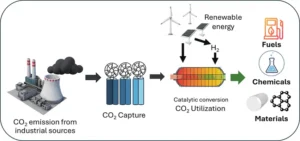
Carbon Capture and Utilisation

How CCU Reduces Emissions

  • Industrial Decarbonisation: Helps reduce emissions from cement, steel, and chemicals, which are difficult to decarbonise.
  • Circular Economy: Converts waste CO₂ into value-added products, reducing dependence on fossil feedstocks.
  • Net-Zero Pathway: Supports India’s 2070 net-zero goal by addressing unavoidable industrial emissions.

Global Strategies

  • EU Bioeconomy Strategy & Circular Economy Action Plan: Promotes CCU to turn CO₂ into feedstocks for chemicals, fuels, and materials.
  • U.S.: Uses tax credits and funding to scale CCU, especially for CO₂-derived fuels.
  • UAE: Al Reyadah project links CCU with green hydrogen for chemicals.
  • Industry Example: ArcelorMittal in Belgium trials converting CO₂ into carbon monoxide for steel production.

India’s Current Efforts

  • Government Roadmaps: Department of Science & Technology and Ministry of Petroleum have drafted CCUS plans.
  • Private Sector Pilots:
    • Ambuja Cements with IIT Bombay (Indo-Swedish project).
    • JK Cement testbed for lightweight concrete and olefins.
    • ORSL Bio-CCU platform converting CO₂ from biogas into bio-alcohols and chemicals.

Challenges in India

  • High Costs: Capturing, purifying, and converting CO₂ is energy-intensive and expensive.
  • Infrastructure Gaps: Requires industrial clusters, CO₂ transport, and integration with downstream industries.
  • Policy & Standards: Lack of clear certification and market signals limits investor confidence.

Way Forward

  • Policy Incentives: Subsidies, tax credits, and carbon pricing to make CCU competitive.
  • Infrastructure Development: Build industrial hubs with shared CO₂ transport and storage facilities.
  • Research & Innovation: Invest in low-cost capture technologies and pilot projects.
  • Market Creation: Establish standards and certification for CO₂-derived products to boost demand.

Conclusion

CCU offers India a pathway to reduce emissions from hard-to-abate sectors while creating new value chains. Scaling up requires policy support, infrastructure readiness, aligning with India’s net-zero and circular economy goals.

EXERCISE DHARMA GUARDIAN

TOPIC: (GS3) SEQURITY: THE HINDU

The 7th edition of Exercise Dharma Guardian between the Indian Army and Japan has begun at the Foreign Training Node, Chaubattia (Uttarakhand).

About Exercise Dharma Guardian

  • Annual joint military exercise between India and Japan.
  • Conducted alternately in India and Japan.
  • Aim: To strengthen military collaboration and improve combined capabilities for joint operations in semi-urban environments.
  • Serves as a key pillar of defence partnership between the two nations.
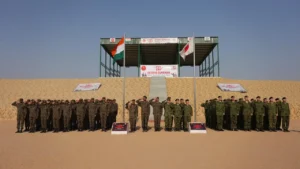
Exercise Dharma Guardian

Key Tactical Activities

  • Establishing a Temporary Operating Base.
  • Developing an Intelligence, Surveillance, and Reconnaissance (ISR) grid.
  • Setting up Mobile Vehicle Check Posts.
  • Conducting Cordon and Search Operations in hostile conditions.
  • Executing Heliborne Operations.
  • Practising House Intervention Drills.

Other India–Japan Defence Exercises

  • Malabar (Naval): With India, Japan, U.S., and Australia.
  • JIMEX (Naval): Bilateral naval exercise.
  • Shinyuu Maitri (Air Force): Focused on air force cooperation.

Significance

  • Enhances interoperability between Indian and Japanese forces.
  • Strengthens strategic partnership amid evolving Indo-Pacific security challenges.
  • Reinforces India’s role in regional security cooperation with like-minded nations.

NEW WHEAT VARIETIES FOR STRENGTHENING RICE–WHEAT SYSTEM IN KASHMIR

TOPIC: (GS3) ECONOMY: THE HINDU

Why in News?

Scientists at Sher-e-Kashmir University of Agricultural Sciences and Technology of Kashmir (SKUAST-Kashmir) have developed two improved wheat varieties to stabilise the rice–wheat cropping cycle in the Valley.

Background: Cropping Pattern in Kashmir

  • Wheat is a rabi crop, sown in October–November and harvested in May–June.
  • Traditional wheat varieties sourced from sub-tropical plains matured late (June–July).
  • In Kashmir, paddy transplantation begins by May–June, requiring fields to be vacated earlier.
  • Delayed wheat harvesting disturbed the rice–wheat rotation, lowering overall productivity.

Newly Developed Wheat Varieties

  1. Shalimar Wheat-4 (SW-4)
  2. Shalimar Wheat-3 (SW-3)

These varieties were specifically bred for temperate climatic conditions of Kashmir.

Key Features

  1. Early Maturity
  • SW-4 matures by the last week of May.
  • SW-3 matures by the first week of June.
  • Ensures smooth transition to paddy cultivation.
  1. High Yield Potential
  • SW-3 can produce up to 38 quintals per hectare under optimal conditions.
  • Suitable for improving farm income and productivity.
  1. Cold Tolerance
  • Adapted to Kashmir’s harsh winters and low temperatures.
  • Agronomic performance comparable or superior to older varieties.
  1. Disease Resistance
  • Resistant to yellow rust, a fungal disease common in the Valley.
  • Yellow rust causes stunted growth and significant yield losses.
  • Reduces dependence on fungicides and lowers cultivation cost.
  1. Biofortification (SW-3)
  • Contains more than 40 ppm iron and zinc.
  • Around 12% protein content, improving nutritional value.
  • Supports efforts to tackle hidden hunger and micronutrient deficiency.
  1. Altitude Suitability
  • Suitable for mid-altitude regions up to 1,850 metres above sea level.
  • Benefits farmers in hilly and remote areas.
  1. Dual Purpose Use
  • Provides both grain and fodder.
  • Straw is vital for winter livestock feeding in Kashmir.

Development Process

  • Developed using conventional breeding methods, not genetic modification.
  • Followed cross-breeding and pedigree selection techniques.
  • Underwent multi-location trials and farmer field testing.
  • Entire development and validation process took 9–10 years, ensuring reliability.

Significance

  • Enables timely rice transplantation, stabilising the rice–wheat system.
  • Enhances food security in Jammu & Kashmir.
  • Reduces crop losses from yellow rust.
  • Improves farmer income through better yield and fodder availability.
  • Supports climate-resilient agriculture in temperate regions.

Conclusion

The development of SW-3 and SW-4 reflects the importance of region-specific crop innovation in strengthening agricultural systems. Such scientific interventions enhance productivity, resilience, and farmer livelihoods in ecologically sensitive areas like Kashmir.

TSOMGO LAKE

TOPIC: (GS3) DISASTER MANAGEMENT: THE HINDU

Recently, over 2,700 tourists stranded near Tsomgo Lake in East Sikkim due to heavy snowfall were successfully rescued.

About Tsomgo Lake

  • Also called Tsongmo Lake or Changu Lake.
  • A glacial lake located in East Sikkim at an altitude of 3,753 m (12,313 ft).
  • Fed by melting snow from surrounding mountains.
  • Remains frozen during winter; after May, the lake’s surroundings bloom with rhododendrons (Sikkim’s state tree), primulas, poppies, and irises.

Ecological and Cultural Significance

  • Habitat for birds such as Brahminy ducks.
  • Wildlife includes the red panda, an endangered species.
  • The lake’s surface changes colour with seasons, considered sacred by local communities.
  • Historically, Buddhist monks studied the lake’s colours to make predictions.
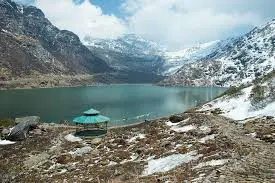
Tsomgo Lake

Tourism Importance

  • A popular tourist attraction in Sikkim, especially for its scenic beauty and biodiversity.
  • Heavy snowfall often disrupts access, requiring rescue operations and safety measures.

CHICORY AND FSSAI ADVISORY

TOPIC: (GS3) ENVIRONMENT: THE HINDU

Why in News?

The Food Safety and Standards Authority of India (FSSAI) has issued an advisory mandating that the percentage of chicory content in coffee blends must be clearly displayed on the front of coffee powder packets from 1 July 2026.

Cichorium-intybus

Botanical and Agricultural Features

  • Scientific name: Cichorium intybus
  • Family: Asteraceae (same family as sunflower and lettuce)
  • Type: Perennial herbaceous plant
  • Grown mainly in temperate climates, including parts of Europe, North America, and India.
  • In India, cultivation is concentrated in Karnataka, Tamil Nadu, and parts of North India.

Parts Used and Culinary Applications

  • Roots: Roasted and powdered; commonly mixed with coffee.
  • Leaves: Used as leafy vegetables or salad greens.
  • Flowers: Sometimes used in traditional remedies.
  • Considered a local wild edible plant in many regions.

Chicory as a Coffee Additive

  • Added to coffee for a darker colour and woody/earthy flavour.
  • Naturally caffeine-free, making it suitable for low-caffeine blends.
  • Significantly cheaper than pure coffee, reducing production costs.
  • In India, certain coffee blends may contain up to 30–49% chicory, depending on the brand.

The FSSAI directive ensures that the exact proportion is prominently declared on packaging to prevent misleading marketing.

Nutritional and Health Aspects

  • Rich in inulin, a soluble dietary fibre beneficial for gut health.
  • Contains carbohydrates, proteins, vitamins (especially Vitamin B group), and minerals.
  • Includes bioactive compounds and phenolic antioxidants.
  • Traditionally used in folk medicine for digestive support and liver health.

Regulatory Significance

  • The advisory strengthens food labelling norms under FSSAI regulations.
  • Promotes consumer rights and informed decision-making.
  • Prevents confusion between pure coffee and blended coffee products.

Write a Review

Your email address will not be published. Required fields are marked *