
Daily Current affairs 27 March 2026

Daily Current Affairs 27-March-2026

Share this Post

SUPREME COURT HANDBOOK AND GENDER STEREOTYPES

TOPIC: (GS2) POLITY: THE HINDU

During a February 2026 hearing on a sexual assault case, the Chief Justice of India (CJI) Surya Kant remarked that the Supreme Court’s Handbook on Combating Gender Stereotypes (2023) was “too technical” and “Harvard-oriented,” and asked for a review by experts.

What Is Handbook

  • Released in 2023 by then CJI D.Y. Chandrachud.
  • Aim: To eliminate gender stereotypes in judicial reasoning and align judgments with constitutional values of dignity and equality.
  • Provides examples of problematic language in judgments and suggests alternatives supported by case law.

Objectives of the Handbook

  • Identify and replace stereotype-promoting language in judgments.
  • Highlight reasoning patterns based on stereotypes and explain why they are flawed.
  • Compile binding Supreme Court decisions that reject stereotypes.

Importance of Judicial Language

  • Language Shapes Justice: Judicial words are powerful; they can either reinforce stereotypes or dismantle inequality, directly influencing how survivors and society perceive justice.
  • Scholarly Evidence of Bias: Feminist legal scholars have long documented sexist and patriarchal expressions in Indian judgments (e.g., “ravished” for rape, “keep” for women in live-in relationships), showing how language undermines dignity and equality.
  • Institutional Recognition of Reform: The Supreme Court Handbook on Combating Gender Stereotypes (2023) is a landmark step, offering alternatives to biased terms and aligning judicial reasoning with constitutional values of equality and justice.

Examples of Problematic Language

  • “Keep” used in D. Velusamy vs D. Patchaiammal (2010) to describe a woman in a live-in relationship — criticised for patriarchal undertones.
  • Use of “ravished” to describe rape — archaic and moralistic, undermining survivor autonomy.
  • Handbook flags such terms to ensure judicial language reflects equality and respect.

Judicial Concerns

  • CJI Surya Kant felt the handbook was too technical and difficult for laypersons.
  • However, the handbook is meant for judges and lawyers, not survivors or families.
  • It is grounded in Indian precedents, not foreign models, and is practical for courtroom use.

Way Forward

  • Handbook should evolve with feedback from judges, lawyers, and civil society.
  • Greater judicial training is needed to ensure sensitivity in handling sexual assault cases.
  • Reform must be based on an accurate understanding of the handbook’s purpose.

Conclusion

Supreme Court’s gender handbook faces criticism as “too technical,” but it marks a vital step in reforming judicial language to dismantle stereotypes and uphold equality.

PATERNITY LEAVE IN INDIA

TOPIC: (GS2) POLITY: THE HINDU

The Supreme Court recently urged the Union government to consider a formal law on paternity leave for all fathers, biological or adoptive, highlighting that parenthood is a shared responsibility and sidelining fathers is “a kind of injustice.”

Why Paternity Leave Matters

  • Ensures equal caregiving roles for both parents, benefiting the child’s formative years.
  • Breaks traditional gender norms where childcare is seen as the mother’s duty.
  • Time-Use Survey shows Indian women spend 10 times more hours on domestic work compared to men.

Background

  • Maternity Benefit Act, 1961: Provides maternity leave and protection against termination.
  • Labour Codes 2020: Aim to expand formalisation, potentially enabling wider coverage of parental benefits.
  • Global Practices: Nordic countries show that paternity leave improves women’s labour force participation and reduces wage gaps.

Current Scenario in India

  • No national law for paternity leave.
  • Central government employees get 15 days leave; some multinational firms offer up to 3 months.
  • Global benchmark: Sweden offers 480 days of paid parental leave, with 90 days non-transferable for each parent.
  • Maternity leave exists (26 weeks in formal sector), but only 10% of workforce is covered due to informality.

Challenges

  • Informal Sector Dominance: 90% of workers are outside formal protections.
  • Small Enterprises: Most firms employ fewer than 10 workers, making long leave difficult to implement.
  • Patriarchal Norms: Risk of misuse where men may not share caregiving equally.
  • Workplace Discrimination: Women already face hiring bias and promotion delays due to maternity leave.

Way Forward

  • Introduce parental leave instead of separate maternity/paternity leave, with non-transferable quotas for fathers.
  • Expand coverage by formalising informal sector jobs and supporting small enterprises.
  • Promote social awareness campaigns to shift patriarchal mindsets.
  • Encourage private sector participation with incentives for family-friendly policies.

Conclusion

Paternity leave is about child welfare, gender equality, and labour rights. India move toward parental leave framework ensures shared caregiving, reduces discrimination against women.

INDIA’S MULTI-DOMAIN DETERRENCE

TOPIC: (GS3) SEQURITY: THE HINDU

China’s rapid military build-up has prompting calls for urgent defence-industrial reforms and a credible multi-domain deterrence strategy.

Concept of Deterrence

  • Deterrence means discouraging adversaries from taking hostile action by convincing them that the costs will outweigh the benefits.
  • It can be conventional (military strength), nuclear (credible nuclear arsenal), or multi-domain (integration of land, air, sea, cyber, and space).

Multi-Domain Operations (MDO)

  • MDO is a modern military concept where operations are conducted across land, air, sea, cyber, and space domains simultaneously.
  • Aim: To create synergy between different forces and deny adversaries a decisive advantage.
  • Countries like the US and China are already investing heavily in MDO capabilities.

The Strategic Challenge

  • China’s military advantage is widening, forcing India to rethink its defence posture.
  • Technology is evolving faster than military doctrine, making choices complex.
  • India must balance between what to buy, what to build, and how to integrate capabilities.

Capability Building

  • Bold Strategy: Invest heavily in new war-fighting technologies. Could reduce the gap if successful. Risky due to India’s limited industrial scale and speed.
  • Conservative Strategy: Upgrade existing systems with emerging tech. Enhances cyber, space, and electronic warfare. More suited for short wars (e.g., with Pakistan), not long conflicts with China.
  • Middle Path: Continue legacy platforms but add enabling layers. Focus on Command & Control (C2), ISR, logistics, and strike capabilities. Difficult to operationalise multi-domain operations (MDO) quickly.

Systemic Vulnerabilities

  • Industrial Weakness: Defence industry lacks speed and scale.
  • Procurement Issues: Red tape and slow adaptation hinder force evolution.
  • Budgetary Constraints: Need smarter spending with long-term contracts and private sector involvement.

Conclusion

India’s deterrence against China must build layered, multi-domain strength by fixing systemic industrial weaknesses. The window for reform is shrinking, making urgent political and military coordination essential.

INDIA’S BATTERY STORAGE CHALLENGE

TOPIC: (GS3) ECONOMY: THE HINDU

India recently updated its Nationally Determined Contributions (NDCs) for 2035, experts warn that without battery storage and grid infrastructure, India cannot fully utilise its renewable capacity.

India’s Updated NDCs (2035)

  • 60% installed capacity from non-fossil sources.
  • 47% reduction in emission intensity per unit of GDP.
  • 3.5–4 billion tonne CO2 carbon sink through forests and tree cover.
  • Net-zero target by 2070.

Background

  • Paris Agreement (2015): Global pact to limit warming below 2°C; requires updated NDCs every 5 years.
  • India’s Emissions Profile: Contributes ~7% of global emissions. Per capita emissions: ~2 tonnes CO2 (below world average of ~4.7 tonnes).
  • Renewable Potential: India has >750 GW solar potential and ~300 GW wind potential.
  • Battery Storage: Global benchmark — China leads with >100 GW storage capacity; India lags at <10 GW.

Challenges

  • Battery Storage Deficit: Solar and wind power remain underutilised due to lack of storage.
  • Grid Limitations: Transmission and distribution networks are outdated.
  • Dependence on Fossil Fuels: Global conflicts (e.g., West Asia war) show vulnerability to fossil fuel supply shocks.
  • Financial Constraints: High cost of large-scale battery deployment.
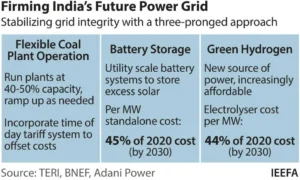
Indias Battery Storage Challenge

Way Forward

  • Expand Battery Storage: Invest in lithium-ion, flow batteries, and indigenous alternatives.
  • Grid Modernisation: Smart grids and flexible transmission systems to integrate renewables.
  • Policy Push: Long-term contracts, subsidies for storage, and private sector participation.
  • Carbon Capture & Utilisation: Scale up CCUS technologies to complement renewables.
  • Forestry & Carbon Sink: Strengthen afforestation to meet carbon sink targets.

India’s three best initiatives on renewable energy

  • National Energy Storage Mission (NESM): Promotes large-scale deployment of advanced battery technologies for grid and mobility.
  • PLI Scheme for Advanced Chemistry Cells (ACC): ₹18,100 crore program to build 50 GWh domestic battery manufacturing capacity.
  • Green Energy Corridor Projects: Strengthen transmission networks and smart grids to integrate solar and wind power efficiently.

Conclusion

India’s updated NDCs tick the right boxes on paper, but real progress depends on storage and grid reforms. Without urgent action, renewable capacity will remain underutilised, undermining India’s climate leadership.

FALL IN GOLD PRICES AND OUTLOOK

TOPIC: (GS3) ECONOMY: THE HINDU

Gold prices, traditionally seen as a safe haven during crises, have fallen sharply since the West Asian conflict (Feb 2026), dropping from nearly ₹1.9 lakh to ₹1.3 lakh per 10 grams in India.

Role of Gold in Crises

  • Gold is a non-interest-bearing asset, attractive when bond yields fall or uncertainty rises.
  • A weaker dollar usually boosts gold demand globally.
  • Historically, gold surged during the 2008 financial crisis, COVID-19 pandemic, and Russia-Ukraine war.
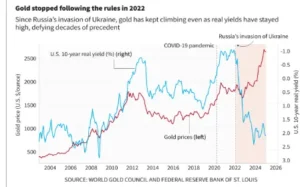
Fall in Gold Prices and Outlook

What Changed This Time

  • Oil Shock: Conflict pushed oil above $120/barrel, raising inflation fears.
  • Interest Rate Expectations: Markets expect rates to stay high longer, making bonds more attractive than gold.
  • Stronger Dollar: Higher demand for U.S. assets strengthened the dollar, making gold costlier for foreign buyers.
  • Liquidity Crunch: Investors sold gold to cover losses in falling stock markets, booking profits after its long rally.

Investor Behaviour

  • Gold had peaked at ₹1.8 lakh per 10g in Jan 2026, doubling in two years.
  • Sharp falls triggered automatic sell orders, worsening the decline.
  • Liquidity needs pushed investors to offload gold holdings despite its safe-haven status.

Background Info

  • Global Reserves: Dollar share in forex reserves fell from 71% (2000s) to <60% now; gold seen as hedge.
  • Central Bank Buying: Despite correction, central banks remain net buyers; Feb 2026 data shows rebound.
  • India’s Demand: Jewellery demand softened, but Gold ETF inflows positive for 10 consecutive months.
  • Imports: Feb 2026 imports fell 38% from Jan, but were still 80% higher year-on-year.

Challenges

  • Volatility: Prices highly sensitive to oil shocks and interest rate expectations.
  • Dollar Dominance: Global trade still dollar-driven, limiting gold’s immediate appeal.
  • Consumer Impact: High prices reduce jewellery demand, affecting India’s gold market.

Way Forward

  • Diversify Reserves: Countries may continue shifting toward gold to reduce reliance on dollar assets.
  • Strengthen Domestic Market: Promote gold ETFs and digital gold to stabilise investment demand.
  • Monitor Oil & Rates: If oil stabilises and rate hike fears ease, gold could regain appeal.
  • Investor Strategy: Treat current correction as temporary; long-term fundamentals remain strong.

Conclusion

The fall in gold prices is driven by higher interest rate expectations, a stronger dollar, and liquidity pressures. While short-term volatility persists, central bank buying and India’s investment demand suggest that gold’s long-term role as a safe haven remains intact.

INDIA’S ENERGY RESERVES

TOPIC: (GS3) ECONOMY: THE HINDU

Amid concerns over fuel shortages the Petroleum Ministry clarified that India has oil reserves for 60 days and LPG supplies for one month.

Current Stock Position

  • India has 60 days of crude oil, petrol, and diesel stocks, up from 50 days earlier.
  • Total reserve capacity: 74 days including strategic and commercial storage.
  • LPG: One month of imports secured; 8,00,000 tonnes of cargo en route from multiple countries.

Domestic Production Boost

  • LPG refinery output increased by 40%, reaching 50,000 tonnes per day.
  • Domestic production now meets over 60% of national demand.
  • Government assures steady supply chains and warns against misinformation on shortages.

Demand Surge

  • Reports of panic buying led to 15% rise in fuel sales nationwide; some areas saw spikes of 50%.
  • Fuel pumps remain adequately stocked, according to state-owned oil firms.

India’s Energy Needs & Fears

  • India imports 85% of crude oil and nearly 40% of LPG, making it vulnerable to global shocks.
  • Strategic reserves are limited compared to global standards (U.S. has ~700 million barrels).
  • Any prolonged disruption in West Asia could strain reserves despite current assurances.

Challenges

  • High Import Dependence: Oil and LPG imports expose India to price volatility.
  • Storage Capacity: Current reserves cover only ~2.5 months; expansion needed.
  • Geopolitical Risks: Conflicts in West Asia threaten supply chains.
  • Consumer Panic: Misinformation can trigger hoarding and artificial shortages.

Way Forward

  • Expand Strategic Petroleum Reserves (SPR) to cover at least 90–100 days.
  • Diversify Import Sources: Strengthen ties with U.S., Russia, Australia, and African suppliers.
  • Boost Domestic Production: Invest in refining, exploration, and renewable alternatives.
  • Promote Energy Efficiency: Encourage electric mobility and reduce dependence on imported fuels.
  • Public Communication: Transparent updates to prevent panic buying and misinformation.

Conclusion

India’s dependence on imports and limited storage capacity remain vulnerabilities. Strengthening strategic reserves, diversifying supply sources, are essential to ensure long-term energy resilience.

IRAN GRANTS HORMUZ PASSAGE TO INDIA

TOPIC: (GS2) INTERNATIONAL RELATIONS: THE HINDU

Iran has allowed India-flagged ships to transit the Strait of Hormuz despite the ongoing U.S.–Iran conflict, a critical development as the strait is one of the world’s most important oil trade routes.

Background of the Conflict

  • On March 4, 2026, an Iranian frigate was sunk by a U.S. submarine near Sri Lanka, killing 87 sailors.
  • The Strait of Hormuz, through which over 100 ships passed daily before the war, now sees traffic reduced to single digits.
  • India’s ships — Jag Vasant, Pine Gas, Shivalik, and Nanda Devi — have successfully crossed the strait since hostilities began.
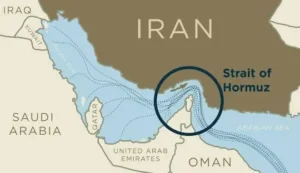
Iran Grants Hormuz Passage to India

Iran’s Position

  • Iran’s negotiator Araghchi stated there are no direct talks with the U.S., only messages via intermediaries like Pakistan, Turkiye, and Egypt.
  • Iran’s stance: resist and defend, with no intention of negotiating under current conditions.
  • U.S. President Trump has warned Iran to “get serious” in talks, while Pentagon prepares for possible ground operations.

Strategic Importance for India

  • The Strait of Hormuz handles nearly 20% of global oil trade; disruption directly impacts India’s energy security.
  • India imports 85% of its crude oil, much of it from West Asia, making safe passage vital.
  • Granting passage to Indian ships ensures continuity of supply lines amidst global uncertainty.

Challenges

  • Geopolitical Risks: Escalation could block Hormuz entirely, choking India’s oil imports.
  • Energy Vulnerability: India’s reserves cover ~60 days of oil; prolonged conflict could strain stocks.
  • Diplomatic Balancing: India must maintain ties with both Iran and the U.S. while securing energy needs.

Way Forward

  • Diversify Energy Sources: Strengthen imports from Russia, U.S., Africa, and domestic production.
  • Expand Strategic Reserves: Increase storage capacity beyond current ~74 days.
  • Enhance Naval Security: Ensure Indian Navy presence in the Indian Ocean to safeguard shipping lanes.
  • Diplomatic Engagement: Continue dialogue with Iran and global partners to keep Hormuz open for trade.

Conclusion

Iran’s decision to grant Hormuz passage to India is a strategic lifeline for energy security amid war. India must prepare for long-term disruptions by diversifying supply, expanding reserves, and strengthening maritime security to safeguard its economic stability.


QS WORLD UNIVERSITY RANKINGS 2026

TOPIC: (GS2) POLITY: THE HINDU

The Indian Institute of Management Kozhikode (IIM-K) entered the Top 100 globally in QS World University Rankings 2026.

About QS Rankings

  • Published annually by Quacquarelli Symonds (QS), a global higher education consultancy.
  • Evaluates universities on parameters like academic reputation, employer reputation, research impact, employability, and sustainability.
  • Uses five “lenses”: Research & Discovery, Employability & Outcomes, Global Engagement, Learning Experience, Sustainability.

India’s Achievements in 2026

  • 120 new entries, making India the 4th largest contributor after the U.S., China, and the UK.
  • Six Indian institutions feature in the Top 100 for Computer Science, all improving from last year.
  • IIT-ISM Dhanbad ranked 21st globally in Mineral & Mining Engineering.
  • IIM Ahmedabad ranked 21st globally in Business & Management Studies and entered the Top 25 in Marketing.
  • IIM Kozhikode broke into the Top 100 in Business & Management for the first time.

Significance for India

  • Reflects India’s growing global academic footprint.
  • Enhances employer confidence in Indian graduates.
  • Strengthens India’s position in research and innovation.
  • Supports the vision of making India a global education hub under initiatives like NEP 2020 and Study in India.

Conclusion

India’s strong showing in QS Rankings 2026 highlights its rising academic reputation and research strength. With institutions like IIM Ahmedabad, IIT-ISM Dhanbad, and IIM Kozhikode gaining global recognition, India is steadily moving toward becoming a knowledge powerhouse.

Write a Review

Your email address will not be published. Required fields are marked *