
Table of Contents
ToggleNEW GDP SERIES & FY26 GROWTH ESTIMATES
TOPIC: (GS3) ECONOMY: THE HINDU
The Government has released the second advance estimates of GDP for FY2025-26 based on a new GDP series with base year 2022-23.
What is GDP?
- Gross Domestic Product (GDP) is the total monetary value of all final goods and services produced within a country during a specific period (usually one year).
- It reflects the size and health of the economy.
- GDP can be measured at constant prices (real GDP) to track growth and at current prices (nominal GDP) to measure the economy’s size.
How is GDP Growth Measured?
- Production (Output) Method – Measures value added across agriculture, industry, and services.
- Expenditure Method – Adds consumption (C), investment (I), government spending (G), and net exports (X–M).
- Income Method – Sums wages, profits, rent, and taxes minus subsidies.
- GDP growth rate shows the percentage increase in real GDP over the previous year.
New GDP Series
- Base Year Updated from 2011-12 to 2022-23 for better accuracy. Incorporates new and broader datasets to improve representation.
- FY26 growth revised upward to 7.6% (from 7.4% earlier).
- FY24 growth revised downward to 7.2% (earlier 9.2%).
- FY25 growth revised upward to 7.1% (from 6.5%).
- Nominal GDP figures have been revised slightly downward, affecting fiscal indicators like fiscal deficit-to-GDP and debt-to-GDP ratios.
Sector-wise Performance in FY26
- Secondary Sector (Industry): Expected to grow at 5%. Manufacturing projected at strong 12.5% growth. Construction growth slightly moderates to 6.9%.
- Primary Sector (Agriculture & Mining): Growth expected to slow to 8%. Agriculture may grow at 2.5%, lower than last year. Mining growth declines to 5%.
- Tertiary Sector (Services): Projected to grow at 9%. Trade, hotels, and transport likely to grow above 10%. Financial and IT services also show double-digit expansion.
Recent Trends in India’s GDP
- Post-pandemic recovery has been strong, with growth above 7% for consecutive years.
- Growth pattern shows manufacturing and services leading, while agriculture remains volatile.
- Quarterly FY26 growth shows moderation from 8.4% (Q2) to 7.8% (Q3).
GDP Growth Projections by Institutions (FY26)
- Government of India: ~7.6%
- RBI: Around 7–7.5%
- IMF: Around 6.5–7%
- World Bank: Around 6.5%
Conclusion
The new GDP series provides a more updated and realistic picture of India’s economic structure and growth trends. Despite slight moderation, India continues to remain one of the fastest-growing major economies globally.
INTERNATIONAL LAW IN A CHANGING GLOBAL ORDER
TOPIC: (GS2) INTERNATIONAL RELATIONS: THE HINDU
Rising geopolitical tensions such as the U.S.–Iran confrontation, the Russia–Ukraine war, and conflicts in West Asia have sparked debate on whether international law is weakening.
Decline of International Law
- Recent wars and unilateral military actions have led some experts to claim that the world is moving towards a “norm-free” global order.
- Actions like the Russian invasion of Ukraine (2022), U.S. interventions, and withdrawal from multilateral institutions have intensified this concern.
- However, declaring the “death” of international law is considered exaggerated and misleading.
Core Principle:
- Article 2(4) of the United Nations Charter prohibits the threat or use of force in international relations.
- Though violated multiple times in history (Cold War conflicts, Gulf War, Iraq War), the rule has survived.
- Even powerful nations attempt to justify military actions under legal exceptions like self-defence, showing that legal norms still matter.
Why International Law Still Matters
- Framework for Accountability: It provides a legal basis to question powerful states. Without such norms, global politics would be more unstable.
- Forces Justification of Actions: Countries often explain their actions in legal terms, proving the continued importance of international legitimacy.
- Protection for Smaller Nations: International law offers weaker states a platform to challenge stronger powers diplomatically and legally.
Wide Scope of International Law
- International law is not limited to war and peace.
- It governs:
- Global trade and investment
- Civil aviation and maritime navigation
- Human rights and climate change
- Control of chemical and biological weapons
- Recent agreements like the High Seas Treaty and pandemic-related frameworks show active law-making.
Conclusion
While current global politics shows stress and violations, international law continues to provide the only structured framework for cooperation and accountability. Instead of declaring it obsolete, strengthening and defending it is crucial to maintaining a rules-based global order.
SIXTEENTH FINANCE COMMISSION AND STRENGTHENING URBAN GOVERNANCE
TOPIC: (GS3) ECONOMY: THE HINDU
The Sixteenth Finance Commission submitted its report for the period 2026–27 to 2030–31, which was tabled in Parliament on 1 February 2026.
Constitutional Background
- The Finance Commission is a constitutional body established under Article 280 of the Indian Constitution.
- It is constituted every five years to recommend how tax revenues should be shared between the Union and the States.
- After the 73rd and 74th Constitutional Amendments, grants to Panchayats and Municipalities became a regular and institutionalised feature.
Vertical Devolution
- The Commission has recommended that 41% of the divisible pool of central taxes be devolved to the States.
- This percentage remains the same as that recommended by the Fifteenth Finance Commission.
- The divisible pool excludes revenue collected through cesses and surcharges, as well as the cost of tax collection.
- By retaining 41%, the Commission has ensured continuity and stability in fiscal federal relations.
Criteria for Horizontal Devolution
- Income Distance has been reduced to 42.5%, but it remains the most important factor to support poorer States.
- Population (2011 Census) weightage has been increased to 17.5%, reflecting demographic realities.
- Demographic Performance has been reduced to 10%, balancing incentives for population control.
- Area weightage has been reduced to 10%, limiting excessive advantage to geographically large States.
Major Increase in Grants to Urban Local Bodies
- The share of grants allocated to Urban Local Bodies has been increased to 45%, compared to 36% under the previous Commission and 26% under earlier cycles.
- The total recommended allocation for urban bodies is ₹3.56 lakh crore. This amount is more than double the allocation made by the previous Commission.
- The increase reflects recognition of the growing role of cities in India’s economic development.
Rationale Behind Higher Urban Allocation
- India’s urban population is projected to reach around 41% by 2031.
- Rapid urbanisation is increasing pressure on housing, transport, sanitation, drinking water, and waste management.
- Urban local bodies require stronger financial capacity to manage infrastructure and service delivery.
- The enhanced allocation also acts as a safeguard in case future Census data shows even higher levels of urbanisation.
Uneven Distribution Across States
- Since allocations are based on a formula, outcomes vary significantly among States.
- Some States such as Kerala and Maharashtra have seen sharp increases in urban grants. Other States like Odisha have received moderate growth.
- These variations highlight the challenges in balancing demographic factors and fiscal federalism.
Conclusion
The Sixteenth Finance Commission reflects India’s transition towards a more urban society by significantly enhancing funding for cities while maintaining stability in Centre–State fiscal relations.
PAKISTAN–AFGHANISTAN TENSIONS
TOPIC: (GS2) INTERNATIONAL RELATIONS: THE HINDU
Pakistan recently carried out airstrikes in Kabul and other Afghan regions after a cross-border militant attack on its troops.
Background of Bilateral Relations
- Relations between Pakistan and Afghanistan have remained strained since Pakistan’s independence in 1947.
- Distrust and hostility have continued despite multiple regime changes in Kabul.
- During both the Soviet intervention (1979–1989) and the US intervention (2001–2021), Pakistan supported Afghan resistance groups.
- The return of the Taliban to power in 2021 has not removed underlying tensions.
Political Instability in Afghanistan
- End of Monarchy and Communist Rule (1973–1989): Afghanistan’s monarchy ended in 1973. A communist government backed by the Soviet Union ruled for over a decade.
- Civil War and First Taliban Regime (1992–2001): After President Najibullah’s fall in 1992, Afghanistan entered a civil war. They ruled most of Afghanistan until 2001.
- US Intervention and Islamic Republic (2001–2021): After the 9/11 attacks, the United States removed the Taliban and set up a new government. The Taliban insurgency continued for two decades.
The Durand Line Dispute
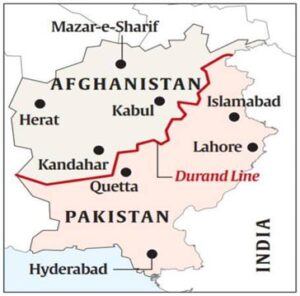
- The Durand Line was drawn in 1893 by Mortimer Durand between British India and Afghanistan. It stretches about 2,640 km and divides Pashtun tribal areas.
- Pakistan treats it as a permanent international border. Afghanistan has never formally accepted it as a final boundary.
- In 1947, Afghanistan even opposed Pakistan’s entry into the United Nations over this issue. The dispute continues to fuel border clashes and mistrust.
Trade and Transit Issues
- Afghanistan is a landlocked country and depends heavily on Pakistan for trade access through Karachi port and land routes.
- Afghanistan has repeatedly sought overland trade with India through the Wagah border, but Pakistan has denied such access.
- Kabul views these restrictions as political pressure tactics. Disagreements arise when Pakistan restricts transit access.
Security and Militancy Concerns
- Pakistan accuses Afghanistan of sheltering anti-Pakistan militant groups.
- Cross-border attacks have increased tensions. The Taliban government denies supporting militants, but trust remains low.
Conclusion
Pakistan–Afghanistan tensions are rooted in historical border disputes, strategic competition, and mutual mistrust. The current escalation reflects unresolved geopolitical and security challenges in the region.
FOREST RIGHTS ACT, 2006 CELLS
TOPIC: (GS2) POLITY: THE HINDU
The Union Government has expanded the role of Forest Rights Act (FRA) Cells to strengthen the implementation of the Forest Rights Act, 2006.
Background and Objective
- FRA Cells were approved under the Dharti Aaba Janjatiya Gram Utkarsh Abhiyaan launched in October 2024.
- Their main purpose is to provide technical and administrative support without interfering in statutory decision-making powers of Gram Sabhas and authorities.
- The initiative is funded by the Ministry of Tribal Affairs.
Structure and Coverage
- At the State level, each cell includes a Program Coordinator, an IT/Data Expert, and an MIS Assistant.
- At the District or Sub-Divisional level, it consists of a Coordinator and an MIS Associate.
- So far, 324 district-level cells in 18 States/UTs and 17 State-level cells have been sanctioned.
Key Functions
- Assist in processing and verification of forest rights claims.
- Help Gram Sabhas and claimants prepare required documents and evidence.
- Support digitisation of records and monitoring of claim status.
- Promote conversion of forest villages into revenue villages and convergence with government schemes.
Conclusion
The strengthening of FRA Cells is expected to accelerate recognition of forest rights and improve delivery of benefits to tribal communities through better coordination and transparency.
VERY SHORT-RANGE AIR DEFENCE SYSTEM (VSHORADS)
TOPIC: (GS3) SEQURITY: THE HINDU
The Defence Research and Development Organisation recently carried out three successful flight trials of VSHORADS.
About VSHORADS
- VSHORADS stands for Very Short-Range Air Defence System.
- It is a Man Portable Air Defence System (MANPADS).
- It has been indigenously designed and developed by Research Centre Imarat along with other DRDO laboratories and industry partners.
- It is part of India’s efforts toward self-reliance in defence technology (Atmanirbhar Bharat).
Key Features
- It is a lightweight, portable surface-to-air missile system.
- Can be operated by a single soldier or a small team.
- Designed to intercept and destroy low-flying aircraft, helicopters, and drones.
- Maximum operational range is around 8 km.
- Can engage targets up to an altitude of 4.5 km.
Technological Highlights
- Equipped with a miniaturised Reaction Control System (RCS) for better manoeuvrability.
- The RCS uses small thrusters to control direction and stability during flight.
- Integrated advanced avionics for improved targeting accuracy.
Strategic Importance
- Enhances short-range air defence capability of the Indian Army, Navy, and Air Force.
- Strengthens border and tactical air defence systems. Reduces dependence on imported MANPADS.
Conclusion
VSHORADS marks a major step in strengthening India’s indigenous air defence capability and improving protection against low-altitude aerial threats.
NILGIRI WOOD PIGEON
TOPIC: (GS3) ENVIRONENT: THE HINDU
Why in News?
A recent scientific study has warned that climate change may significantly shrink Nilgiri Wood Pigeon (Columba elphinstonii) suitable habitat by the end of the century.

Taxonomy and Identification
Scientific Classification
- Scientific Name: Columba elphinstonii
- Family: Columbidae
- Status: Endemic to India (Western Ghats Biodiversity Hotspot)
Physical Features
- Large-sized forest pigeon.
- Dark grey-brown plumage.
- Distinct black-and-white checkerboard pattern on the nape, which helps in identification.
Habitat
- Found in wet evergreen, moist evergreen, and semi-evergreen forests.
- Strong association with ‘shola’ forests (montane evergreen forest patches in valleys).
- Occurs up to 2,250 metres above sea level.
Geographical Distribution
- Major populations in:
- Nilgiri Hills (Tamil Nadu)
- Anamalai Hills (Tamil Nadu & Kerala)
- Isolated populations in:
- Biligirirangan Hills (Karnataka)
- Nandi Hills
- Parts of northern Maharashtra
Ecological Role
- Primarily frugivorous (fruit-eating).
- Feeds in dense forest canopies.
- Plays a key role in seed dispersal, supporting forest biodiversity and regeneration.
Status
- Listed as Vulnerable on the IUCN Red List.
Major Threats
- Deforestation and habitat fragmentation.
- Expansion of plantations such as tea and coffee.
- Infrastructure development in hill regions.
- Hunting in certain areas.
- Climate change, causing habitat shift to higher elevations.
AMONDAWA TRIBE
TOPIC: (GS2) SOCIETY: THE HINDU
Why in News?
Recent anthropological research has highlighted that the Amondawa tribe lives without clocks, calendars, or numerical age systems.

Location and Demography
- Located deep inside the Brazilian Amazon rainforest.
- First contacted by the outside world in 1986.
- Current population is around 150 individuals.
- Continue traditional practices such as hunting, fishing, and small-scale farming.
Absence of Abstract Time
No Linguistic Concept of Time
- No words equivalent to:
- “Time”
- “Week”
- “Month”
- “Year”
Nature-Based Organisation
- Understand sequence of events but do not treat time as measurable.
- Daily life revolves around:
- Sunrise and sunset
- Seasonal patterns
- Immediate social and environmental needs
No Concept of Numerical Age
Absence of Age Calculation
- Do not record birthdays.
- Do not count years lived.
Identity-Based Life Stages
- Life stages marked through name changes.
- Individuals may change names several times during their lifetime.
- Social identity and role define maturity rather than age numbers.
Anthropological Significance
- Demonstrates that time perception is culturally constructed.
- Supports the idea that language influences thought and cognition.
- Shows that complex social organisation is possible without mechanical timekeeping.