The U.S. has intensified economic pressure on Venezuela by announcing a naval “quarantine” on Venezuelan oil exports.
Venezuela and Oil Wealth
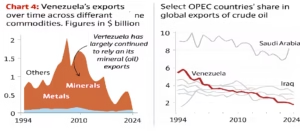
- Venezuela is a classic petrostate, where the economy depends heavily on oil exports.
- It holds the world’s largest proven crude oil reserves, estimated at about 303 billion barrels (2023).
- Venezuela was a founding member of OPEC and once one of the richest countries in Latin America.
- However, over time, heavy dependence on oil created structural weaknesses, leading to a resource curse.
What is the Resource Curse?
- The resource curse refers to a situation where countries rich in natural resources experience slow growth, weak institutions, and economic instability.
- Over-reliance on a single resource discourages diversification and makes the economy vulnerable to shocks.
Nature of Venezuela’s Oil Reserves
- Most Venezuelan oil is extra-heavy crude, which is difficult and costly to extract.
- It requires advanced technology, skilled manpower, and specialised refineries.
- Due to sanctions and internal problems, Venezuela lacks the capital and expertise needed.
Problems in the Oil Sector (PDVSA)
- Venezuela’s state-owned company PDVSA controls oil production and refining.
- Years of underinvestment, mismanagement, and political interference weakened the company.
- After the failed coup attempt (2002) and oil strike, the government replaced experienced staff, leading to loss of technical capacity.
- As a result, oil production in 2024 fell to about 9.2 lakh barrels per day, far below past levels.
Impact of Global Shocks and Sanctions
- In the 1970s, high oil prices boosted Venezuela’s income, but benefits were unevenly distributed.
- After 2014, falling oil prices and rising sanctions worsened the economy. Restrictions on importing diluents further reduced production.
- U.S. sanctions (2017 onwards) restricted access to finance, froze assets, and blocked oil trade payments.
Lack of Economic Diversification
- Unlike other OPEC members, Venezuela failed to develop manufacturing, agriculture, or services.
- Oil continues to dominate exports, making the economy highly vulnerable.
- Venezuela’s share in global oil exports fell from over 4% in the 1990s to about 0.35% in 2023.
Macroeconomic Consequences
- GDP per capita has fallen to levels seen three decades ago, a rare global decline.
- Government debt is the highest among OPEC countries.
- Inflation, unemployment, and poverty have sharply increased.
Conclusion
Venezuela’s crisis is not caused by oil prices alone but by mismanagement, sanctions, lack of diversification, and weak institutions. The country illustrates how resource abundance can become a liability if governance and economic planning are poor. Addressing the resource curse requires diversification, institutional reform, and stable external engagement.
Indian astronomers have discovered a rare spiral galaxy named Alaknanda using James Webb Space Telescope (JWST) data. Its early formation challenges existing theories of galaxy evolution.
Discovery and Naming
- Found by researchers at the National Centre for Radio Astrophysics (NCRA), Pune. Detected while analysing JWST’s UNCOVER survey data.
- Named Alaknanda after a river in Uttarakhand, chosen to complement the Milky Way’s Hindi name Mandakini.

What Makes Alaknanda Unique
- It is the second farthest spiral galaxy ever observed. Formed just 1.5 billion years after the Big Bang, much earlier than expected.
- Shows two symmetrical spiral arms, a central bulge, and a disk—features of a mature spiral galaxy. Star formation rate: ~60 solar masses per year.
Challenge to Existing Galaxy Formation Models
- Spiral galaxies usually require billions of years to form stable, rotating disks that support spiral arms.
- The discovery of Alaknanda, a mature spiral galaxy formed just 1.5 billion years after the Big Bang, contradicts these established timelines.
- Its early development suggests that unknown factors or faster-than-expected processes may be influencing galaxy evolution in the early universe.
Possible Formation Theories
- Cold gas accretion: Galaxy steadily drew in cold gas, forming a rotating disk.
- Galaxy interaction: Merged or interacted with a smaller galaxy, triggering spiral arms.
- Neither theory is confirmed due to limited data.
Significance for Indian Astronomy
- Marks a major achievement for Indian researchers in global space science.
- Reflects growing capabilities in data analysis and astrophysics.
- India aims to strengthen its astronomy base through:
- Building domestic facilities like the 10-metre telescope in Hanle.
- Joining global collaborations like SKA and LIGO.
- Expanding training and funding for young scientists.
JAMES WEBB SPACE TELESCOPE
- Launch Date: 25 December 2021, using an Ariane 5 rocket from French Guiana.
- Agencies Involved: A joint project of NASA, ESA (European Space Agency), and CSA (Canadian Space Agency).
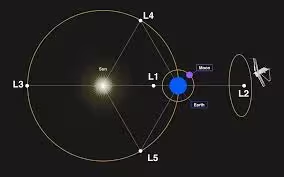
- Location: Operates at the Sun–Earth L2 orbit, about 1.5 million km from Earth.
- Size: Largest telescope ever launched into space, with a 6.5metre primary mirror.
- Technology: Uses infrared sensitivity to look back over 13.5 billion years, observing the first galaxies after the Big Bang.
- Mission Goals:
- Study the formation of stars and galaxies.
- Explore exoplanets and their atmospheres for signs of habitability.
- Investigate the origins of cosmic structures and dark matter.
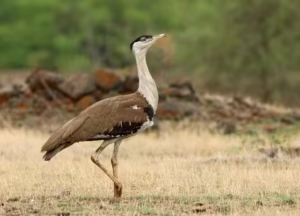
The Supreme Court of India recently issued a landmark judgment to protect the critically endangered Great Indian Bustard (GIB). The ruling focuses on reducing bird deaths caused by collisions with overhead power lines in Rajasthan and Gujarat, while balancing renewable energy expansion.
Background
- Petition filed highlighting frequent GIB deaths due to transmission lines in desert habitats.
- GIBs are highly vulnerable because of poor frontal vision and heavy body.
- Earlier (2021), the Court banned new overhead lines in ~99,000 sq km of habitat and ordered undergrounding of highvoltage lines.
- In March 2024, the blanket ban was modified after concerns from power ministries about feasibility.
Supreme Court’s Latest Directions
- Priority Areas: Special conservation zones have been marked in Rajasthan (14,013 sq km) and Gujarat (740 sq km) to protect the Great Indian Bustard.
- Safe Corridors: Dedicated routes for power lines are created — up to 5 km wide in Rajasthan and 1–2 km in Gujarat — to reduce bird collisions.
- Project Limits: No new overhead lines (except very low voltage), wind turbines, or large solar parks are allowed inside these priority zones.
- Underground Lines: Rajasthan will bury 80 km of 33 kV lines by 2028, while Gujarat will underground nearly 145 km of lines and 250 km of critical lines within 2 years.
- Bird Diverters: Their use is not made compulsory yet; experts will first study how effective they are in preventing bird deaths.
Conservation Measures
- Rajasthan: Grassland restoration, predator control, food and water management, community participation.
- Gujarat: “Jumpstart” breeding by transferring fertile eggs, GPS tagging for monitoring.
Significance
- Balances India’s climate goals with species conservation.
- Strengthens Project GIB and sets a precedent for integrating biodiversity safeguards into renewable energy planning.
Conclusion:
Three important government initiatives to protect the Great Indian Bustard are Project Great Indian Bustard, establishment of sanctuaries, and Supreme Courtmandated safeguards against power lines.
Rajasthan is fasttracking the installation of rooftop solar plants under the RDSS to cut transmission losses and improve the quality of electricity supply.
About the Scheme
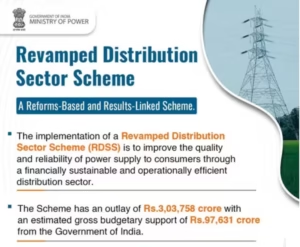
- Launch: July 2021 by the Ministry of Power, Government of India.
- Objective: Transform India’s electricity distribution sector into a financially sustainable and efficient system.
- Outlay: ₹3,03,758 crore for five years (FY 202122 to FY 202526).
- Nature: Reformsbased and resultslinked scheme.
Key Goals
- Reduce Aggregate Technical & Commercial (AT&C) losses to 12–15% nationwide.
- Eliminate the gap between Average Cost of Supply (ACS) and Average Revenue Realised (ARR) by 202425.
- Modernise distribution networks through smart metering and infrastructure upgrades.
Major Components
- Part A – Infrastructure & Metering: Financial support for prepaid smart consumer meters and system metering. Upgradation of distribution infrastructure.
- Part B – Capacity Building: Training programmes for staff. Supporting activities to strengthen reforms.
Implementation
- Financial aid to DISCOMs is conditional on meeting reform benchmarks.
- Focus on smart metering, network strengthening, and reducing losses.
- Encourages renewable integration like rooftop solar to improve efficiency.
Significance
- Aims to create operationally efficient DISCOMs.
- Supports India’s clean energy transition.
- Enhances consumer satisfaction with reliable and affordable power supply.
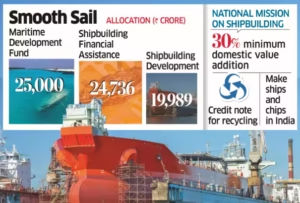
The Ministry of Ports, Shipping & Waterways has issued operational guidelines for two major initiatives — the Shipbuilding Financial Assistance Scheme (SBFAS) and the Shipbuilding Development Scheme (SbDS) — to boost India’s shipbuilding industry.
About the Scheme
- Launch & Validity: Applicable till 31 March 2036.
- Nodal Ministry: Ministry of Ports, Shipping & Waterways.
- Objective: Strengthen India’s domestic shipbuilding capacity and enhance global competitiveness.
Key Features of SBFAS
- Financial Aid: Support of 15%–25% per vessel, depending on category.
- Graded Support: Stagewise disbursement linked to milestones, backed by security instruments.
- Shipbreaking Credit Note: Ship owners scrapping vessels in Indian yards get 40% of scrap value as credit.
- National Shipbuilding Mission: Ensures coordinated planning and execution of shipbuilding initiatives.
Shipbuilding Development Scheme (SbDS)
- Focus: Longterm capacity creation and modernisation.
- Infrastructure Development:
- Greenfield clusters: 100% capital support for common infrastructure via a 50:50 Centre–State SPV.
- Brownfield yards: 25% capital aid for upgrades like dry docks and shiplifts.
- India Ship Technology Centre: To be set up under Indian Maritime University for research, design, innovation, and skill development.
- Credit Risk Coverage: Governmentbacked insurance for preshipment, postshipment, and vendordefault risks.
Significance
- Strengthens India’s shipbuilding ecosystem.
- Encourages domestic manufacturing and reduces reliance on imports.
- Supports employment, innovation, and maritime infrastructure growth.