Daily Current Affairs 31-December-2025

Share this Post

A MULTIPOLAR WORLD WITH BIPOLAR CHARACTERISTICS

TOPIC: (GS2) INTERNATIONAL RELATIONS: THE HINDU

The U.S. has undertaken its largest troop mobilisation in the Caribbean in decades, targeting Venezuela. This comes alongside the release of the National Security Strategy (NSS) 2025, which revives the Monroe Doctrine and highlights Latin America as a strategic priority.

Shift in U.S. Foreign Policy

  • U.S. is reinforcing primacy in Latin America and the Caribbean, aiming to block Chinese influence.
  • At the same time, Washington is reducing its security role in Europe, a traditional sphere of influence since WWII.
  • This reflects a recalibration of priorities, focusing on the Western Hemisphere while stepping back from Europe.

End of Unipolarity

  • Post1991, the U.S. enjoyed a unipolar moment with unmatched dominance.
  • Russia’s annexation of Crimea (2014) and China’s rise marked the limits of U.S. primacy.
  • Today, three great powers — U.S., China, and Russia — shape global outcomes, making the system multipolar.

The Three Great Powers

  • United States: Still the strongest military and economic power but faces systemic challenges.
  • China: Economy at 66% of U.S. GDP, growing faster; building the world’s largest navy; seeking regional hegemony and global dominance.
  • Russia: Smaller economy but strong in nuclear weapons, energy resources, and military assertiveness; closer ties with China after Ukraine war.

Bipolar Tendencies within Multipolarity

  • U.S. vs China is emerging as the central contest — reigning power vs rising power.
  • Russia plays the role of a swing power, aligning with China but wary of being seen as subordinate.
  • This dynamic creates a multipolar system with bipolar features, dominated by U.S.–China rivalry.

Implications for Middle Powers

  • Countries like India, Brazil, Japan, and Germany hedge their bets, balancing between major powers.
  • India, in particular, seeks autonomy while navigating U.S.–China competition and Russia’s shifting role.
  • The fluidity of the system means alliances are less rigid compared to Cold War blocs.

Conclusion

The emerging order is multipolar but shaped by bipolar rivalry between the U.S. and China, with Russia acting as a swing power. Middle powers, including India, must adapt to this fluid landscape by pursuing strategic autonomy and flexible diplomacy.

INDIA–NEW ZEALAND FTA

TOPIC: (GS2) INTERNATIONAL RELATIONS: THE HINDU

India and New Zealand concluded a Free Trade Agreement (FTA) in December 2025, the pact provides zeroduty access for Indian exports and commits $20 billion FDI from New Zealand over 15 years.

Features of the Agreement

  • Duty concessions: New Zealand will remove duties on 100% of tariff lines, giving full access to Indian exports.
  • India will open 70% of tariff lines, including concessions on apples, while protecting sensitive farm products.
  • FDI commitment: New Zealand to invest $20 billion in India by 2030, with safeguards for compliance.
  • Services and labour mobility: Wide access for Indian professionals in IT, education, healthcare, engineering, tourism, and construction.
  • Intermediate inputs: Dutyfree imports of wood logs, coking coal, metal scrap to reduce manufacturing costs.
  • Traditional medicine: Annex on Ayurveda, yoga, and health services, boosting India’s pharmaceutical and healthcare exports.

Sectoral Gains for India

  • Labourintensive industries: Textiles, apparel, leather, gems, engineering goods, and processed foods to benefit from dutyfree access.
  • Healthcare and pharma: Expanded opportunities in wellness and medical services, strengthening India’s role as a global health partner.
  • Agriculture: Balanced approach — no concessions on dairy, sugar, spices, and edible oils, protecting farmers. Collaboration in apples, kiwifruit, and honey through technology transfer and value chain development.

Challenges in Utilisation

  • India’s past FTAs show low utilisation (25%) compared to developed countries (70–80%).
  • Barriers include lack of awareness, compliance issues, and nontariff barriers (NTBs).
  • The FTA addresses these through regulatory cooperation, streamlined customs, and transparency measures.
  • Success depends on industry associations, policymakers, and enterprises actively promoting awareness and capacity building.

Strategic Importance

  • Builds on India’s strengths: large middle class, skilled workforce, reformdriven economy.
  • Positions India in global value chains, supporting the $7 trillion economy target by 2030.
  • With this pact, India has FTAs with all RCEP members except China, enhancing regional integration.
  • Reflects trust from developed economies, strengthening India’s image as a stable and reliable trade partner.

Free Trade Agreement (FTA)

A Free Trade Agreement (FTA) is an arrangement under international law where countries agree to form a free-trade area. It aims to reduce or eliminate tariffs, quotas, and restrictions on imports and exports between the signatory nations.

Types of FTAs

  • Bilateral FTAs: Between two countries (e.g., India–Sri Lanka FTA).
  • Multilateral FTAs: Between three or more countries (e.g., ASEAN Free Trade Area).

Key Features

  • Tariff reduction: Lower or zero duties on goods traded between members.
  • Market access: Easier entry for services, investments, and goods.
  • Regulatory cooperation: Simplified customs procedures and reduced nontariff barriers.
  • Encourages competition: Promotes efficiency and innovation among domestic industries.

Examples

  • NAFTA/USMCA: Agreement between the U.S., Canada, and Mexico.
  • India–ASEAN FTA: Covers trade in goods and services between India and ASEAN nations.

Conclusion

The India–New Zealand FTA is more than a trade deal; it is a strategic partnership that enhances India’s global standing. Its success will depend on effective utilisation, protection of sensitive sectors, and leveraging opportunities in services and labourintensive industries.

THE RISE OF GENAI AND THE FALL OF PROGRAMMING

TOPIC: (GS3) SCIENCE AND TECHNOLOGY: THE HINDU

Recent reports and infographics show that AI/ML and data analysis skills now outpace programming in both demand and salary growth. The tech hierarchy is changing, with AI proficiency becoming the new benchmark for high-value roles.

Trends in Skill Demand

  • AI/ML, Big Data, and Data Analysis are growing faster than traditional programming.
  • Learning hours for AI and Big Data have surpassed programming since 2020.
  • Job roles in AI/ML and data analysis have seen a steep rise from 2010 to 2025, while programming roles have grown slowly.
  • Salary growth is higher in AI/ML and data-related fields compared to coding jobs.

Reasons for Decline in Programming’s Dominance

  • Automation of coding tasks through GenAI tools reduces the need for manual programming.
  • GenAI enables non-programmers to build apps, websites, and tools using natural language prompts.
  • Companies now prefer professionals who can interpret data, train models, and apply AI solutions.
  • Programming is becoming a support skill rather than a core requirement in many tech roles.

Rise of AI and Data Skills

  • AI/ML roles include machine learning engineers, data scientists, and AI researchers.
  • Data analysis is crucial for business intelligence, decision-making, and predictive modeling.
  • These roles are more resilient to AI disruption, unlike basic coding jobs.
  • GenAI tools still need human oversight, especially in model training, ethical use, and validation.

Impact on Education and Careers

  • Tech education is shifting focus from pure coding to AI literacy, data handling, and model building.
  • Students and professionals are encouraged to learn AI tools, cloud platforms, and data visualization.
  • Career paths now include AI ethics, prompt engineering, and AI product management.

Challenges and Concerns

  • Over-reliance on GenAI may reduce critical thinking and problem-solving among developers.
  • Some experts warn that developers may lose core skills if they depend too much on AI tools.
  • There is a need for balanced learning, combining AI tools with foundational programming knowledge.

Global Market Response

  • Developed economies are investing in AI-driven education and workforce training.
  • Companies are restructuring teams to include AI specialists and data experts.
  • India is also adapting, with initiatives to promote AI skilling and digital transformation.

PROGRAMMING

Programming (or coding) is the act of creating a set of instructions, called a program, that a computer can execute to perform specific tasks.

  • How it works:
    • Programmers design algorithms (step-by-step procedures).
    • They write these in programming languages such as Python, Java, or C++.
    • The code is then translated into machine-readable instructions for the computer.
  • Purpose:
    • Enables computers to run applications, websites, games, and operating systems.
    • Powers everyday systems like banking, healthcare, and communication.

LARGE LANGUAGE MODELS (LLMS)

LLMs are AI models built using deep learning techniques, trained on vast amounts of text data to process, understand, and generate natural language.

  • Architecture: Based on the Transformer model, which captures context and meaning across long text sequences.
  • Capabilities: Answer questions, write essays, translate languages, generate code, and summarize information.
    • Examples include ChatGPT, Google Gemini, Anthropic Claude.
  • Strengths:
    • Can mimic human-like conversation.
    • Useful in education, customer support, content creation, and programming assistance.
  • Limitations: May produce inaccurate or biased outputs. Dependent on training data quality and scale.

Conclusion

Programming is no longer the only gateway to tech careers. As GenAI transforms how software is built, AI and data skills are becoming central to innovation and growth. While coding remains important, the future belongs to those who can combine technical knowledge with AI fluency and strategic thinking.

INDIA BECOMES THE WORLD’S FOURTH LARGEST ECONOMY

TOPIC: (GS3) ECONOMY: THE HINDU

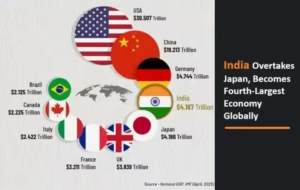
India has overtaken Japan to become the fourth largest economy with a GDP of $4.18 trillion. The government projects India will surpass Germany by 2030 with a GDP of $7.3 trillion.

Current Economic Position

  • India is now behind only the U.S., China, and Germany in global GDP rankings.
  • Real GDP growth in Q2 of 202526 stood at 8.2%, the highest in six quarters.
  • Growth momentum reflects resilience despite global trade uncertainties.
Current Economic Position

Drivers of Growth

  • Private consumption has been the main engine of expansion.
  • Strong urban demand and rising credit flows to the commercial sector supported growth.
  • Inflation remains below tolerance levels, unemployment is declining, and exports are improving.

Strategic Importance

  • India aims to achieve high middleincome status by 2047, its centenary of independence.
  • Structural reforms, social progress, and innovation are strengthening longterm foundations.
  • The FDI environment and export competitiveness are improving, positioning India as a reliable global partner.

Informal Money and Its Impact on India’s GDP Growth

Hidden Economic Activity

  • The informal sector contributes nearly 40–45% of India’s GDP.
  • Example: In 2024–25, India’s GDP was valued at $4.18 trillion, but informal transactions mean the actual economic activity is higher than reported.

Loss of Tax Revenue

  • According to the Economic Survey 2024–25, India’s tax-to-GDP ratio is only 11–12%, lower than many emerging economies.
  • Formalisation through GST has expanded the tax base — GST collections crossed ₹1.6 lakh crore per month in 2025, showing how capturing informal money boosts revenue.

Weak Financial Inclusion

  • Over 80% of India’s workforce is employed in the informal sector.
  • Digital payments have helped: UPI transactions crossed ₹18 lakh crore in November 2025, showing how informal cash is moving into formal channels.

GLOBAL PROJECTIONS

  • World Bank: 6.5% growth in 2026.
  • Moody’s: India to remain fastestgrowing G20 economy (6.4% in 2026, 6.5% in 2027).
  • IMF: 6.6% in 2025, 6.2% in 2026.
  • OECD: 6.7% in 2025, 6.2% in 2026.
  • ADB: 7.2% forecast for 2025.
  • Fitch: 7.4% growth in FY26.

Conclusion

India’s rise to the fourth largest economy highlights its strong growth trajectory. With reforms, consumption, and global confidence, India is wellplaced to become the third largest economy by 2030.

FREQUENCY COMB

TOPIC: (GS3) SCIENCE AND TECHNOLOGY: THE HINDU

Frequency combs are in the spotlight as they are being used in atomic clock calibration and advanced experiments in space science and spectroscopy. Recent developments highlight their role in detecting exoplanets and measuring minute gravitational shifts.

Frequency combs

About Frequency Comb

  • A frequency comb is a special type of laser light.
  • Its spectrum looks like the teeth of a comb, with evenly spaced frequencies.
  • It acts as a bridge between radio frequencies (below 100 GHz) and optical frequencies (above 200 THz).

Key Characteristics

  • Emits multiple colours (frequencies) instead of a single one.
  • The spacing between frequencies is extremely regular and precise.
  • Known for high stability and accuracy, making it a reliable scientific tool.

Applications

  • Atomic clocks: Used to calibrate the world’s most precise clocks.
  • Gravitational studies: Helps measure tiny shifts in light caused by gravity.
  • Astronomy: Plays a role in detecting exoplanets by analysing light variations.
  • Spectroscopy: Enables high-speed and high-precision measurements of different light frequencies.
  • Scientific research: Allows comparison of unknown light frequencies with stable references.

Conclusion

Frequency combs are a modern breakthrough in laser technology, combining simplicity with precision. Their expanding applications in space exploration, physics, and time measurement make them vital tools for future scientific progress.

NARSAPURAM LACE CRAFT

TOPIC: (GS1) INDIAN ART AND CULTURE: THE HINDU

The Prime Minister recently praised Narsapuram Lace Craft products made by selfhelp groups in Andhra Pradesh during his Mann Ki Baat broadcast.

Location and Background

  • Narsapur is located on the banks of the Godavari River in Andhra Pradesh.
  • The lace craft tradition began about 150 years ago, initiated by women from farming families.
  • It survived major historical challenges like the Indian famine of 1899 and the Great Depression of 1929.
  • By the early 1900s, more than 2,000 women artisans were engaged in this craft in the Godavari region.

Narsapuram Lace Craft

Materials and Tools

  • Cotton threads of different thicknesses and colours are the primary raw material.
  • Decorative pieces may use silk, rayon, synthetic threads, beads, and sequins.
  • The main tool is the crochet hook, available in various sizes for intricate designs.

Designs and Products

  • Patterns include floral, geometric, and paisley motifs, inspired by nature and tradition.
  • Products range from doilies, pillow covers, cushion covers, bedspreads, table runners, and tablecloths.
  • The craft has earned a Geographical Indication (GI) tag, ensuring recognition and protection.

Significance

  • Provides livelihood opportunities for women and selfhelp groups.
  • Strengthens India’s handicraft exports and cultural identity.
  • Showcases resilience and continuity of traditional skills across generations.

Conclusion

Narsapuram Lace Craft is both a heritage art form and a source of rural empowerment, symbolising how traditional skills can thrive with modern recognition and support.

PM-YUVA 3.0 SCHEME

TOPIC: (GS3) ECONOMY: THE HINDU

The results of the Prime Minister’s Scheme for Mentoring Young Authors (PM-YUVA 3.0) were announced recently. Out of an all-India competition, 43 young writers under 30 years have been selected for mentorship.

About the Scheme

  • Launched to nurture young authors and provide them with guidance, exposure, and opportunities.
  • Focuses on developing writers who can present India’s past, present, and future through creative works.
  • Implemented by the National Book Trust (NBT), India under the Ministry of Education.
PM-YUVA 3.0 Scheme

Themes of PM-YUVA 3.0

  • Indian Diaspora’s role in nation-building.
  • Indian Knowledge Systems.
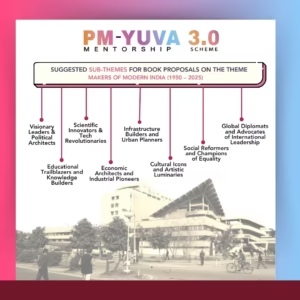
  • Makers of Modern India (1950–2025).
  • Provides a platform for youth to express perspectives on India’s contributions across time.

Selection Process

  • Applications invited through MyGov portal.
  • Candidates submit a 10,000-word book proposal.
  • A multi-stage evaluation shortlists authors; final selection made by a committee.
  • Previous PM-YUVA participants (1.0 and 2.0) are not eligible.

Mentorship and Support

  • Six-month mentorship with workshops, literary interactions, and exposure to publishing.
  • Each author receives a scholarship of ₹50,000 per month (₹3 lakh total).
  • Books written will be published by NBT; authors earn 10% royalty.
  • Works may be translated into other Indian languages.
  • Authors will showcase their work at the New Delhi World Book Fair 2026 and other literary forums.

Conclusion

PM-YUVA 3.0 is a nationwide initiative to encourage young voices, strengthen India’s literary ecosystem, and promote cultural narratives through youth-driven writing.

AKASH-NG MISSILE SYSTEM

TOPIC: (GS3) SEQURITY: THE HINDU

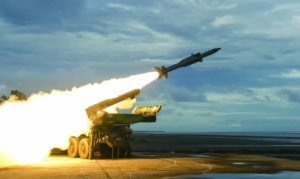
The Defence Research and Development Organisation (DRDO) has recently completed User Evaluation Trials of the Akash-NG (Next Generation) missile system. This marks a major step in strengthening India’s air defence capabilities.
Akash-NG (Next Generation) missile system

About Akash-NG

  • Akash-NG is a modern surface-to-air missile (SAM) system developed by DRDO and produced by Bharat Dynamics Limited (BDL).
  • It is designed to defend vulnerable areas and assets against aerial threats.
  • It is the successor to the original Akash missile system, which has been in service with the Indian Air Force (since 2014) and the Indian Army (since 2015).

Key Features

  • Weight: Lighter at 350 kg compared to the earlier version’s 720 kg.
  • Technology: Equipped with an indigenous RF seeker, dual-pulse solid rocket motor, and homegrown radars and C2 systems.
  • Target Engagement:
    • Range: up to 30 km.
    • Altitude: up to 18 km.
    • Can engage 10 targets simultaneously.
    • Firing rate: one missile every 10 seconds.
  • Deployment: Flexible for both mobile and fixed installations.

Significance

  • Enhances India’s air defence network against high-speed, low-altitude, and long-range aerial threats.
  • Strengthens indigenous defence production and reduces reliance on imports.
  • Supports India’s vision of self-reliance in defence technology (Atmanirbhar Bharat).

Conclusion

The successful trials of Akash-NG highlight India’s progress in developing advanced missile defence systems, ensuring greater security for strategic assets and boosting indigenous technological capabilities.


Write a Review

Your email address will not be published. Required fields are marked *