
Table of Contents
ToggleG4 (SEVERE) GEOMAGNETIC STORM
This topic is part of Daily Current Affairs – 21 January 2026
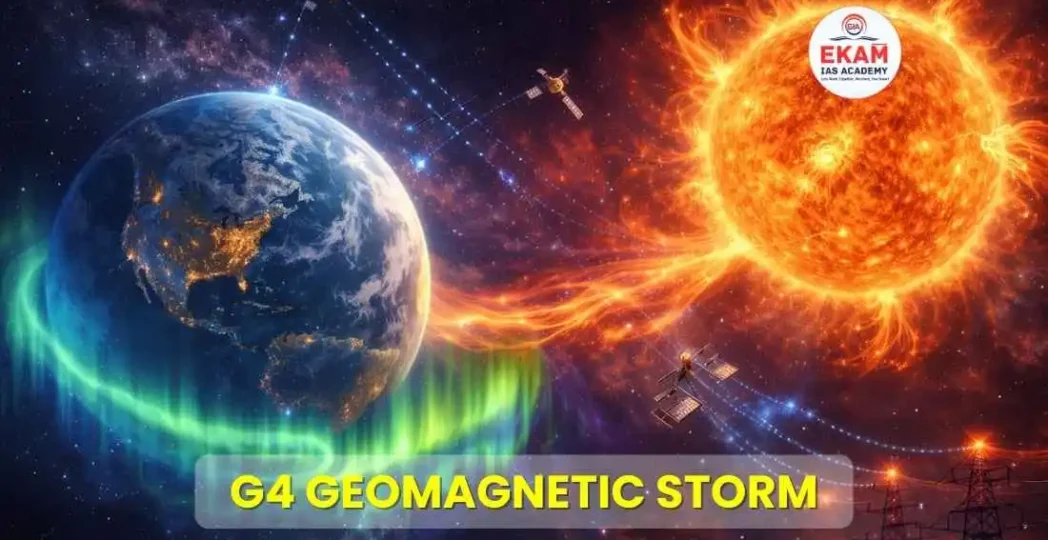
A G4-level severe geomagnetic storm recently struck Earth, triggered by strong solar activity. It produced spectacular auroras visible across continents and raised concerns about impacts on satellites, communication, and power grids.
What are Geomagnetic Storms?
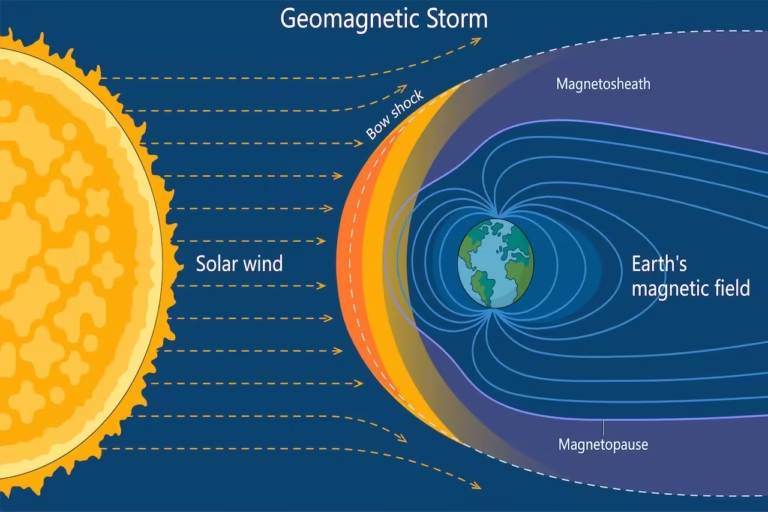
- A geomagnetic storm is a major disturbance in Earth’s magnetosphere caused by solar wind energy entering Earth’s space environment.
- Triggered by:
- High-speed solar wind sustained for hours.
- Southward-directed solar magnetic field opposing Earth’s field.
- Strongest storms linked to Coronal Mass Ejections (CMEs) – massive plasma bursts from the Sun carrying embedded magnetic fields.
Effects of Geomagnetic Storms
- Auroras: Beautiful light displays near polar regions.
- Ionosphere heating: Distorts long-range radio communication.
- Satellite drag: Expansion of ionosphere alters satellite orbits.
- Electronics damage: Static charge buildup can harm satellite systems.
- Navigation disruption: GPS and global positioning systems affected.
- Power grids: Geomagnetically induced currents (GICs) can damage pipelines and electricity networks.
What is Solar Wind?
- Continuous stream of charged particles (protons & electrons) from the Sun’s corona.
- Travels at speeds of 400–800 km/s in plasma form.
- Carries the Sun’s magnetic field outward.
- When reaching Earth, particles funnel along magnetic field lines toward poles, sparking auroras and storms.
Conclusion
Geomagnetic storms highlight the interconnectedness of solar activity and Earth’s technology systems
G4 (SEVERE) GEOMAGNETIC STORM - FAQs
What is a G4 (severe) geomagnetic storm?
A G4 geomagnetic storm is a severe disturbance of Earth’s magnetosphere caused by intense solar activity, capable of affecting satellites, communication, and power systems.
What causes geomagnetic storms on Earth?
Geomagnetic storms are triggered by high-speed solar wind and Coronal Mass Ejections (CMEs) when the Sun’s magnetic field interacts strongly with Earth’s field.
Why do geomagnetic storms produce auroras?
During a geomagnetic storm, charged solar particles travel along Earth’s magnetic field lines toward the poles, colliding with gases and creating auroras.
How do geomagnetic storms affect satellites and GPS?
Ionospheric heating increases atmospheric drag and distorts signals, leading to satellite orbit changes, GPS errors, and communication disruptions.
What risks do geomagnetic storms pose to power grids?
Strong storms generate geomagnetically induced currents (GICs) that can overload transformers, disrupt electricity networks, and damage pipelines.