Table of Contents
ToggleIndia and Iran share one of the most ancient civilisational bonds in the world, dating back to the 3rd century BC. Long before modern diplomacy existed, the two nations were connected through the ancient Silk Route, facilitating exchange of spices, cotton, silk, ideas, philosophy, and culture. The Mughal-Safavid connection deepened this bond further — Babur, the founder of the Mughal Empire, traced his roots to Central Asia via Persia, and Persian became the court language of Mughal India. Sufi saints, scholars like Al-Biruni and poets like Amir Khusro carried the civilisational thread between the two nations across centuries. Until 1947, Iran was India’s immediate geographical neighbour, and it remains India’s maritime neighbour to this day.
Post-Independence Phase and Cold War Era
After independence, India maintained cordial but cautious relations with Iran. India’s Non-Aligned Movement (NAM) framework meant it avoided taking sides in Cold War rivalries. During this period, India-Iran ties remained largely transactional, focused on trade and energy cooperation. Iran under the Shah of Iran had pro-Western leanings, which created ideological distance from Nehruvian India. However, the relationship remained stable with consistent diplomatic exchanges. After the 1979 Iranian Revolution, Iran transformed into an Islamic Republic under Ayatollah Khomeini, which altered the geopolitical landscape of West Asia significantly and introduced a new dimension to India-Iran engagement.
Strategic Foundations: Energy and Connectivity
The most defining pillar of India-Iran bilateral relations has always been energy security. At its peak, India imported nearly 2.5 billion tonnes of Iranian crude oil monthly, accounting for over 10% of India’s total energy requirements. Iran was consistently India’s second or third largest oil supplier. Beyond energy, geography makes Iran irreplaceable for India’s connectivity ambitions. Iran provides India the only viable land-sea corridor to Afghanistan and Central Asia, completely bypassing the Pakistan blockade — India’s most persistent regional constraint. This is precisely why India invested in the Chabahar Port in Iran’s Sistan-Baluchistan province, signing the landmark Chabahar Port Agreement in 2016 under Prime Minister Narendra Modi. India agreed to develop and operate the Shahid Beheshti terminal, with the long-term vision of connecting it to the Chabahar-Zahedan railway line and onward to the International North-South Transport Corridor (INSTC) linking India to Russia and Central Asia via Iran.
The US Sanctions Challenge and India's Difficult Choice
The single biggest disruption to India-Iran relations came with US sanctions. Under the Trump administration’s maximum pressure strategy, the USA reimposed sanctions on Iran after withdrawing from the JCPOA (Joint Comprehensive Plan of Action) in May 2018. The JCPOA, a landmark 2015 nuclear deal between Iran and the P5+1 nations (USA, UK, France, Russia, China, and Germany), had provided significant sanctions relief to Iran. Trump’s unilateral exit shattered this framework. India, under threat of secondary sanctions from the USA, drastically cut its oil imports from Iran to near-zero levels by 2019 — a sharp reversal that had severe consequences. Bilateral trade fell to one-third of its 2018 peak of $17 billion. Iran lost faith in India as a reliable strategic partner. Most critically, Iran excluded India from the Chabahar-Zahedan railway project in 2020, citing prolonged investment delays. As scholar Kabir Taneja noted, India’s complex engagement with Iran proved that “just promoting historical, cultural and political ties will not cut it — India needs to make huge economic investments.”
The China-Iran Factor: A Red Alert for India
The vacuum left by India’s retreat was swiftly filled by China. In 2021, China and Iran signed a Comprehensive Strategic Partnership — a 25-year, $400 billion deal — under which China invests massively in Iran’s infrastructure, energy, and defence in exchange for guaranteed oil supplies. This is deeply alarming for India for multiple reasons. First, China could build a strategic port at Jask, near the Strait of Hormuz, potentially establishing a Chinese military footprint in the western Indian Ocean Region. Second, China could link Chabahar Port to Gwadar Port in Pakistan, completely undercutting India’s connectivity advantage. Third, a Golden Ring — comprising China, Pakistan, Iran, Russia, and Turkey — could emerge as the centrepiece of the Belt and Road Initiative (BRI), encircling India from the west. M.K. Narayanan warned that “the virtual retreat of the US, the growing China-Russia-Pakistan nexus, and a hardline Iran under Raisi all work to India’s disadvantage.”
India's Current Stand and the Way Forward
India’s present policy on Iran is shaped by the principle of strategic autonomy — maintaining independent foreign policy choices without succumbing to external pressure. Shyam Saran articulated this clearly: “The pursuit of a closer security partnership with the US does not mean that India should follow the US lead on its other important relationships.” India’s current position involves: continued diplomatic engagement with Tehran; maintaining the Chabahar investment as a long-term strategic asset; watching for a JCPOA revival under the Biden and subsequent US administrations, which could reopen Indian trade with Iran; and pursuing broader West Asia balancing by maintaining ties with Israel, Saudi Arabia, UAE, and Iran simultaneously — a policy called de-hyphenation and multi-alignment.
India and Iran also share convergent interests on Afghanistan — both oppose the Taliban’s Islamic Emirate, both have faced attacks from Sunni extremist groups like Lashkar-e-Taiba and Jundullah, and both have been excluded from the Troika Plus talks on Afghanistan. Iran’s Foreign Minister Zarif acknowledged that “an Islamic Emirate in Afghanistan is a security threat for India and an existential threat for Pakistan.” This shared concern must be the foundation for a reinvigorated bilateral partnership.
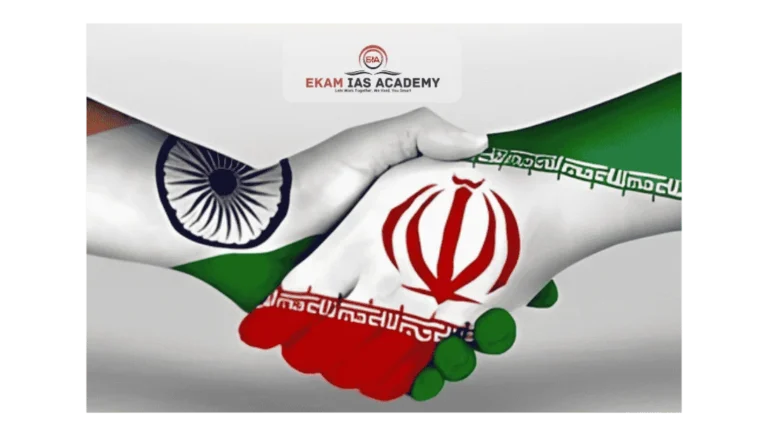
C. Rajmohan suggests India must “ramp up dialogue with Iran and remove misunderstandings.” P.R. Kumaraswamy reminds us that “India should analyse its relations with Iran beyond the US prism.” Most importantly, India must remember that Iran is not merely an energy supplier — it is a civilisational partner, a strategic gateway, and an irreplaceable piece in India’s West Asia foreign policy architecture.
UPSC Prelims: PYQs & Practice Questions
Previous Year Questions (Prelims)
Q1. [UPSC GS Prelims Pattern / 2017–2023 Trend]
Q: With reference to Chabahar Port, which of the following statements is/are correct?
1. It is located in the Sistan-Baluchistan province of Iran.
2. India has agreed to develop and operate the Shahid Beheshti terminal at Chabahar.
3. It provides India direct land access to Pakistan.
Select the correct answer:
(a) 1 and 2 only
(b) 2 only
(c) 1, 2 and 3
(d) 3 only
Answer: (a) 1 and 2 only
Explanation: Chabahar is located in Iran’s Sistan-Baluchistan province. India agreed to develop and operate the Shahid Beheshti terminal under the Chabahar framework. However, it does not provide access to Pakistan; rather, it helps India bypass Pakistan and connect to Afghanistan and Central Asia through Iran.
Q2. [UPSC GS Pattern 2018]
Q: The International North-South Transport Corridor (INSTC) is primarily relevant to India's relationship with which of the following?
(a) East Africa
(b) Iran and Russia
(c) Southeast Asia
(d) China
Answer: (b) Iran and Russia
Explanation: The INSTC is a multi-modal transport corridor connecting India with Russia and Central Asia through Iran. Since it uses Iranian connectivity routes and northern Eurasian links, India’s ties with Iran and Russia are central to the corridor’s strategic importance.
Practice Questions
Practice Q1
Q: India was excluded from which project by Iran in 2020 due to delays caused by US sanctions?
(a) TAPI Pipeline
(b) Chabahar-Zahedan Railway Line
(c) INSTC southern corridor
(d) Iran-Pakistan gas pipeline
Answer: (b) Chabahar-Zahedan Railway Line
Explanation: Iran excluded India from the Chabahar-Zahedan railway project in 2020, citing delays caused by US sanctions. Iran decided to build the railway on its own. This was a major diplomatic setback for India's connectivity vision to Central Asia via Chabahar.
Practice Q2
Q: The China-Iran 25-year Comprehensive Strategic Partnership is significant for India because:
1. It could allow China to establish military presence along the Iran-Pakistan coastline.
2. China may link Chabahar Port to Gwadar, affecting India's strategic interests.
3. Iran will immediately sever all ties with India.
Which of the following is correct?
(a) 1 only
(b) 1 and 2 only
(c) 3 only
(d) 1, 2 and 3
Answer: (b) 1 and 2 only
Explanation: Statements 1 and 2 are correct. China could build a port at Jask near the Strait of Hormuz and link Chabahar to Gwadar, threatening India's position in the western Indian Ocean. Statement 3 is wrong — Iran has not severed ties with India; it still regards India as a civilisational and historical partner.



UPSC Mains – Previous Year & Practice Questions
Mains Previous Year Questions
Mains Q1. [UPSC GS2 2019 | 15 Marks]
Question: Evaluate the strategic importance of Chabahar Port for India in the context of its foreign policy objectives in West Asia and Central Asia. What are the challenges India faces in operationalising this project?
Mains Q2. [UPSC Mains GS2 / PSIR Paper 2 2021 | 15 Marks]
Question: Discuss the implications of the China-Iran 25-year Comprehensive Strategic Partnership on India's strategic interests in the Indian Ocean Region.
Mains Q3. [UPSC PSIR Paper 2 / GS2 2020 | 20 Marks]
Question: “India's relationship with Iran has been described as an affair, not a serious relationship.” Critically examine this characterisation with reference to India's foreign policy priorities.
Mains Q4. [UPSC PSIR Paper 2 2022 / GS2 IR | 15 Marks]
Question: Examine India's position in the Iran-US-China triangle and suggest a way forward for India to protect its strategic interests in West Asia.
Mains Q5. [UPSC PSIR Paper 2 / GS2 2023 | 20 Marks]
Question: India's West Asia policy since 2014 has undergone a significant transformation. In this context, analyse the changes in India-Iran bilateral relations and the role of domestic and external factors.
Mains Practice Questions
Practice Mains Q1. [PSIR Paper 2 | 20 Marks]
Question: “India's Iran policy is caught between the anvil of US strategic partnership and the hammer of China-Iran consolidation.” Critically analyse this statement and suggest India's best course of action.
Practice Mains Q2. [GS Paper 2 IR | 15 Marks]
Question: Examine the civilisational and strategic dimensions of India-Iran relations. How can India convert historical goodwill into contemporary strategic leverage?
Practice Mains Q3. [PSIR Paper 2 / GS2 | 20 Marks]
Question: “India and Iran share common concerns on Afghanistan and terrorism, yet their relationship remains underdeveloped.” Substantiate with examples and suggest a roadmap for reinvigorating India-Iran ties.