Table of Contents
ToggleWhat is the weightage of Indian History in UPSC Prelims and Mains?
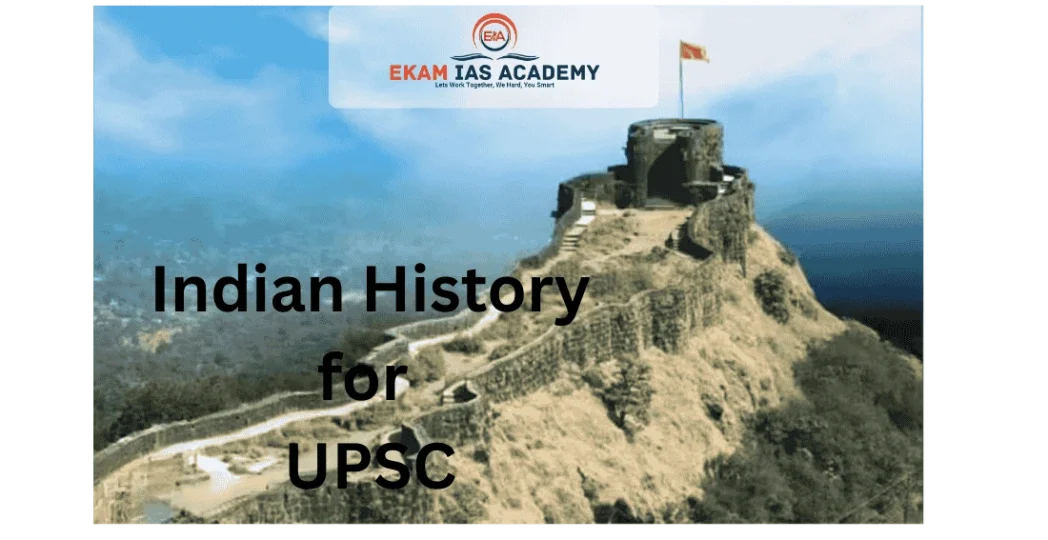
Indian History is one of the most vast and multifaceted subjects in the UPSC syllabus, contributing 15-17 questions in Prelims and forming the backbone of GS Paper 1 in Mains. Art and Culture, a sub-component of History, is one of the most frequently appearing sections in both Prelims and Mains. At Ekam IAS Academy — Hyderabad’s best IAS coaching institute — Indian History is taught by a specialist faculty who makes the subject come alive through stories, connections, and exam-relevance.
What topics are included in Ancient Indian History for UPSC?
Ancient Indian History for UPSC covers: Indus Valley Civilisation (key features, major sites like Harappa, Mohenjo-daro, Dholavira), Vedic Age (early and later Vedic period, significant changes in society and polity), Buddhism and Jainism (founders, key concepts, major texts, differences), Mauryan Empire (Chandragupta, Ashoka’s Dhamma, administrative system), post-Mauryan period (Kushanas, Satavahanas), Gupta Empire (golden age of India — literature, science, art), and South Indian dynasties (Cholas, Pallavas, Chalukyas — especially their art and temple architecture).
What are the important topics in Medieval Indian History for UPSC?
Medieval Indian History covers: Delhi Sultanate (Slave, Khilji, Tughlaq, Sayyid, Lodi dynasties — their administrative and revenue systems), Vijayanagara Empire (significance for South Indian history and culture), Mughal Empire (Akbar’s administrative innovations, Aurangzeb’s policies and their consequences), Bhakti Movement (key saints: Kabir, Mirabai, Tukaram, Chaitanya, Ramananda — their social significance), Sufi Movement, and Maratha Empire.
What should aspirants study in Modern Indian History for UPSC?
Modern Indian History is the most UPSC-critical section of History covering: early European contact and British consolidation, socio-religious reform movements (Brahmo Samaj, Arya Samaj, Aligarh Movement, Prarthana Samaj), freedom struggle from 1857 to 1947 (1857 revolt, moderate-extremist divide, Home Rule League, Non-Cooperation, Civil Disobedience, Quit India), revolutionary nationalism, and the role of Gandhi, Nehru, Ambedkar, Bose, and Patel.
Why is Art and Culture important for UPSC preparation?
Art and Culture requires separate dedicated study: Indian architecture (Buddhist, Hindu temple styles, Indo-Islamic architecture), classical Indian music and dance forms, Indian painting schools (Mughal, Rajput, Pahari, Bengal), major Indian literary traditions, and Indian performing arts and crafts.
Why is Post-Independence history important for UPSC?
Post-Independence history, though often neglected by aspirants, is regularly asked in Mains and requires understanding the evolution of India’s political, economic, and social developments after 1947.
ow should aspirants write history answers for UPSC Mains GS Paper 1?
Effective history answers should include chronological clarity, cause-and-effect analysis, references to key personalities and events, and where appropriate, the use of maps or cultural examples.
How does Ekam IAS Academy Hyderabad teach Indian History for UPSC?
Ekam’s History module at its Hyderabad coaching centre covers Art and Culture with the depth and visual approach it deserves, helping aspirants understand historical processes through structured explanations and exam-focused analysis.



Indian History for UPSC-FAQs Answered
How many questions from Indian History are asked in UPSC Prelims?
Indian History usually contributes 15–17 questions in UPSC Prelims GS Paper 1. These questions are distributed across Ancient, Medieval, Modern History and Art & Culture. Modern History and Art & Culture tend to have relatively higher weightage in recent UPSC papers.
Which period of Indian History is most important for UPSC preparation?
Among the three periods, Modern Indian History (1757–1947) is considered the most important for UPSC because it directly relates to the Indian freedom struggle, British policies, and socio-religious reform movements. However, Ancient and Medieval History also contribute several conceptual questions in Prelims, especially related to culture, dynasties, and administration.
What are the best books for preparing Indian History for UPSC?
Commonly recommended resources for UPSC Indian History preparation include:
- Ancient History: Old NCERT by R.S. Sharma
- Medieval History: Old NCERT by Satish Chandra
- Modern History: Spectrum – A Brief History of Modern India by Rajiv Ahir
- Art & Culture: Nitin Singhania
- Post-Independence History: Bipan Chandra
These books provide a strong foundation for both UPSC Prelims and Mains preparation.
How should aspirants prepare Art and Culture for UPSC?
Art and Culture preparation should focus on:
- Indian architecture (Buddhist, temple, Indo-Islamic)
- Classical dance and music traditions
- Indian painting schools
- UNESCO heritage sites and cultural traditions
Regular revision, visual learning through images/maps, and solving previous UPSC questions help improve retention.
How important are previous year questions (PYQs) in History preparation for UPSC?
Previous Year Questions (PYQs) are extremely important because they help aspirants:
- Understand UPSC’s question patterns
- Identify frequently repeated themes
- Learn how to approach analytical Mains questions
Most successful aspirants analyse 10–15 years of PYQs to align their preparation with the actual UPSC exam pattern.