Table of Contents
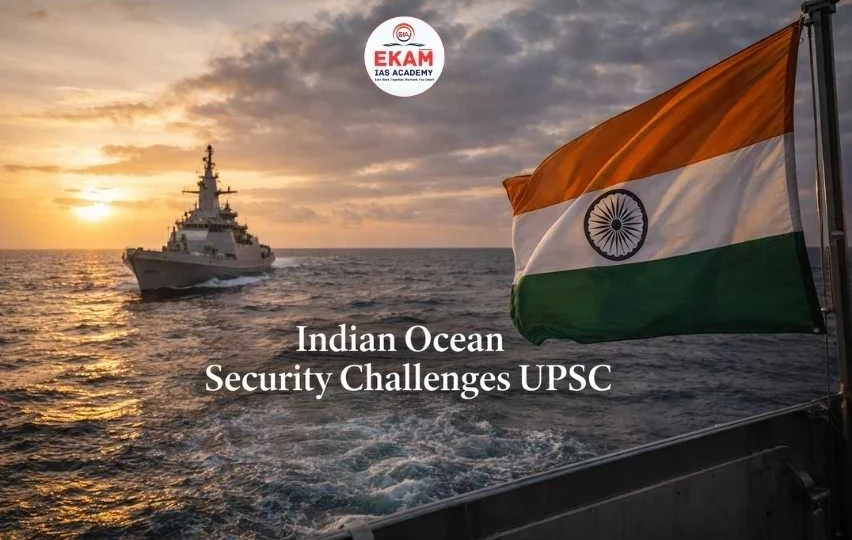
ToggleThe Indian Ocean Region (IOR), often described as the “center of gravity” of the 21st century, is no longer just a transit zone but a primary theater of global power competition. Spanning over 70 million sq. km, it is home to 2.7 billion people. For India, maintaining Indian Ocean security challenges UPSC remains a top priority to ensure regional stability and economic sovereignty.
Strategic Significance
The IOR is the world’s pre-eminent energy and trade corridor.
- Global Trade Hub: It facilitates 70% of global container traffic and 80% of the world’s seaborne oil trade.
- Choke Points: It contains vital maritime arteries like the Strait of Hormuz, Bab-el-Mandeb, and the Strait of Malacca.
- Indo-Pacific Linkage: As a key component of the Indo-Pacific geopolitics, it bridges the Western Pacific and the Atlantic.
Key Security Challenges
The region faces a mix of traditional and non-traditional threats:
- Maritime Terrorism & Piracy: Resurgence of Somali piracy (e.g., the 2024 MV Ruen incident) and risks of sea-borne terror attacks similar to 26/11.
- Illegal, Unreported, and Unregulated (IUU) Fishing: Large-scale poaching, primarily by Chinese trawlers, depletes marine resources.
- Narcotics & Arms Smuggling: The “Golden Crescent” and “Golden Triangle” routes fuel organized crime and insurgency.
- Climate Change: Rising sea levels threaten the existence of island nations like the Maldives and Seychelles.
Role of Major Players
- China: The “String of Pearls” strategy and the development of the Blue Water Navy signal Beijing’s intent to dominate the IOR.
- USA: Maintains a massive presence via the Diego Garcia base and seeks a “Free and Open Indo-Pacific.”
- Extra-Regional Powers: France, UK, and Japan are increasingly active through maritime surveillance and joint exercises.
India’s Interests in the Region
- Trade Security: Over 90% of India’s trade by volume passes through the IOR.
- Energy Security: India depends on this region for nearly 80% of its crude oil imports.
- Strategic Autonomy: Preventing the hegemony of any single power to maintain India’s role as a Net Security Provider.
India’s Initiatives
India has moved from a “passive observer” to an “active leader”:
- SAGAR Policy UPSC: Standing for “Security and Growth for All in the Region,” it is India’s vision for cooperative maritime security.
- Project Mausam: A cultural and strategic initiative to reconnect with IOR countries.
- IFC-IOR: The Information Fusion Centre – Indian Ocean Region (Gurugram) shares real-time data on white shipping with partner nations.
- Indo-Pacific Oceans Initiative (IPOI): Focused on maritime ecology, resources, and disaster risk reduction.
Recent Developments
- India has moved from a “passive observer” to an “active leader”:
- SAGAR Policy UPSC: Standing for “Security and Growth for All in the Region,” it is India’s vision for cooperative maritime security.
- Project Mausam: A cultural and strategic initiative to reconnect with IOR countries.
- IFC-IOR: The Information Fusion Centre – Indian Ocean Region (Gurugram) shares real-time data on white shipping with partner nations.
- Indo-Pacific Oceans Initiative (IPOI): Focused on maritime ecology, resources, and disaster risk reduction.
Challenges for India
- China’s “Debt-Trap Diplomacy”: Countries like Sri Lanka (Hambantota) and Pakistan (Gwadar) are increasingly under Chinese leverage.
- Limited Budget: The naval budget as a percentage of defense spending remains lower than that of major competitors.
- Technological Gaps: Need for better undersea domain awareness and drone surveillance.
Way Forward
- Strengthening Quad: Enhancing the Quadrilateral Security Dialogue for maritime domain awareness.
- Naval Modernization: Accelerating the construction of indigenous aircraft carriers and nuclear submarines.
- Blue Economy: Promoting sustainable ocean development to build economic resilience among littoral states.
Conclusion
The Indian Ocean is the pivot of India’s global ambitions. To navigate the complex Indian Ocean geopolitics, India must balance its military readiness with robust diplomatic engagement. Through the SAGAR policy UPSC, India can lead the region toward a future defined by collective security and shared prosperity.
UPSC Prelims: PYQs & Practice Questions
Previous Year Questions (Prelims)
Q1. [UPSC Prelims 2015]
Q: With reference to 'Indian Ocean Rim Association for Regional Cooperation (IORA)', consider the following statements:
1. It was established very recently in response to incidents of piracy and accidents of oil spills.
2. It is an alliance meant for maritime security only.
Which of the statements given above is/are correct?
(a) 1 only
(b) 2 only
(c) Both 1 and 2
(d) Neither 1 nor 2
Answer: (d) Neither 1 nor 2
Explanation:
Statement 1 is incorrect because IORA was established in 1997, not recently. Statement 2 is also incorrect because IORA is not limited to maritime security alone; it covers a much wider agenda including trade, investment, fisheries, disaster management, and regional cooperation in the Indian Ocean region.
Q2.
Q: Which of the following is the most appropriate description of 'SAGAR', a term frequently used in India’s maritime diplomacy?
(a) A deep-sea mining mission in the Central Indian Ocean
(b) A bilateral naval exercise between India and South African nations
(c) A strategic vision for "Security and Growth for All in the Region."
(d) A new radar system for tracking Chinese submarines in the IOR
Answer: (c) A strategic vision for "Security and Growth for All in the Region."
Explanation:
SAGAR stands for "Security and Growth for All in the Region." It is India’s maritime policy vision announced in 2015 to strengthen economic cooperation, maritime security, and regional partnership with countries in the Indian Ocean Region.
Practice Questions
Q: In the context of IOR security, the 'Information Fusion Centre - Indian Ocean Region' (IFC-IOR) is located in:
(a) Mumbai
(b) Kochi
(c) Vishakhapatnam
(d) Gurugram
Answer: (d) Gurugram
Explanation:
The IFC-IOR was established by the Indian Navy in 2018 at Gurugram to strengthen maritime domain awareness in the Indian Ocean Region. It tracks commercial shipping movements and shares white shipping information with partner countries, thereby improving regional maritime security cooperation.
UPSC Mains – Previous Year & Practice Questions
Mains Previous Year Questions
Q1. [UPSC CSE Mains 2014]
Question: With respect to the South China Sea, maritime territorial disputes and rising tension affirm the need for safeguarding maritime security to ensure freedom of navigation and overflight throughout the region. In this context, discuss the bilateral issues between India and China.
Q2. [UPSC CSE Mains 2016]
Question: Evaluate the economic and strategic dimensions of India’s Look East Policy in the context of the post-Cold War international scenario.
Q3. [UPSC CSE Mains 2023]
Question: Discuss the strategic importance of the Indo-Pacific region for India, particularly in the context of maritime security and the Act East Policy.
Q4. [UPSC CSE Mains 2021]
Question: The newly tri-nation partnership AUKUS is aimed at countering China’s ambitions in the Indo-Pacific region. Is it going to supersede the existing partnerships in the region? Discuss.
Q5. [UPSC CSE Mains 2013]
Question: What do you understand by 'The String of Pearls'? How does it impact India? Briefly outline the steps taken by India to counter this.
Mains Practice Questions
Q1. [15 Marks | 250 Words]
Question: "The resurgence of piracy in the Western Indian Ocean and the Red Sea crisis highlight that non-traditional security threats are as potent as traditional ones." Comment.
Q2. [10 Marks | 150 Words]
Question: Explain the significance of Maritime Domain Awareness (MDA) for India and the role of the IFC-IOR in achieving this objective.
Q3. [15 Marks | 250 Words]
Question: To what extent can India's SAGAR policy act as a counterweight to China’s Maritime Silk Road (MSR) initiative in the Indian Ocean?
Indian Ocean Region-fAQs
What is the 'String of Pearls'?
It is a strategic concept describing a network of Chinese military and commercial facilities along its sea lines of communication, extending from the Chinese mainland to Port Sudan. Notable “pearls” include Gwadar (Pakistan), Hambantota (Sri Lanka), and Djibouti.
How does 'Operation Sankalp' relate to IOR security?
Launched by the Indian Navy in 2019, it is a maritime security operation to ensure the safe passage of Indian-flagged vessels through the Strait of Hormuz and the Gulf of Oman amidst regional tensions.
What are 'Choke Points' in the Indian Ocean?
These are narrow channels through which significant volumes of global trade pass. The primary ones in the IOR are the Strait of Malacca, Strait of Hormuz, and Bab-el-Mandeb. Any disruption here impacts global energy prices.
What is India's 'Necklace of Diamonds' strategy?
This is India’s strategic counter-move to China’s ‘String of Pearls’. It involves developing naval access and strategic bases in countries like Oman (Duqm), Seychelles (Assumption Island), Mauritius (Agalega), and Indonesia (Sabang).
Why is the 'Blue Economy' important for IOR security?
A secure maritime environment is a prerequisite for the Blue Economy (sustainable use of ocean resources). Without security against piracy and IUU (Illegal, Unreported, and Unregulated) fishing, the economic potential of the IOR cannot be realized.