Table of Contents
ToggleThe Civil Services Preliminary Examination conducted by the Union Public Service Commission (UPSC) is widely considered one of the most competitive objective examinations in India. Over the last decade, the nature of questions in the Prelims stage has evolved significantly. Understanding the trends of the last ten years is extremely important for aspirants because it helps identify the changing focus areas, conceptual depth, and strategic approach required to clear the examination.
For aspirants preparing through structured programs such as UPSC coaching in Hyderabad, analysis of previous question papers is a core part of the preparation strategy. The last ten years clearly demonstrate that UPSC has shifted from purely factual questions to analytical and application-based questions.
Understanding the UPSC Prelims Structure
The Preliminary Examination consists of two papers:
- General Studies Paper I
- CSAT (Civil Services Aptitude Test)
General Studies Paper I determines the cutoff and final selection for the Mains stage. The syllabus covers topics such as history, geography, polity, economy, environment, science and technology, and current affairs.
Aspirants enrolled in programs offered by institutes providing IAS Coaching in Hyderabad are often trained to analyze previous year questions to understand question framing patterns and priority areas.
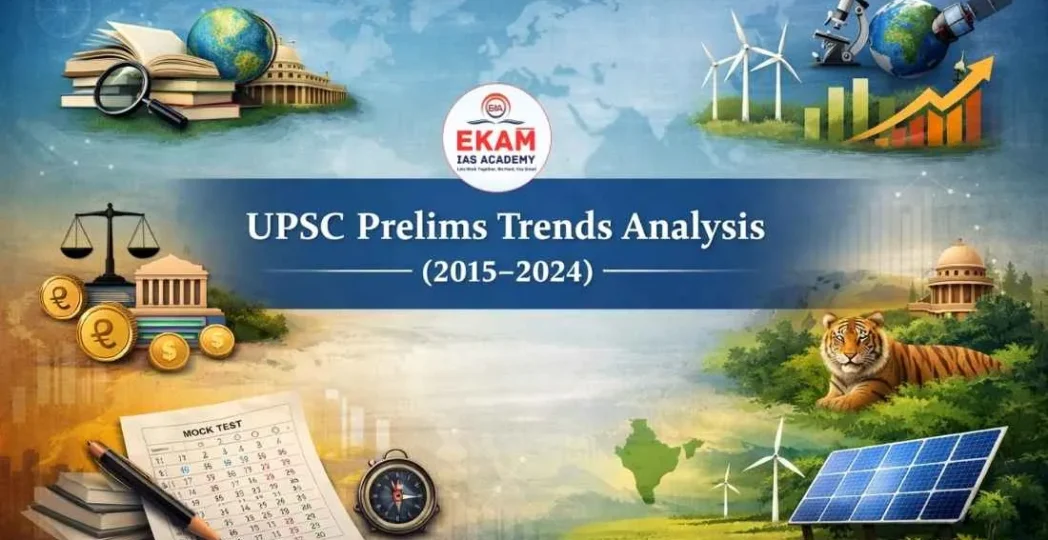
Overview of UPSC Prelims Trends (2015–2024)
Increasing Analytical Depth
Over the last decade, UPSC has gradually reduced direct factual questions and increased conceptual questions. Questions now test an aspirant’s ability to connect static knowledge with current developments.
For example, environment-related questions often require linking ecological concepts with contemporary conservation policies.
Subject-Wise Analysis of Last 10 Years
Polity
Polity has remained a consistent component of the Prelims examination. However, the pattern has changed significantly.
Earlier questions focused on constitutional articles and institutional structures. In recent years, questions have become more conceptual, focusing on governance mechanisms, constitutional interpretation, and legislative procedures.
Key areas frequently tested include:
- Parliamentary procedures
- Constitutional bodies
- Federal structure
- Fundamental rights and duties
Institutes recognized among the Best IAS Academy in Hyderabad often emphasize strong conceptual clarity in polity to handle complex question framing.
Economy
Economic questions have become increasingly analytical. Earlier questions focused on definitions such as inflation or GDP. Recent papers test deeper understanding of economic policies and government schemes.
Important themes include:
- Monetary policy and banking
- Budget and fiscal policy
- Financial inclusion programs
- International economic institutions
Many questions combine theoretical understanding with contemporary developments.
Environment and Ecology
Environment has emerged as one of the most dynamic sections over the past decade. Questions frequently appear on:
- Biodiversity conventions
- Conservation initiatives
- Climate change mechanisms
- National parks and wildlife reserves
UPSC increasingly asks questions linking international environmental agreements with Indian conservation policies.
Geography
Geography questions have shifted from purely physical geography to applied geography. Recent papers include questions related to:
- Ocean currents
- Climate systems
- Agricultural geography
- Resource distribution
Maps, conceptual diagrams, and geographic processes are becoming more relevant for answering these questions.
History
History questions are still asked every year, but the pattern has evolved. Instead of direct factual questions, UPSC increasingly focuses on conceptual understanding of historical movements and their socio-political implications.
Major areas include:
- Modern Indian history
- Freedom struggle phases
- Cultural history
- Art and architecture
Ancient and medieval history questions appear but are fewer compared to modern history.
Science and Technology
Science questions have moved away from basic textbook facts toward application-oriented topics such as:
- Biotechnology
- Space technology
- Artificial intelligence
- Health technologies
Many questions are inspired by contemporary developments and government initiatives.
Current Affairs Integration
Perhaps the most significant pattern change in the last decade is the integration of current affairs with static subjects.
For example:
- A biodiversity question may combine ecological theory with a recent conservation initiative.
- An economy question may link a government scheme with macroeconomic concepts.
This integrated approach requires aspirants to study static concepts alongside contemporary developments.

Pattern Changes Observed Over the Last Decade
Shift from Direct Facts to Conceptual Questions
Earlier papers included straightforward factual questions. Now, most questions require conceptual clarity and elimination techniques.
Increase in Multi-Statement Questions
UPSC frequently uses multiple statements where aspirants must identify correct combinations. These questions test analytical reasoning rather than memorization.
Greater Emphasis on Interdisciplinary Thinking
Many questions now combine knowledge from multiple subjects such as environment, geography, and economics.
Higher Difficulty Level
The overall difficulty level has increased, making intelligent guessing and elimination strategies essential.
Institutes recognized among Top UPSC Coaching in Hyderabad often train aspirants to develop elimination techniques to handle such complex questions.
Importance of Previous Year Question Analysis
Analyzing past question papers helps aspirants:
- Identify recurring themes
- Understand exam difficulty level
- Improve elimination techniques
- Focus on high-weightage topics
This analysis is a core part of structured courses offered by many institutes.
Role of Mock Tests in Understanding Pattern Changes
Mock tests simulate real exam conditions and incorporate evolving patterns. Aspirants who regularly attempt mock tests gain familiarity with the nature of UPSC questions.
Working professionals attending weekend batches particularly benefit from structured mock tests that combine learning with evaluation.
Optional Subjects and Their Indirect Role
Although optional subjects are part of the Mains stage, conceptual clarity from optional subjects sometimes strengthens Prelims performance.
For instance:
- Geography optional helps with environment and climate questions.
- Political Science optional supports polity and international relations understanding.
Strong conceptual foundations across subjects enhance analytical ability.
Ekam IAS Academy Approach to Prelims Analysis
At Ekam IAS Academy, previous year question analysis forms an essential part of academic preparation. The academy emphasizes:
- Detailed explanation of past question trends
- Topic-wise mapping of previous year questions
- Conceptual learning instead of rote memorization
- Integrated current affairs linkage
Through structured guidance and focused mentoring, the academy helps aspirants understand evolving examination patterns and adapt their preparation accordingly.
This analytical approach ensures that students prepare strategically rather than relying on guesswork or random study methods.
Conclusion
The last ten years of UPSC Prelims papers reveal a clear shift toward conceptual understanding, analytical reasoning, and interdisciplinary knowledge. Aspirants can no longer rely solely on memorization; they must develop strong conceptual clarity and strategic thinking.
Studying previous year questions is one of the most effective ways to understand the examination pattern. When combined with consistent revision, mock testing, and structured guidance, it significantly improves an aspirant’s chances of clearing the Preliminary stage.
Understanding trends is not about predicting questions—it is about preparing intelligently for the unpredictable nature of the UPSC examination.
Last 10 Years UPSC Prelims Question Papers Analysis Along with Pattern Changes-FAQs Answered
How should I analyze UPSC Prelims previous year question papers?
To analyze UPSC Prelims previous year question papers, aspirants should identify frequently asked topics, understand question patterns, and observe how static subjects are linked with current affairs.
What are the major pattern changes in UPSC Prelims in the last 10 years?
Major pattern changes in UPSC Prelims include more conceptual questions, multi-statement formats, interdisciplinary topics, and a stronger focus on current affairs integration.
How important is UPSC Prelims question paper analysis for preparation?
UPSC Prelims question paper analysis helps aspirants understand exam trends, focus on high-weightage topics, and develop elimination techniques for objective questions.
Do coaching institutes teach UPSC Prelims exam pattern analysis?
Yes, many institutes offering UPSC coaching in Hyderabad provide detailed UPSC Prelims exam pattern analysis through classroom discussions and test series.
How many previous year questions for UPSC Prelims should I practice?
Aspirants should practice at least the last 10–15 years of UPSC Prelims previous year questions to understand the evolving difficulty level and question framing style.