
Table of Contents
TogglePUNJAB BORDER FENCE SHIFT
This topic is part of Daily Current Affairs – 22 January 2026
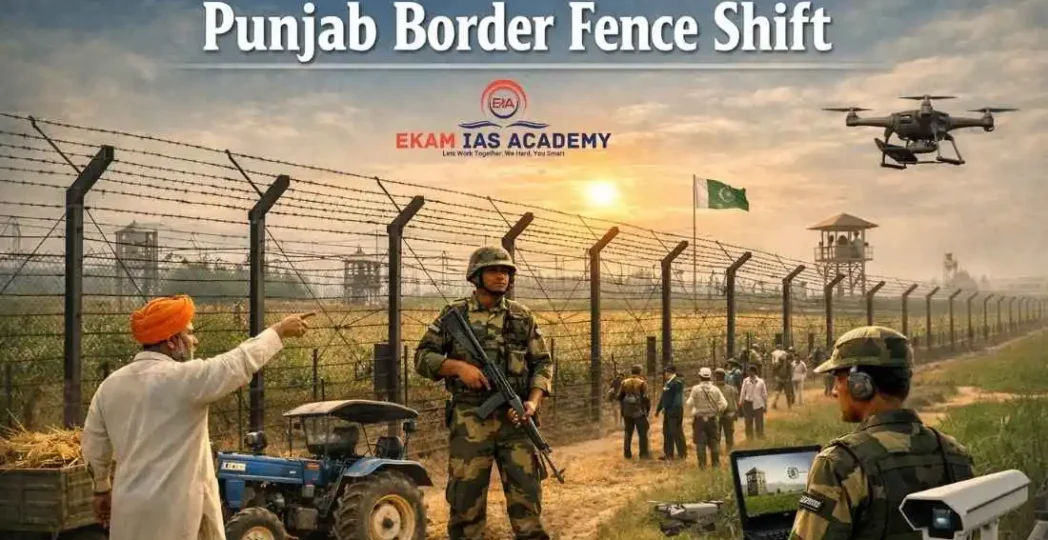
The Punjab Chief Minister announced that the Centre has agreed in principle to move the India–Pakistan border fence closer to the international boundary, potentially restoring access to farmland currently trapped between the fence and the border.
Punjab Border Fence
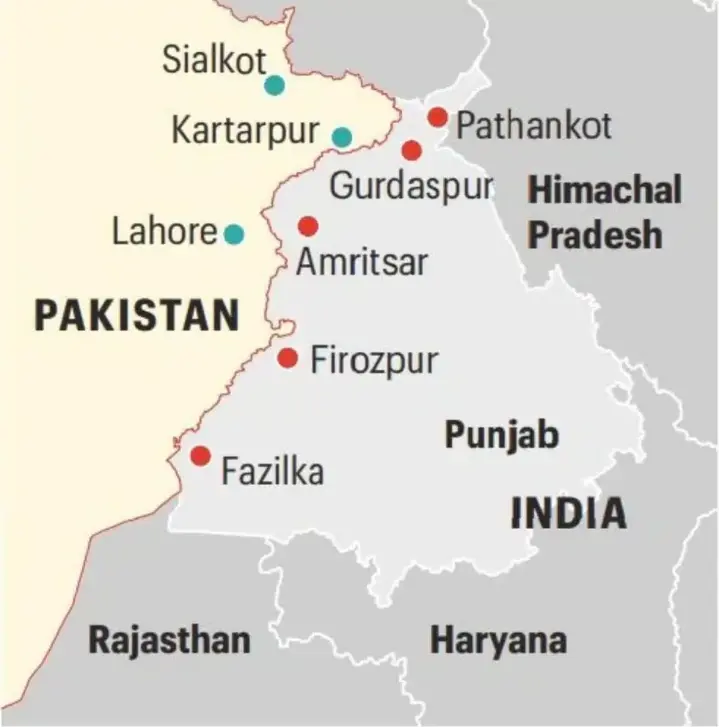
- Punjab shares a 532-km border with Pakistan.
- The barbed-wire fence, built in 1988 during militancy, lies several feet to 2 km inside Indian territory due to terrain.
- Purpose: Prevent infiltration, militancy, and drug smuggling.
- Farmers initially did not protest, but later formed the Border Area Sangharsh Committee (1992) to raise concerns.
Farmers’ Concerns
- Around 21,500 acres of private land and 10,000 acres of government land lie beyond the fence.
- Farmers face restrictions:
- Gates open only for limited hours.
- Caps on number of people and tractors allowed.
- Each tractor escorted by BSF Kisan Guards, slowing work.
- Result: Delays in cultivation, crop transport, and machinery use.
- Farmers demand fence relocation to ease farming access.
Kapoor Committee & Compensation
- Formed in 1986, headed by Chief Secretary S.L. Kapoor.
- Recommended compensation for affected farmers.
- In 1988, an inconvenience allowance of ₹2,500 per acre was introduced.
- Farmers claim payments have been irregular and inconsistent.
Changing Security Context
- Farmers argue that modern surveillance, drones, and defence resources make the current fence alignment outdated.
- They believe shifting the fence closer to the border would not compromise security.
- Improved technology can balance border safety and farming rights.
Why Fence Has Not Been Shifted
- BSF cites practical hurdles: Fence is nearly 40 years old and in poor condition.
- Relocation requires dismantling and rebuilding with new barbed wire.
- Farmers remain sceptical, noting similar promises during elections (e.g., 2023) that were never implemented.
Conclusion
The Punjab border fence issue reflects the tension between national security and farmers’ livelihood. While relocation could ease cultivation for thousands of farmers, administrative hurdles and security concerns have delayed action. The final decision will need to balance border safety with socio-economic justice for border communities.
PUNJAB BORDER FENCE SHIFT - FAQs
What is the Punjab border fence issue?
The Punjab border fence issue relates to the barbed-wire fence along the India–Pakistan border being placed inside Indian territory, restricting farmers’ access to their land.
Why are farmers demanding the Punjab border fence shift?
Farmers want the border fence shifted closer to the international boundary as thousands of acres of farmland lie beyond the fence, causing delays and restrictions in cultivation.
How much land is affected by the Punjab border fence?
Around 21,500 acres of private land and 10,000 acres of government land in Punjab are trapped between the fence and the international border.
What security concerns are linked to shifting the border fence?
The Border Security Force cites infiltration, smuggling, and militancy risks, though farmers argue modern surveillance and drones can manage security.
What compensation is given to farmers affected by the border fence?
An inconvenience allowance of ₹2,500 per acre was recommended, but farmers report irregular and inconsistent payments over the years.