Table of Contents
ToggleSources of Information about the Interior
Since humans cannot reach the center of the Earth (the deepest drill at Kola Peninsula is only about 12 km), we rely on Direct and Indirect sources.
Direct Sources
- Mining and Drilling: Deep gold mines and oceanic drilling projects provide rock samples from limited depths.
- Volcanic Eruptions: When magma reaches the surface as lava, it provides a direct look at the molten material within the Mantle.
Indirect Sources
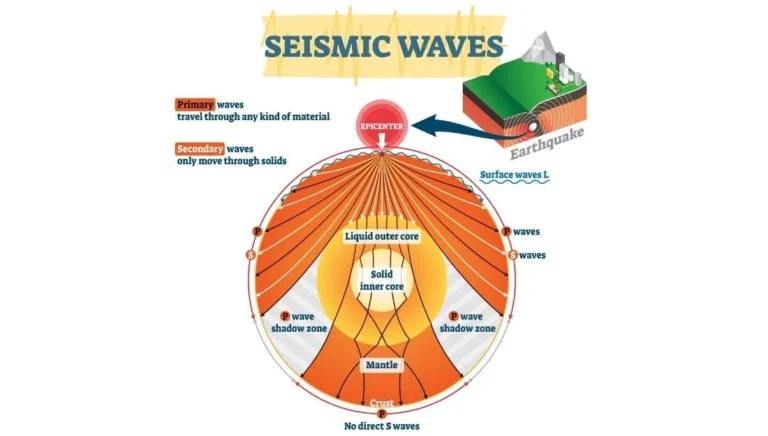
- Seismic Activity: The study of Seismic Waves (P-waves and S-waves) is the most important source. Their changes in velocity and direction reveal the density and state (solid/liquid) of the internal layers.
- Meteors: Since they are made of materials similar to the Earth’s primordial matter, they offer clues about our planet’s composition.
- Gravitation, Magnetic Field, and Temperature: Variations in these factors help in identifying the distribution of mass and metallic content within.
The Layered Structure: Chemical Composition
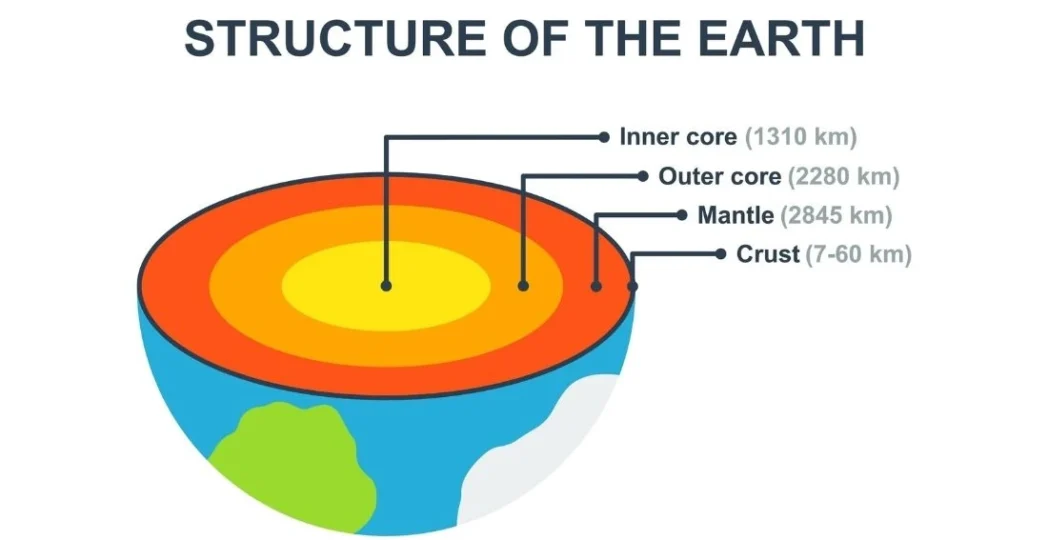
Based on chemical characteristics (Sess, 1885), the Earth is divided into three primary layers: SiAl, SiMa, and NiFe.
The Crust (SiAl)
- The outermost solid part, varying in thickness from 5 km (oceanic) to 70 km (mountainous).
- Continental Crust is composed mainly of Silica and Aluminium (SiAl), while Oceanic Crust is made of Silica and Magnesium (SiMa).
- Conrad Discontinuity separates the upper and lower crust.
The Mantle (SiMa)
- Extends from the base of the crust to a depth of 2,900 km.
- Mohorovicic Discontinuity (Moho) marks the boundary between the Crust and the Mantle.
- Asthenosphere: The upper portion of the mantle (up to 400 km) is in a semi-solid (plastic) state. It is the main source of magma.
- Repetti Discontinuity separates the upper and lower mantle.
The Core (NiFe)
- The innermost layer, composed primarily of Nickel and Iron (NiFe).
- Gutenberg Discontinuity separates the Mantle from the Core.
- Outer Core: In a liquid state, responsible for the Earth’s Magnetic Field.
- Inner Core: In a solid state due to extreme pressure, despite the high temperature.
- Lehmann Discontinuity separates the outer and inner core.
Mechanical Divisions: Physical State
Modern geography also classifies the interior based on mechanical properties:
Lithosphere: The brittle outermost layer (0–100 km) comprising the Crust and the rigid uppermost part of the Mantle.
Barysphere: Often used to refer to the core or the entire interior beneath the lithosphere.
Seismic Waves and Shadow Zones
Understanding how Earthquake waves travel is vital for UPSC Prelims.
- P-waves (Primary): Longitudinal waves that travel through solid, liquid, and gas. They travel fastest through high-density solids.
- S-waves (Secondary): Transverse waves that can only travel through solids. Their disappearance at the core boundary proves the Outer Core is liquid.
- Shadow Zones: Regions where seismic waves are not detected. The S-wave Shadow Zone is much larger than the P-wave Shadow Zone, covering everything beyond 103° from the epicenter.
Crucial Geological Concepts for UPSC
- Density Gradient: Density increases from the Crust (~2.7 g/cm³) to the Inner Core (~13 g/cm³).
- Temperature Gradient: Temperature increases with depth, but the rate of increase decreases as we go deeper.
- Geomagnetism: The convection currents in the liquid iron of the Outer Core create the Earth’s Magnetosphere.
Summary Table for Discontinuities
| Boundary | Separates |
| Conrad | Upper and Lower Crust |
| Mohorovicic (Moho) | Crust and Mantle |
| Repetti | Upper and Lower Mantle |
| Gutenberg | Mantle and Core |
| Lehmann | Outer and Inner Core |
UPSC Prelims: PYQs & Practice Questions
Previous Year Questions (Prelims)
Question 1 (2013)
Q: Which of the following are responsible for bringing dynamic changes on the surface of the Earth?
1. Electromagnetic radiation
2. Geothermal energy
3. Gravitational force
4. Plate movements
5. Rotation of the Earth
6. Revolution of the Earth
Select the correct answer:
(a) 1, 2, 3 and 4 only
(b) 1, 3, 5 and 6 only
(c) 2, 4, 5 and 6 only
(d) 1, 2, 3, 4 and 5 only
Answer: (d)
Explanation: Electromagnetic radiation drives climatic processes, geothermal energy fuels internal heat, gravitational force drives tides and mass movements, plate movements cause tectonic activity, and Earth’s rotation influences atmospheric and oceanic circulation. Revolution mainly governs seasonal variation and does not directly cause geomorphic dynamic changes.
Question 2
Q: Which of the following is/are the direct source(s) of information about the interior of the Earth?
1. Deep ocean drilling
2. Volcanic eruptions
3. Seismic wave analysis
4. Meteorites
Select the correct answer:
(a) 1 and 2 only
(b) 2 and 3 only
(c) 1, 2 and 4 only
(d) 1, 2, 3 and 4
Answer: (a)
Explanation: Deep ocean drilling and volcanic eruptions provide direct evidence because materials from beneath the surface are physically examined. Seismic waves and meteorites provide indirect evidence, as their interpretation requires inference and scientific modeling.
Practice Questions (Prelims)
Question 1
Q: Consider the following statements regarding Seismic Waves:
1. P-waves travel through solid, liquid, and gaseous materials.
2. S-waves can only travel through solid materials.
3. The velocity of seismic waves decreases as the density of the material increases.
Which of the statements given above is/are correct?
(a) 1 and 2 only
(b) 2 and 3 only
(c) 1 and 3 only
(d) 1, 2, and 3
Answer: (a)
Explanation: P-waves (Primary waves) can travel through solids, liquids, and gases, while S-waves (Secondary waves) travel only through solids. Statement 3 is incorrect because seismic wave velocity generally increases with density and rigidity, which is why waves travel faster in the mantle than in the crust.
Question 2
Q: Match the following Discontinuities with the layers they separate:
A. Mohorovicic — 1. Outer Core and Inner Core
B. Gutenberg — 2. Crust and Mantle
C. Lehmann — 3. Mantle and Core
Select the correct code:
(a) A-2, B-3, C-1
(b) A-3, B-2, C-1
(c) A-2, B-1, C-3
(d) A-1, B-2, C-3
Answer: (a)
Explanation: The Mohorovicic (Moho) discontinuity separates the Crust and Mantle. The Gutenberg discontinuity separates the Mantle and Core. The Lehmann discontinuity separates the Outer Core and Inner Core.
UPSC Mains – Previous Year & Practice Questions
Mains Standard Questions
Seismic Waves and Interior of the Earth
Question: "The study of seismic waves is the most significant indirect source to understand the interior of the Earth." Elaborate. (150 words)
Asthenosphere and Plate Tectonics
Question: Describe the chemical and physical characteristics of the Asthenosphere and its role in plate tectonics. (150 words)
Continental Crust vs Oceanic Crust
Question: Compare and contrast the composition of the Continental Crust (SiAl) and the Oceanic Crust (SiMa). (150 words)
Shadow Zone of Seismic Waves
Question: Explain the 'Shadow Zone' of P-waves and S-waves and what they reveal about the state of the Earth's Core. (250 words)
Earth’s Magnetic Field and Dynamo Theory
Question: Discuss the Earth’s Magnetic Field and the role of the Outer Core in its generation (Dynamo Theory). (250 words)
Mains Practice Questions
Geothermal Gradient & Volcanic Activity
Question: How does the 'Geothermal Gradient' vary from the surface to the center of the Earth? Discuss its implications for volcanic activity. (250 words)
Discontinuities in Earth’s Interior
Question: "Discontinuities within the Earth's interior are markers of abrupt changes in density and physical state." Analyze. (250 words)
Meteorites & Earth’s Primordial Composition
Question: Analyze the importance of meteorites as an indirect source of information for understanding the Earth’s primordial composition. (150 words)
The Interior of the Earth: A Comprehensive UPSC Guide - FAQs
Why is the Inner Core solid despite having a higher temperature than the Outer Core?
While the temperature is high enough to melt iron, the extreme pressure at the center of the Earth forces the atoms into a tightly packed solid state, preventing them from becoming liquid.
What is the 'Moho' Discontinuity?
Named after Andrija Mohorovicic, it is the boundary between the Crust and the Mantle. It is identified by a sudden increase in the velocity of seismic waves, indicating a change to denser rocks.
What is the Lithosphere?
The Lithosphere is the rigid, outermost shell of Earth. It includes the Crust and the very uppermost part of the Mantle. It is broken into several tectonic plates.
How do we know the Outer Core is liquid?
Because S-waves (Secondary waves) cannot travel through liquids and they disappear completely at the Gutenberg Discontinuity, creating a massive Shadow Zone. This proves the material beyond the mantle is not solid.
What are 'SiAl' and 'SiMa'?
These are chemical abbreviations. SiAl (Silica and Aluminium) makes up the lighter Continental Crust. SiMa (Silica and Magnesium) makes up the denser Oceanic Crust and the upper mantle.