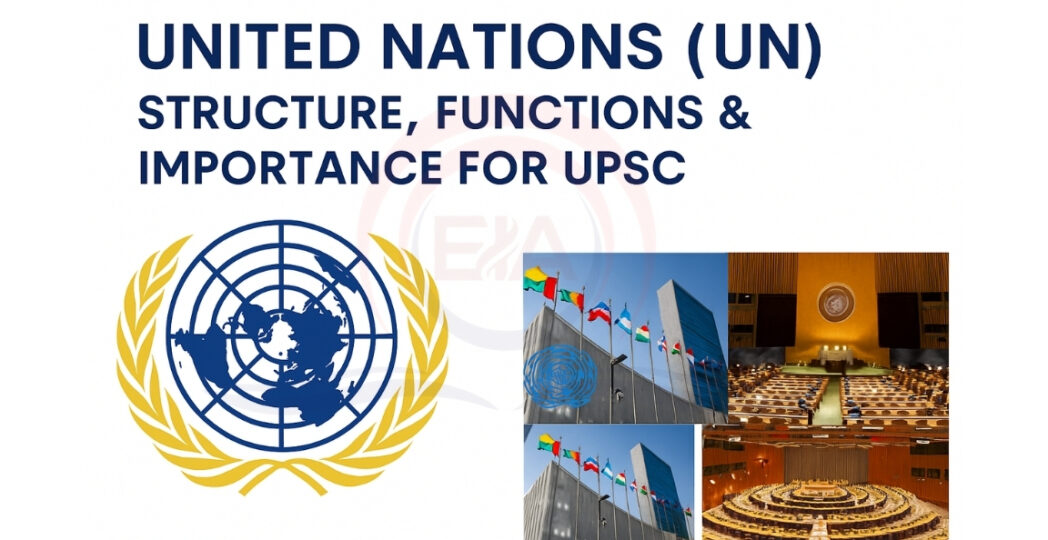
The United Nations (UN) is the world’s largest and most influential intergovernmental organization, playing a vital role in global peace, diplomacy, sustainable development, and humanitarian affairs. It is a core topic for UPSC Prelims and Mains, especially in International Relations, Governance, and Current Affairs.
Background and Formation of the United Nations
After the devastation caused by World War II, global leaders realized the necessity of a more effective international body than the League of Nations, which had failed to prevent global conflict.
- San Francisco Conference: 25 April 1945 – 50 nations met to draft the UN Charter.
- Charter Adoption: 25 June 1945.
- Came into Effect: 24 October 1945 (celebrated as UN Day).
- Original Members: 51
- Current Members (as of 2024): 193 countries
Objectives of the United Nations
According to its Charter, the UN is committed to:
- Maintaining international peace and security.
- Promoting human rights and dignity.
- Providing humanitarian aid during crises.
- Encouraging sustainable development.
- Upholding international law and justice.
Principal Organs of the United Nations
The UN operates through six principal organs, each with specific responsibilities. Here’s a breakdown:
| Organ | Primary Function | Key Tasks / Powers |
|---|---|---|
| General Assembly (UNGA) | Deliberative organ with representation from all 193 member states |
• Makes recommendations • Approves the UN budget • Elects UNSC, ECOSOC, ICJ judges • Admits new members • One vote per country |
| Security Council (UNSC) | Maintains international peace and security |
• Binding resolutions • Sanctions / military action • 15 members (5 permanent with veto) • Recommends Secretary-General |
| ECOSOC | Coordinates economic & social efforts |
• Coordinates UN agencies • Promotes cooperation • 54 members, 3-year terms |
| ICJ | Judicial organ for international law |
• Settles disputes • Advisory opinions • 15 judges, 9-year terms |
| UN Secretariat | Admin body led by Secretary-General |
• Runs daily operations • Organizes events • Main spokesperson |
| Trusteeship Council | Oversaw transition to independence |
• Suspended in 1994 • Supervised decolonization |
The Secretary-General
- Current (as of 2024): António Guterres (Portugal).
- Term: 5 years (renewable).
- Appointed by: UNGA on the recommendation of the UNSC.
- Role: Chief diplomat, spokesperson, and administrative head of the UN.
United Nations Specialized Agencies (Total: 17)
| Agency | Acronym | Headquarters | Founding Year |
|---|---|---|---|
| Food and Agriculture Organization | FAO | Rome, Italy | 1945 |
| International Telecommunication Union | ITU | Geneva, Switzerland | 1865 (UN: 1947) |
| International Fund for Agricultural Development | IFAD | Rome, Italy | 1977 |
| International Labour Organization | ILO | Geneva, Switzerland | 1946 |
| International Maritime Organization | IMO | London, UK | 1948 |
| International Monetary Fund | IMF | Washington, D.C., USA | 1945 |
| UN Educational, Scientific and Cultural Organization | UNESCO | Paris, France | 1946 |
| World Health Organization | WHO | Geneva, Switzerland | 1948 |
| UN Industrial Development Organization | UNIDO | Vienna, Austria | 1966 |
| International Civil Aviation Organization | ICAO | Montreal, Canada | 1944 |
| World Intellectual Property Organization | WIPO | Geneva, Switzerland | 1967 |
| Universal Postal Union | UPU | Bern, Switzerland | 1874 |
| UN World Tourism Organization | UNWTO | Madrid, Spain | 1974 |
| World Meteorological Organization | WMO | Geneva, Switzerland | 1950 |
| World Bank Group | WBG | Washington, D.C., USA | 1944 |
Important UN Agencies and Programmes (Non-Specialized)
| Agency / Programme | Acronym | Headquarters | Founding Year |
|---|---|---|---|
| United Nations Environment Programme | UNEP | Nairobi, Kenya | 1972 |
| United Nations Children’s Fund | UNICEF | New York, USA | 1946 |
| United Nations Population Fund | UNFPA | New York, USA | 1967 |
| United Nations High Commissioner for Refugees | UNHCR | Geneva, Switzerland | 1950 |
| United Nations Office on Drugs and Crime | UNODC | Vienna, Austria | 1997 |
| UN Interregional Crime and Justice Research Institute | UNICRI | Turin, Italy | 1968 |
| UN Office for Disaster Risk Reduction | UNDRR | Geneva, Switzerland | 1999 |
| United Nations Development Programme | UNDP | New York, USA | 1965 |
| United Nations University | UNU | Tokyo, Japan | 1972 |
| UN Conference on Trade and Development | UNCTAD | Geneva, Switzerland | 1964 |
| International Atomic Energy Agency | IAEA | Vienna, Austria | 1957 |
| UN Human Settlements Programme | UN-Habitat | Nairobi, Kenya | 1978 |
| Joint UN Programme on HIV/AIDS | UNAIDS | Geneva, Switzerland | 1994 |
| World Food Programme | WFP | Rome, Italy | 1961 |
| Office of the High Commissioner for Human Rights | OHCHR | Geneva, Switzerland | 1993 |
Important UN Conventions, Protocols & Related Legal Bodies
| Convention / Treaty / Body | Acronym / Alternate Name |
|---|---|
| United Nations Convention on the Law of the Sea | UNCLOS |
| United Nations Framework Convention on Climate Change | UNFCCC |
| United Nations Convention on Biological Diversity | UNCBD |
| United Nations Convention Against Torture | UNCAT |
| UN Convention on the Rights of Persons with Disabilities | UNCRPD |
| Minamata Convention on Mercury | Minamata Convention |
| Montreal Protocol on Substances that Deplete the Ozone Layer | Montreal Protocol |
| Kigali Amendment to the Montreal Protocol | Kigali Amendment |
| United Nations Convention to Combat Desertification | UNCCD |
| Kyoto Protocol to the UNFCCC | Kyoto Protocol |
| Global Environment Facility | GEF |
| United Nations Conference on Environment and Development | Rio Summit (UNCED) |
| International Tribunal for the Law of the Sea | ITLOS |
| UN Convention on the Rights of the Child | UNCRC |
| UN Convention against Transnational Organized Crime | UNTOC |
| Convention on Elimination of Discrimination Against Women | CEDAW |
Why is the UN Important Today?
- Coordinates global efforts on climate change, health (like WHO), peacekeeping missions, disaster relief, and human rights.
- Has helped end apartheid, fight diseases, and manage conflicts across the globe.
- Plays a key role in implementation of the Sustainable Development Goals (SDGs).
UPSC Relevance
The United Nations and its bodies are important for:
- Prelims: Facts, headquarters, reports, functions of agencies.
- Mains: GS Paper II – International relations, multilateral organizations, India’s role in global governance
- Essay: Topics on global peace, cooperation, and sustainability