Table of Contents
ToggleMauryan art marks the first major use of stone in Indian architecture after the Harappan age. Rooted in indigenous traditions yet influenced by Achaemenid–Persian styles, it reflected imperial grandeur, Buddhist values, and folk traditions.
Features of Mauryan Art
- First large-scale stone architecture in India.
- Use of monolithic polished sandstone.
- Influence of Achaemenid (Persian) styles (polish, animal capitals, stambha design).
- Indigenous elements: yaksha–yakshini figures, stupas, pottery.
- Patronage mainly under Ashoka (273–232 BCE).
Palaces & Secular Architecture Pataliputra — Kumhrar
- Kumhrar is the main excavation area for ancient Pataliputra (the Mauryan capital). Archaeology here reveals continuous occupation from ca. 600 BCE to later periods.
- Assembly (Hypostyle) Hall of 80 pillars (the famous “Eighty-Pillar Hall” / royal assembly building):
- Excavations found 72 pits originally and later 8 more, giving the name “80-pillared hall.” The pillars were arranged in 8 rows × 10 columns.
- Pillar specs (excavation data): each pillar was made of black-spotted buff sandstone monoliths, about 9.75 m in total height (≈ 2.74 m below ground for grounding). The inter-pillar spacing is recorded at ~4.57 m. It’s generally thought the pillars supported a wooden roof (no surviving stone roof), making it an open hypostyle hall.
- South of the hall archaeologists found wooden platforms — interpreted as stair/platforms leading to the nearby canal, used to receive guests arriving by boat. Some scholars suggest the hall was a pleasure/assembly hall outside the palisaded city; others link it to events like the Third Buddhist Council (the latter remains debated)
- Wooden palisades and other Pataliputra remains: nearby Bulandi Bagh shows traces of the famous wooden stockade/palisade of Pataliputra mentioned by ancient writers. Kumhrar and Bulandi Bagh together map the Mauryan urban plan
- Arogya Vihar (at Kumhrar): excavations also uncovered remains identified as Arogya Vihar — a monastery-cum-hospital (later date, generally dated to post-Mauryan / Gupta period by archaeologists) — identified on the basis of a terracotta seal reading “Sri Arogya Vihare Bhikshu Sanghasya” and inscribed potsherds (mention of “Dhanvantari”). So while Kumhrar preserves Mauryan layers (80-pillar hall), it also contains later Gupta/Gupta-era structures like Arogya Vihar.
Pillars (Stambhas) — material, polish & examples
- Material & finish: Mauryan pillars are typically monolithic sandstone (most quarried near Chunar). They display the famous “Mauryan polish” — a high, mirror-like finish — seen especially on Ashokan pillars and some caves. Form & function: tapering shafts, carved capitals (animals like lion, bull, elephant), and polished shafts; many pillars carry Ashokan edicts (Pillar Edicts) that broadcast dhamma and imperial policy.
Key pillar examples & notes
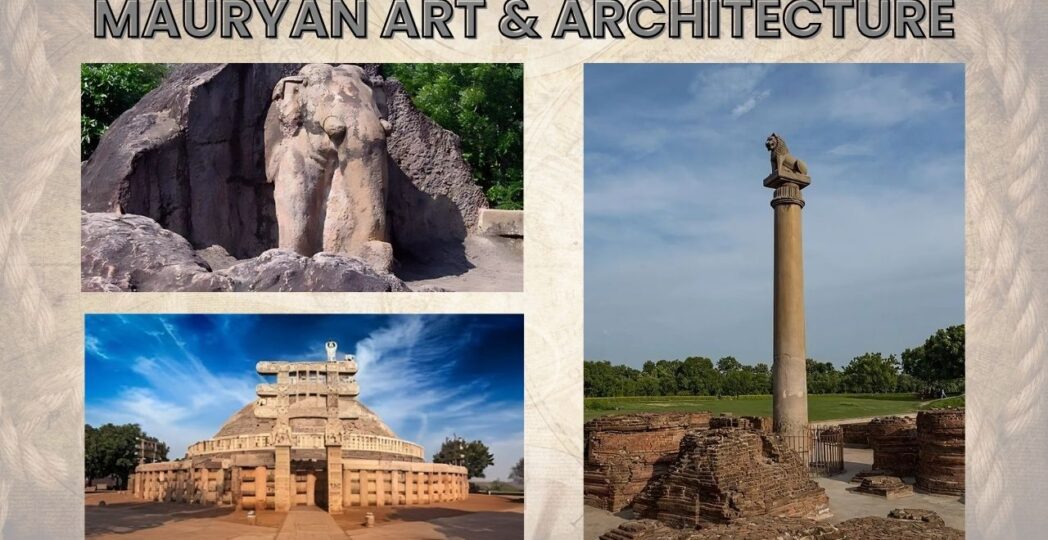
- Sarnath (Lion Capital) — the iconic Ashokan capital: four lions standing back-to-back on a circular abacus carved with the 24-spoked chakra and four animals (horse, bull, lion, elephant) in relief; bell-shaped lotus at base. The Sarnath capital commemorates the Dharmachakra-pravartana (Buddha’s first sermon) and is the model for the State Emblem of India.
- Lauriya Nandangarh (Bihar) — monolithic pillar with bell-shaped capital and circular abacus; polished shaft with multiple edicts (six edicts inscribed); the drum often shows geese motifs and a seated lion capital.
- Rampurva (Bull Capital) — famous Zebu (Indian) bull capital; realistic naturalistic rendering with Persian floral motifs on the base — shows Indian + Achaemenid influences. (Original bull capital is now at Rashtrapati Bhavan).
- Prayag / Allahabad Pillar (Prashasti) — contains Major Pillar Edicts (I–VI) and the Schism Edict; also later inscriptions (Samudragupta, Jahangir), and was crucial to decipherment of Brahmi script.
Stupas
- Ashoka built 84,000 stupas (tradition).
- Main stupas:
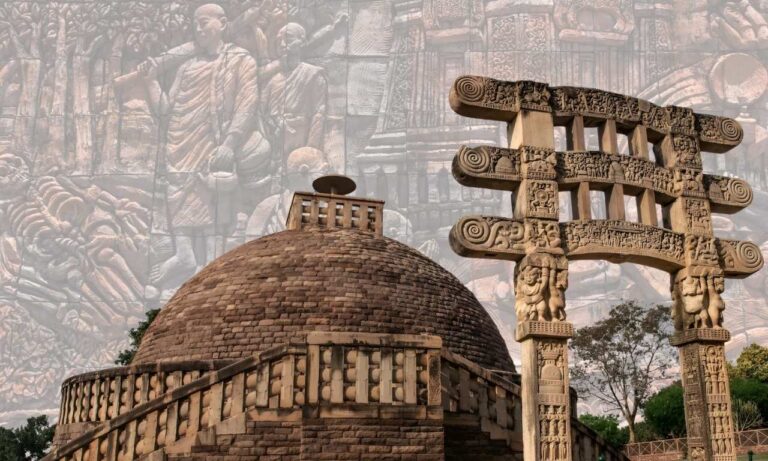
- Sanchi (Madhya Pradesh):
- Original brick stupa by Ashoka; later enlarged with stone facing.
- Hemispherical dome, harmika (square railing), central mast with chhatras (umbrellas).
- Later Shunga/Satavahana periods added elaborate gateways (toranas) with Jataka scenes.
- Bharhut (MP):
- Built under Ashoka; railing decorated with reliefs of Jataka tales, yakshas, yakshinis, animals.
- Reliefs are more linear, less naturalistic than Sanchi.
- Dhamek Stupa (Sarnath, UP):
- Commemorates Buddha’s first sermon (Dharmachakra Pravartana).
- Ashoka built original structure; present massive stone-and-brick form is later.
- Dhauli (Odisha):
- Near Kalinga battlefield; stupa + elephant sculpture.
- Rock edicts nearby show Ashoka’s remorse after Kalinga war.
Rock-cut Caves
- Earliest rock-cut architecture in India.
- Polished interiors, imitation of wooden style (arched façade).
- Donated mainly to Ajivika sect by Ashoka & Dasharatha.
- Barabar Hills (Bihar):
- Sudama Cave (Ashoka, 261 BCE): simple, polished chamber with semicircular roof.
- Lomas Rishi Cave: famous for chaitya-arch façade (elephant frieze, imitation of timber huts) → prototype for later Buddhist chaityas.
- Karna Chaupar: with Ashokan inscription.
- Nagarjuni Caves: donated later by Dasharatha; inscriptions record dedication to Ajivikas.
Sculpture
- Yakshas & Yakshinis: popular fertility deities, incorporated into Mauryan art.
- Didarganj Yakshini (Patna):
- 5’4” tall sandstone statue.
- Exquisite Mauryan polish.
- Drapery naturalistic, but stance rigid (early attempt at realism).
- Parkham Yaksha (Mathura): bulky, strong features.
- Besnagar Yakshini (Vidisha).
- Animal Sculptures:
- Dhauli Elephant → carved in rock, symbolic of Buddha’s birth/awakening.
- Rampurva Bull → realistic Zebu.
- Style: combination of folk religiosity & imperial polish.
Pottery
- Northern Black Polished Ware (NBPW):
- Luxury pottery used by elites.
- Fine fabric with glossy black or metallic sheen.
- Found at sites like Rajghat, Hastinapur, Pataliputra.
- Associated with Second Urbanisation (Mahajanapada–Maurya).
- Utility pottery: plain grey and red ware also in use.
Literature (Sources)
- Kautilya’s Arthashastra: palace, fortification, urban layout.
- Megasthenes’ Indica: wooden palace & city description.
- Buddhist texts (Divyavadana, Ashokavadana): stupas & Ashoka’s patronage.
- Jain texts: Bhadrabahu’s accounts.
Significance
- First grand use of stone since Harappan period.
- Blend of indigenous & foreign (Achaemenid) styles.
- Legacy → foundation for post-Mauryan art (Shunga, Satavahana, Kushana, Gupta).
Q1. Which of the following statements about Mauryan pillars is correct?
a) They were made of wood and later covered with plaster.
b) They were monolithic, polished sandstone structures.
c) They were built in pieces and assembled on site.
d) They always carried inscriptions in Prakrit written in Brahmi script.
Answer: b) They were monolithic, polished sandstone structures.
Explanation: Mauryan pillars were cut from a single block of Chunar sandstone with mirror-like polish. Some carried inscriptions, but not all.
Q2. The National Emblem of India is adopted from which Mauryan site?
a) Rampurva
b) Sanchi
c) Sarnath
d) Prayag
Answer: c) Sarnath
Explanation: The Lion Capital of Ashoka at Sarnath (four lions, abacus with chakra, horse, bull, elephant) is India’s National Emblem.
Q3. Which Mauryan site is associated with Buddha’s first sermon?
a) Sanchi
b) Bharhut
c) Dhamek Stupa, Sarnath
d) Dhauli
Answer: c) Dhamek Stupa, Sarnath
Explanation: Buddha delivered his first sermon at Sarnath (Dharmachakrapravartana). Ashoka commemorated it by building the Dhamek Stupa.
Q4. The famous Didarganj Yakshini belongs to which category of Mauryan art?
a) Stupa sculpture
b) Court art under Ashoka
c) Folk art tradition
d) Palace ornamentation
Answer: c) Folk art tradition
Explanation: Yaksha–Yakshini worship was a folk tradition, absorbed into Mauryan sculpture. Didarganj Yakshini is sandstone, polished, with folk symbolism.
Q5. The Barabar Hill caves were dedicated to which sect?
a) Buddhists
b) Jains
c) Ajivikas
d) Hindus
Answer: c) Ajivikas
Explanation: Ashoka & Dasharatha dedicated Barabar & Nagarjuni caves to Ajivika sect, founded by Makkhali Gosala.
Q6. Which stupa was originally built by Ashoka but later enlarged by the Sungas?
a) Dhamek Stupa
b) Bharhut Stupa
c) Dhauli Stupa
d) Amaravati Stupa
Answer: b) Bharhut Stupa
Explanation: Bharhut was built by Ashoka, expanded by Sungas. Known for railings, Yaksha–Yakshini carvings, Jataka tales.
Q7. The Lomas Rishi cave façade is important because:
a) It depicts the earliest representation of Buddha.
b) It imitates wooden architecture in stone.
c) It was built by Kanishka.
d) It houses Ashoka’s Lion Capital.
Answer: b) It imitates wooden architecture in stone.
Explanation: Lomas Rishi cave has a chaitya-arch façade with elephant frieze, imitating wooden huts → prototype for later Buddhist chaitya halls.
Q8. Which Mauryan sculpture depicts Airavat (white elephant), symbolizing Buddha?
a) Rampurva Bull
b) Dhauli Elephant
c) Parkham Yaksha
d) Sarnath Lion
Answer: b) Dhauli Elephant
Explanation: At Dhauli (Orissa), an elephant is carved in rock near Ashokan edicts → symbolic of Airavat & Buddhism.
Q9. Northern Black Polished Ware (NBPW), associated with Mauryan period, was:
a) Used only for temple construction.
b) Luxury pottery with glossy black sheen.
c) Made of red sandstone with inscriptions.
d) Restricted only to the ruling class.
Answer: b) Luxury pottery with glossy black sheen.
Explanation: NBPW = luxury dining ware, thin, shiny black polish, found in Mauryan urban centres.
Q10. Which pillar carries inscriptions not only of Ashoka but also of Samudragupta & Jahangir?
a) Sarnath Pillar
b) Lauriya Nandangarh Pillar
c) Prayag (Allahabad) Pillar
d) Rampurva Pillar
Answer: c) Prayag (Allahabad) Pillar
Explanation: Ashoka’s edicts I–VI, Schism edict + Samudragupta’s Allahabad Prashasti + Jahangir’s Persian inscription.
Q11. Which stupa’s gateways (toranas) were added later by the Satavahanas?
a) Sanchi Stupa
b) Dhamek Stupa
c) Bharhut Stupa
d) Dhauli Stupa
Answer: a) Sanchi Stupa
Explanation: Sanchi’s toranas (carved gateways with Jataka tales) were added during Satavahana period in 1st century BCE.
Q12. Which of the following pairs is incorrectly matched?
a) Rampurva – Bull Capital
b) Lauriya Nandangarh – Lion Capital
c) Sarnath – Lion Capital
d) Bharhut – Elephant Capital
Answer: d) Bharhut – Elephant Capital
Explanation: Bharhut is known for railings & Jataka reliefs, not elephant capital. Elephant is at Dhauli.
Frequently Asked Questions (FAQs)
What are the main features of Mauryan art and architecture for UPSC?
Mauryan art is marked by polished sandstone pillars, stupas, rock-cut caves, and yaksha-yakshini sculptures. It shows a blend of indigenous traditions and Achaemenid–Persian influence.
Why are Ashokan pillars important in Mauryan architecture?
Ashokan pillars, made of monolithic sandstone with inscriptions, spread Buddhist values and imperial orders. The Sarnath Lion Capital became India’s national emblem.
What role did Ashoka play in Mauryan art and architecture?
Ashoka patronized stupas, pillars, and rock-cut caves. His monuments spread Buddhism and reflected the imperial grandeur of the Mauryan Empire.
What is the significance of Barabar Caves in Mauryan art?
The Barabar Caves in Bihar are the earliest rock-cut caves in India, with polished interiors and wooden-style façades. They were donated mainly to the Ajivika sect.
How is Mauryan art important for UPSC Ancient History preparation?
Mauryan art marks the first grand use of stone after Harappan times, blending local and foreign styles. It laid the foundation for later Shunga, Satavahana, and Gupta art forms.