
Daily Current affairs 22 January 2026

Daily Current Affairs 22-January-2026

Share this Post

RBI’s STATE OF THE ECONOMY

TOPIC: (GS3) ECONOMY: THE HINDU

The Reserve Bank of India (RBI) released its State of the Economy article (December 2025), highlighting India’s strong growth momentum and resilient domestic demand, even as global geopolitical and economic uncertainties remain high.

Domestic Economy Growth Signals

  • Strong demand conditions: High-frequency indicators show buoyant consumption and economic activity.
  • Rural demand revival: Automobile sales grew across categories. Boosted by GST rate cuts, promotional offers, and advance purchases before price hikes.
  • Commercial activity: Retail sales of commercial vehicles rose, reflecting robust goods movement and logistics.
  • Formal economy indicators: E-way bill generation increased due to GST rationalisation, stock clearance, and year-end sales push.

Macro-Economic Indicators

  • GDP Growth: NSO’s first advance estimate projects 7.4% growth in 2025–26, up from 6.5% last year.
  • Inflation: CPI inflation rose to 1.3% in December 2025, driven by reduced food deflation and higher core inflation.

Global Geopolitical & Geo-Economic Risks

  • Key flashpoints:
    • U.S. intervention in Venezuela.
    • Middle East conflicts.
    • Uncertainty over Russia–Ukraine peace deal.
    • Greenland territorial dispute.
  • Implications:
    • Elevated risks for trade, energy, and capital flows.
    • High policy uncertainty across global markets.

Structural Reforms & Policy Environment (2025)

  • Reforms undertaken: Tax structure rationalisation. Implementation of labour codes. Financial sector deregulation.
  • Expected outcomes: Higher productivity. Stronger medium- to long-term fundamentals. Improved growth prospects.

External Sector & Trade Strategy

  • Export diversification: Expanding into Africa and Latin America.
  • Trade negotiations: Talks ongoing with 14 countries/groups, covering nearly 50 nations including EU, GCC, and USA.

Challenges & Way Forward

  • Global instability: Strengthen domestic demand while enhancing export competitiveness.
  • Imported inflation risks: Use monetary, fiscal, and trade policies to manage.
  • Balancing growth & inflation: Ensure stability while supporting innovation.
  • Inclusive growth: Deepen reforms for productivity and resilience.
  • Policy uncertainty: Maintain prudent regulation and supervision.

Reports Released by RBI

  • Annual Report – Comprehensive review of India’s economy, RBI’s operations, monetary policy, financial markets, and banking sector.
  • Financial Stability Report (FSR) – Assesses risks to the financial system, banking health, credit growth, and global spillovers.
  • Report on Currency and Finance (RCF) – Thematic study on long-term economic issues such as growth, inflation, and structural reforms.
  • Report on Trend and Progress of Banking in India – Reviews performance of banks, NBFCs, and cooperative institutions.
  • Monetary Policy Report (MPR) – Published bi-annually, explains inflation trends, growth outlook, and policy stance.

Conclusion

The RBI’s assessment highlights India’s resilient economy, supported by strong domestic demand, rural revival, and reform momentum. Despite global uncertainties, India’s fundamentals and proactive policy framework provide confidence for sustained and stable long-term growth.

JUDICIARY ON CORRUPTION PROBE

TOPIC: (GS2) POLITY: THE HINDU

The Supreme Court has given a split verdict on the constitutional validity of Section 17A of the Prevention of Corruption Act (PCA), 1988, which requires prior government approval before investigating public servants.

Prevention of Corruption Act, 1988

  • Originated from Santhanam Committee (1962–64) recommendations.
  • Consolidated laws on bribery, misconduct, and abuse of office.
  • Defines “public servant” broadly – includes government employees, judges, and persons with public duties.
  • Over time, amendments and judicial rulings shaped the balance between protecting honest officials and ensuring accountability.

Section 17A – Legislative Intent

  • Introduced in 2018 amendment.
  • Requires prior approval of government before inquiry/investigation into decisions taken by public servants in official capacity.
  • Aim: Protect honest officers from frivolous or malicious probes.
  • Concern: Without safeguards, officials may become risk-averse, leading to policy paralysis.
  • Note: PCA already has Section 19, which requires sanction before prosecution; Section 17A extends protection to the pre-investigation stage.

Judicial Precedents

  • Vineet Narain vs Union of India (1998): Struck down “Single Directive” requiring prior approval for senior officials.
  • Subramanian Swamy vs Director, CBI (2014): Declared Section 6A of DSPE Act unconstitutional; held it violated Article 14.
  • Principle: Equal accountability irrespective of rank or position.

Supreme Court’s Split Verdict

  • One judge upheld Section 17A: Needed to protect honest officers. Suggested approval should be given by independent bodies like Lokpal/Lokayukta, not just executive.
  • Other judge struck it down: Called it unconstitutional and a revival of earlier invalid safeguards. Argued Section 19 already provides adequate protection. Case referred to larger Bench for final ruling.

Governance & Accountability Implications

  • Excessive safeguards may delay investigations and weaken anti-corruption agencies.
  • Lack of checks may lead to political misuse of probes.
  • Need to balance administrative efficiency, autonomy, and equality before law.

Way Forward

  • Ensure speedy investigations and time-bound trials.
  • Penalise false/malicious complaints to prevent misuse.
  • Strengthen institutional independence and transparency in approval mechanisms.
  • Judicial oversight is vital to maintain public trust in anti-corruption systems.

Conclusion

The verdict on Section 17A highlights the tension between protecting honest officials and ensuring accountability. The larger Bench’s decision will shape India’s future anti-corruption framework, balancing governance efficiency with constitutional principles.

PUNJAB BORDER FENCE SHIFT

TOPIC: (GS2) GOVERNANCE: THE HINDU

The Punjab Chief Minister announced that the Centre has agreed in principle to move the India–Pakistan border fence closer to the international boundary, potentially restoring access to farmland currently trapped between the fence and the border.

Punjab Border Fence

  • Punjab shares a 532-km border with Pakistan.
  • The barbed-wire fence, built in 1988 during militancy, lies several feet to 2 km inside Indian territory due to terrain.
  • Purpose: Prevent infiltration, militancy, and drug smuggling.
  • Farmers initially did not protest, but later formed the Border Area Sangharsh Committee (1992) to raise concerns.
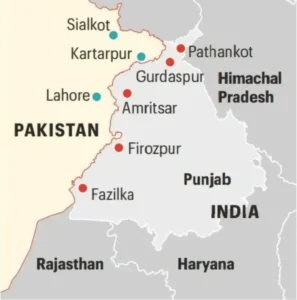
Punjab Border Fence Shift

Farmers’ Concerns

  • Around 21,500 acres of private land and 10,000 acres of government land lie beyond the fence.
  • Farmers face restrictions:
    • Gates open only for limited hours.
    • Caps on number of people and tractors allowed.
    • Each tractor escorted by BSF Kisan Guards, slowing work.
  • Result: Delays in cultivation, crop transport, and machinery use.
  • Farmers demand fence relocation to ease farming access.

Kapoor Committee & Compensation

  • Formed in 1986, headed by Chief Secretary S.L. Kapoor.
  • Recommended compensation for affected farmers.
  • In 1988, an inconvenience allowance of ₹2,500 per acre was introduced.
  • Farmers claim payments have been irregular and inconsistent.

Changing Security Context

  • Farmers argue that modern surveillance, drones, and defence resources make the current fence alignment outdated.
  • They believe shifting the fence closer to the border would not compromise security.
  • Improved technology can balance border safety and farming rights.

Why Fence Has Not Been Shifted

  • BSF cites practical hurdles: Fence is nearly 40 years old and in poor condition.
  • Relocation requires dismantling and rebuilding with new barbed wire.
  • Farmers remain sceptical, noting similar promises during elections (e.g., 2023) that were never implemented.

Conclusion

The Punjab border fence issue reflects the tension between national security and farmers’ livelihood. While relocation could ease cultivation for thousands of farmers, administrative hurdles and security concerns have delayed action. The final decision will need to balance border safety with socio-economic justice for border communities.

BOMBAY HIGH COURT ON PROTECTIVE CUSTODY UNDER PITA

TOPIC: (GS2) POLITY: THE HINDU

The Bombay High Court struck down an order placing an adult trafficking survivor in a protective home for one year, ruling that such custody without proper legal grounds violates constitutional liberty.

Immoral Traffic (Prevention) Act, 1988

  • The court clarified that protective homes under the Immoral Traffic (Prevention) Act (PITA) are meant for rehabilitation, not confinement.
  • Originated from recommendations of the Santhanam Committee to combat trafficking and exploitation.
  • Defines “public servant” broadly and provides mechanisms for rescue and rehabilitation.
  • Distinguishes between protective homes (for victims’ care) and corrective institutions (for offenders).

Section 17 – Limits on Custody

  • After rescue, a person may be kept in safe custody for up to 10 days if immediate production before a magistrate is not possible.
  • Once produced, the magistrate can order interim custody, but only for three weeks.
  • Long-term placement (1–3 years) is allowed only if the magistrate finds the person “in need of care and protection.”

Court’s Observations

  • Consent is central: Care must be voluntary; confinement without consent becomes detention.
  • Adult rights remain intact: Article 19 freedoms (movement, residence, livelihood) cannot be curtailed merely because of trafficking.
  • Victims are not offenders: PITA targets exploiters, not survivors of sex work.
  • Substance over labels: Rehabilitation means voluntary support (counselling, shelter), while detention implies compulsion.

Why Detention Failed in This Case

  • No medical evidence of incapacity.
  • No finding of danger to society.
  • The woman was not accused of any offence.
  • Assumptions about poverty or risk of returning to sex work were deemed insufficient grounds.

What PITA Penalises

  • Running or managing a brothel.
  • Living off earnings of another’s prostitution.
  • Procuring or trafficking persons for exploitation.
  • Detaining someone for sexual exploitation.
  • Certain acts (like soliciting near schools or hospitals) punishable only when they affect public order.
  • Importantly, prostitution itself is not a crime.

Governance & Rights Implications

  • Protective custody must not become forced confinement.
  • Poverty or lack of family support cannot justify curtailing liberty.
  • Rehabilitation should focus on voluntary care, counselling, and livelihood support.
  • Judicial oversight is essential to prevent misuse of protective homes.

Conclusion

The ruling strengthens constitutional principles of liberty, autonomy, and dignity, ensuring that state protection does not become unlawful restraint.

HIMACHAL APPLE IMPORT DUTY

TOPIC: (GS3) ECONOMY: THE HINDU

The Himachal Pradesh Chief Minister has urged the Centre to raise import duty on foreign apples and impose a seasonal ban from July to November to safeguard nearly farmers.

Apple Economy in India

  • India produces about 28 lakh metric tonnes (LMT) of apples annually.
  • Jammu & Kashmir contributes around 20 LMT, while Himachal Pradesh produces 5–6 LMT.
  • Apple farming is the backbone of the rural economy:
    • Valued at ₹12,000 crore in J&K.
    • Valued at ₹4,500 crore in Himachal Pradesh.
  • Farmers in these regions are most vulnerable to import competition.

India–New Zealand FTA and Duty Reduction

  • The demand comes after India reduced duty on New Zealand apples to 25% under the Free Trade Agreement (FTA).
  • Import duty on New Zealand apples cut from 50% to 25% (April–August).
  • Quota system: 32,500 tonnes in year one, rising to 45,000 tonnes by year six.
  • Imports must meet a minimum price of $1.25 (₹113.6) per kg.
  • Shipments beyond quota continue to attract 50% duty.

Farmers’ Concerns

  • Harvest overlap: India harvests apples July–November. New Zealand harvests Jan–May, supplying fresh apples when Indian farmers rely on stored produce.
  • Price impact: Cheaper imports depress domestic prices, reducing farmers’ income.
  • Market share loss: Imported apples threaten sales of varieties like Royal Delicious and Gala during peak season.

Challenges Beyond Imports

  • Climate stress: Erratic weather, reduced snowfall, floods, and landslides lowering yields.
  • Disease burden: Rising cases of apple scab, fire blight, powdery mildew, and bitter rot.
  • Production losses: Himachal’s output fell to 4.84 LMT in 2023 (28% drop), later recovering but with poor quality.
  • Transport bottlenecks: Highway closures (NH-44) stranded trucks, delaying market access.

Farmers’ Demands

  • Raise import duty to 100%.
  • Impose seasonal ban (July–November) on foreign apples.
  • Provide special protection status and higher subsidies.
  • Focus on domestic resilience, productivity, and support schemes rather than exposing farmers to subsidised foreign competition.

Apple Farming in India

Annual Output (2024–25): ~2.55 MMT, a 6% increase from the previous year due to favorable weather.

Major Producing States:

    • Jammu & Kashmir – contributes ~70% of India’s apples (~20 LMT).
    • Himachal Pradesh – produces ~5–6 LMT.
    • Uttarakhand & North-East states – smaller but growing production.
  • Varieties: Royal Delicious, Golden Delicious, Gala, and newer high-density varieties.

Imports

  • 2024–25 Imports Forecast: ~600,000 MT, up 10% from last year.
  • Key Sources: New Zealand, USA, Chile, and European countries.

Conclusion

With climate stress, disease, and infrastructure hurdles already weakening production, growers in Himachal and J&K seek stronger safeguards to ensure fair prices, stable incomes, and long-term sustainability of India’s apple economy.

PARBATI GIRI

TOPIC: (GS1) INDIAN HISTORY: THE HINDU

On her birth centenary (19 January 2026), the Prime Minister paid tribute to Parbati Giri, acknowledging her remarkable role in India’s freedom struggle and her lifelong service to society.

Early Life

  • Born on 19 January 1926 in Samleipadar village, Bargarh district (then Sambalpur), Odisha.
  • Parents: Srimati and Dhananjay Giri.
  • Inspired by Gandhian philosophy from childhood; came in contact with Mahatma Gandhi.
  • Trained at Gandhian Ashrams in Bari, Wardha, and Delhi Gandhi Sebashram.

Parbati Giri

Role in Freedom Struggle

  • At just 16 years old, she actively participated in the Quit India Movement (1942).
  • Led protests in her village and staged an agitation at Bargarh Court, urging lawyers to boycott British institutions.
  • Known for her courage and patriotism, she earned the epithet ‘Banhi-kanya’ (daughter of fire).

Social Work After Independence

  • Dedicated her life to serving the poor and marginalized.
  • Established Ashrams and worked closely with freedom fighter Rama Devi.
  • Affectionately called ‘Badamaa’ (Big Mother) by the people she cared for.
  • Remembered as the “Mother Teresa of Western Odisha” for her humanitarian work.

Legacy

  • Parbati Giri remains a symbol of youthful courage, sacrifice, and social service.
  • Her life reflects the continuity of freedom struggle into nation-building, combining patriotism with compassion for the downtrodden.

CENTRAL SILK BOARD

TOPIC: (GS3) ECONOMY: THE HINDU

The government has amended Rule 22 of the Central Silk Board Rules, 1955, raising the Board’s financial approval limit to strengthening its role in promoting the silk industry.

Central Silk Board

  • Established in 1948 by an Act of Parliament.
  • Functions under the Ministry of Textiles, Government of India.
  • Headquarters: Bengaluru.
  • It is a statutory body responsible for planning and coordinating the development of the silk sector.
Central Silk Board

Mandate of the Board

  • Advises the Central Government on matters related to the silk industry, including import and export of raw silk.
  • Prepares reports and recommendations for policy decisions.
  • Promotes scientific sericulture practices to improve productivity and income.
  • Works to generate employment opportunities in rural areas through sericulture.

Silk Production in India

  • India is the second-largest producer and consumer of silk in the world.
  • Raw silk output rose from 31,906 MT (2017–18) to 38,913 MT (2023–24).
  • Major silk-producing states:
    • Karnataka – largest producer.
    • Andhra Pradesh, West Bengal, Tamil Nadu, and Assam also contribute significantly.
  • Varieties produced: Mulberry, Eri, Tasar, and Muga (unique to Assam).

Significance

  • Enhancing financial powers of the Board will help in faster project approvals and better support for farmers and weavers.
  • Strengthens India’s silk sector, which is vital for employment, exports, and traditional crafts.

RESPONSIBLE NATIONS INDEX (RNI)

TOPIC: (GS2) POLITY: THE HINDU

India has recently launched the Responsible Nations Index (RNI) at the Dr. Ambedkar International Centre, New Delhi, marking the country’s first globally anchored index to assess nations beyond GDP and military power.

About the Index

  • Developed by the World Intellectual Foundation (WIF) in collaboration with JNU, IIM Mumbai, and Dr. Ambedkar International Centre.
  • Covers 154 countries using transparent, globally sourced data for credibility.
  • Moves away from conventional measures like GDP, focusing instead on responsibility and ethics in governance.

Core Dimensions

  • Internal Responsibility – Ensures dignity, justice, and welfare of citizens.
  • Environmental Responsibility – Focuses on sustainable use of natural resources and climate action.
  • External Responsibility – Evaluates contributions to peace, cooperation, and global stability.

Significance

  • Promotes a value-based global dialogue on ethics, responsibility, and sustainable leadership.
  • Encourages nations to balance economic growth with social justice and environmental stewardship.
  • Highlights issues like global food security, climate resilience, and equitable governance.
  • Provides a more holistic measure of national performance compared to traditional indices.

Conclusion

The Responsible Nations Index is a pioneering step by India to reshape global evaluation standards. By focusing on responsibility, sustainability, and ethics, it aims to foster a more balanced understanding of nations’ roles in ensuring peace, justice, and environmental care on the world stage.

Write a Review

Your email address will not be published. Required fields are marked *