Table of Contents
ToggleThe UPSC GS Paper III is one of the most analytical papers in the Civil Services Mains Examination. It evaluates how well aspirants apply concepts to real-world issues. Many candidates find this paper challenging because it combines static knowledge with current affairs.
However, with the right preparation strategy, this paper becomes scoring and manageable.
Structure of the Paper
The UPSC GS Paper III is a descriptive paper of 250 marks. It tests analytical ability, problem-solving skills, and awareness of contemporary developments.
In addition, aspirants must focus on answer writing practice. Clear structure and logical presentation are essential for scoring well.
Core Areas Covered
Economic Development in UPSC GS Paper III
This section focuses on economic growth, fiscal policy, budgeting, and infrastructure. Candidates should connect theory with real-world economic issues.
Topics like inflation and government schemes are frequently asked in this paper.
Science and Technology
This area includes artificial intelligence, biotechnology, and space technology.
Instead of rote learning, aspirants must understand practical applications of these concepts.
Preparation Support and Guidance
For effective preparation, many aspirants rely on structured mentorship and expert guidance. Choosing the right institute plays a key role in success. A reputed IAS coaching in Hyderabad can provide conceptual clarity, answer writing practice, and regular performance analysis.
Environment and Ecology
Important topics include climate change, biodiversity, and conservation efforts.
Linking static content with current developments improves answer quality significantly.
Internal Security
This section covers cyber security, terrorism, and border management. Most questions are application-based. Therefore, conceptual clarity is important.
Disaster Management
This section includes disaster preparedness, mitigation strategies, and institutional mechanisms. Candidates should focus on case studies and practical solutions to score well in UPSC GS Paper III.
Preparation Strategy for UPSC GS Paper III
Answer Writing Practice
Regular answer writing is crucial. It helps improve structure, clarity, and presentation. Most coaching programs include daily practice sessions for better results.
Current Affairs Integration
Secondly, integrate UPSC current affairs with static topics. This makes answers more relevant.
Smart Study Approach
Aspirants should integrate Prelims and Mains preparation. Additionally, options like weekend UPSC batches help working professionals maintain consistency.
Ekam IAS Academy Approach
At Ekam IAS Academy, students receive:
- Concept-based learning
- Current affairs integration
- Answer writing practice
- Personalized mentorship
As a result, aspirants perform better in UPSC GS Paper III.
Conclusion
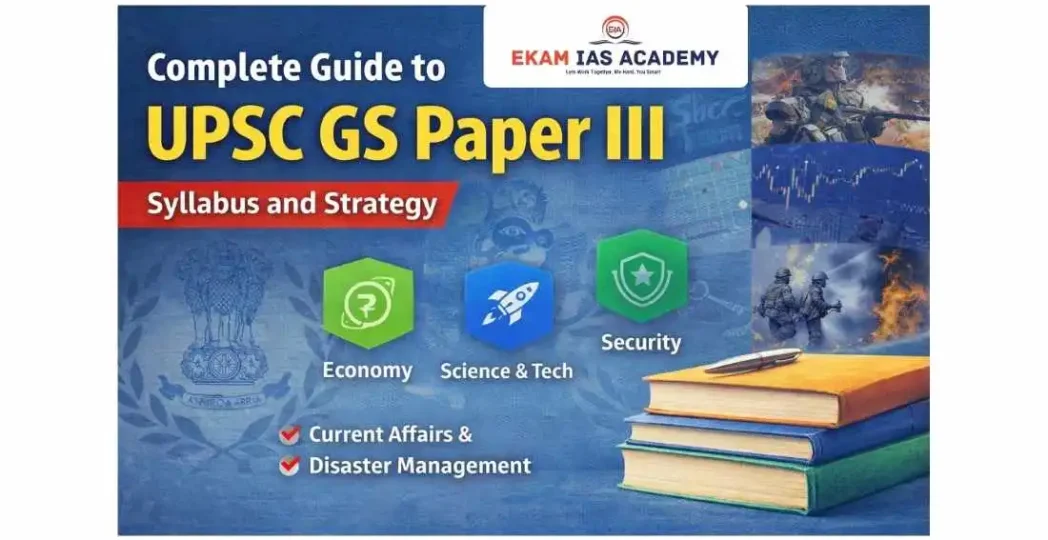
The UPSC GS Paper III covers critical areas such as economy, technology, environment, security, and disaster management.
With consistent practice, proper guidance, and a strategic approach, aspirants can master this paper and improve their overall Mains performance.



Complete Guide to UPSC GS Paper III-FAQs Answered
What is UPSC GS Paper III?
UPSC GS Paper III is a Mains paper covering economy, science & technology, environment, internal security, and disaster management.
How to prepare for UPSC GS Paper III effectively?
Focus on answer writing, concept clarity, and current affairs integration for better performance.
What topics are included in GS Paper III syllabus?
The syllabus includes economic development, technology, environment, and security topics.
Is GS Paper III difficult in UPSC?
It becomes scoring with structured answers, examples, and proper analysis.
Why is current affairs important for this paper?
Current affairs help connect theoretical knowledge with real-world applications.