Table of Contents
ToggleIntroduction: A Cumulative Outburst
The Revolt of 1857 was not a sudden occurrence but the culmination of a century of colonial exploitation, political annexations, and social interference. While it began as a military mutiny, it rapidly transformed into a popular uprising involving peasants, artisans, zamindars, and religious leaders.
Causes of the Revolt: A Multi-Dimensional Analysis
Political Causes
The aggressive expansionist policies of the British created a sense of insecurity among Indian rulers.
- Doctrine of Lapse: Introduced by Lord Dalhousie, it allowed the British to annex states where the ruler died without a natural heir. This led to the annexation of Satara, Nagpur, and Jhansi.
- Annexation of Awadh (1856): Despite being a loyal ally, Awadh was annexed on the grounds of “misgovernance.” This deeply hurt the sentiments of the sepoys, as many hailed from this region.
- Abolition of Titles: The British refused to recognize the titles of the successors of the Mughal Emperor (Bahadur Shah Zafar) and the Peshwas (Nana Saheb).
Economic Causes
British economic policies systematically impoverished India.
- Heavy Land Revenue: The Permanent Settlement and Ryotwari systems imposed exorbitant taxes, leading to widespread peasant indebtedness and land alienation.
- De-industrialization: The influx of cheap British machine-made goods destroyed traditional handicrafts and textiles, rendering millions of artisans unemployed.
- Drain of Wealth: The systematic siphoning of Indian resources to Britain without any equivalent return.
Socio-Religious Causes
The British attempted to “modernize” India, which was viewed as an attack on tradition.
- Social Reforms: The abolition of Sati (1829), the Widow Remarriage Act (1856), and the promotion of Western education were seen as interference in religious customs.
- Religious Disabilities Act (1850): This act enabled a convert from Hinduism to other religions to inherit his ancestral property, which was seen as a way to encourage Christian conversions.
- Racial Arrogance: British officers often treated Indians with contempt, characterizing the rule as a “civilizing mission” by a superior race.
Military Causes
The Indian Sepoy was the backbone of the British army but faced constant discrimination.
- Lower Pay and Status: Indian sepoys were paid significantly less than British soldiers and were denied promotions to higher ranks.
- General Service Enlistment Act (1856): It required sepoys to serve overseas if needed. In Hindu tradition, crossing the “Kalapani” (sea) meant losing one’s caste.
- Immediate Cause (The Greased Cartridges): The introduction of the Enfield Rifle, whose cartridges were rumored to be greased with beef and pork fat, served as the final spark.
The Course of the Revolt: From Meerut to Delhi
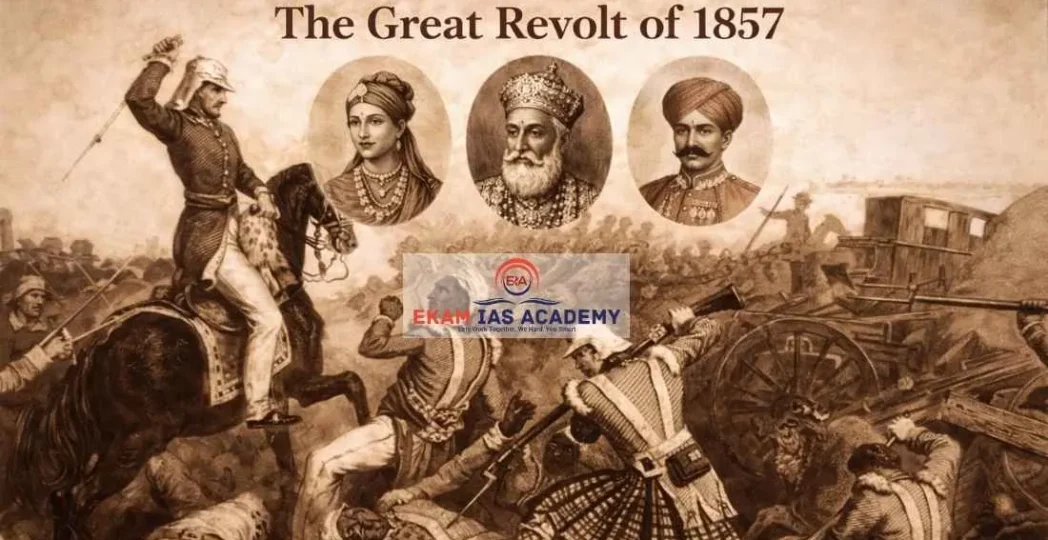
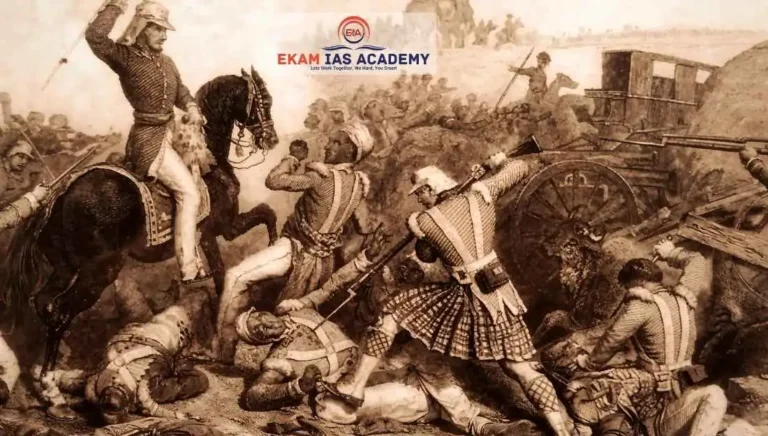
The revolt began at Meerut on May 10, 1857, when sepoys refused to use the greased cartridges. They killed their officers and marched toward Delhi.
- Delhi: The sepoys proclaimed the aged Mughal Emperor, Bahadur Shah Zafar, as the Emperor of India (Shahenshah-e-Hindustan). The real command lay with General Bakht Khan.
- Kanpur: Led by Nana Saheb, the adopted son of Peshwa Baji Rao II. He was assisted by the brilliant strategist Tatya Tope and Azimullah Khan.
- Lucknow: Led by Begum Hazrat Mahal. The revolt here was particularly intense due to the recent annexation of Awadh.
- Jhansi: Led by Rani Lakshmibai, who fought heroically after her adopted son was denied the throne under the Doctrine of Lapse.
- Arrah (Bihar): Led by the 80-year-old zamindar Kunwar Singh, who displayed remarkable military skill against British forces.
Why the Revolt Failed: Critical Analysis
Despite its scale, the British managed to suppress the revolt by late 1858.
- Limited Territorial Spread: The revolt was largely confined to North and Central India. South India, Punjab, and most of Bengal remained relatively quiet.
- Lack of Unity: Many Indian rulers (e.g., Scindia of Gwalior, Holkar of Indore, Nizam of Hyderabad) remained loyal to the British. Lord Canning famously remarked that they acted as “breakwaters in the storm.”
- Modern vs. Traditional Weapons: The British used advanced Enfield rifles and the Telegraph (which allowed quick communication), whereas Indians fought with traditional swords and spears.
- Lack of Centralized Leadership: While Bahadur Shah was the symbolic head, there was no unified plan or a single political vision for a post-British India.
Consequences of the Revolt: The End of an Era
Despite its scale, the British managed to suppress the revolt by late 1858.
- Limited Territorial Spread: The revolt was largely confined to North and Central India. South India, Punjab, and most of Bengal remained relatively quiet.
- Lack of Unity: Many Indian rulers (e.g., Scindia of Gwalior, Holkar of Indore, Nizam of Hyderabad) remained loyal to the British. Lord Canning famously remarked that they acted as “breakwaters in the storm.”
- Modern vs. Traditional Weapons: The British used advanced Enfield rifles and the Telegraph (which allowed quick communication), whereas Indians fought with traditional swords and spears.
- Lack of Centralized Leadership: While Bahadur Shah was the symbolic head, there was no unified plan or a single political vision for a post-British India.
Government of India Act 1858
- The rule of the East India Company was abolished.
- Authority was transferred directly to the British Crown.
- The office of the Secretary of State for India was created.
- The Governor-General was given the title of Viceroy (Lord Canning became the first Viceroy).
Changes in the Army
- The Peel Commission recommended increasing the ratio of European soldiers to Indian soldiers.
- The policy of “Divide and Rule” was implemented by recruiting soldiers from “martial races” (Sikhs, Gorkhas) who had remained loyal during the revolt.
Policy Toward Indian Princes
- The Doctrine of Lapse was withdrawn.
- The British promised to respect the integrity of Indian states and allowed rulers to adopt heirs, turning them into pillars of support for the Empire.
UPSC Prelims: PYQs & Practice Questions
Previous Year Questions (PYQs)
Question 1 (UPSC 2006)
Q: With reference to the Revolt of 1857, who among the following was betrayed by a ‘friend’, captured and put to death by the British?
Options:
(a) Nana Sahib
(b) Kunwar Singh
(c) Khan Bahadur Khan
(d) Tatya Tope
Answer: (d)
Explanation: Tatya Tope was betrayed by his associate Man Singh, captured in the forests of Paron, and executed by the British in April 1859.
Question 2 (UPSC 2005)
Q: Which one of the following places was NOT a center of the Revolt of 1857?
Options:
(a) Ajmer
(b) Jaipur
(c) Neemuch
(d) Auwa
Answer: (b)
Explanation: Jaipur remained largely unaffected by the Revolt of 1857, as its ruler supported the British, unlike Neemuch and Auwa which witnessed rebel activity.
Question 3 (UPSC 1996)
Q: The primary cause of the ‘Sepoy Mutiny’ of 1857 was:
Options:
(a) The greased cartridges
(b) The annexation of Awadh
(c) The exploitation of peasants
(d) The General Service Enlistment Act
Answer: (a)
Explanation: The immediate trigger of the revolt was the introduction of greased cartridges, which hurt the religious sentiments of both Hindu and Muslim sepoys.
Previous Year Questions (PYQs)
Question 4 (Revolt of 1857)
Q: With reference to the leaders of the Revolt of 1857, consider the following pairs:
1. General Bakht Khan : Delhi
2. Begum Hazrat Mahal : Lucknow
3. Maulvi Ahmadullah : Faizabad
Which of the pairs given above is/are correctly matched?
Options:
(a) 1 and 2 only
(b) 2 and 3 only
(c) 1 and 3 only
(d) 1, 2, and 3
Answer: (d)
Explanation: All the pairs are correctly matched. Bakht Khan commanded the rebel forces in Delhi, Begum Hazrat Mahal led the resistance in Lucknow, and Maulvi Ahmadullah was a key rebel leader in Faizabad.
Question 5 (Post-1857 Reforms)
Q: The ‘Peel Commission’, established after the Revolt of 1857, was concerned with:
Options:
(a) Judicial reforms
(b) Land revenue settlement
(c) Reorganisation of the Army
(d) Educational reforms
Answer: (c)
Explanation: The Peel Commission examined military reforms and recommended restructuring the Indian Army, increasing the proportion of European soldiers, and reorganizing recruitment to prevent future rebellions.
UPSC Mains – Previous Year & Practice Questions
Previous Year Questions (PYQs)
Background of the Revolt
Question: “The Revolt of 1857 was the culmination of the recurrent big and small local rebellions that had occurred in the preceding hundred years of British rule.” Elucidate. (UPSC 2012)
Failure & Impact
Question: Examine the reasons for the failure of the Revolt of 1857. Did it have any positive impact on the Indian National Movement? (UPSC 2005/Modified)
Nature of the Revolt
Question: “The Revolt of 1857 was much more than a mere Sepoy Mutiny.” Critically examine the popular character of the uprising. (UPSC 2014/Modified)
Post-1857 Policy Changes
Question: Discuss the changes in British administrative and military policies towards India after the Revolt of 1857. (UPSC 2001/Modified)
Political Causes
Question: Analyze the role of the ‘Doctrine of Lapse’ and the annexation of Awadh as primary political causes of the Revolt. (UPSC 1998/Modified)
Mains Practice Questions
Nature of the Revolt
Question: “The Revolt of 1857 was a desperate effort of the traditional elements of Indian society to save their old way of life.” Critically analyze.
Role of Women
Question: Evaluate the role of women in the Revolt of 1857, with special reference to Rani Lakshmibai and Begum Hazrat Mahal.
Communication & Technology
Question: “While the British used the telegraph and railways to suppress the revolt, the lack of modern communication was a major handicap for the Indian rebels.” Substantiate.
The Great Revolt of 1857: The First War of Independence - FAQs
Why is the Revolt of 1857 called the "First War of Independence"?
Popularized by V.D. Savarkar, this term highlights that it was the first time diverse sections of Indian society (soldiers, peasants, and royalty) united across regions to overthrow British rule, moving beyond local grievances.
Who were the "Martial Races" recruited after 1857?
The British labeled groups that helped them during the revolt—such as Sikhs, Gorkhas, and Pathans—as “Martial Races.” They were recruited heavily into the army to replace the “rebellious” soldiers from Awadh and Bengal.
What was the "Queen’s Proclamation" of 1858?
It was a declaration by Queen Victoria that promised to respect the rights of Indian princes, end territorial expansion, and ensure religious neutrality, effectively ending the East India Company’s rule.
Why did the educated middle class stay away from the revolt?
Most educated Indians believed that British rule was a modernizing force that would eventually lead to progress. They viewed the rebels as representatives of a backward-looking feudal order.
What happened to the Mughal Empire after the revolt?
The Mughal Empire was formally abolished. Bahadur Shah Zafar was tried for treason and exiled to Rangoon, ending the 300-year-old dynasty.
What was the significance of the "Greased Cartridges" rumor?
It served as a unifying factor for both Hindu and Muslim sepoys, as the use of cow fat (sacred to Hindus) and pig fat (forbidden for Muslims) was seen as a deliberate attempt by the British to defile their religions.