Table of Contents
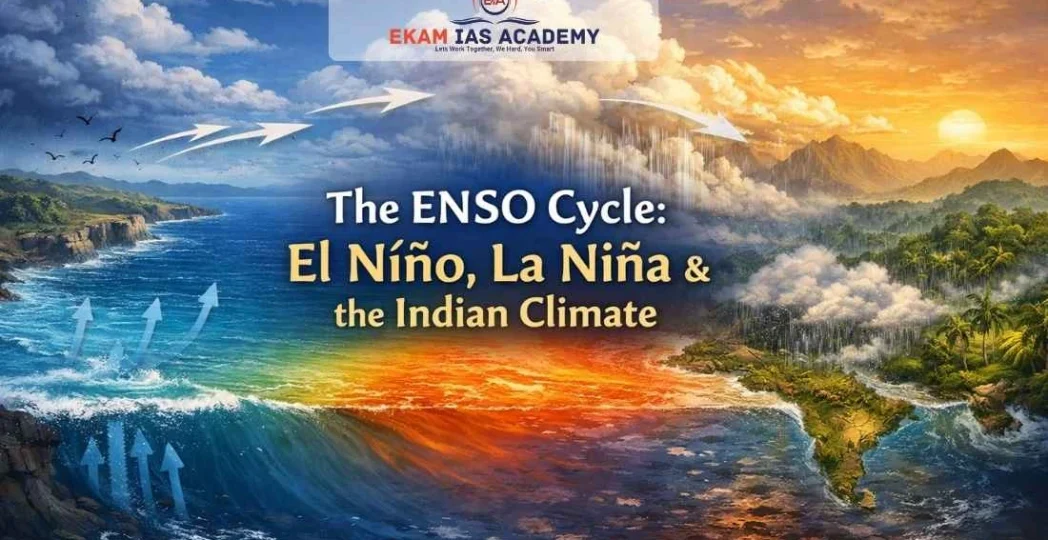
ToggleThe ENSO cycle is a periodic fluctuation in sea surface temperatures (SST) and the air pressure of the overlying atmosphere across the equatorial Pacific Ocean. It is arguably the most significant driver of year-to-year climate variability globally.
The Normal Conditions: The Walker Circulation
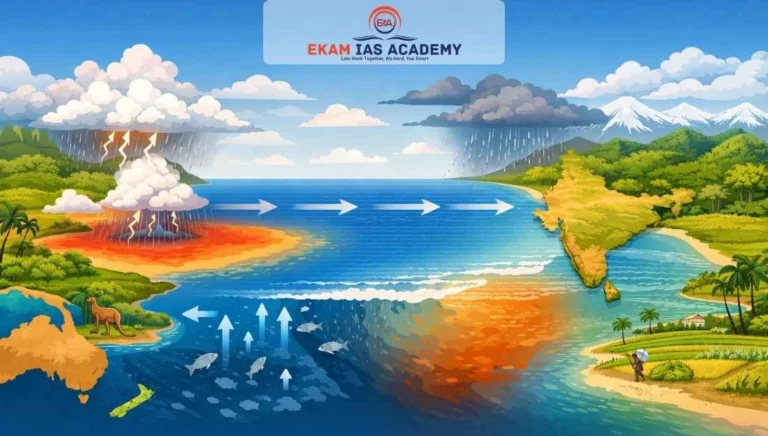
Under normal circumstances, the tropical Pacific is governed by a robust atmospheric loop known as the Walker Circulation.
- Trade Winds: Strong Tropical Easterly Trade Winds blow from East to West.
- Warm Pool: These winds push warm surface waters toward the Western Pacific (near Indonesia and Australia), creating a “warm pool.”
- Upwelling: In the Eastern Pacific (off the coast of Peru), cold, nutrient-rich water rises from the deep ocean to replace the displaced surface water.
- Convection: The warm water in the West leads to low pressure and heavy convectional rainfall over Southeast Asia, which indirectly supports the pressure gradient required for the Indian Monsoon.
El Niño: The "Warm Phase"
El Niño (The Boy Child) refers to the large-scale warming of the surface waters in the central and eastern equatorial Pacific.
The Mechanism
- Weakening of Trade Winds: The Easterly Trade winds falter or even reverse.
- Eastward Shift: The “warm pool” of water slides back toward the South American coast.
- Thermocline Deepening: The boundary between warm surface water and cold deep water (the Thermocline) sinks in the East, suppressing Upwelling.
- Atmospheric Reversal: The center of rising air and rainfall shifts from the Western Pacific to the Central/Eastern Pacific.
La Niña: The "Cold Phase"
La Niña (The Girl Child) is essentially an intensification of “normal” conditions.
The Mechanism
- Stronger Trade Winds: The Easterlies become exceptionally powerful.
- Exaggerated Warm Pool: Warm water is pushed even further West, leading to intense low pressure over Northern Australia and Indonesia.
- Enhanced Upwelling: The Eastern Pacific becomes significantly colder than usual as deep-sea water surges upward.
The Impact on India: Teleconnections
- For the UPSC Mains, the link between the Pacific and the Indian Subcontinent is the most critical area of study.
A. Impact of El Niño on India
- Monsoon Failure: El Niño is historically linked to weak monsoons. It creates a high-pressure zone over the Indian Ocean/Southeast Asia, which “sucks” moisture away from the Indian landmass.
- Drought and Heatwaves: Approximately 60% of El Niño years have resulted in droughts in India, leading to crop failures in the Kharif season.
- Inflation: Poor rainfall leads to reduced agricultural output (Rice, Sugar, Pulses), triggering food inflation and impacting the GDP.
B. Impact of La Niña on India
- Bumper Harvests: La Niña generally brings above-normal rainfall to India. It strengthens the monsoon winds and the Tropical Easterly Jet.
- Increased Cyclonic Activity: While it aids agriculture, La Niña is also associated with a higher frequency of cyclones in the Bay of Bengal.
- Cold Waves: During La Niña years, North India often experiences prolonged and more intense winter cold waves.
The "Saviour": Indian Ocean Dipole (IOD)
The relationship between ENSO and the Indian Monsoon is not 1:1. The Indian Ocean Dipole (IOD), or the “Indian El Niño,” can modify the outcome.
- Positive IOD: Occurs when the Western Indian Ocean (near Africa) is warmer than the Eastern part. A Positive IOD can neutralize an El Niño, bringing good rains to India despite Pacific warming (as seen in 1997 and 2019).
- Negative IOD: Occurs when the Eastern Indian Ocean is warmer. This can worsen an El Niño-induced drought.
ENSO and Climate Change
Modern research suggests that Global Warming is increasing the frequency of Extreme El Niño and Extreme La Niña events. The melting of Arctic ice and Arctic Amplification are further complicating the predictability of these cycles.
UPSC Prelims: PYQs & Practice Questions
Previous Year Questions (PYQs)
1. With reference to the ‘Indian Ocean Dipole (IOD)’, consider the following statements: (2017)
Q:
1. IOD phenomenon is characterized by a difference in sea surface temperature between tropical Western Indian Ocean and tropical Eastern Pacific Ocean.
2. An IOD phenomenon can influence an El Niño’s impact on the monsoon.
Which of the statements given above is/are correct?
(a) 1 only
(b) 2 only
(c) Both 1 and 2
(d) Neither 1 nor 2
Answer: (b) 2 only
Explanation: Statement 1 is incorrect because IOD is the difference in sea surface temperature between the Western and Eastern Indian Ocean (not Pacific). Statement 2 is correct; a Positive IOD can neutralize the drought-inducing effects of El Niño, leading to a normal monsoon for India.
2. Which of the following is the most likely cause of a 'Negative SOI' (Southern Oscillation Index)? (Conceptual Theme)
Q:
(a) La Niña
(b) El Niño
(c) Normal Walker Circulation
(d) Western Disturbances
Answer: (b) El Niño
Explanation: The SOI is the pressure difference between Tahiti (Central Pacific) and Darwin (Australia). During El Niño, pressure at Tahiti is low and Darwin is high. This creates a Negative Index, signifying the weakening of the Trade Winds.
Practice Questions (Prelims)
Question 1
Q: During a 'La Niña' event, which of the following is most likely to occur in the Indian context?
1. Stronger than average Southwest Monsoon.
2. Increased frequency of Cold Waves in North India.
3. Severe drought in the Indo-Gangetic plains.
Select the correct answer:
(a) 1 and 2 only
(b) 2 and 3 only
(c) 1 and 3 only
(d) 1, 2, and 3
Answer: (a) 1 and 2 only
Explanation: La Niña typically brings surplus rainfall to India and is statistically associated with stronger monsoon conditions. It is also linked to harsher winters and increased cold wave conditions in parts of North India. Severe drought in the Indo-Gangetic plains is not the usual outcome of La Niña.
Question 2
Q: The term 'Upwelling' is inhibited during an El Niño year off the coast of Peru. What is the primary biological consequence of this?
(a) Massive increase in coral reef growth.
(b) Collapse of the Anchovy fishing industry due to nutrient depletion.
(c) Formation of tropical cyclones in the Eastern Pacific.
(d) Rapid desalination of surface waters.
Answer: (b)
Explanation: During El Niño, the warm surface water suppresses the normal rise of cold, nutrient-rich water from below. This reduces nutrient availability, leading to decline in phytoplankton productivity and a sharp fall in fish populations, especially anchovy, affecting the fishing industry severely.
UPSC Mains – Previous Year & Practice Questions
Previous Year Questions (Mains)
El Niño Effect & Unusual Climatic Happenings (2014)
Question: “Most of the unusual climatic happenings are explained as an outcome of the El-Niño effect. Do you agree?” (2014)
Key Focus: Discuss global teleconnections—floods in Peru, droughts in Australia and India, and the weakening of the Atlantic hurricane season.
Indian Ocean Dipole (IOD) vs El Niño & Indian Monsoon (General Theme)
Question: “How does the Indian Ocean Dipole (IOD) differ from El Niño and what is its impact on the Indian Monsoon?” (General Theme)
Key Focus: Compare the two ocean-atmosphere systems in the Indian and Pacific basins, and explain how a Positive IOD can act as a ‘savior’ during El Niño years.
ENSO & Global Food Security with Special Reference to India (General Theme)
Question: “Assess the impact of ENSO on global food security with special reference to India.” (General Theme)
Key Focus: Impact on Kharif crops, groundwater and water table depletion, and food inflation.
Walker Circulation & Its Disruption During ENSO (Geography Optional Theme)
Question: “Explain the mechanism of the Walker Circulation and its disruption during an ENSO event.” (Geography Optional Theme)
Key Focus: Discuss the pressure gradient, Trade Winds, normal east-west circulation, and the shift of the convective heat source during ENSO.
Triple-Dip La Niña & Indian Subcontinent (Recent Theme 2022–23)
Question: “Describe the climatic impact of a ‘Triple-Dip’ La Niña on the Indian Subcontinent.” (Recent Theme 2022–23)
Key Focus: Prolonged monsoon seasons, urban flooding, and extended winter durations.
Mains Practice Questions
Arctic Amplification and Predictability of the ENSO Cycle
Question: “In the context of ‘Arctic Amplification’, examine how rising global temperatures are altering the predictability of the ENSO cycle.”
Why All El Niños Do Not Cause Monsoon Failure in India
Question: “While El Niño is usually associated with drought in India, not all El Niños lead to monsoon failure. Discuss the atmospheric factors that can override the ENSO signal.”
El Niño Modoki and Its Impact on the Indian Monsoon
Question: “Explain the phenomenon of ‘El Niño Modoki’ and how its impact on the Indian Monsoon differs from a classic El Niño.”



The ENSO Cycle: El Niño, La Niña and the Indian Climate- FAQs
What is 'ENSO'?
ENSO (El Niño Southern Oscillation) is a single climate phenomenon that has three phases: El Niño (Warm), La Niña (Cold), and Neutral. It represents the “see-saw” of atmospheric pressure and ocean temperatures in the Pacific.
Why does El Niño cause drought in India?
During El Niño, the heat source in the Pacific shifts Eastward. This disrupts the Walker Circulation, causing sinking air (high pressure) over the Western Pacific and Indian Ocean. Sinking air inhibits cloud formation, thus weakening the Southwest Monsoon.
What is the 'Thermocline'?
It is the transition layer between the warm mixed surface water and the cold deep water. During El Niño, the thermocline in the Eastern Pacific deepens, while during La Niña, it becomes shallow.
How does La Niña affect the Atlantic Hurricane season?
La Niña reduces vertical wind shear over the Atlantic. Low wind shear allows storms to grow vertically and intensify, typically leading to a more active hurricane season.
What is the 'Southern Oscillation Index' (SOI)?
It is a numerical index based on the air pressure difference between Tahiti (Pacific) and Darwin (Australia).
- Negative SOI = El Niño.
- Positive SOI = La Niña.