Table of Contents
ToggleThe Early State of Earth
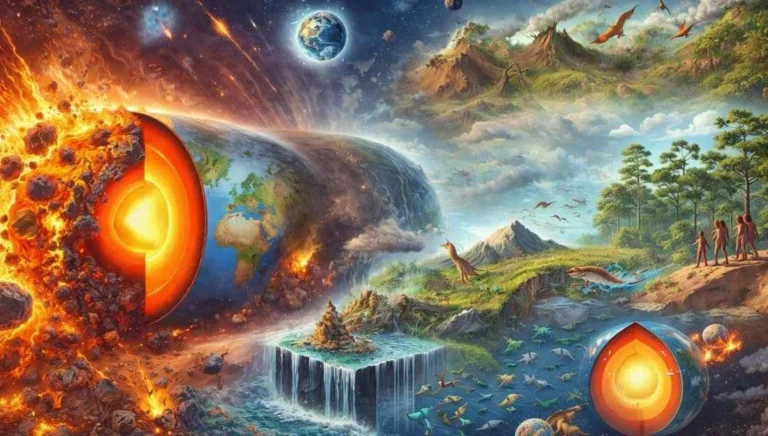
The primordial Earth was a hostile environment. Formed approximately 4.6 billion years ago, it was initially in a volatile, molten state. Due to constant bombardment by meteorites and the heat generated by radioactive decay, the surface remained fluid for millions of years.
- Primordial Heat: The combination of accretion energy, gravitational compression, and radioactive isotopes (like Uranium and Thorium) kept the Earth extremely hot.
- Atmospheric Absence: There was no protective atmosphere; only a thin layer of hydrogen and helium existed, which was quickly stripped away by intense solar winds.
The Process of Lithospheric Differentiation
As the Earth began to cool, the process of differentiation occurred. This is the most crucial event in the formation of Earth’s internal structure.
- Density Stratification: Under the influence of gravity, materials were sorted by density. Heavier elements, primarily iron and nickel, sank toward the center to form the Core.
- Formation of Layers: Lighter materials, such as silicates and aluminum, floated toward the surface, eventually cooling to form the Crust.
- The Result: This created the chemically distinct layers we study today: the Lithosphere (Crust), the Mantle, and the Core (Inner and Outer).
Evolution of the Atmosphere and Hydrosphere
The transition of the atmosphere from toxic gases to life-sustaining oxygen occurred in three distinct stages.
Stage I: Loss of Primordial Atmosphere
- The early Earth’s atmosphere, dominated by hydrogen and helium, was blown away into space by the solar wind because the Earth’s gravitational field was not yet strong enough, and the sun was highly active.
Stage II: Volcanic Degassing
As the Earth cooled and the crust solidified, internal gases were expelled through massive volcanic eruptions. This process is known as Degassing.
- Released Gases: Water vapor, nitrogen, carbon dioxide, methane, and ammonia.
- Missing Element: There was very little free oxygen in the atmosphere at this stage.
Stage III: Photosynthesis and Oxygenation
The Hydrosphere formed as water vapor condensed and fell as rain, filling the depressions to create oceans roughly 4 billion years ago.
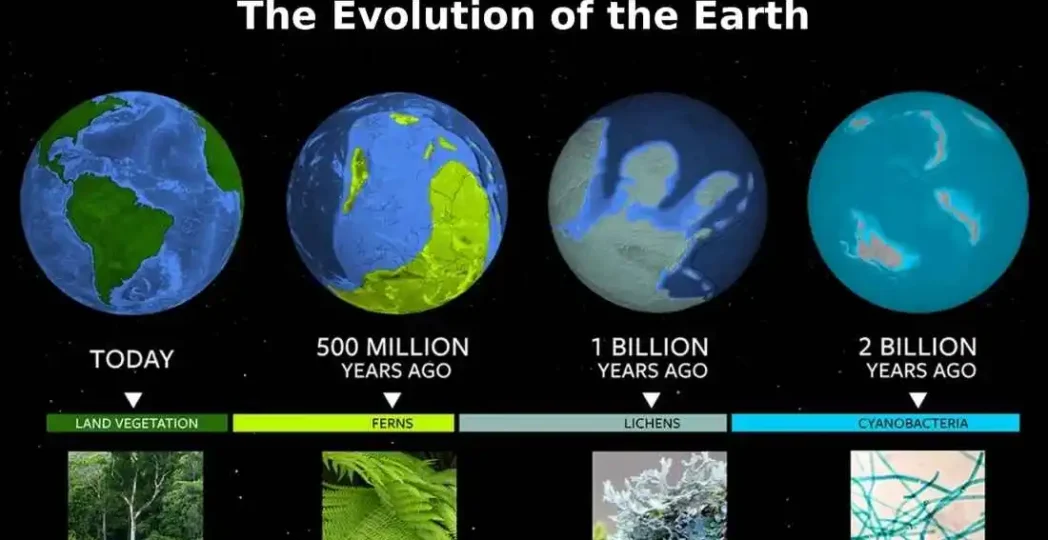
- Early Life: Around 2.5 to 3 billion years ago, the process of photosynthesis began in the oceans through blue-green algae (cyanobacteria).
- Oxygen Flood: Initially, oxygen was consumed by the oceans to oxidize iron. Once the oceans were saturated, oxygen began to accumulate in the atmosphere, leading to the Great Oxidation Event.
The Origin and Evolution of Life
The evolution of the Earth is incomplete without the study of the biosphere.
- Chemical Evolution: Modern scientists suggest that life began as a chemical reaction, where complex organic molecules assembled into self-replicating units.
- Geological Time Scale: Life progressed from unicellular bacteria in the Pre-Cambrian era to complex multicellular organisms in the Phanerozoic Eon.
- Human Arrival: In the vast timeline of Earth’s 4.6 billion years, modern humans (Homo sapiens) appeared only in the very last moments of the Quaternary Period.
Crucial Concepts for UPSC
- The Big Splat: The collision that formed the Moon also played a massive role in melting the Earth’s crust and resetting the evolutionary clock.
- Zonal Structure: The Earth is the only terrestrial planet with a fully developed zonal structure consisting of a solid lithosphere, plastic asthenosphere, and liquid outer core.
- Precipitation and Oceans: Within 500 million years of Earth’s formation, the hydrosphere was established, allowing for the regulation of surface temperatures.
UPSC Prelims: PYQs & Practice Questions
Previous Year Questions (Prelims)
Question 1
Q: Which of the following is/are cited by scientists as evidence for the "Evolution of the Atmosphere"? (Self-Generated UPSC Standard)
1. Loss of primordial hydrogen and helium.
2. Degassing of water vapor and nitrogen from the interior.
3. Modification of the atmosphere by photosynthesis.
Select the correct answer:
Options:
(a) 1 and 2 only
(b) 2 and 3 only
(c) 1 and 3 only
(d) 1, 2, and 3
Answer: (d)
Explanation: The atmosphere evolved in three stages: Stage 1 was the stripping of the primordial atmosphere (Hydrogen/Helium) by solar winds. Stage 2 was Degassing, where volcanic activity released water vapor and gases. Stage 3 was the addition of Oxygen through photosynthesis by early life forms.
Question 2 (2015)
Q: The term "Goldilocks Zone" is often seen in the news in the context of:
Options:
(a) the limits of habitable zone above the surface of the Earth
(b) regions inside the Earth-like planets in outer space
(c) search for Earth-like planets in outer space
(d) search for meteorites containing precious metals
Answer: (c)
Explanation: The Goldilocks Zone refers to the habitable zone around a star where the temperature is "just right" (not too hot or cold) for liquid water to exist, a key factor in the evolution of life on Earth.
Prelims Practice Questions
Question 1
Q: Consider the process of "Differentiation" in the early Earth:
1. It led to the formation of the Earth's layered structure: Crust, Mantle, and Core.
2. It occurred because heavier materials like iron and nickel sank to the center due to gravity.
Which of the statements given above is/are correct?
Options:
(a) 1 only
(b) 2 only
(c) Both 1 and 2
(d) Neither 1 nor 2
Answer: (c)
Explanation: Differentiation is the process where materials were separated based on density. As the Earth was in a molten state, heavier elements like iron formed the Core, while lighter silicates formed the Crust.
Question 2
Q: During which Eon did the "Great Oxidation Event" occur, significantly changing Earth's atmosphere?
Options:
(a) Hadean
(b) Archean
(c) Proterozoic
(d) Phanerozoic
Answer: (c)
Explanation: The Great Oxidation Event occurred approximately 2.4 billion years ago during the Proterozoic Eon, when cyanobacteria produced enough oxygen to saturate the oceans and begin accumulating in the atmosphere.
UPSC Mains – Previous Year & Practice Questions
Previous Year Mains Questions
Evolution of Earth's Atmosphere
Question: Discuss the three distinct stages in the evolution of the Earth’s atmosphere. (150 words)
Giant Impact (Big Splat)
Question: Explain the significance of the 'Giant Impact' (Big Splat) in the context of Earth's evolution and the formation of the Moon. (150 words)
Degassing and Early Hydrosphere
Question: How did the process of 'Degassing' contribute to the formation of the early Hydrosphere? (150 words)
Oxygen Revolution
Question: Describe the biological and chemical changes that led to the 'Oxygen Revolution' on Earth. (250 words)
Formation of the Lithosphere
Question: Analyze how the Earth's cooling led to the formation of the Lithosphere. (150 words)
Mains Practice Questions (3)
Density-based Stratification
Question: "The evolution of the Earth is a story of density-based stratification." Evaluate this statement with reference to the internal structure of the planet. (250 words)
Hydrosphere and Life
Question: Examine the relationship between the development of the Hydrosphere and the eventual emergence of Life on Earth. (150 words)
Solar Winds & Primordial Atmosphere
Question: Critically analyze the role of Solar Winds in the removal of the primordial atmosphere and its impact on the subsequent evolution of Terrestrial planets. (250 words)
The Evolution of the Earth: From Primordial Chaos to Life - FAQs
What is the primary difference between the Primordial Atmosphere and the Current Atmosphere?
The Primordial Atmosphere consisted mainly of light gases like Hydrogen and Helium, which were lost to space. The Current Atmosphere is a nitrogen-oxygen dominated system created through Degassing and Photosynthesis.
When did the Oceans form on Earth?
The Oceans formed roughly 4 billion years ago. As the Earth cooled, water vapor released through degassing condensed and fell as torrential rain for centuries, filling the great depressions on the Earth’s surface.
Why is Earth called a "Layered Planet"?
Due to Differentiation, Earth is not a uniform mass. It has a Zonal Structure consisting of the Crust (lightest), Mantle (intermediate), and Core (densest), which is unique among many celestial bodies in its level of development.
What was the "Great Oxidation Event"?
This was a period when atmospheric oxygen levels rose sharply due to the biological activity of blue-green algae. This event was crucial as it allowed for the evolution of aerobic (oxygen-breathing) life forms.
How did the Moon's formation affect Earth's evolution?
The Giant Impact or Big Splat generated immense heat, melting the Earth again and causing further differentiation. It also tilted the Earth’s axis, which eventually led to the creation of seasons.