Table of Contents
Toggle1. Introduction to Geological Time
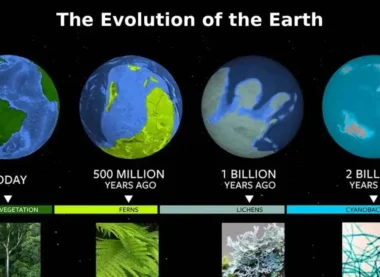
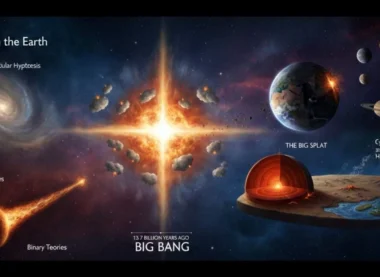
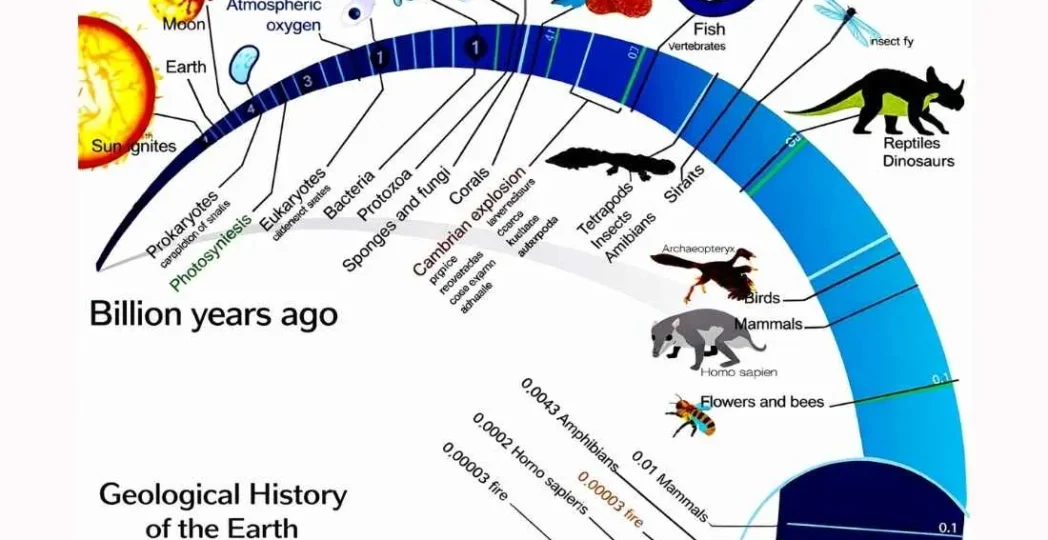
The Geological Time Scale (GTS) is a system of chronological dating that relates geological strata to time. It is used by geologists and paleontologists to describe the timing and relationships of events that have occurred during Earth’s 4.6 billion years of history.
- Standard Units: The scale is divided into Eons, Eras, Periods, Epochs, and Ages.
- Basis of Classification: The divisions are based on major geological or paleontological events, such as mass extinctions or the emergence of new life forms.
2. The Pre-Cambrian Era (The Longest Phase)
Representing nearly 88% of Earth’s history, the Pre-Cambrian is the foundational stage of our planet.
- Hadean Eon: The era of “hellish” conditions. Earth was a molten mass. This period saw the formation of the Moon and the first solid crust.
- Archean Eon: Earth cooled sufficiently for continental plates to form. The first life—unicellular bacteria (prokaryotes)—emerged in the oceans.
- Proterozoic Eon: Characterized by the Great Oxidation Event. Cyanobacteria produced oxygen, leading to the formation of the Ozone layer and the rise of multicellular organisms.
The Paleozoic Era (Era of Ancient Life)
Spanning from 541 to 252 million years ago, this era saw the “explosion” of life.
- Cambrian Period: Known for the Cambrian Explosion, where most major animal phyla appeared in the fossil record.
- Ordovician & Silurian: Rise of first land plants and armored fish.
- Carboniferous Period: High atmospheric oxygen allowed for massive forests. The decay of these forests under high pressure led to the formation of Earth’s major Coal deposits, a crucial fact for UPSC Geography.
- Permian Period: Ended with the Permian-Triassic Extinction, the deadliest mass extinction in history, wiping out 96% of marine species.
The Mesozoic Era (Age of Reptiles)
This is the era of the Supercontinent Pangea and its subsequent breakup.
- Triassic Period: Rise of dinosaurs and the first mammals.
- Jurassic Period: Dinosaurs reached their peak. The Gondwanaland began to break apart, leading to the formation of the Atlantic Ocean.
- Cretaceous Period: Ended with the K-Pg Extinction (Asteroid impact), which led to the extinction of dinosaurs and cleared the path for mammalian dominance.
The Cenozoic Era (Age of Mammals)
This is the current era, beginning 66 million years ago. For Indian Geography, this is the most critical era.
- Tertiary Period: Characterized by the collision of the Indian Plate with the Eurasian Plate, resulting in the Orogeny of the Himalayas.
Quaternary Period:
- Pleistocene Epoch: Known as the Ice Age. Large parts of the Earth were covered in glaciers.
- Holocene Epoch: The current “warm” period that began 11,700 years ago. This period saw the rise of human civilization.
- Anthropocene: A proposed new epoch where human activity has become the dominant influence on Earth’s climate and environment.
Key Geological Processes for UPSC
- Orogenesis: The process of mountain building. The Earth has seen three major orogenies: Pre-Cambrian, Hercynian, and Alpine (Himalayan).
- Epeirogenesis: Large-scale uplift or subsidence of continents.
- Plate Tectonics: The movement of lithospheric plates over the asthenosphere, which explains the current distribution of continents and oceans.



Major Mass Extinctions
- Aspirants should remember the “Big Five” mass extinctions as they mark the boundaries of geological periods:
Late Ordovician
Late Devonian
Permian-Triassic (The Great Dying)
Late Triassic
Cretaceous-Paleogene (Dinosaur Extinction)
UPSC Prelims: PYQs & Practice Questions
Previous Year Questions (Prelims)
Question 1
Q: Which of the following is/are cited by scientists as evidence for the "Evolution of the Atmosphere"? (Self-Generated UPSC Standard)
1. Loss of primordial hydrogen and helium.
2. Degassing of water vapor and nitrogen from the interior.
3. Modification of the atmosphere by photosynthesis.
Select the correct answer:
(a) 1 and 2 only
(b) 2 and 3 only
(c) 1 and 3 only
(d) 1, 2, and 3
Answer: (d)
Explanation: The atmosphere evolved in three stages: Stage 1 – Loss of primordial hydrogen and helium due to solar winds. Stage 2 – Degassing released water vapor, nitrogen, and other gases from Earth's interior. Stage 3 – Photosynthesis by early organisms released oxygen, transforming the atmosphere.
Question 2 (2015)
Q: The term "Goldilocks Zone" is often seen in the news in the context of:
(a) the limits of habitable zone above the surface of the Earth
(b) regions inside the Earth-like planets in outer space
(c) search for Earth-like planets in outer space
(d) search for meteorites containing precious metals
Answer: (c)
Explanation: The Goldilocks Zone refers to the habitable zone around a star where conditions are neither too hot nor too cold, allowing liquid water to exist. This makes it crucial in the search for Earth-like planets capable of supporting life.
Practice Questions (Prelims)
Question 1
Q: Consider the process of "Differentiation" in the early Earth:
1. It led to the formation of the Earth's layered structure: Crust, Mantle, and Core.
2. It occurred because heavier materials like iron and nickel sank to the center due to gravity.
Which of the statements given above is/are correct?
(a) 1 only
(b) 2 only
(c) Both 1 and 2
(d) Neither 1 nor 2
Answer: (c)
Explanation: Differentiation is the process by which materials were separated based on density when the early Earth was in a molten state. Heavier elements like iron and nickel sank to form the Core, while lighter silicate materials rose to form the Crust, resulting in the layered internal structure of the Earth.
Question 2
Q: During which Eon did the "Great Oxidation Event" occur, significantly changing Earth's atmosphere?
(a) Hadean
(b) Archean
(c) Proterozoic
(d) Phanerozoic
Answer: (c)
Explanation: The Great Oxidation Event occurred approximately 2.4 billion years ago during the Proterozoic Eon. During this period, cyanobacteria produced large amounts of oxygen through photosynthesis. After the oceans became saturated with oxygen, it began accumulating in the atmosphere, transforming Earth's atmospheric composition.
UPSC Mains – Previous Year & Practice Questions
Previous Year Mains Questions
Division of the Geological Time Scale
Question: Explain the division of the Geological Time Scale and its significance in understanding the Earth's history. (150 words)
Cenozoic Era and Indian Subcontinent
Question: Describe the major geological events that took place during the Cenozoic Era with special reference to the Indian subcontinent. (250 words)
Carboniferous Period and Energy Resources
Question: Discuss the environmental conditions of the Carboniferous Period and how they contributed to the world’s present-day energy resources. (150 words)
Permian–Triassic Extinction
Question: What were the causes and consequences of the Permian-Triassic extinction? (250 words)
Anthropocene Epoch Debate
Mains Practice Questions
Geological History of India and Gondwanaland
Question: The geological history of India is intrinsically linked to the movement of the Gondwanaland. Critically analyze. (250 words)
Pleistocene Ice Age and Human Migration
Question: Discuss how the 'Pleistocene Ice Age' influenced the global distribution of flora and fauna and the migration of early humans. (250 words)
Pre-Cambrian vs Paleozoic Eras
Question: Compare and contrast the geological characteristics of the Pre-Cambrian and the Paleozoic Eras. (150 words)
Geological History of the Earth: A Detailed UPSC Guide - FAQs
Why is the Carboniferous period important for the economy?
During this period, vast swamp forests were buried under sediment. Over millions of years, heat and pressure turned this organic matter into the major coal seams found today in regions like the Damodar Valley in India.
What is the difference between an 'Era' and a 'Period'?
An Era is a large division of time (e.g., Mesozoic). Eras are further subdivided into Periods (e.g., Jurassic, Triassic), which represent more specific changes in rock layers and fossil types.
When did the Himalayas begin to form?
The Himalayan Orogeny began in the Tertiary Period (Cenozoic Era), roughly 50 million years ago, when the Indian Plate collided with the Eurasian Plate, closing the Tethys Sea.
What are 'Mass Extinctions'?
These are intervals in geological history where a significant percentage of all living species died out in a relatively short period. The most famous is the K-Pg extinction (Cretaceous) which killed the dinosaurs.
What is the 'Holocene'?
The Holocene is the current epoch of the Quaternary Period. It began approximately 11,700 years ago after the last major ice age and is characterized by a stable climate that allowed human civilization to flourish.