Table of Contents
ToggleThe term ‘Monsoon’ is derived from the Arabic word ‘Mausim’, meaning season. It refers to the seasonal reversal in the wind direction over the Indian subcontinent and the surrounding seas.
1. Classic and Modern Theories of Origin
Understanding the “why” behind the monsoon requires looking at multiple perspectives:
A. Thermal Theory (Halley’s Concept)
Sir Edmund Halley proposed that the monsoon is a large-scale land and sea breeze.
- During summer, the huge landmass of Asia heats up much faster than the surrounding oceans.
- This creates a Low-Pressure zone over Central Asia and North India, while the oceans remain under High-Pressure.
- Consequently, moisture-laden winds blow from the sea to the land.
B. Dynamic Theory (Flohn’s Concept)
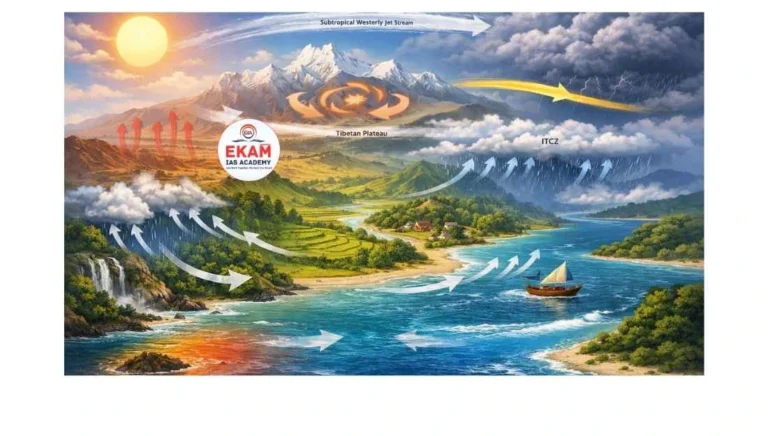
Flohn emphasized the shift of the Inter-Tropical Convergence Zone (ITCZ).
- In summer, the sun is vertical over the Tropic of Cancer.
- The ITCZ (the low-pressure belt where trade winds meet) shifts northward to the Ganga Plains (around 20°N-25°N).
- This shift is often referred to as the Monsoon Trough, which attracts the Southeast Trade Winds from the Southern Hemisphere. After crossing the Equator, these winds deflect right (due to Coriolis Force) and become the Southwest Monsoon.
C. Role of the Tibetan Plateau
The Tibetan Plateau acts as an enormous heat source.
- In summer, it gets intensely heated, causing air to rise and creating a thermal anti-cyclone in the upper troposphere.
- This rising air moves southward and sinks over the Indian Ocean, strengthening the Mascarene High (a high-pressure cell near Madagascar), which in turn pushes more moisture toward India.
D. Jet Streams
- Sub-tropical Westerly Jet Stream: During winter, this jet flows south of the Himalayas. The Onset of Monsoon is triggered only when this jet moves north of the Himalayas.
- Tropical Easterly Jet (TEJ): This jet develops over the peninsula in summer. It is responsible for the “Burst of Monsoon” and the steerage of monsoon depressions into the Indian heartland.
2. The Onset and Progress of Monsoon
The monsoon arrives in India in two major branches:
I. The Arabian Sea Branch
This branch hits the Western Ghats first.
- It causes heavy orographic rainfall on the windward side of the Ghats.
- It enters the mainland through three sub-streams: the Western Ghats, the Narmada-Tapi fault (reaching Central India), and the Saurashtra-Kutch (moving toward Rajasthan).
II. The Bay of Bengal Branch
- It moves toward Northeast India and hits the Arakan Mountains in Myanmar, which deflects a part of it toward the Ganga Plains.
- This branch is responsible for the record-breaking rainfall at Mawsynram and Cherrapunji due to the funnel-shaped Khasi Hills.
3. Important Phenomena of the Monsoon
- Burst of Monsoon: The sudden, violent arrival of rain accompanied by thunder and lightning, usually in the first week of June.
- Break in Monsoon: During the rainy season, if there are one or more weeks without rain, it is called a “break.” This happens when the Monsoon Trough shifts closer to the Himalayas or the Tropical Easterly Jet weakens.
- Retreating Monsoon: In October and November, the sun moves south, the ITCZ shifts back toward the equator, and the winds start blowing from the land to the sea (North-east Monsoon). This brings rain to the Tamil Nadu coast (Coromandel Coast).
4. Global Teleconnections (ENSO & IOD)
UPSC frequently tests the relationship between the monsoon and global oceanic cycles:
- El Niño: Warming of the Central Pacific. It usually weakens the Indian Monsoon, leading to droughts.
- La Niña: Cooling of the Central Pacific. It typically strengthens the Indian Monsoon, leading to surplus rain and floods.
- Indian Ocean Dipole (IOD):
- Positive IOD: Warmer Western Indian Ocean. It enhances monsoon rainfall.
- Negative IOD: Warmer Eastern Indian Ocean. It decreases monsoon rainfall.
UPSC Prelims: PYQs & Practice Questions
Previous Year Questions (PYQs)
1. With reference to the ‘Indian Ocean Dipole (IOD)’, consider the following statements: (2017)
Q:
1. IOD phenomenon is characterized by a difference in sea surface temperature between tropical Western Indian Ocean and tropical Eastern Pacific Ocean.
2. An IOD phenomenon can influence an El Niño’s impact on the monsoon.
Which of the statements given above is/are correct?
(a) 1 only
(b) 2 only
(c) Both 1 and 2
(d) Neither 1 nor 2
Answer: (b) 2 only
Explanation: Statement 1 is incorrect because IOD involves the temperature difference between the Western and Eastern Indian Ocean (not Pacific). Statement 2 is correct; a Positive IOD can neutralize the drought-inducing effects of El Niño.
2. The seasonal reversal of winds is the typical characteristic of: (2014)
Q:
(a) Equatorial climate
(b) Mediterranean climate
(c) Monsoon climate
(d) All of the above
Answer: (c) Monsoon climate
Explanation: The primary definition of a monsoon is the 180° seasonal reversal of wind direction. In India, winds blow from the Southwest in summer and the Northeast in winter.
Practice Questions (Prelims)
Question 1
Q: Consider the following regarding the 'Break in the Monsoon':
1. It occurs when the Monsoon Trough shifts toward the Himalayan foothills.
2. It leads to heavy rainfall in the plains and dry conditions in the mountains.
Which of the statements is/are correct?
(a) 1 only
(b) 2 only
(c) Both 1 and 2
(d) Neither 1 nor 2
Answer: (a) 1 only
Explanation: When the Monsoon Trough shifts toward the Himalayas, the mountains receive heavy rain, while the Indo-Gangetic plains experience a dry spell or "break."
Question 2
Q: The 'Burst of Monsoon' is primarily triggered by:
(a) The arrival of the Westerly Jet Stream south of the Himalayas.
(b) The sudden northward shift of the Sub-tropical Westerly Jet Stream.
(c) The cooling of the Tibetan Plateau.
(d) A decrease in the pressure at the Mascarene High.
Answer: (b)
Explanation: The onset is triggered when the Sub-tropical Westerly Jet Stream moves north of the Himalayas, allowing the Tropical Easterly Jet to establish itself over the peninsula.
UPSC Mains – Previous Year & Practice Questions
Previous Year Questions (Mains)
The Himalayas as a Physical Barrier & Climatic Divide (General Theme)
Question: “The Himalayas are not only a physical barrier but also a climatic divide.” Elaborate with reference to the Indian Monsoon. (General Theme)
Key Focus: Shielding from cold Central Asian winds and trapping the moisture of the SW Monsoon.
Indian Ocean Dipole (IOD) & Monsoon Predictability (General Theme)
Question: “How does the 'Indian Ocean Dipole' (IOD) affect the predictability of the Indian Monsoon?” (General Theme)
Key Focus: Explain the interaction between IOD and ENSO.
Tibetan Plateau as a Thermal Engine for Monsoon (General Theme)
Question: “Explain the role of the Tibetan Plateau as a 'thermal engine' for the intensification of the monsoon.” (General Theme)
Key Focus: Heating of the plateau, rising air, and the formation of the Tropical Easterly Jet.
Retreating Monsoon Mechanism & Coromandel Coast (General Theme)
Question: “Discuss the mechanism of the 'Retreating Monsoon' and its impact on the Coromandel Coast.” (General Theme)
Key Focus: Shift of the ITCZ and moisture pickup from the Bay of Bengal.
India’s Economic Growth as a Gamble on Monsoons (General Theme)
Question: “Economic growth of India is still a gamble on the monsoons.” Comment. (General Theme)
Key Focus: Dependency of agriculture, rural demand, and inflation on monsoon performance.
Mains Practice Questions
Climate Change and the Vagaries of the Indian Monsoon
Question: “Analyze the impact of climate change on the 'vagaries' of the Indian monsoon, focusing on the increasing frequency of dry spells and cloudbursts.”
Arabian Sea vs Bay of Bengal Branch of the Monsoon
Question: “Compare the Arabian Sea branch and the Bay of Bengal branch of the monsoon in terms of rainfall distribution and intensity.”
Mascarene High and the Strength of the Indian Monsoon
Question: “Explain the significance of the 'Mascarene High' in the strength of the Indian monsoon.”



The Indian Monsoon: Mechanism, Theories, and Global Teleconnections- FAQs
What is the 'ITCZ' shift?
The Inter-Tropical Convergence Zone (ITCZ) is a low-pressure belt. In summer, it moves to about 25°N latitude (the Ganga plains). This shift creates the Monsoon Trough, which sucks in the Southeast Trade winds from the Southern Hemisphere.
What is the 'Mascarene High'?
It is a high-pressure area located near Madagascar in the Southern Indian Ocean. The stronger this high-pressure cell is, the more powerful the monsoon winds pushing toward India will be.
Why does the 'Rain Shadow' area exist in the Deccan Plateau?
When the Arabian Sea branch hits the Western Ghats, the air rises and cools on the windward side. As it crosses the mountains and descends into the plateau (leeward side), it warms and dries up, leading to minimal rainfall in regions like Vidarbha or Rayalaseema.
How does El Niño affect India?
El Niño involves the warming of the Pacific waters. It creates a secondary atmospheric circulation that suppresses the rising air over the Indian Ocean, typically leading to weak monsoons or droughts in India.
What is 'Mawsynram' famous for?
Located in the Khasi Hills of Meghalaya, its funnel-shaped topography traps the Bay of Bengal branch of the monsoon, forcing the air to rise vertically and cause the highest average annual rainfall in the world.