Table of Contents
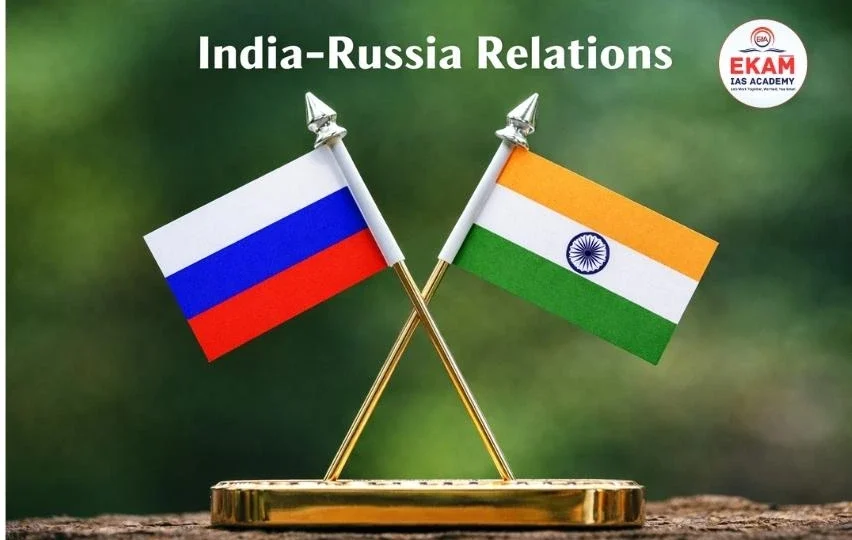
ToggleIndia and Russia share one of the most enduring, strategically rooted, and trust-based bilateral relationships in the world — often described as a “Special and Privileged Strategic Partnership” that has survived the Cold War’s end, Soviet collapse, US pressure, and the Russia-Ukraine War to remain one of India’s most consequential bilateral engagements. For UPSC aspirants studying GS Paper 2 and PSIR Paper 2 Section B, Indian – Russia Relations offer an essential case study of how historical solidarity, defence dependence, energy cooperation, strategic autonomy, and multipolar world order aspirations create a uniquely resilient bilateral relationship that defies the conventional alliance logic of contemporary international politics.
Historical Background of Indian - Russia Relations
Ancient Connections and Modern Diplomatic Roots in Indian - Russia Relations
The civilisational connection between India and Russia — while not as ancient as India’s ties with its immediate neighbours — developed through intellectual, cultural, and literary exchanges beginning in the 19th century. Russian orientalists, scholars, and travellers showed deep interest in Indian philosophy, Sanskrit literature, and Buddhist traditions — with figures like Helena Blavatsky (founder of Theosophy) drawing explicit connections between Indian spiritual traditions and Russian intellectual culture. Rabindranath Tagore’s visits to the Soviet Union in 1930 and his appreciation of Soviet social experiments — while maintaining his commitment to individual freedom — reflected early Indo-Soviet intellectual engagement. Indian nationalists during the independence struggle drew inspiration from the 1917 Bolshevik Revolution as a model of anti-imperialist transformation — creating an early ideological affinity between Indian nationalist aspirations and Soviet revolutionary politics.
The formal foundations of modern India-Soviet bilateral relations were laid immediately after India’s independence — with the Soviet Union recognising India on the very day of independence and establishing diplomatic relations in April 1947. The Soviet Union’s early support was particularly significant because Pakistan received Western backing — the USA through SEATO and CENTO military alliances and Britain through Commonwealth security arrangements — creating a strategic asymmetry that naturally pushed India toward the Soviet Union for diplomatic and eventually military support.
Cold War Era in Indian - Russia Relations
The Strategic Partnership Foundation
The Cold War period (1947–1991) witnessed the foundational construction of India-Soviet bilateral relations — built on three critical pillars that continue to define the relationship’s structural logic.
Political solidarity formed the first pillar. The Soviet Union provided India crucial diplomatic support at the United Nations Security Council — using its veto power to protect India’s positions on Kashmir against Western-backed Pakistan. When the USA and Britain moved UNSC resolutions unfavourable to India on Kashmir in the 1950s and 1960s, Soviet vetoes provided India critical protection. This UNSC veto solidarity created an enduring sense of bilateral trust that India has never fully replicated with any other P5 nation.
Defence cooperation formed the second and most critical pillar. India’s defence relationship with the Soviet Union — beginning in the late 1950s with MiG fighter aircraft transfers — transformed into the most comprehensive defence partnership in India’s bilateral portfolio. By the 1980s, approximately 70–80% of India’s military equipment was of Soviet origin — including MiG-21, MiG-23, MiG-27, MiG-29 fighter aircraft, T-55 and T-72 battle tanks, submarines, destroyers, and frigates, artillery systems, and air defence systems. The Soviet Union transferred defence technology to India on terms unavailable from any Western supplier — including licensed production of military equipment in India, providing India defence industrial capacity that formed the foundation of its indigenous defence industry. This defence dependence created a structural bilateral bond that persists to this day — India’s military operates enormous volumes of Soviet-origin equipment requiring Russian spare parts, upgrades, and technical support.
Economic cooperation formed the third pillar. The Soviet Union provided India significant economic assistance — particularly in the public sector industrial development that Nehru championed. Soviet-assisted projects included: Bhilai Steel Plant (Chhattisgarh) — India’s first integrated steel plant; Bokaro Steel Plant (Jharkhand); Bharat Heavy Electricals Limited (BHEL) — foundation of India’s heavy electrical industry; and multiple hydroelectric and thermal power projects. Soviet economic assistance was provided on concessional terms and rupee payment arrangements — avoiding India’s foreign exchange constraints.
The 1971 Treaty in Indian - Russia Relations
India-Soviet Strategic Partnership at Its Peak
The Indo-Soviet Treaty of Peace, Friendship and Cooperation signed on August 9, 1971 — between PM Indira Gandhi and Soviet Premier Alexei Kosygin — represents the peak of India-Soviet strategic partnership and the most consequential bilateral agreement in India’s foreign policy history. The treaty was signed in the context of Pakistan’s military campaign against Bangladesh — when the USA under President Nixon and National Security Advisor Kissinger was explicitly supporting Pakistan and the USS Enterprise carrier group was deployed to the Bay of Bengal as a coercive signal against India.
The treaty — while carefully avoiding the language of a formal military alliance to preserve India’s Non-Alignment credentials — contained Article IX providing that either party would consult the other if attacked, and Article X requiring neither to assist a third party attacking the other. This security umbrella provided India diplomatic protection against potential US-China intervention during the Bangladesh war — the USSR explicitly warned both Washington and Beijing against intervention. India’s successful 1971 military operation creating Bangladesh was significantly enabled by the strategic deterrence provided by the Indo-Soviet Treaty — making it India’s most valuable bilateral security arrangement in post-independence history.
Post-Cold War Recalibration in Indian - Russia Relations
From Soviet to Russian Partnership
The Soviet Union’s dissolution in December 1991 created the most significant bilateral structural disruption in Indian – Russia Relations. The immediate consequences were severe: India’s primary arms supplier disappeared; the concessional economic assistance framework collapsed; India’s UNSC protection became uncertain as Russia’s diplomatic priorities shifted; and the rupee-ruble trade arrangement — which had facilitated bilateral trade — became dysfunctional. India owed approximately $11 billion in rupee debt to the Soviet Union that had to be renegotiated with Russia.
However, the bilateral relationship demonstrated extraordinary resilience — transitioning from India-Soviet to India-Russia partnership with remarkable continuity. The Treaty of Friendship and Cooperation (1993) between India and Russia — signed by President Boris Yeltsin during his India visit — established the continuation of the bilateral framework under post-Soviet conditions. The Strategic Partnership Declaration (2000) — signed during PM Vajpayee and President Putin’s bilateral — elevated the relationship to a formal strategic partnership level. The Special and Privileged Strategic Partnership (2010) — under PM Manmohan Singh and President Medvedev — represents the current institutional framework of the bilateral.
Defence cooperation survived the Soviet collapse and deepened through the post-Cold War period. The most significant defence agreements include: the BrahMos supersonic cruise missile — a joint India-Russia venture producing the world’s fastest cruise missile, now deployed across Indian Army, Navy, and Air Force; licensed production of Sukhoi Su-30MKI fighters — the backbone of Indian Air Force with 272 aircraft manufactured at Hindustan Aeronautics Limited (HAL) in India; the INS Vikramaditya (originally Admiral Gorshkov) — India’s aircraft carrier refurbished and delivered by Russia; the S-400 Triumf air defence system — India’s most significant recent Russian acquisition worth $5.43 billion signed in 2018 despite US CAATSA threats; and nuclear submarine leasing — India leased two Russian nuclear submarines (INS Chakra) for operational experience.
Energy Cooperation in Indian - Russia Relations
An Emerging Bilateral Pillar
Energy cooperation has emerged as a critically important dimension of contemporary Indian – Russia Relations. The Kudankulam Nuclear Power Plant in Tamil Nadu — developed with Russian VVER reactor technology — is India’s largest nuclear power project with 6 reactors planned (2 operational, 4 under construction/planned). Russia’s Rosatom is India’s primary civilian nuclear partner — providing technology, fuel, and operational support. This nuclear partnership creates a long-term structural energy bond that complements the defence dimension.
Oil and energy trade has dramatically expanded following the Russia-Ukraine War (2022) — when Western sanctions made Russian oil available at significant discounts (estimated $15–25 per barrel below market prices). India dramatically increased its Russian crude oil imports — from negligible levels pre-war to becoming Russia’s second largest oil customer after China. India’s imports of Russian crude rose from approximately 1% of total imports pre-2022 to over 35–40% by 2023 — saving India enormous foreign exchange and reducing its oil import bill significantly. This opportunistic energy partnership has transformed the bilateral’s economic dimension while simultaneously creating diplomatic friction with Western partners.
Russia-Ukraine War and Indian - Russia Relations
India’s Defining Strategic Autonomy Test
The Russia-Ukraine War launched on February 24, 2022 created India’s most significant strategic autonomy test in decades — requiring India to simultaneously maintain its Russian partnership while managing Western pressure to condemn Russia and join sanctions. India’s response demonstrated classic strategic autonomy — nuanced, interest-driven, and independent.
India abstained at the UNSC and UNGA resolutions condemning Russia’s invasion — joining China, Pakistan, and a few others rather than the Western bloc. India refused to join Western sanctions against Russia — citing the impact on Indian energy security and defence supply chains. India continued purchasing Russian oil at discounted prices — generating significant economic savings. India maintained S-400 procurement despite CAATSA threats. Simultaneously, India condemned civilian casualties and humanitarian violations; called for “respect for sovereignty and territorial integrity” of all nations; PM Modi told Putin at the SCO Samarkand Summit (September 2022): “This is not an era of war” — India’s most direct statement to Russia on the conflict. India provided humanitarian assistance to Ukraine and voted for UN resolutions on humanitarian corridors.
India’s Russia-Ukraine War position reflected several strategic calculations: approximately 60% of India’s military equipment is of Russian origin — requiring spare parts, upgrades, and maintenance support that cannot be immediately replaced; immediate defence supply disruption during the conflict would leave India strategically vulnerable particularly given LAC tensions with China; discounted Russian oil significantly reduces India’s import bill providing economic relief; strategic autonomy requires not allowing any single relationship — including with the USA — to dictate India’s positions; and India genuinely believes in dialogue and diplomacy over military confrontation.
Harsh V. Pant argues India successfully demonstrated “mature strategic autonomy” — protecting multiple national interests simultaneously without being captured by any single power’s agenda. C. Raja Mohan acknowledges India’s Russia position while noting that sustained Russian dependence may limit India’s strategic flexibility as Russia increasingly becomes a junior partner of China.
Key Challenges in Indian - Russia Relations
Contemporary Constraints and Strategic Contradictions
Russia’s deepening China embrace represents the most significant structural challenge for India’s Russia relationship. The Russia-China “no limits” partnership announced in February 2022 — just before the Ukraine invasion — reflects Russia’s growing dependence on China for economic, diplomatic, and strategic support. For India, this creates a strategic contradiction — India’s primary defence partner is increasingly aligned with India’s primary strategic rival. As Shyam Saran warns, India must carefully monitor whether Russia’s China alignment compromises Russia’s value as a strategic partner and arms supplier to India.
Defence supply disruption has become a practical challenge. Russia’s own military consumption during the Ukraine War has affected its ability to deliver defence equipment and spare parts to India — creating supply chain vulnerabilities in India’s military readiness. This has accelerated India’s defence diversification — towards the USA (foundational defence agreements), France (Rafale, Scorpene), and Israel — and the Atmanirbhar Bharat initiative in defence.
CAATSA threat remains a latent bilateral challenge. The US CAATSA law threatens secondary sanctions on countries purchasing Russian defence systems — India’s S-400 procurement is the most significant potential trigger. While the USA has so far waived CAATSA sanctions on India — recognising the strategic cost of sanctioning a critical Indo-Pacific partner — the threat remains legally alive and creates bilateral friction with the USA that is managed but not resolved.
India’s Current Stand in Indian - Russia Relations
Multi-Alignment Preserves Russia Partnership
India’s current position on Russia is guided by “strategic autonomy through multi-alignment” — maintaining the Russian partnership as one critical element of a diversified foreign policy portfolio rather than as an exclusive alliance. India’s approach involves: continuing defence cooperation while accelerating diversification; deepening energy partnership through Kudankulam and oil trade; maintaining diplomatic engagement through 2+2 dialogue mechanisms, regular bilateral summits, and multilateral cooperation in BRICS, SCO, and RIC (Russia-India-China) trilateral frameworks; and clearly communicating to Russia that India’s China concerns must be acknowledged and addressed within the bilateral partnership.
S. Jaishankar has articulated India’s Russia approach most clearly — India is “not non-aligned but multi-aligned” — maintaining Russian partnership while deepening USA ties, French partnership, and QUAD engagement simultaneously. As India’s most experienced diplomatic voice on Russia, Jaishankar argues that abandoning Russia under Western pressure would reduce India’s strategic options without meaningfully changing Russia’s Ukraine conduct.
Conclusion on Indian - Russia Relations
Indian – Russia Relations have demonstrated extraordinary bilateral resilience — surviving Soviet collapse, post-Cold War realignment, US pressure through CAATSA, and Russia-Ukraine War sanctions pressure — to remain one of India’s most strategically consequential bilateral partnerships. The relationship’s strength stems from defence dependence, nuclear cooperation, energy complementarity, and shared commitment to multipolarity rather than values alignment or formal alliance. The Russia-China deepening and defence supply disruption created by the Ukraine War represent genuine challenges requiring careful bilateral management and accelerated defence diversification. For UPSC aspirants, Indian – Russia Relations offer the most sophisticated case study of how strategic autonomy, realpolitik, historical trust, and pragmatic national interest simultaneously shape a bilateral relationship in the 21st century multipolar world order.
UPSC Prelims: PYQs & Practice Questions
Previous Year Questions (Prelims)
Q1. [UPSC CSE Prelims 2019]
Q: Recently, India signed a deal known as 'Action Plan for Prioritization and Implementation of Cooperation Areas in the Nuclear Field' with which of the following countries?
(a) Japan
(b) Russia
(c) The United Kingdom
(d) The United States of America
Answer: (b) Russia
Explanation:
During the 19th India-Russia Annual Bilateral Summit in 2018, both countries signed this action plan to strengthen civil nuclear cooperation. It focused particularly on the construction of six more nuclear reactors at a new site in India, highlighting the strategic depth of India-Russia partnership in the nuclear energy sector.
Q2. [UPSC CSE Prelims 2014]
Q: Which one of the following is the best description of 'INS Vikramaditya', which was in the news?
(a) Amphibious warfare ship
(b) Nuclear-powered submarine
(c) Aircraft carrier
(d) Stealth destroyer
Answer: (c) Aircraft carrier
Explanation:
INS Vikramaditya is a modified Kiev-class aircraft carrier acquired by India from Russia. Formerly known as Baku/Admiral Gorshkov, it was commissioned into the Indian Navy in 2013. Its induction significantly strengthened India’s naval aviation capability and reflected the long-standing India-Russia defence partnership.
Practice Questions
Q: With reference to the 'BrahMos Missile', consider the following statements:
1. It is a joint venture between India and Russia.
2. It is a surface-to-surface missile only.
3. It has a flight range of up to 290 km (original version).
Which of the statements given above is/are correct?
(a) 1 and 2 only
(b) 1 and 3 only
(c) 2 and 3 only
(d) 1, 2, and 3
Answer: (b) 1 and 3 only
Explanation:
BrahMos is a joint venture between India and Russia, so Statement 1 is correct. Statement 2 is incorrect because BrahMos is not only a surface-to-surface missile; it can be launched from land, sea, submarine platforms, and air. Statement 3 is correct for the original version, which had a range of about 290 km.



UPSC Mains – Previous Year & Practice Questions
Mains Previous Year Questions
Q1. [UPSC CSE Mains GS2 2021 | 15 Marks]
Question: Critically examine the aims and objectives of SCO (Shanghai Cooperation Organization). What importance does it hold for India?
Q2. [UPSC CSE Mains GS2 2020 | 15 Marks]
Question: What is the significance of Indo-US defence deals over Indo-Russian defence deals? Discuss with reference to stability in the Indo-Pacific region.
Q3. [UPSC CSE Mains GS2 2021 | 15 Marks]
Question: The newly tri-nation partnership AUKUS is aimed at countering China’s ambitions in the Indo-Pacific region. Is it going to supersede the existing partnerships in the region? Discuss.
Q4. [UPSC CSE Mains GS2 2016 | 12.5 Marks]
Question: Evaluate the economic and strategic dimensions of India’s Look East Policy in the context of the post-Cold War international scenario.
Q5. [UPSC CSE Mains GS2 (Trend-Based)]
Question: Russia and India share a 'Special and Privileged Strategic Partnership'. Discuss the challenges to this relationship in the current global geopolitical scenario.
Mains Practice Questions
Q1. [15 Marks | 250 Words]
Question: "Despite the increasing proximity between India and the United States, Russia remains a time-tested and indispensable partner for India's national security." Discuss.
Q2. [10 Marks | 150 Words]
Question: "The trade imbalance remains the 'Achilles' heel' of the India-Russia economic relationship. Suggest measures to diversify bilateral trade beyond oil and defense."
Q3. [15 Marks | 250 Words]
Question: "Analyze the impact of the growing Russia-China 'no-limits' partnership on India's strategic autonomy."