Table of Contents
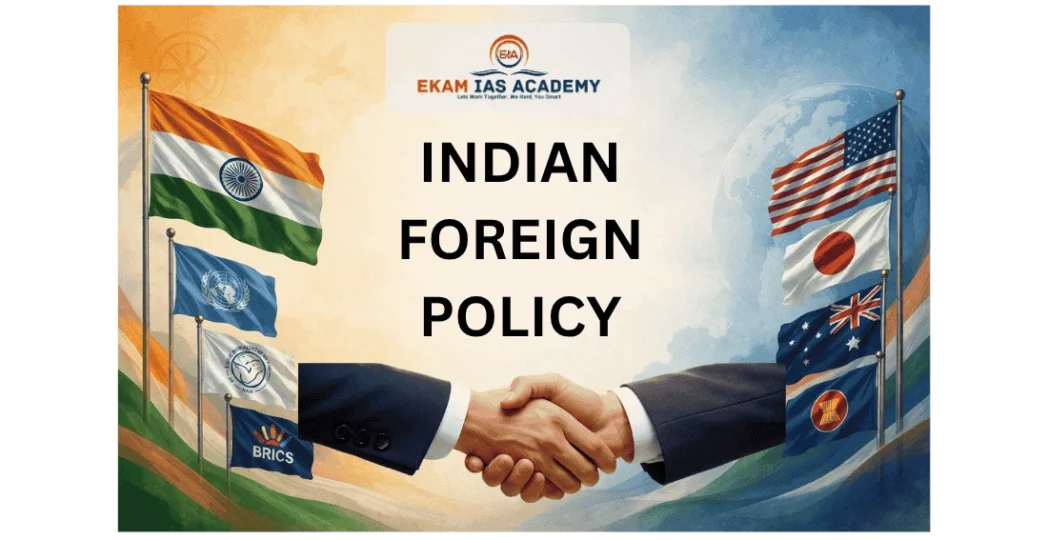
ToggleIndia’s foreign policy is one of the most sophisticated and evolving frameworks in the world, shaped by millennia of civilisational history, colonial experience, post-independence idealism, and contemporary geopolitical realism. Understanding Indian Foreign Policy (IFP) is essential for UPSC aspirants studying GS Paper 2 and PSIR Paper 2 Section B, as it forms the bedrock of all bilateral and multilateral discussions in International Relations.
Historical Background: Civilisational Roots and Colonial Legac
India’s foreign policy consciousness did not begin in 1947 — it has deep civilisational roots. Ancient Indian statecraft was guided by Kautilya’s Arthashastra, which articulated the Mandala theory — a sophisticated framework of concentric circles of friends, enemies, and neutrals. The principle that “the enemy of my enemy is my friend” and the idea of strategic engagement over isolation find their modern echoes in India’s foreign policy behaviour even today.
The colonial experience under British rule fundamentally shaped independent India’s foreign policy orientation. India emerged from 200 years of exploitation with a deep suspicion of Western imperialism, a strong commitment to national sovereignty, and a fierce desire to assert its independent identity on the world stage. Jawaharlal Nehru, India’s first Prime Minister and the architect of Indian foreign policy, translated these experiences into concrete principles — most notably Non-Alignment, anti-colonialism, anti-racism, and peaceful coexistence.
India and Iran share one of the most ancient civilisational bonds in the world, dating back to the 3rd century BC. Long before modern diplomacy existed, the two nations were connected through the ancient Silk Route, facilitating exchange of spices, cotton, silk, ideas, philosophy, and culture. The Mughal-Safavid connection deepened this bond further — Babur, the founder of the Mughal Empire, traced his roots to Central Asia via Persia, and Persian became the court language of Mughal India. Sufi saints, scholars like Al-Biruni and poets like Amir Khusro carried the civilisational thread between the two nations across centuries. Until 1947, Iran was India’s immediate geographical neighbour, and it remains India’s maritime neighbour to this day.
The Nehruvian Era: Idealism, NAM, and Panchsheel
The Nehruvian era (1947–1964) defined Indian foreign policy through idealism and moral leadership. The five foundational principles of Panchsheel (1954) — mutual respect for sovereignty, non-aggression, non-interference, equality, and peaceful coexistence — became India’s diplomatic signature, co-authored with China’s Zhou Enlai. India became a founding pillar of the Non-Aligned Movement (NAM), refusing to join either the US-led Western bloc or the Soviet-led Eastern bloc during the Cold War.
However, the 1962 Sino-Indian War shattered Nehruvian idealism and exposed the limits of moral diplomacy in a realist world. The defeat forced India to confront hard security realities and marked the beginning of a gradual shift from pure idealism to pragmatic realism in Indian foreign policy.
Cold War Phase: Shifting Alignments and the Soviet Tilt
Despite official non-alignment, India developed a strategic tilt towards the Soviet Union through the 1971 Indo-Soviet Treaty of Peace, Friendship, and Cooperation — a landmark agreement signed during the Bangladesh Liberation War. This treaty provided India crucial diplomatic cover against potential US-China interference. India’s 1974 Pokhran nuclear test further demonstrated its assertion of strategic autonomy on the global stage, though it triggered international sanctions and deepened India’s nuclear isolation.
The 1991 economic crisis and the collapse of the Soviet Union fundamentally altered India’s strategic environment, forcing a complete recalibration of foreign policy to align with the new unipolar world order led by the United States.
Post-1991 Liberalisation: From Idealism to Pragmatic Engagement
The 1991 LPG Reforms (Liberalisation, Privatisation, Globalisation) did not just transform India’s economy — they transformed its foreign policy DNA. India launched the Look East Policy under Prime Minister Narasimha Rao, signalling a decisive pivot towards Southeast and East Asia. India established full diplomatic relations with Israel in 1992, ending decades of ideological hesitancy. The 1998 Pokhran-II nuclear tests under Prime Minister Atal Bihari Vajpayee announced India’s arrival as an overt nuclear weapons state, triggering global sanctions but ultimately leading to India’s recognition as a de facto nuclear power through the landmark India-US Civil Nuclear Deal of 2008 under Prime Minister Manmohan Singh.
This deal became a watershed in India-US relations, signalling India’s strategic convergence with the West without abandoning its core principle of strategic autonomy.
Post-2014 Transformation: Modi Doctrine and New Assertiveness
The election of Prime Minister Narendra Modi in 2014 marked the most significant transformation in Indian foreign policy since Nehru. The Modi Doctrine is characterised by several distinctive features. First, an unprecedented diplomatic outreach — Modi became the most widely travelled Indian Prime Minister, conducting high-frequency bilateral summits and diaspora diplomacy across continents. Second, a decisive shift from idealism to pragmatism — ideology gave way to national interest, economic diplomacy, and strategic partnerships.
Third, the Neighbourhood First Policy placed India’s immediate neighbourhood — Pakistan, Nepal, Bangladesh, Bhutan, Sri Lanka, Myanmar, Maldives, and Afghanistan — at the centre of India’s foreign policy priorities, reflecting the Kautilyan logic of Mandala siddhanta — “when you have complicated ties with neighbours, it makes sense to strengthen ties with your neighbours’ neighbours.”
Fourth, India’s active engagement with the Indo-Pacific construct through membership in the Quadrilateral Security Dialogue (Quad) — comprising India, USA, Japan, and Australia — signalled India’s willingness to play a larger security role in the Indo-Pacific, balancing China’s growing assertiveness. Fifth, India’s Act East Policy replaced the Look East Policy, upgrading engagement with ASEAN, Japan, South Korea, and Australia from a trade framework to a comprehensive strategic partnership framework.
Core Principles That Continue to Guide Indian Foreign Policy
Despite all transformations, certain foundational principles have remained constant across all governments. Strategic Autonomy — India’s refusal to join permanent military alliances — remains the defining characteristic. As External Affairs Minister S. Jaishankar articulated, “the age of alliances is over and India will go for issue-based partnerships.” Multilateralism — India’s active engagement with the United Nations, G20, SCO, BRICS, and IBSA — reflects its belief in a rule-based international order. South-South Cooperation — India’s developmental partnerships with Africa, Latin America, and Central Asia — reflects its civilisational responsibility as a rising power.
Current Challenges and India's Contemporary Stand
India’s foreign policy today navigates an extraordinarily complex landscape. The India-China rivalry — marked by the 2020 Galwan Valley clash and ongoing LAC tensions — has become the defining strategic challenge. India’s management of the Russia-Ukraine War demonstrated classic strategic autonomy — India abstained at the UNSC, continued purchasing Russian oil at discounted prices, and resisted Western pressure, all while deepening its strategic partnerships with the USA and Europe simultaneously.
India’s G20 Presidency in 2023 marked a defining moment — the New Delhi Declaration achieved consensus among deeply divided powers, showcasing India’s capacity for global leadership and bridge-building diplomacy. India’s successful Chandrayaan-3 mission and growing role in global supply chains further enhanced its soft power and economic diplomacy credentials.
C. Raja Mohan describes India’s present foreign policy as “high-octane diplomacy” — ambitious, multi-directional, and unapologetically interest-driven. Harsh V. Pant argues that India has finally shed its post-colonial hesitancy and embraced the role of a net security provider in the Indo-Pacific.
Conclusion
Indian Foreign Policy has travelled a remarkable journey — from Nehruvian idealism to Vajpayee’s pragmatism, from Manmohan Singh’s economic diplomacy to Modi’s assertive bilateralism. What remains unchanged is India’s commitment to strategic autonomy, sovereign decision-making, and civilisational responsibility. For UPSC aspirants, understanding this continuity and change in Indian Foreign Policy is not just an examination requirement — it is essential to understanding India’s place in the emerging multipolar world order.
UPSC Prelims: PYQs & Practice Questions
Previous Year Questions (Prelims)
Q1. [UPSC CSE Prelims 2015]
Q: With reference to the 'Panchsheel Agreement', which of the following statements is/are correct?
1. It was signed between India and China in 1954.
2. It laid down five principles of peaceful coexistence.
3. It was signed during the tenure of Prime Minister Jawaharlal Nehru.
Select the correct answer:
(a) 1 only
(b) 1 and 2 only
(c) 2 and 3 only
(d) 1, 2 and 3
Answer: (d) 1, 2 and 3
Explanation: The Panchsheel Agreement was signed on April 29, 1954 between India and China during Prime Minister Jawaharlal Nehru’s tenure. It laid down five principles: mutual respect for sovereignty and territorial integrity, mutual non-aggression, mutual non-interference, equality and mutual benefit, and peaceful coexistence. Hence, all three statements are correct. Panchsheel later became a key philosophical pillar of India’s foreign policy and Non-Aligned outlook.
Q2. [UPSC CSE Prelims 2016]
Q: The Non-Aligned Movement (NAM) was formally founded at which of the following conferences?
(a) Bandung Conference, 1955
(b) Belgrade Conference, 1961
(c) Cairo Conference, 1964
(d) Colombo Conference, 1976
Answer: (b) Belgrade Conference, 1961
Explanation: The Bandung Conference of 1955 laid the ideological groundwork for the Non-Aligned Movement by bringing together Asian and African countries. However, NAM was formally established at the First NAM Summit held in Belgrade, Yugoslavia, in 1961. Jawaharlal Nehru, Josip Broz Tito, and Gamal Abdel Nasser were among its principal architects. Bandung was the precursor, not the founding event.
Practice Questions
Practice Q1
Q: Which of the following best describes the 'Mandala Theory' of Kautilya and its relevance to Indian foreign policy?
(a) A theory advocating complete isolation from neighbouring states
(b) A theory of concentric circles where immediate neighbours are potential enemies and neighbours' neighbours are potential friends
(c) A theory of military expansion through conquest
(d) A theory of economic integration with neighbouring nations
Answer: (b) A theory of concentric circles where immediate neighbours are potential enemies and neighbours' neighbours are potential friends
Explanation: Kautilya's Mandala Theory from the Arthashastra describes foreign policy as a system of concentric circles — the immediate neighbour is a natural rival, while the neighbour's neighbour is a natural ally. This ancient logic continues to inform Indian strategic thinking in its outreach to countries such as Iran, Afghanistan, Central Asia, and Russia while managing difficult ties with immediate neighbours.
Practice Q2
Q: Consider the following about India's G20 Presidency in 2023:
1. India's G20 Presidency theme was "Vasudhaiva Kutumbakam — One Earth, One Family, One Future."
2. The New Delhi Declaration achieved unanimous consensus among all G20 members.
3. India used its G20 Presidency to advocate for the African Union's permanent membership in the G20.
Which of the above is/are correct?
(a) 1 only
(b) 1 and 3 only
(c) 1, 2 and 3
(d) 2 and 3 only
Answer: (c) 1, 2 and 3
Explanation: India's G20 Presidency used the theme "Vasudhaiva Kutumbakam — One Earth, One Family, One Future." The New Delhi Declaration secured unanimous consensus despite major geopolitical divisions, and India strongly pushed for the African Union’s inclusion as a permanent G20 member. Together, these reflected India’s attempt to project civilisational values and leadership in multilateral diplomacy.



UPSC Mains – Previous Year & Practice Questions
Mains Previous Year Questions
Q1. [UPSC CSE Mains GS2 2015 | 12.5 Marks]
Question: What are the determinants of India's foreign policy? How have they evolved since independence?
Q2. [UPSC CSE Mains GS2 2017 | 15 Marks]
Question: “Non-Alignment has lost its relevance in the post-Cold War world.” Critically examine this statement with reference to India's foreign policy choices.
Q3. [UPSC CSE Mains GS2 2019 | 15 Marks ]
Question: “India's foreign policy since 2014 represents a fundamental shift from idealism to realpolitik.” Discuss the major changes in Indian foreign policy under the Modi government.
Q4. [UPSC CSE Mains GS2 2021 | 15 Marks]
Question: India's abstention on resolutions related to the Russia-Ukraine War at the UN has been criticised as abandonment of its principled foreign policy. Do you agree? Analyse India's position.
Q5. [UPSC CSE Mains GS2 2023 | 20 Marks]
Question: Examine the continuity and change in Indian foreign policy from Nehru to Modi. What factors account for both the enduring principles and the significant shifts?
Mains Practice Questions
Q1. [PSIR Paper 2 / GS2 | 20 Marks]
Question: “India's foreign policy under Modi represents the end of post-colonial hesitancy and the beginning of civilisational confidence.” Critically evaluate this assertion.
Q2. [GS Paper 2 | 15 Marks]
Question: How has India's multilateral engagement — through the UN, G20, SCO, BRICS, and Quad — shaped its foreign policy identity as a rising global power?
Q3. [PSIR Paper 2 | 20 Marks]
Question: “The biggest challenge to Indian foreign policy in the 21st century is managing the simultaneous rise of China and India's deepening partnership with the United States.” Analyse.