Table of Contents
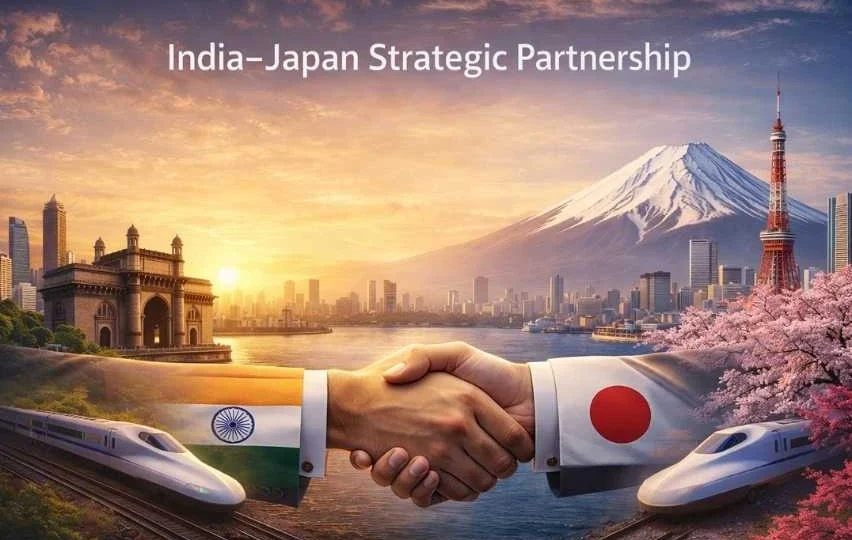
ToggleThe India-Japan relations UPSC syllabus highlights a partnership that is often described as the most natural in the Indo-Pacific region. Elevated to a Special Strategic and Global Partnership, the bond is built on a shared commitment to democracy, human rights, and the rule of law. For India, Japan is not just a leading investor but a vital partner in its quest for technological modernization and regional security.
Historical Background
The spiritual foundation of the relationship was laid by Buddhism, which reached Japan in the 6th century. In the modern era, the Indo-Japan bond was strengthened by the symbolic gesture of Justice Radhabinod Pal at the Tokyo Trials and the gift of an elephant named ‘Indira’ to Tokyo’s Ueno Zoo in 1949. Formal diplomatic ties were established in 1952, making India one of the first nations to sign a peace treaty with Japan after World War II.
Strategic Significance
Japan is central to India’s vision of a “Free and Open Indo-Pacific” (FOIP).
- Maritime Security: Both nations occupy strategic positions along vital sea lines of communication (SLOCs).
- Counter-Hegemony: A strong India-Japan strategic partnership acts as a stabilizer against unilateral attempts to change the status quo in Asia.
- Economic Synergy: Japan’s capital and high-end technology complement India’s massive market and human resources.
Key Areas of Cooperation
- Infrastructure: Japan is the force behind the Mumbai-Ahmedabad High-Speed Rail (MAHSR) and the Dedicated Freight Corridors (DFC).
- Defense: Cooperation is characterized by the “2+2” Ministerial Dialogue and joint exercises like Dharma Guardian (Army), JIMEX (Navy), and Veer Guardian (Air Force).
- Connectivity: The Asia-Africa Growth Corridor (AAGC) and development projects in India’s North-East focus on creating high-quality infrastructure.
- Supply Chains: The Supply Chain Resilience Initiative (SCRI), involving India, Japan, and Australia, aims to reduce dependency on a single manufacturing hub (China).
Recent Developments
- Semiconductor Cooperation: A landmark MoU on the Semiconductor Supply Chain to build an ecosystem for design and manufacturing.
- Clean Energy Partnership: Collaborative efforts in Green Hydrogen, electric vehicles (EVs), and battery storage.
- Industrial Competitiveness Partnership: Roadmap to increase Japan’s investment in India’s manufacturing sector to 5 trillion yen by 2027.
Importance for India’s Foreign Policy
- Act East Policy: Japan is the most critical partner in India’s engagement with East and Southeast Asia.
- Strategic Autonomy: Deepening ties with Tokyo allows New Delhi to navigate the US-China rivalry without compromising its core interests.
- Multilateralism: Cooperation within the Quad, G20, and G7 (as guests) allows both to lead the “Global South” agenda.
Challenges
- Trade Deficit: Despite a Comprehensive Economic Partnership Agreement (CEPA), the trade volume remains below potential, with a significant deficit on India’s side.
- Nuclear Sensitivities: Different historical perspectives on nuclear weapons occasionally influence domestic debates in Japan regarding civil nuclear cooperation.
- Infrastructure Delays: Complexity in land acquisition and bureaucratic hurdles in India sometimes slow down Japan-funded projects.
Way Forward
- Defense Technology Transfer: Moving from a buyer-seller model to co-development of defense equipment under ‘Make in India.’
- Digital Partnership: Integrating India’s UPI with Japanese digital payment systems and collaborating on Cyber Security.
- People-to-People Ties: Enhancing the Specified Skilled Worker (SSW) program to address Japan’s labor shortage with Indian talent.
Conclusion
For IR UPSC notes Japan, the relationship is defined by a convergence of interests and values. As the global order shifts toward the Indo-Pacific, the synergy between India’s SAGAR vision and Japan’s FOIP will be the deciding factor for regional peace. The partnership is no longer just bilateral; it is a global force for good.
UPSC Prelims: PYQs & Practice Questions
Previous Year Questions (Prelims)
Q: With reference to the 'Mumbai-Ahmedabad High-Speed Rail' (MAHSR) project, consider the following statements:
1. It is being developed with technical and financial assistance from Japan.
2. The project utilizes the Shinkansen technology.
Which of the statements given above is/are correct?
(a) 1 only
(b) 2 only
(c) Both 1 and 2
(d) Neither 1 nor 2
Answer: (c) Both 1 and 2
Explanation:
Both statements are correct. The Mumbai-Ahmedabad High-Speed Rail project is being developed with major technical and financial support from Japan, including a soft loan through JICA. It also uses Japan’s renowned Shinkansen high-speed rail technology, making it a flagship symbol of India-Japan strategic and infrastructure cooperation.
Q: Which of the following is the best description of 'Dharma Guardian', often seen in the news?
(a) A joint initiative for maritime security in the South China Sea.
(b) An annual joint military exercise between India and Japan.
(c) A bilateral agreement on civil nuclear cooperation.
(d) A cultural exchange program celebrating the Buddhist circuit.
Answer: (b) An annual joint military exercise between India and Japan
Explanation:
Dharma Guardian is an annual joint military exercise conducted between the Indian Army and the Japanese Ground Self-Defense Force. It focuses on improving interoperability and sharing best practices in areas such as counter-terrorism and urban warfare.
Practice Questions
Q: In the context of the Indo-Pacific, the 'Supply Chain Resilience Initiative' (SCRI) was launched by India, Japan, and which other country? (Mock-based)
(a) USA
(b) Australia
(c) Vietnam
(d) South Korea
Answer: (b) Australia
Explanation:
The Supply Chain Resilience Initiative was launched in 2021 by India, Japan, and Australia. Its objective is to reduce overdependence on a single manufacturing hub, especially China, and to build more resilient and diversified supply chains across the Indo-Pacific region.
UPSC Mains – Previous Year & Practice Questions
Mains Previous Year Questions
Q1. [UPSC CSE Mains 2023]
Question: Discuss the strategic importance of the Indo-Pacific region for India, particularly in the context of maritime security and the 'Act East' Policy.
Q2. [UPSC CSE Mains 2016]
Question: Evaluate the economic and strategic dimensions of India’s Look East Policy in the context of the post-Cold War international scenario.
Question: The '2+2' Ministerial Dialogue is a significant shift in India’s engagement with Japan. Analyze its impact on the bilateral strategic partnership.
Question: Analyze the importance of the India-Japan partnership in developing the infrastructure of India’s North-Eastern region.
Question: Critically examine the aims and objectives of the Quad (Quadrilateral Security Dialogue) and Japan's role in its institutionalization.
Mains Practice Questions
Q1. [15 Marks | 250 Words]
Question: "The India-Japan partnership is described as the 'most natural' in the Indo-Pacific. Analyze the shared values and strategic convergences that drive this bond."
Q2. [10 Marks | 150 Words]
Question: Examine the significance of the 'Asia-Africa Growth Corridor' (AAGC) as an alternative to China’s Belt and Road Initiative (BRI).
Q3. [15 Marks | 250 Words]
Question: "Despite strong political and strategic ties, bilateral trade between India and Japan remains stagnant. Identify the bottlenecks and suggest measures to bridge this gap."



India-Japan Relations-fAQs
What is the '2+2 Dialogue'?
It is a high-level institutional mechanism where the Foreign and Defense Ministers of both countries meet to discuss strategic, security, and defense cooperation. India has this format with only a few key partners like the US, Japan, Australia, and Russia.
How does Japan help in India's North-East?
Japan is the only country India has allowed to invest in infrastructure projects in the sensitive North-Eastern states. The India-Japan Act East Forum coordinates projects in road connectivity, electricity, and water supply to transform the NE into a gateway to Southeast Asia.
What are JIMEX and Veer Guardian?
These are bilateral military exercises. JIMEX is a naval exercise, while Veer Guardian is the inaugural joint air exercise between the Indian Air Force and the Japan Air Self-Defense Force, started in 2023.
What is the significance of the Civil Nuclear Deal (2016)?
It was a landmark agreement because it was the first time Japan signed such a deal with a non-signatory of the NPT (Nuclear Non-Proliferation Treaty). It allows Japanese companies to supply nuclear reactors and technology to India.
Why is 'Haifa Port' in Israel mentioned in the context of India-Japan-UAE?
Under the I2U2 and broader trilaterals, India and Japan often collaborate on third-country projects. The Adani Group (India) and Japanese firms have shown interest in infrastructure that aligns with the IMEC corridor, where Japan provides technological/financial backing for Indian-led regional projects.