Table of Contents
ToggleEvery organism in an ecosystem has a specific place where it lives and a specific role it performs. While these terms are often used interchangeably in casual conversation, in ecology, they represent two distinct dimensions of an organism’s life. Understanding an organism’s “address” versus its “profession” is a fundamental ecological concept UPSC tests frequently.
What is a Habitat?
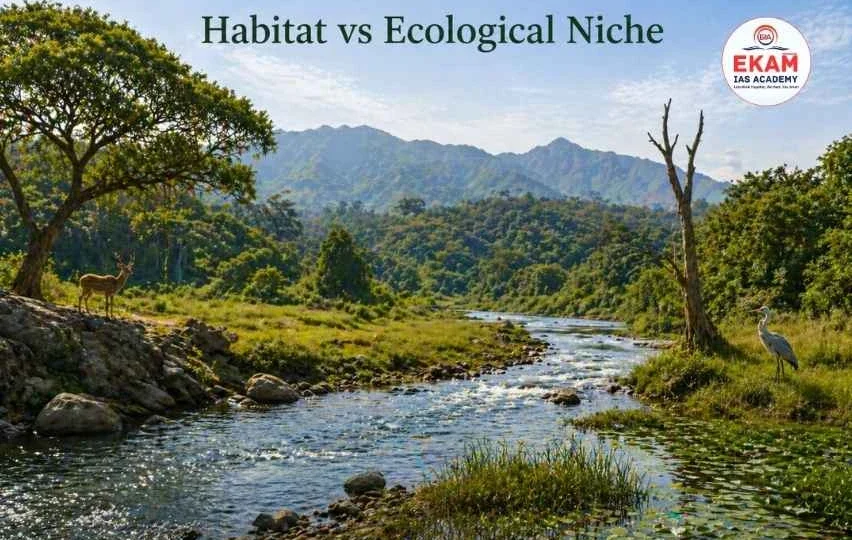
Definition: A Habitat is the physical environment in which an organism lives. It is the natural home or environment of a plant, animal, or other organism that provides the necessary resources like food, water, shelter, and space for survival.
Types of Habitat
Habitats are broadly classified based on their physical characteristics:
Terrestrial Habitats: Land-based environments such as forests, grasslands, deserts, and mountains.
Aquatic Habitats: Water-based environments, divided into Freshwater (ponds, rivers) and Marine (oceans, coral reefs).
Arboreal Habitats: Specific to animals that live primarily in trees, such as certain primates.
Microhabitats: Small-scale localized environments, such as the underside of a rock or the bark of a decaying log.
What is an Ecological Niche?
Definition: An Ecological Niche is a term coined by Roswell Hill Johnson but popularized by Joseph Grinnell and Charles Elton. It refers to the functional role and position of a species in its ecosystem, including its use of resources and its interactions with other species.
Types of Ecological Niche
A niche is multi-dimensional and includes:
- Habitat Niche: Where the organism lives specifically within the habitat.
- Food Niche: What the organism eats, what it competes with, and its position in the food web.
- Reproductive Niche: How and when it reproduces.
- Physical & Chemical Niche: The range of temperature, humidity, and land slope it can tolerate.
Key Difference Between Habitat and Niche
Understanding the difference between habitat and niche is vital for the Preliminary exam:
| Feature | Habitat | Ecological Niche |
| Basic Concept | The “Address” of an organism. | The “Profession” (Role) of an organism. |
| Components | Physical/Abiotic factors (soil, water). | Biological, Physical, and Chemical factors. |
| Specificity | Multiple species can share the same habitat. | No two species can occupy the exact same niche (Gause’s Law). |
| Focus | Focuses on the environment. | Focuses on the organism’s interaction. |
Important Concepts Related to Niche
- Gause’s Competitive Exclusion Principle: States that two species competing for the exact same resources cannot coexist indefinitely. One will eventually outcompete the other.
- Niche Partitioning: To avoid competition, species evolve to use different resources or the same resource at different times (e.g., different birds feeding on different parts of the same tree).
- Fundamental vs. Realized Niche: The Fundamental Niche is the entire set of conditions under which a species can survive, while the Realized Niche is the actual conditions used after accounting for competition and predation.
Examples for Better Understanding
- The Tiger: Its habitat is the tropical evergreen forest. Its niche is that of a “top predator” that controls the population of herbivores like deer, maintaining the health of the vegetation.
- The Mangrove: Its habitat is the intertidal zone. Its niche involves stabilizing the shoreline and acting as a nursery for juvenile fish.
Importance in Environmental Management and Conservation
- Conservation of Endangered Species: To save a species like the Snow Leopard, we must protect not just its habitat but ensure its niche (prey base like Blue Sheep) is intact.
- Invasive Species Management: Invasive species often succeed because they occupy an “empty niche” or outcompete native species for their niche.
- Ecosystem Services: Understanding niches helps in valuing ecosystem services, such as pollination by bees or water purification by wetlands.
Conclusion
In conclusion, while a habitat provides the space for life, the ecological niche defines how life persists and interacts. For the environment notes UPSC preparation, remember that a healthy ecosystem requires diverse niches to be filled to maintain the balance of nature.
UPSC Prelims: PYQs & Practice Questions
Previous Year Questions (Prelims)
Q: Which one of the following terms describes not only the physical space occupied by an organism, but also its functional role in the community of organisms?
(a) Ecotone
(b) Ecological niche
(c) Habitat
(d) Home range
Answer: (b) Ecological niche
Explanation:
This is the classic definition of an Ecological Niche. While Habitat is the physical “address,” the niche includes the “profession” or functional role, such as how an organism uses resources and interacts with other species.
Q: In the context of ecosystem productivity, marine upwelling zones are important as they increase marine productivity by bringing the:
1. Decomposer microorganisms to the surface.
2. Nutrients to the surface.
3. Bottom-dwelling organisms to the surface.
Which of the statements given above is/are correct?
(a) 1 and 2
(b) 2 only
(c) 2 and 3
(d) 3 only
Answer: (b) 2 only
Explanation:
Upwelling brings nutrient-rich waters to the surface. This supports the growth of primary producers like phytoplankton, which increases marine productivity and supports diverse ecological niches in the marine food web.
Practice Questions
Q: With reference to the Competitive Exclusion Principle (Gause's Law), consider the following statements:
1. It states that two species with identical niches cannot coexist indefinitely.
2. It inevitably leads to the extinction of the less competitive species in all scenarios.
3. Species may evolve niche partitioning to avoid the consequences of this principle.
Which of the statements given above are correct?
(a) 1 and 2 only
(b) 1 and 3 only
(c) 2 and 3 only
(d) 1, 2, and 3
Answer: (b) 1 and 3 only
Explanation:
The Competitive Exclusion Principle states that two species with identical niches cannot coexist indefinitely. However, it does not always lead to extinction, as species may adapt through niche partitioning, such as using different resources or feeding at different times.
Q: A "Microhabitat" is best described as:
(a) The entire biosphere where life exists.
(b) A large geographical area with uniform climate.
(c) A very small, specific area within a habitat with distinct conditions.
(d) The functional role of a microorganism.
Answer: (c)
Explanation:
A microhabitat refers to a small-scale environment, such as the space under a fallen log or inside a pitcher plant, which provides unique conditions different from the surrounding larger habitat.
UPSC Mains – Previous Year & Practice Questions
Mains Previous Year Questions
Question: Coastal regions of India are vulnerable to various climate change impacts. Discuss the ecological significance of mangrove ecosystems in this context. (Mains 2019)
Question: Enumerate the indirect services provided by an ecosystem. How do these help in sustainable development? (Mains 2014)
Question: How does biodiversity vary in India? How is the Biological Diversity Act, 2002 helpful in conservation of flora and fauna? (Mains 2020)
Question: What is a wetland? Explain the Ramsar concept of 'wise use' in the context of wetland conservation in India. (Mains 2018)
Question: Rehabilitation of human settlements is one of the important environmental impacts which always attracts controversy while planning major projects. Discuss. (Mains 2016)
Mains Practice Questions
[15 Marks | 250 Words]
Question: The concept of Ecological Niche is fundamental to understanding the resilience of an ecosystem. Explain how niche specialization prevents the collapse of food webs during environmental stress.
[10 Marks | 150 Words]
Question: Analyze the impact of Invasive Alien Species on the native ecological niches in India. Suggest measures to protect indigenous biodiversity.
[15 Marks | 250 Words]
Question: Explain the difference between Fundamental Niche and Realized Niche. How does human-induced habitat fragmentation force species into smaller realized niches?



Habitat vs Ecological Niche-FAQs
Can two species occupy the same habitat but different niches?
Yes. For example, in a savanna habitat, a Giraffe (feeds on high tree leaves) and a Zebra (feeds on ground grass) occupy the same space but have different feeding niches.
What happens if a niche becomes vacant?
If a niche becomes vacant (e.g., due to extinction), it creates an opportunity for other species to evolve or for an invasive species to move in and take over that functional role.
Is a habitat always a large area?
No. While a forest is a habitat, a single oak tree or even a small pool of water can be a habitat for specific insects or microorganisms.
How does climate change affect an organism's niche?
Climate change shifts the Physical and Chemical Niche (temperature and moisture). If an organism cannot adapt or move to a new habitat with similar conditions, it faces a high risk of extinction.
What is 'Niche Breadth'?
It refers to the variety of resources a species can use. Generalist species (like crows) have a wide niche breadth, while Specialist species (like the Giant Panda) have a very narrow niche breadth.