

Why in News?
The Ministry of Coal signed agreements under the 14th round of commercial coal auctions introducing Underground Coal Gasification (UCG) provisions for the first time.
Key Highlights of the Initiative
- Agreements signed for 4 coal mines in Andhra Pradesh and Odisha.
- Allocated to:
- Reliance Industries Limited
- Axis Energy Ventures India Private Limited
- Part of the 14th tranche of commercial coal mining auctions.
- Mix of partially explored and fully explored mines.
- Total commercial coal blocks now: 138 mines.
Underground Coal Gasification (UCG)
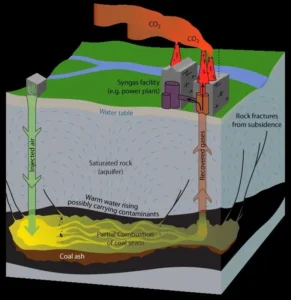
UCG is an in-situ thermochemical process that converts coal into combustible gas without physically extracting it.
Process
- Injection wells are drilled into coal seams.
- Air/oxygen/steam is injected to initiate combustion.
- Controlled reactions convert coal into syngas (CO + H₂ + CH₄).
- Gas is brought to the surface via production wells.
Importance for India’s Energy Landscape
1. Unlocking Untapped Resources
- Nearly 300+ billion tonnes of coal reserves in India.
- A large portion is deep-seated or economically unviable.
- UCG enables utilisation of these otherwise stranded reserves.
2. Enhancing Energy Security
- Reduces dependence on Imported crude oil and Liquefied Natural Gas (LNG)
- Strengthens domestic energy basket diversification.
3. Fertiliser and Agriculture Linkages
- Syngas can produce: Ammonia → Urea fertilisers
- Helps reduce India’s fertiliser import bill.
4. Boost to Gas-Based Economy
- Supports India’s target of increasing the share of natural gas to ~15% in energy mix.
- Syngas acts as a substitute feedstock.
5. Industrial Value Addition
- Enables production of Methanol economy fuels, Dimethyl Ether (DME) and Synthetic petroleum products
Advantages of UCG Technology
- Minimal land disturbance compared to open-cast mining
- Lower operational costs in difficult terrains
- Reduced transport and logistics burden
- Potential integration with Carbon Capture, Utilisation and Storage (CCUS)
- Better resource efficiency and energy extraction
Challenges and Concerns
Environmental Issues
- Risk of groundwater contamination
- Possible land subsidence
- Release of toxic gases if not controlled
Technological Constraints
- Requires high precision monitoring systems
- Limited domestic expertise and pilot experience
Regulatory & Policy Gaps
- Need for clear environmental guidelines specific to UCG
- Absence of large-scale operational framework in India
Climate Commitments
- Coal remains a carbon-intensive resource, raising concerns under climate change obligations
Government Initiatives
- Commercial Coal Mining Reforms (post-2020) allowing private participation
- Promotion of clean coal technologies
- Alignment with National Energy Policy, Make in India and Atmanirbhar Bharat
Way Forward
- Establish pilot UCG projects with global collaboration
- Develop strict environmental safeguards and monitoring systems
- Integrate CCUS technologies for emission reduction
- Strengthen R&D ecosystem in clean coal technologies
- Ensure balanced approach between energy security and sustainability
Conclusion
The integration of UCG in coal mining agreements marks a strategic evolution in India’s energy policy. It enables efficient utilisation of untapped coal resources while supporting industrial growth. However, careful regulation and sustainable practices will be crucial to ensure long-term benefits.
Why in News?
India has recently allowed blending of ethanol and synthetic hydrocarbons in Aviation Turbine Fuel (ATF) to promote Sustainable Aviation Fuel (SAF).
What is Sustainable Aviation Fuel (SAF)?
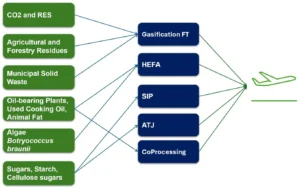
- SAF is a biofuel derived from renewable sources such as Agricultural residues, Used cooking oil and Biomass and ethanol
- It can be blended with conventional jet fuel without major engine modifications.
- Helps reduce lifecycle carbon emissions significantly compared to fossil fuels.
How Ethanol is Used in SAF (Ethanol-to-Jet Pathway)
The Alcohol-to-Jet (ATJ) process involves multiple steps:
- Production of Ethanol: Derived from Sugarcane, Corn and Agricultural waste
- Dehydration: Ethanol is converted into ethylene (removal of water).
- Oligomerisation: Small molecules are combined to form long-chain hydrocarbons.
- Hydrotreating & Refining: Final processing to meet aviation fuel standards.
Importance of Ethanol-Based SAF for India
1. Energy Security
- India imports ~85–87% of crude oil.
- Ethanol-based SAF reduces import dependence.
2. Utilisation of Ethanol Surplus
- India has achieved E20 petrol blending (2025).
- Excess ethanol can be diverted to aviation fuel production.
3. Climate Commitments
- Supports India’s Net Zero (2070) target.
- Reduces aviation sector emissions.
4. Boost to Agriculture
- Increases demand for Sugarcane, Grains and biomass
- Enhances farm income.
5. Industrial Growth
- Encourages Bio-refineries, New investments in green fuel technologies
Government Initiatives & Targets
- Amendment in ATF regulations (2026) to allow ethanol blending.
- SAF blending targets:
- ~1% by 2027
- 2–5% by 2030
Challenges and Limitations
- High Production Cost: SAF is currently costlier than conventional ATF.
- Feedstock Constraints: Competes with Food crops, Land and water resources
- Technological Barriers: ATJ process still scaling up globally
- Infrastructure Issues: Requires New refining facilities, Certification and blending systems
- Sustainability Concerns: Risk of monoculture farming and environmental stress
Way Forward
- Promote second-generation ethanol (2G biofuels) from waste
- Provide financial incentives for SAF production
- Strengthen R&D in ATJ technology
- Develop international certification standards
- Ensure balance between food security and fuel production
Conclusion
Ethanol-based SAF represents a promising pathway for decarbonising aviation while enhancing energy self-reliance. India’s policy shift to allow ethanol blending in jet fuel is a strategic step toward sustainable growth. However, cost, technology, and sustainability challenges must be addressed to scale its adoption effectively.
Why in News?
India has recently launched a nationwide HPV vaccination drive for adolescent girls, aiming to reduce cervical cancer burden.
About Cervical cancer
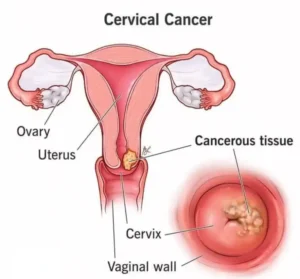
Cervical cancer is a preventable disease caused mainly by persistent infection of Human Papillomavirus (HPV).
Burden of Cervical Cancer in India
- India accounts for nearly one-fifth of global cervical cancer cases.
- Around 1.2–1.3 lakh new cases and ~80,000 deaths occur annually.
- It is the second most common cancer among women aged 15–44 years.
- Screening coverage remains extremely low at less than 2%, leading to late diagnosis.
Causes and Risk Factors
- HPV infection (types 16 & 18) responsible for nearly 70% of cases.
- Early marriage and early sexual activity increase risk.
- Multiple pregnancies and poor reproductive health awareness.
- Lack of screening and vaccination access.
- Higher vulnerability among poor and rural women.
Key Strategies to Eliminate Cervical Cancer
1. HPV Vaccination
- Vaccination of girls (9–14 years) prevents infection before exposure.
- India has introduced indigenous vaccine (CERVAVAC) to improve affordability.
- WHO recommends 90% vaccination coverage for elimination.
2. Screening and Early Detection
- Methods include:
- VIA (Visual Inspection with Acetic Acid)
- HPV testing
- Early detection helps treat precancerous conditions effectively.
- WHO target: 70% women screened by age 35 and 45.
3. Treatment and Care
- Early-stage treatment includes cryotherapy and minor procedures.
- Advanced cases need Surgery and Radiotherapy
- WHO target: 90% treatment coverage.
Government Initiatives in India
- Nationwide HPV vaccination programme for adolescent girls.
- National Programme for Prevention and Control of Cancer (NPCDCS).
- Expansion of primary health centres for screening and treatment.
- Promotion of indigenous vaccines to reduce cost barriers.
Key Challenges
1. Low Awareness
- Limited knowledge about HPV and Vaccination benefits
- Social stigma around reproductive health.
2. Poor Screening Coverage
- Less than 2% women undergo screening.
- Lack of infrastructure at primary healthcare level.
3. Vaccine Hesitancy
- Misinformation and cultural concerns reduce uptake.
- Past controversies affect public trust.
4. Inequality in Access
- Rural and marginalised women face Financial barriers and Lack of healthcare facilities
5. Weak Health Infrastructure
- Shortage of Trained personnel and Diagnostic facilities
- Limits early detection and treatment.
Why in News?
Scientists globally are advancing cyborg botany, converting plants into bio-electronic systems capable of sensing and signalling.
Key Features of Cyborg Botany
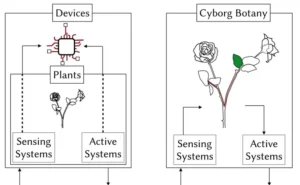
- Integration of plant tissues with electronic devices
- Plants act as living platforms for sensing and signal transmission
- Use of biodegradable and conductive materials
- Enables real-time monitoring of plant health and environment
Working Mechanism
1. Embedding Nanomaterials
- Nanowires and nanosensors are inserted into plant cells
- Detect biochemical signals like Water stress and Disease markers
2. Conductive Polymers
- Materials such as PEDOT (Poly(3,4-ethylenedioxythiophene)) act as Electrical conductors inside plant tissues
- Facilitate transmission of signals to external devices
3. Signal Processing
- Plant-generated signals are converted into Electrical outputs and Data for monitoring systems
Significance
1. Precision Agriculture
- Early detection of Drought stress and Pest infestation
- Helps farmers take targeted action, reducing input costs
2. Environmental Monitoring
- Plants can act as natural sensors for pollution and climate changes
- Useful in monitoring Soil health and Air quality
3. Sustainable Technology
- Combines biological systems with eco-friendly electronics
- Reduces dependence on artificial sensors
4. Scientific Innovation
- Opens new avenues in Bioelectronics and Synthetic biology
Why in News?
The rare orchid Eulophia picta has been recently recorded in central Andhra Pradesh, expanding its known distribution.
About Eulophia picta
Eulophia picta, commonly known as the Nodding Swamp Orchid, is a terrestrial orchid species found in tropical regions.
Taxonomy & Basic Features
- Family: Orchidaceae
- Type: Terrestrial (grows in soil, not on trees)
- Growth: Medium to small-sized plant

Habitat and Distribution
- Distributed across India, Southeast Asia, and Australia
- Found in Moist grasslands, Coastal sandy areas, Rainforests and dry deciduous forests
- Altitude range: Up to 1000 meters
Morphological Characteristics
- Leaves: 3–5 broad, ribbed leaves
- Flowers:
- Up to 20 pale pink (rarely white) flowers
- Do not fully open, remain tubular
- Unique feature:
- Inflorescence bends like a hook (shepherd’s crook) during flowering
- Has underground pseudobulbs for nutrient storage
Ecological Importance
- Indicator of healthy ecosystems
- Supports Pollinators and biodiversity
- Contributes to genetic diversity of orchids
Conservation Concerns
- Habitat loss due to Urbanisation and Agricultural expansion
- Climate change affecting Moisture and temperature conditions
- Lack of awareness and documentation