Table of Contents
ToggleThe green revolution introduced heavy reliance on synthetic pesticides, which, while initially effective, led to the destruction of non-target species and environmental degradation. Biological control UPSC studies focus on reversing this trend by utilizing natural enemies to keep pest populations below the “Economic Injury Level”.
Definition of Biological Control
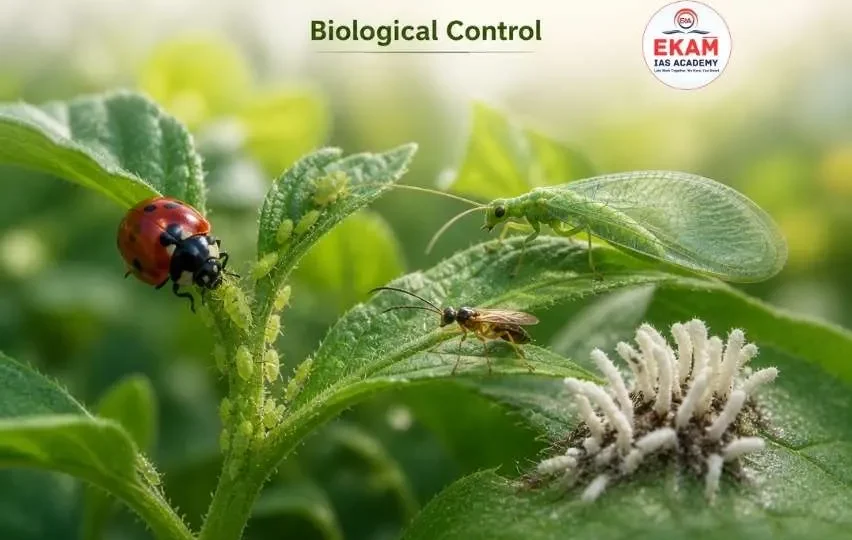
Biological control is a method of controlling pests such as insects, mites, weeds, and plant diseases using other living organisms. Unlike chemical methods, it relies on natural ecological relationships like predation, parasitism, and herbivory to maintain a stable ecosystem.
Types of Biological Control
Understanding the types of biological control is essential for answering technical questions in GS Paper III:
- Importation (Classical Biological Control): Introducing a natural enemy from the pest’s native range into a new area where it does not occur naturally.
- Augmentation: Increasing the population of existing natural enemies through periodic release. This includes Inoculative release (small numbers) and Inundative release (mass release like “biological insecticides”).
- Conservation: Modifying the environment or existing practices to protect and enhance the natural enemies already present in the field.
Agents of Biological Control
Commonly used biological pest control methods involve four main categories of agents:
- Predators: Organisms that consume many prey individuals during their lifetime (e.g., Ladybugs eating aphids).
- Parasitoids: Insects whose larvae develop inside or on a host, eventually killing it (e.g., Trichogramma wasps).
- Pathogens: Microorganisms like bacteria, fungi, and viruses that cause disease in pests (e.g., Bacillus thuringiensis (Bt)).
- Competitors: Organisms that compete with pests for resources or space.
Examples of Biological Control in Practice
- Cochineal Insect: Used in India to control the spread of the invasive Prickly Pear Cactus (Opuntia).
- Gambusia Fish: Introduced in water bodies to eat mosquito larvae, serving as a biological tool against malaria and dengue.
- Neem Oil/Extracts: Acts as a natural repellent and growth disruptor for various agricultural pests.
Comparison: Biological vs. Chemical Control
| Feature | Biological Control | Chemical Control |
|---|---|---|
| Specificity | Highly specific to target pests. | Broad-spectrum; kills non-target species. |
| Sustainability | Self-perpetuating and eco-friendly. | Requires repeated applications. |
| Resistance | Pests rarely develop resistance. | Leads to “Pesticide Treadmill” (high resistance). |
| Cost | Low long-term costs. | High recurring costs for farmers. |
Role in Integrated Pest Management (IPM)
Biological control is the primary intervention in IPM. It aims to combine biological, cultural, and physical tools to manage pests, using chemicals only as a last resort. This holistic approach prevents biomagnification and ensures the long-term health of the food chain.
Importance for Biodiversity and Sustainable Agriculture
- Preserving Ecosystem Services: By avoiding toxic chemicals, biocontrol protects pollinators like bees and soil decomposers.
- Sustainable Agriculture: It reduces the chemical residue in food, aligning with Paramparagat Krishi Vikas Yojana (PKVY) and organic farming goals in India.
- Climate Resilience: Biocontrol agents often adapt better to changing ecological conditions than static chemical formulas.
Conclusion
Biological control is more than just a farming technique; it is an application of ecosystem ecology to solve human problems. For the UPSC exam, remember that while biocontrol is slower to show results than chemicals, its benefits for biodiversity conservation and environmental safety are far superior.
UPSC Prelims: PYQs & Practice Questions
Previous Year Questions (Prelims)
Q: Biological Oxygen Demand (BOD) is a standard criterion for:
(a) Measuring oxygen levels in blood.
(b) Computing oxygen levels in forest ecosystems.
(c) Pollution assay in aquatic ecosystems.
(d) Assessing oxygen levels in high altitude regions.
Answer: (c)
Explanation:
BOD is used as a standard criterion for assessing pollution in aquatic ecosystems. It indicates the amount of oxygen required by microorganisms to decompose organic matter in water.
Q: Use of microorganisms to degrade harmful hazardous pollutants in the environment is called:
(a) Bioremediation
(b) Biotransformation
(c) Bioaugmentation
(d) Biosensor
Answer: (a) Bioremediation
Explanation:
Bioremediation is a biological method in which living organisms, especially microbes, are used to degrade or remove harmful pollutants from the environment.
Practice Questions
Q: With reference to types of biological control, consider the following statements:
1. Classical biological control involves importing a natural enemy from a pest's native range.
2. Augmentation involves protecting existing natural enemies by modifying the habitat.
Which of the statements given above is/are correct?
(a) 1 only
(b) 2 only
(c) Both 1 and 2
(d) Neither 1 nor 2
Answer: (a) 1 only
Explanation:
Statement 1 is correct. Classical biological control involves importing a natural enemy from the pest’s native range. Statement 2 is incorrect because protecting existing natural enemies is called conservation, while augmentation refers to the periodic release of natural enemies.
Q: Which of the following is an example of a pathogen used as a biological control agent?
(a) Ladybug (Coccinellidae)
(b) Bacillus thuringiensis (Bt)
(c) Gambusia fish
(d) Trichogramma wasp
Answer: (b) Bacillus thuringiensis (Bt)
Explanation:
Bacillus thuringiensis (Bt) is a bacterium used as a biological control agent against specific pests. Ladybugs and Gambusia are predators, while Trichogramma is a parasitoid.
UPSC Mains – Previous Year & Practice Questions
Mains Previous Year Questions
Question: Each year a large amount of plant material is produced by photosynthesis. Explain the mechanism of their decomposition. (Mains 2022)
Question: What is an ecosystem? Describe the various services provided by an ecosystem. (Mains 2017)
Question: Coastal regions of India are vulnerable to various climate change impacts. Discuss. (Mains 2019)
Question: How does biodiversity vary in India? How is the Biological Diversity Act, 2002 helpful in conservation of flora and fauna? (Mains 2020)
Question: The standard of living in a country can be raised only through sustainable development. Discuss. (Mains 2015)
Mains Practice Questions
[10 Marks | 150 Words]
Question: Compare and contrast Biological Control with Chemical Pesticides. Why is the former considered more sustainable for long-term biodiversity conservation?
[15 Marks | 250 Words]
Question: Discuss the role of Integrated Pest Management (IPM) in reducing the chemical footprint of Indian agriculture. How do biological agents act as the first line of defense?
[15 Marks | 250 Words]
Question: Analyze the potential ecological risks associated with 'Classical Biological Control'. Why is rigorous quarantine research necessary before introducing foreign agents into an environment?
Biological Control-FAQs
Is Biological Control the same as Bioremediation?
They are related but distinct. Biological control generally refers to managing living pests (insects/weeds), while Bioremediation uses organisms to clean up non-living pollutants (oil spills/heavy metals) in the environment.
Can biological control agents become pests themselves?
Yes, this is a major limitation. If an introduced agent (Importation) starts attacking non-target native species, it can disrupt the local ecology.
How does biocontrol help in preventing Biomagnification?
By replacing synthetic chemicals that are fat-soluble and persistent, biological control ensures that toxic substances do not build up in the food chain.
What is the 'Pesticide Treadmill'?
It refers to the need for farmers to use more frequent and stronger chemicals as pests develop resistance. Biological control helps break this cycle as pests rarely develop resistance to natural predators.
What is the Economic Injury Level (EIL)?
It is the lowest pest population density that will cause economic damage. The goal of biological pest control methods is to keep the pest population below this level without necessarily eradicating the species.