Table of Contents
ToggleEnvironmental pollution is not always visible to the naked eye. Some of the most dangerous pollutants are those that do not break down easily and instead travel up the food chain. Biomagnification is a phenomenon that explains why top predators, including humans, often carry the highest burden of toxic chemicals in their bodies.
Definition of Biomagnification
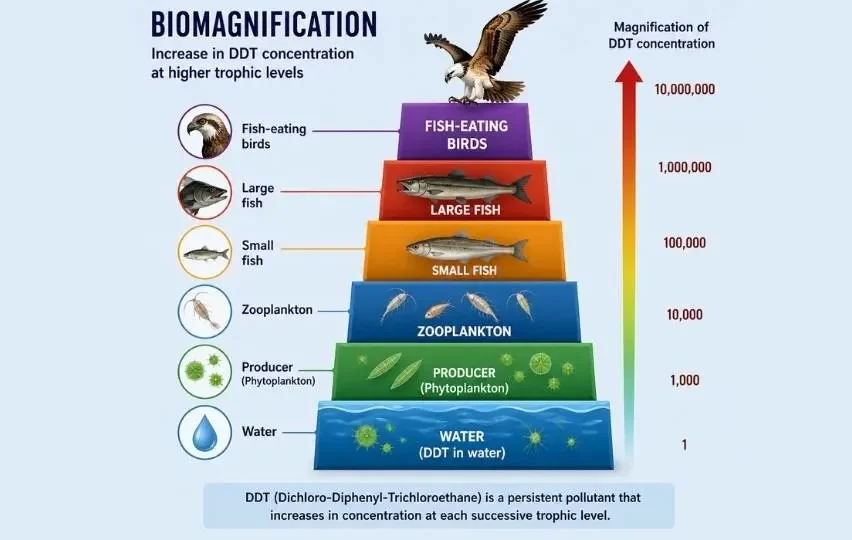
Biomagnification (also known as bio-amplification) is the process whereby the concentration of a substance, such as a toxic chemical, increases in the tissues of organisms at successively higher trophic levels in a food chain.
For a substance to undergo biomagnification, it must be:
- Long-lived (Persistent): It cannot be easily broken down by environmental processes.
- Mobile: It must be easily taken up by organisms through food or water.
- Soluble in fats (Lipophilic): It stays in the fatty tissues rather than being excreted in urine.
Biomagnification vs Bioaccumulation
A common conceptual trap in environment ecology notes UPSC is confusing these two terms.
| Feature | Bioaccumulation | Biomagnification |
| Definition | Increase in concentration of a pollutant in a single organism over time.
| Increase in concentration of a pollutant as it moves up the food chain.
|
| Level | Occurs at an individual level.
| Occurs at the ecosystem/trophic level.
|
| Source | Taken up from the environment (water/air) and food.
| Primarily taken up through the consumption of lower-level organisms.
|
Process of Biomagnification in a Food Chain
The process follows a multiplicative pattern:
- Primary Producers: Phytoplankton or plants absorb low levels of toxins (e.g., Mercury) from the water.
- Primary Consumers: Zooplankton or small fish eat large quantities of producers, accumulating the toxins in their fat.
- Secondary Consumers: Larger fish eat thousands of small fish, concentrating the toxins further.
- Tertiary Consumers: Top predators like Eagles, Sharks, or Humans consume the larger fish, receiving a massive, concentrated dose of the pollutant.
Common Pollutants Involved
- Heavy Metals: Mercury, Lead, Cadmium, and Arsenic.
- Persistent Organic Pollutants (POPs): DDT (pesticide), Polychlorinated biphenyls (PCBs), and Toxaphene.
- Microplastics: Recently recognized as a carrier for various chemical toxins up the food chain.
Effects of Biomagnification
- Reproductive Failure: High levels of DDT in birds cause eggshell thinning, leading to the death of embryos.
- Neurotoxicity: Mercury accumulation (Minamata disease) causes severe nervous system damage in humans.
- Endocrine Disruption: Many POPs interfere with hormones, affecting growth and development.
- Biodiversity Loss: Top predators are often “keystone species”; their decline can trigger a trophic cascade.
Examples for Better Understanding
- The Case of the Indian Vulture: The use of Diclofenac in cattle led to biomagnification in vultures, causing near-extinction due to kidney failure.
- Mercury in Tuna: Large predatory fish like Tuna and Swordfish contain higher mercury levels than smaller fish like Sardines.
Importance in Environmental Studies and Policy
Understanding food chain pollution UPSC is critical for global treaties:
- Stockholm Convention: Aims to eliminate or restrict the production and use of Persistent Organic Pollutants (POPs).
- Minamata Convention: A global treaty to protect human health and the environment from the adverse effects of Mercury.
- Food Safety Standards: Helps organizations like FSSAI set limits on heavy metals in seafood and agricultural products.
Conclusion
Biomagnification serves as a stark reminder of the interconnectedness of life. A small amount of poison at the bottom of the pyramid can become a lethal dose at the top. For UPSC, remember that biomagnification is not just a biological process but a significant public health and policy challenge that requires international cooperation to solve.
UPSC Prelims: PYQs & Practice Questions
Previous Year Questions (Prelims)
Q: Which of the following can be found as pollutants in the drinking water in some parts of India?
1. Arsenic
2. Sorbitol
3. Fluoride
4. Formaldehyde
5. Uranium
Select the correct answer using the codes given below:
(a) 1 and 3 only
(b) 2, 4 and 5 only
(c) 1, 3 and 5 only
(d) 1, 2, 3, 4 and 5
Answer: (c) 1, 3 and 5 only
Explanation:
Arsenic, fluoride, and uranium are found as drinking water pollutants in some parts of India. Persistent substances like arsenic and uranium can enter ecological systems and may move through food chains, creating environmental and health concerns.
Q: Government of India is encouraging the cultivation of 'Sea Buckthorn'. What is the importance of this plant?
1. It helps in controlling soil erosion and in preventing desertification.
2. It is a rich source of biodiesel.
3. It has nutritional value and is well-adapted to live in cold areas of high altitudes.
4. Its timber is of great commercial value.
Which of the statements given above is/are correct?
(a) 1 and 3 only
(b) 2, 3 and 4 only
(c) 1 and 4 only
(d) 1, 2, 3 and 4
Answer: (a) 1 and 3 only
Explanation:
Sea Buckthorn helps control soil erosion and prevent desertification. It also has nutritional value and is adapted to cold, high-altitude regions. This question tests species-specific ecological roles and their relevance to environmental conservation.
Practice Questions
Q: For a chemical to undergo biomagnification within an ecosystem, it must possess which of the following characteristics?
1. It must be hydrophilic (water-soluble).
2. It must be environmentally persistent.
3. It must be soluble in fats (lipophilic).
Select the correct answer:
(a) 1 and 2 only
(b) 2 only
(c) 2 and 3 only
(d) 1, 2, and 3
Answer: (c) 2 and 3 only
Explanation:
To biomagnify, a substance must be lipophilic so it remains in fatty tissues rather than being excreted. It must also be persistent so it does not degrade before moving up the trophic levels.
Q: In a marine food chain contaminated with mercury, which organism is likely to show the highest concentration of the toxin?
(a) Phytoplankton
(b) Zooplankton
(c) Small Fish
(d) Apex Predator, e.g., Shark
Answer: (d) Apex Predator
Explanation:
Mercury is a heavy metal that undergoes biomagnification. Its concentration increases at each successive trophic level; therefore, the apex predator accumulates the highest concentration.
UPSC Mains – Previous Year & Practice Questions
Mains Previous Year Questions
Question: Each year a large amount of plant material is produced by photosynthesis. Explain the mechanism of their decomposition. (Mains 2022)
Question: What are the key features of the National Clean Air Programme (NCAP) initiated by the Government of India? (Mains 2020)
Question: Coastal regions of India are vulnerable to various climate change impacts. Discuss. (Mains 2019)
Question: What is an ecosystem? Describe the various services provided by an ecosystem. (Mains 2017)
Question: The standard of living in a country can be raised only through sustainable development. Discuss. (Mains 2015)
Mains Practice Questions
[10 Marks | 150 Words]
Question: Distinguish between biomagnification and bioaccumulation. How does the presence of Persistent Organic Pollutants (POPs) in the environment lead to the collapse of top predator populations?
[15 Marks | 250 Words]
Question: The near-extinction of the Indian Vulture due to Diclofenac is a classic example of biomagnification. Analyze the socio-economic and ecological consequences of losing a keystone scavenger.
[15 Marks | 250 Words]
Question: Discuss the role of international treaties like the Minamata Convention and Stockholm Convention in mitigating the risks of biomagnification globally.



Biomagnification-FAQs
What is the main difference between bioaccumulation and biomagnification?
Bioaccumulation happens within a single organism over its lifetime as it absorbs a toxin faster than it can excrete it. Biomagnification is the increase in toxin concentration as it moves from one trophic level to the next in a food chain.
Why is Mercury particularly dangerous for biomagnification?
Mercury, especially in the form of methylmercury, is highly persistent and lipophilic. It binds easily to proteins and fats in marine organisms, making it nearly impossible for the body to eliminate as it moves up the ecosystem hierarchy.
Does biomagnification affect humans?
Yes, humans are often apex predators. We consume large fish (like Tuna), meat, and dairy products that may have accumulated concentrated levels of toxins like heavy metals or pesticides through the food chain.
Can biomagnification be reversed?
It cannot be reversed within an individual, but it can be stopped at a population level by eliminating the source of the pollutant from the environment. Banning chemicals like DDT and Diclofenac are prime examples.
What is a 'Trophic Cascade' in the context of biomagnification?
If biomagnification kills off top predators, it can cause a trophic cascade where the next level down (herbivores) grows unchecked, leading to overgrazing and the eventual degradation of the entire ecosystem.