Table of Contents
ToggleUPSC preparation is generally viewed as a long-term process, but not every aspirant starts with a full year or more in hand. Many candidates reach a stage where they need focused, time-bound revision and consolidation rather than full-length classroom programmes. This is where crash courses come into the picture. Today, several coaching institutes design crash courses to support aspirants who are close to the examination cycle and require strategic sharpening rather than foundational learning.
In cities with a strong UPSC ecosystem, such as those offering UPSC coaching in Hyderabad, crash courses have become an important part of the preparation landscape.
What Are UPSC Crash Courses?
Meaning and Purpose
Crash courses are short-duration, high-intensity programmes designed to revise, consolidate, and refine preparation within a limited time frame. Unlike foundation courses, they do not focus on building concepts from scratch. Instead, they aim to:
- Strengthen weak areas
- Improve exam-oriented thinking
- Enhance performance through revision and practice
These courses are usually aligned with a specific stage of the exam cycle.
Types of UPSC Crash Courses Available
Stage-Based Crash Courses
Most institutes structure crash courses based on exam stages:
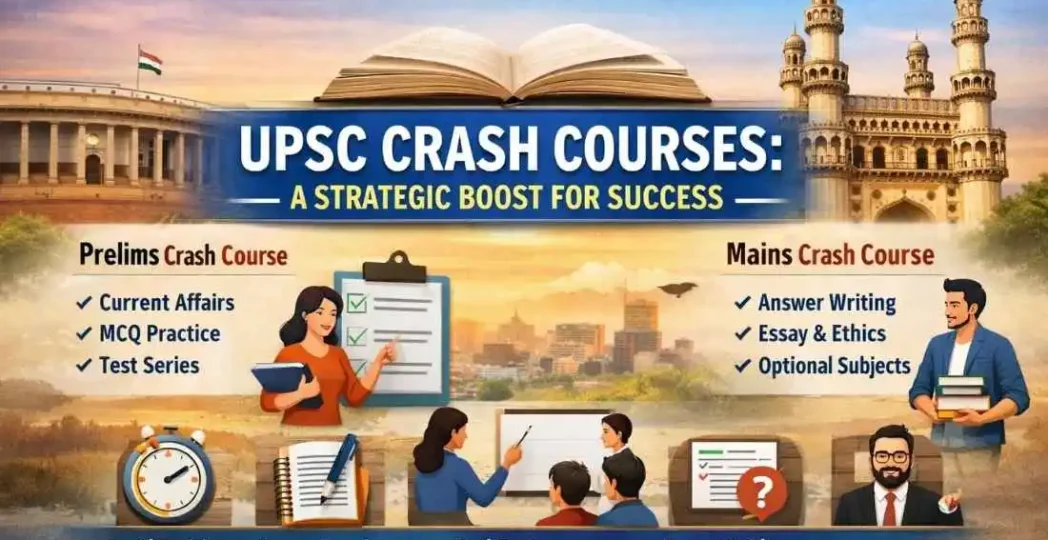
- Prelims crash course for rapid revision and MCQ practice
- Mains crash course focusing on answer writing and value addition
- Essay and Ethics-specific short modules
Institutes recognised as the Best IAS Academy in Hyderabad often design these courses after analysing recent UPSC trends.
Crash Courses for Prelims and Mains
Prelims-Oriented Crash Courses
Crash courses for Prelims focus on:
- Static subject revision
- Current affairs consolidation
- High-quality test series
- Elimination techniques
These courses assume that aspirants already have basic familiarity with the syllabus.
Mains-Oriented Crash Courses
Mains crash courses emphasise:
- Structured answer writing
- Content enrichment
- Essay and Ethics preparation
- Integration of optional subjects with GS
This format is particularly popular among repeat aspirants.
Role of Optional Subjects in Crash Courses
Are Optional Subjects Covered?
Yes, many crash courses include optional subjects, either as:
- Separate short-term modules, or
- Integrated revision blocks within Mains-focused programmes
Optional crash courses usually concentrate on:
- Recurrent themes
- High-yield topics
- Writing practice rather than content expansion
Course Formats: Flexibility and Accessibility
Weekend and Hybrid Models
To accommodate aspirants with time constraints, crash courses are often offered through:
- Weekend batches
- Hybrid classroom–online models
- Condensed daily schedules
Such flexibility is commonly found in institutes categorised under Top UPSC Coaching in Hyderabad.

Teaching Approach in UPSC Crash Courses
Revision-Centric and Exam-Oriented
Crash courses typically follow a:
- Topic-wise revision strategy
- Question-driven learning model
- Continuous testing and feedback system
Faculty focus more on what to write and how to write, rather than exhaustive theory coverage.
Who Should Opt for a UPSC Crash Course?
Ideal Candidates
Crash courses are suitable for:
- Aspirants who have already covered the syllabus once
- Repeaters aiming to improve scores
- Candidates seeking last-phase guidance before the exam
They are not ideal for beginners without basic conceptual clarity.
Crash Courses vs Regular Courses
Key Differences
| Aspect | Crash Courses | Regular Courses |
|---|---|---|
| Duration | Short-term | Long-term |
| Focus | Revision & practice | Concept building |
| Pace | Intensive | Gradual |
| Target Group | Repeaters & advanced aspirants | Beginners |
This distinction is clearly explained during orientation sessions of reputed IAS Coaching in Hyderabad institutes.
Brief Note on Crash Courses at EKAM IAS Academy
Focused Support for Advanced Aspirants
EKAM IAS Academy offers UPSC crash courses designed specifically for aspirants who are nearing the examination stage. These programmes focus on:
- High-yield topic revision
- Answer writing refinement
- Essay and Ethics strengthening
- Strategic mentorship and feedback
The crash courses are structured to complement prior preparation rather than replace it, making them suitable for aspirants seeking focused guidance in limited time.
Things to Check Before Joining a Crash Course
Important Considerations
Before enrolling, aspirants should verify:
- Stage-specific relevance
- Test series inclusion
- Optional subject coverage
- Faculty interaction and evaluation support
A transparent course structure is a hallmark of a reliable UPSC academy in Hyderabad.
Conclusion
Yes, crash courses for UPSC are widely available and can be extremely effective when chosen wisely. They are not shortcuts but strategic finishing tools designed to maximise performance in a limited timeframe. For aspirants who already have foundational preparation and need structured revision, practice, and mentorship, crash courses can provide the final push required for success.
Selecting the right crash course—aligned with your preparation stage and offered by a credible civil services coaching institute—is essential to make the most of this intensive format.