Table of Contents
ToggleIndustrial Evolution in Post-Independence India: Policies, Phases, and Progress
Introduction: The Industrial Legacy of 1947
At the time of independence, India’s industrial base was thin and lopsided, characterized by a few consumer goods industries like textiles and sugar. The British policy of Deindustrialization had left the country as a mere supplier of raw materials and a market for finished British goods. The primary goal of the new government was to achieve Economic Consolidation through a Mixed Economy model, balancing social welfare with private enterprise.
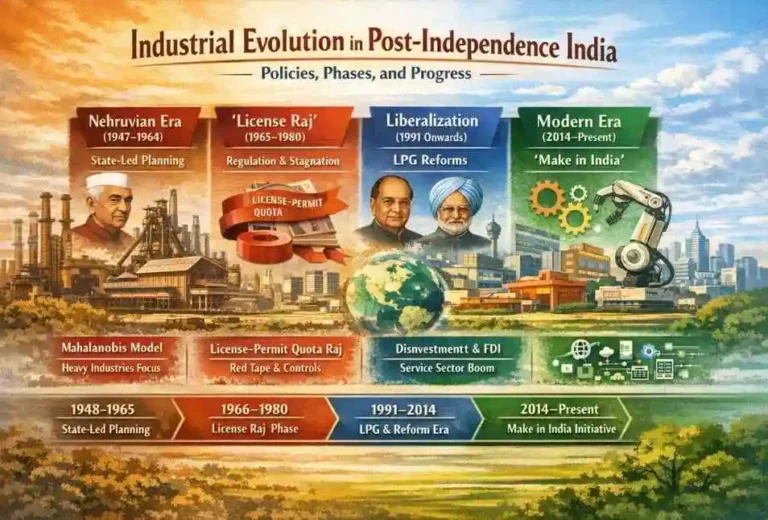
Phase 1: The Nehruvian Era – The Command and Control Economy (1947–1964)
Jawaharlal Nehru, influenced by the success of economic planning in the Soviet Union, championed a State-led Industrialization strategy.
1. Industrial Policy Resolution (IPR), 1948
The IPR 1948 laid the foundation for a Mixed Economy, dividing industries into four categories and assigning a dominant role to the Public Sector in core areas like atomic energy and railways.
2. IPR 1956: The “Economic Constitution” of India
The Industrial Policy Resolution of 1956 became the bedrock of Indian industrialization.
- Three Schedules: It classified industries into Schedule A (state monopoly), Schedule B (state-led with private help), and Schedule C (private sector).
- Mahalanobis Model: Under the Second Five-Year Plan, focus shifted to Heavy Industries—steel, chemicals, and machine-building—to make India self-reliant.
- Temples of Modern India: Massive Public Sector Undertakings (PSUs) like Bhilai, Rourkela, and Durgapur steel plants were established as symbols of national pride.
Phase 2: The "License Raj" and Economic Stagnation (1960s–1980s)
While the initial phase saw growth, the economy eventually entered a period of slow expansion known as the “Hindu Rate of Growth” (around 3.5%).
1. The License-Permit-Quota Raj
The Monopolies and Restrictive Trade Practices (MRTP) Act, 1969 and the Foreign Exchange Regulation Act (FERA), 1973 created a web of regulations. Private companies required multiple licenses to start or expand, leading to red tapism and stifled innovation.
2. Public Sector Expansion
The government continued to nationalize key sectors, including coal, insurance, and commercial banks (1969), to ensure Financial Inclusion and redirect resources to Priority Sectors.
Phase 3: The 1991 Watershed – LPG Reforms
By 1991, a severe Balance of Payments (BoP) crisis forced India to dismantle the License Raj and embrace market-driven growth.
1. Liberalization, Privatization, and Globalization (LPG)
Under Prime Minister P. Narasimha Rao and Finance Minister Manmohan Singh, the New Industrial Policy (NIP) 1991 was launched.
- Abolition of Industrial Licensing: Licensing was removed for almost all industries, except for a few sensitive sectors.
- Foreign Direct Investment (FDI): Limits were raised to encourage foreign capital and technology.
- Disinvestment: The state began reducing its stake in PSUs to improve efficiency.
2. Shift to the Service Sector
Interestingly, India bypassed the traditional manufacturing-led model, seeing an explosion in the Information Technology (IT) and Services sectors.
Phase 4: Modern Era – "Make in India" and Digital Transformation
In recent decades, the focus has returned to boosting Manufacturing and Self-Reliance.
1. Structural Reforms and Infrastructure
- Goods and Services Tax (GST): Aimed at creating a Unified National Market by removing cascading taxes.
- National Manufacturing Policy (NMP): Focuses on increasing the manufacturing share of GDP to 25%.
2. Atmanirbhar Bharat and PLI Schemes
The Production Linked Incentive (PLI) scheme targets 14 key sectors (like semiconductors and electric vehicles) to make India a global Manufacturing Hub. The push for Digital India and Industry 4.0 is integrating Artificial Intelligence and Automation into the industrial fabric.
Summary Table: Eras of Industrial Development
Period | Core Theme | Key Policy/Event |
1948–1965 | State-led Planning | IPR 1956, Mahalanobis Model, Heavy Industry. |
1966–1980 | Self-Reliance | Bank Nationalization, MRTP Act, PSUs expansion. |
1981–1990 | Incremental Reform | Partial deregulation; ending in BoP Crisis. |
1991–2014 | LPG Era | New Industrial Policy 1991, IT Boom, FDI. |
2014–Present | Strategic Autonomy | Make in India, PLI Schemes, Digitalization. |
UPSC Prelims: PYQs & Practice Questions
Previous Year Questions (PYQs)
Question 1 (Second Five-Year Plan – Mahalanobis Strategy)
Q: Which of the following adopted the "Mahalanobis Strategy" of development? (UPSC Prelims – Historical Context)
Options:
(a) First Five-Year Plan
(b) Second Five-Year Plan
(c) Third Five-Year Plan
(d) Fourth Five-Year Plan
Answer: (b)
Explanation: The Second Five-Year Plan (1956–61) was based on the Mahalanobis Model, emphasizing heavy industries and capital goods to build a self-reliant industrial base and reduce import dependence.
Question 2 (Public Investment in Agriculture – UPSC Prelims 2020)
Q: In the context of India, which of the following is/are considered as "Public Investment" in Agriculture? (UPSC Prelims 2020 – Economic Context)
Statements:
1. Fixing Minimum Support Price (MSP)
2. Computerization of Primary Agricultural Credit Societies
3. Social Capital Development
4. Free electricity supply to farmers
5. Setting up cold storage facilities by the government
Select the correct answer:
(a) 1, 2 and 5 only
(b) 1, 3, 4 and 5 only
(c) 2, 3 and 5 only
(d) 1, 2, 3, 4 and 5
Answer: (c)
Explanation: Public investment means government spending that creates assets/infrastructure and long-term capacity (like digital systems, institutions, and storage infrastructure). Hence, 2, 3 and 5 qualify. MSP and free electricity are typically subsidies/revenue support, not capital investment.
Prelims Practice Questions
Question 1
Q: The New Industrial Policy (1991) abolished Industrial Licensing for all except a few industries. Which of the following still requires a compulsory license?
Options:
(a) Textiles
(b) Information Technology
(c) Industrial Explosives
(d) Leather Goods
Answer: (c) Industrial Explosives
Explanation: The 1991 policy largely ended licensing to promote competition and ease of doing business. However, compulsory licensing still continues for a limited set of industries due to security, public health, and environmental concerns. These include industrial explosives and other sensitive categories such as hazardous chemicals, along with select strategic or regulated products.
Question 2
Q: Which Industrial Policy Resolution (IPR) is known as the “Economic Constitution of India”?
Options:
(a) IPR 1948
(b) IPR 1956
(c) IPR 1977
(d) IPR 1991
Answer: (b) Industrial Policy Resolution (IPR) of 1956
Explanation: The IPR 1956 laid down the long-term blueprint of India’s industrial system and is called the Economic Constitution because it clearly defined the role of the State and the Private Sector. It classified industries into schedules, strengthened the idea of a mixed economy, and provided the guiding framework for public sector expansion in core and strategic areas.
UPSC Mains – Previous Year & Practice Questions
Mains Previous Year Questions (Indian Economy: Industry, Investment & GST)
Services-led Growth vs Manufacturing Stagnation
Question: "Industrial growth in the post-reform period has been led by the services sector." Analyze the reasons for the relative stagnation of the manufacturing sector. (UPSC 2013/2015 Context)
Investment vs Consumption Expenditure
Question: Explain the meaning of 'investment' in the context of the Indian economy. How does it differ from 'consumption' expenditure? (UPSC 2016)
Manufacturing Target: Why 25% of GDP Not Achieved?
Question: Account for the failure of the 'Manufacturing Sector' in achieving the goal of 25% of GDP despite several policy interventions. (UPSC 2018/2020)
Integrated Steel Plants and Regional Development
Question: How far is the 'Integrated Steel Plants' policy responsible for the regional development of the Chhota Nagpur plateau? (UPSC - Geography/Industry Context)
GST and MSMEs
Question: Critically examine the impact of the 'Goods and Services Tax' (GST) on the MSME sector in India. (UPSC 2017/2021)
Mains Practice Questions
License Raj to Liberalization: Economic Philosophy Shift
Question: “The shift from 'License Raj' to 'Liberalization' was not just a policy change but a shift in the economic philosophy of the nation.” Discuss. (250 Words)
PLI Schemes & Global Manufacturing Hub
Question: Evaluate the potential of 'Production Linked Incentive' (PLI) schemes in making India a global manufacturing hub for electronics and semiconductors. (250 Words)
PSUs in the Era of Privatization & Disinvestment
Question: Discuss the challenges faced by 'Public Sector Undertakings' (PSUs) in the era of privatization and disinvestment. (250 Words)
Frequently Asked Questions (FAQs)
1: What is 'Disinvestment' and how does it differ from 'Privatization'?
Disinvestment is the dilution of the government’s stake in a PSU (e.g., selling 10% shares). Privatization occurs when the government transfers management control or sells more than 51% of the shares to a private entity.
What are 'Maharatna', 'Navratna', and 'Miniratna' companies?
These are statuses granted to Central Public Sector Enterprises (CPSEs) based on their financial performance and size. Maharatnas (like ONGC or SAIL) have the highest degree of financial autonomy, allowing them to invest up to ₹5,000 crore without government approval.
Why did India skip the 'Manufacturing Stage' of development?
Unlike China or South Korea, India’s growth was driven by the Service Sector (IT, Finance) due to a highly skilled English-speaking workforce and heavy regulations in the manufacturing sector (like labor laws and land acquisition issues) during the License Raj.
What is the 'Production Linked Incentive' (PLI) Scheme?
The PLI scheme provides financial incentives to companies based on incremental sales from products manufactured in domestic units. It aims to boost Atmanirbhar Bharat by encouraging large-scale manufacturing in sectors like Mobile Phones, Pharma, and Automobiles.
What is 'Industry 4.0' in the Indian context?
It refers to the Fourth Industrial Revolution, characterized by the integration of Internet of Things (IoT), Cloud Computing, and Artificial Intelligence into manufacturing. Initiatives like Smart Advanced Manufacturing and Rapid Transformation Hub (SAMARTH) Udyog are driving this in India.