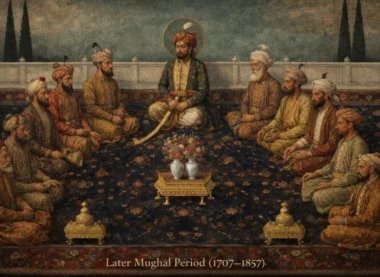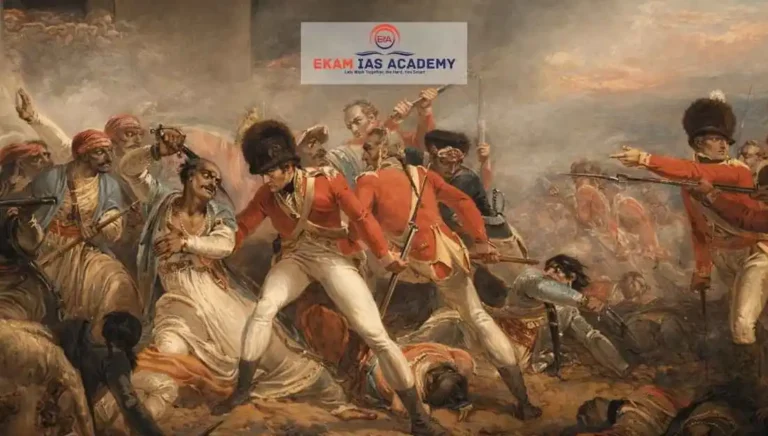
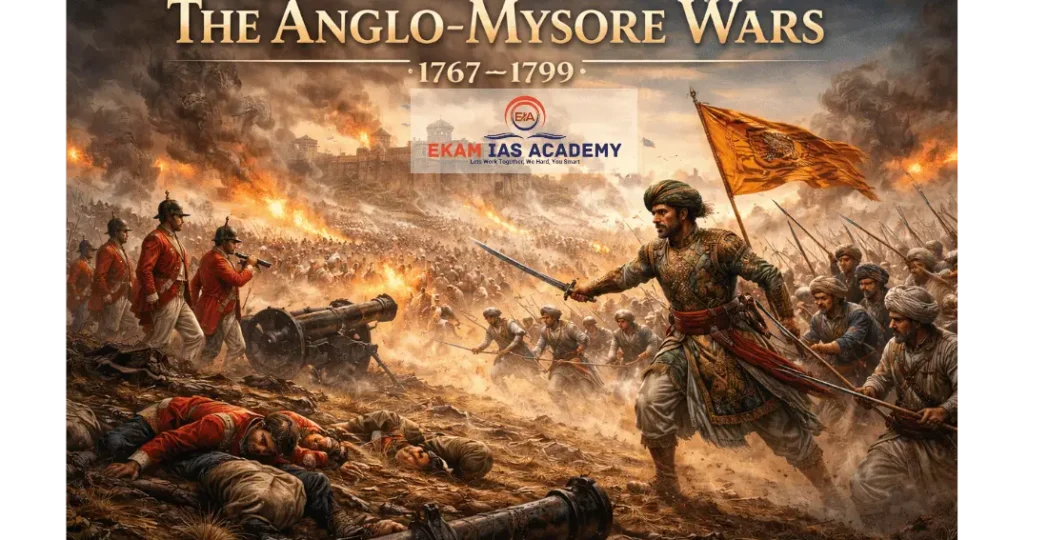
The Anglo-Mysore Wars

The Anglo-Mysore Wars: A Century of Resistance and the Fall of a Frontier
Share this Post

Introduction: The Rise of a Challenger

The Anglo-Mysore Wars (1767–1799) represent one of the most significant military challenges to British paramountcy in India. While the British were busy consolidating their hold over Bengal after the Battle of Buxar, a powerful, modern, and fiercely independent state was emerging in the South under the leadership of Haidar Ali and his son Tipu Sultan.

Mysore was not a traditional feudal state; it was a state that embraced military modernization, global diplomacy, and economic mercantilism, making it a “prime target” for British expansionist designs.

The Foundation: Rise of Haidar Ali

The Wodeyar Dynasty had ruled Mysore since the 14th century, but by the mid-18th century, the state was weakened by internal decay and external threats from the Marathas and the Nizam of Hyderabad.

  • Haidar Ali’s Ascent: Starting as a petty officer, Haidar Ali rose through the ranks due to his military brilliance. By 1761, he had become the de facto ruler of Mysore.
  • Military Innovation: Recognizing the superiority of European arms, Haidar established a modern arsenal at Dindigul with French assistance and introduced Western-style discipline to his infantry
The Anglo-Mysore Wars A Century of Resistance and the Fall of a Frontier

The First Anglo-Mysore War (1767–1769)

Context: The British, fresh from their victory in Bengal, sought to curb Haidar’s growing influence. They formed a Triple Alliance with the Nizam and the Marathas against Haidar.

Key Developments:

  • Diplomatic Masterstroke: Haidar Ali used skillful diplomacy to break the alliance, paying off the Marathas and winning over the Nizam.
  • The Campaign: The war saw Haidar’s forces reaching the gates of Madras, causing panic among the British authorities.
  • Outcome: The Treaty of Madras (1769) was signed. It was a humiliated peace for the British, based on the mutual restitution of conquests and a promise of British aid to Haidar if he was attacked by a third party.

The Second Anglo-Mysore War (1780–1784)

Context: The British failed to honor the Treaty of Madras when the Marathas attacked Mysore in 1771. Furthermore, the British capture of Mahe (a French settlement in Mysore’s territory) provided the immediate spark.

Key Developments:

  • The Anti-British Confederacy: Haidar joined hands with the Marathas and the Nizam
  • Early Successes: Haidar inflicted a crushing defeat on the British under Colonel Baillie at Pollilur (1780)
  • Turning Tide: Sir Eyre Coote was sent from Bengal; he defeated Haidar at Porto Novo in 1781
  • Death of a Lion: Haidar Ali died of cancer in 1782, leaving the war to his son, Tipu Sultan
  • Outcome: The Treaty of Mangalore (1784) was signed on the basis of status quo ante bellum (mutual return of territories and prisoners).

The Third Anglo-Mysore War (1790–1792)

Context: Under Lord Cornwallis, the British sought a decisive victory. The immediate cause was Tipu’s attack on Travancore, a British ally.

Key Developments:

  • Cornwallis’s Leadership: Unlike previous wars, the Governor-General personally led the campaign.
  • The Siege of Seringapatam: The British, supported by the Marathas and the Nizam, besieged Tipu’s capital.
  • Outcome: The Treaty of Seringapatam (1792) was devastating for Mysore.
    • Tipu had to cede half of his kingdom to the allies.
    • He was forced to pay a war indemnity of 3 crore rupees.
    • His two sons were taken as hostages by the British until the payment was made.

The Fourth Anglo-Mysore War (1799)

Context: Lord Wellesley, an aggressive imperialist, arrived with the goal of eliminating Mysore. He accused Tipu of conspiring with the French (Napoleon) and demanded he join the Subsidiary Alliance.

Key Developments:

  • The Final Assault: The war was short and decisive. Mysore was attacked from both the east and the west.
  • Death of the Tiger: Tipu Sultan died on May 4, 1799, defending his capital, Seringapatam.
  • Post-War Settlement:
    • The British and the Nizam annexed large portions of Mysore.
    • A small central part was restored to the original Wodeyar Dynasty under a minor ruler, who was forced to sign the Subsidiary Alliance.

Estimate of Tipu Sultan: The Patriot and the Innovator

Tipu Sultan remains one of the most complex and debated figures in Indian history.

  • Economic Vision: He introduced new industries, established state commercial corporations, and even tried to set up a “Navy of the Line”
  • Global Outlook: He sent embassies to France, Turkey, and Afghanistan to seek support against the British
  • The Mysore Rocket: He is credited with the pioneering use of iron-cased rockets in warfare, which later influenced British rocket development
  • UPSC Perspective: While often criticized for religious zealotry, for the exam, focus on his role as a modernizer and the only Indian ruler who understood the full extent of the British threat to Indian sovereignty.

Why the British Won: A Strategic Summary

  1. Naval Superiority: The British could bring in reinforcements from Bengal and Europe, whereas Mysore was isolated.
  2. Financial Depth: The Diwani of Bengal provided the British with an inexhaustible treasury to fund long wars
  3. The Alliance System: The British successfully used the Marathas and the Nizam to sandwich Mysore, preventing Tipu from focusing on a single front.
  4. Technological Consistency: While Tipu innovated, the British had a more stable supply chain of modern weaponry and professional military leadership.

UPSC Prelims: PYQs & Practice Questions

Previous Year Questions (PYQs)

Question 1 (UPSC 2004)

Q: Which of the following statements is/are correct?

1. In the Third Anglo-Mysore War, Tipu Sultan was defeated by Lord Cornwallis.
2. In the Fourth Anglo-Mysore War, Tipu Sultan was defeated and killed by Lord Wellesley.

Select the correct answer using the code given below:

Options:
(a) 1 only
(b) 2 only
(c) Both 1 and 2
(d) Neither 1 nor 2

Answer: (c)

Explanation: Lord Cornwallis led the British campaign in the Third Anglo-Mysore War (1790–92), resulting in the Treaty of Seringapatam. In the Fourth War (1799), British forces under Lord Wellesley’s administration defeated Tipu, who died defending Seringapatam.

Question 2 (UPSC 1998/Modified)

Q: Who among the following was the first to use rockets in warfare in India?

Options:
(a) Haidar Ali
(b) Tipu Sultan
(c) Maharaja Ranjit Singh
(d) Nana Fadnavis

Answer: (b)

Explanation: Tipu Sultan is credited with pioneering the use of iron-cased Mysorean rockets, used effectively against the British during the Anglo-Mysore Wars.

Practice Questions for Prelims

Question 3

Q: With reference to the ‘Treaty of Madras’ (1769), consider the following statements:

1. It ended the First Anglo-Mysore War.
2. It was a humiliating treaty for Haidar Ali as he lost significant territory.
3. It included a defensive alliance where the British promised to help Mysore against Maratha invasions.

Which of the statements given above are correct?

Options:
(a) 1 and 2 only
(b) 1 and 3 only
(c) 2 and 3 only
(d) 1, 2, and 3

Answer: (b)

Explanation: Statement 2 is incorrect. The Treaty of Madras (1769) was favourable to Haidar Ali, based on mutual restitution of conquests and a defensive alliance clause.

Question 4

Q: The ‘Subsidiary Alliance’ was imposed on Mysore in which year?

Options:
(a) 1792
(b) 1799
(c) 1801
(d) 1831

Answer: (b)

Explanation: After the death of Tipu Sultan in 1799, the British imposed the Subsidiary Alliance on Mysore while restoring the Wodeyar dynasty.

UPSC Mains – Previous Year & Practice Questions

Previous Year Questions (PYQs)

Tipu Sultan & Modernisation

Question: “Tipu Sultan was a man of complex character and a pioneer in many ways.” Critically evaluate his contributions to the modernization of Mysore. (UPSC 1993/Modified)

Third Anglo-Mysore War

Question: Examine the causes of the Third Anglo-Mysore War and the significance of the Treaty of Seringapatam. (UPSC 1990)

Fall of Tipu Sultan

Question: “The fall of Tipu Sultan cleared the way for British supremacy in South India.” Discuss. (UPSC 1997/Modified)

Haidar Ali vs Tipu Sultan

Question: Compare the administrative and military systems of Haidar Ali and Tipu Sultan. (UPSC 1995)

Triple Alliance

Question: Discuss the role of the ‘Triple Alliance’ in the British victory over Mysore. (UPSC 1991)

Mains Practice Questions (Add-ons)

Tipu’s Strategic Vision

Question: “While the Marathas and the Nizam fought for territorial gains, Tipu Sultan was the only Indian ruler who recognized the systemic threat posed by the East India Company.” Substantiate.

Anglo-French Rivalry & Mysore

Question: Evaluate the impact of the Anglo-French global rivalry on the Second and Fourth Anglo-Mysore Wars.

Treaty of Seringapatam (1792)

Question: “The Treaty of Seringapatam (1792) did not just reduce Tipu's territory but also his prestige and financial capability.” Analyze.

The Anglo-Mysore Wars - FAQs

Why did the British view Mysore as a more dangerous threat than the Marathas?

Mysore under Haidar and Tipu was a centralized state with a modern army, a state-controlled economy, and direct diplomatic links with France and Turkey. The British feared Tipu’s “Jacobin” sympathies and his potential to lead a French-backed coalition.

What was the significance of the 'Hostage Princes' after the Third War?

As part of the Treaty of Seringapatam, Tipu had to pay 3.3 crore rupees. Since he couldn’t pay it immediately, two of his sons were taken as hostages by Lord Cornwallis to ensure the payment was made.

How did the death of Haidar Ali affect the Second Anglo-Mysore War?

Haidar died in 1782 during the war. His son Tipu Sultan took over immediately and continued the fight for two more years, eventually forcing the British to sign the Treaty of Mangalore in 1784.

What was the 'Jacobin Club' of Seringapatam?

In his effort to build an alliance with revolutionary France, Tipu allowed French soldiers in his service to establish a ‘Jacobin Club’ in his capital. He even called himself ‘Citizen Tipu’ to show solidarity with the French Republic.

Who were the 'Wodeyars' and why were they restored in 1799?

The Wodeyars were the original Hindu ruling family of Mysore before Haidar Ali took power. After defeating Tipu, the British restored them as puppet rulers to gain local legitimacy while controlling the state through the Subsidiary Alliance.

What made Mysorean Rockets special?

Unlike earlier bamboo-based rockets, Tipu used iron tubes to hold the propellant. This allowed for higher compression, a longer range (up to 2km), and greater explosive power. The British later took these designs to develop the ‘Congreve Rocket’.

Write a Review

Your email address will not be published. Required fields are marked *