Table of Contents
ToggleCommunalism and Social Consolidation in Post-Independence India
Introduction: The Colonial Legacy
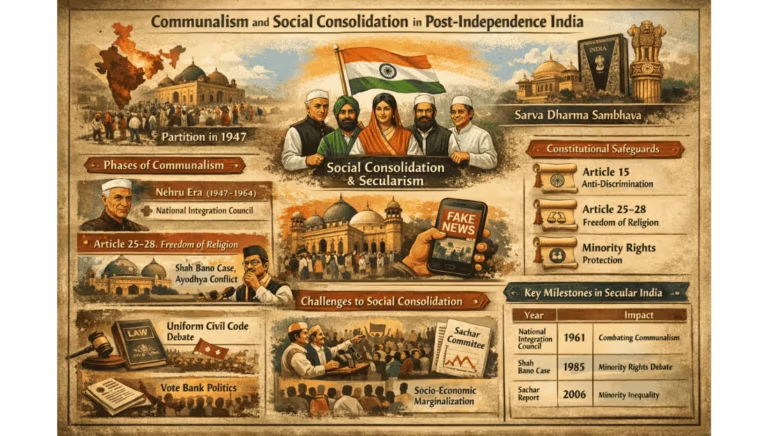
The birth of independent India was marred by the Partition of 1947, which left behind a legacy of Communalism—the use of religious identity for political and social gain. The primary challenge for the post-independence state was Social Consolidation: weaving together a diverse population into a single National Identity while maintaining a Secular Fabric.
The Constitutional Response: Secularism as a Tool for Consolidation
The Founding Fathers rejected the “Two-Nation Theory” and adopted a unique form of Secularism based on Sarva Dharma Sambhava (equal respect for all religions).
1. Legal Safeguards
- Article 15: Prohibits discrimination on grounds of religion, race, caste, sex, or place of birth.
- Article 25–28: Guarantees the Freedom of Religion to all individuals.
- Article 29 & 30: Provides Minority Rights to protect the distinct culture and educational interests of religious and linguistic minorities.
2. Principled Distance
Unlike Western secularism, the Indian State maintains a Principled Distance from religion. This allows the state to intervene in religious practices to promote Social Reform, such as the abolition of Untouchability or regulating temple entry.
Evolution of Communalism: Three Historical Phases
1. Phase I: The Nehruvian Consensus (1947–1964)
Jawaharlal Nehru viewed communalism as a “fascist” force.
- National Integration Council (1961): Formed to combat communalism, casteism, and regionalism.
- Focus: The emphasis was on Scientific Temper and Rationalism to erode religious orthodoxy.
2. Phase II: Resurgence of Identity Politics (1970s–1980s)
The 1980s saw a rise in Majoritarianism and communal mobilization.
- Shah Bano Case (1985): The government’s decision to bypass a Supreme Court ruling on maintenance for Muslim women led to accusations of Minority Appeasement.
- Ayodhya Issue: The opening of the locks at the Babri Masjid and the subsequent Rath Yatra led to a sharp rise in Polarization.
3. Phase III: Globalization and Digital Communalism (1990s–Present)
The post-Mandal era combined with the rise of Social Media has changed the nature of communalism.
- Ghettoization: Frequent communal riots (e.g., 1992 Mumbai, 2002 Gujarat) led to communities living in isolation, creating a Trust Deficit.
- Digital Communalism: The use of Fake News and viral videos to incite communal hatred represents a modern challenge to Internal Security.
Challenges to Social Consolidation
1. The Uniform Civil Code (UCC) Debate
Article 44 of the Directive Principles of State Policy mandates a Uniform Civil Code. While it is seen as a tool for Gender Justice and National Integration, critics argue it threatens Cultural Pluralism.
2. Vote Bank Politics
The politicization of religion for Electoral Gain prevents the development of a Secular National Identity, as political parties often rely on communal “card-playing” to secure votes.
3. Socio-Economic Marginalization
The Sachar Committee Report (2006) highlighted that certain religious minorities lagged behind in Human Development Indices. True Social Consolidation is impossible without Inclusive Growth.
Summary Table: Milestones in Secular India
Event/Law | Year | Impact on Consolidation |
National Integration Council | 1961 | Institutionalized the fight against communalism. |
42nd Amendment Act | 1976 | Formally added ‘Secular’ to the Preamble. |
Shah Bano Case | 1985 | Debated the limits of Personal Laws vs. Human Rights. |
Places of Worship Act | 1991 | Aimed to freeze the status of religious sites to prevent disputes. |
Sachar Committee Report | 2006 | Identified economic gaps in Minority Welfare. |
UPSC Prelims: PYQs & Practice Questions
Previous Year Questions (PYQs)
Question 1 (UPSC Prelims – Historical Context)
Q: Which of the following is/are the main objectives of the National Integration Council (NIC)?
Options:
(a) To combat the evils of communalism and casteism.
(b) To promote regionalism and linguistic pride.
(c) To oversee the rehabilitation of refugees after partition.
(d) Both (a) and (c).
Answer: (a)
Explanation: The National Integration Council (NIC) was constituted in 1961 under Prime Minister Jawaharlal Nehru to address threats to national unity—especially communalism, casteism, and divisive tendencies such as regionalism. It functions as a broad-based forum to promote harmony and strengthen social cohesion.
Question 2 (UPSC Prelims 2011)
Q: The Sachar Committee was appointed by the Government of India to report on:
Options:
(a) The economic and social condition of the Muslim community in India.
(b) The conditions of the Scheduled Castes and Scheduled Tribes.
(c) The feasibility of a Uniform Civil Code.
(d) The implementation of the PESA Act in tribal areas.
Answer: (a)
Explanation: The Sachar Committee (2005) was a high-level committee set up to study the socio-economic and educational status of Muslims in India. Its findings highlighted gaps in human development indicators and access to opportunities—issues that directly relate to social consolidation and inclusive governance.
Prelims Practice Questions
Question 1
Q: With reference to the Places of Worship (Special Provisions) Act, 1991, consider the following statements:
1. It seeks to maintain the religious character of any place of worship as it existed on August 15, 1947.
2. It applies to all religious structures including the Ram Janmabhoomi–Babri Masjid site.
Which of the statements given above is/are correct?
Options:
(a) 1 only | (b) 2 only | (c) Both 1 and 2 | (d) Neither 1 nor 2
Answer: (a) 1 only
Explanation: Statement 1 is correct: the Act freezes the religious character of places of worship as on 15 August 1947. Statement 2 is incorrect because the Act explicitly excluded the Ram Janmabhoomi–Babri Masjid dispute from its scope. The law was enacted to prevent fresh communal disputes and maintain status quo over historical religious sites.
Question 2
Q: The concept of “Principled Distance” in Indian Secularism implies:
Options:
(a) Complete separation of State and religion in all circumstances
(b) The State supports one religion to ensure social stability
(c) The State may intervene in religion to promote reform and justice, while otherwise remaining neutral
(d) Religion has absolute autonomy and State has no regulatory role
Answer: (c) The State may intervene in religion to promote reform and justice, while otherwise remaining neutral
Explanation: Principled Distance means the State is not strictly “wall-separated” from religion; instead, it maintains balanced neutrality. It can engage with or regulate religious practices when required to uphold constitutional morality, social reform, and justice (e.g., abolishing untouchability, enabling temple entry, regulating secular aspects of religious institutions), but it avoids partisan favoritism toward any one faith.
UPSC Mains – Previous Year & Practice Questions
Mains Previous Year Questions (Society: Communalism & Secularism)
Communalism: Power Struggle vs Relative Deprivation
Question: "Communalism arises either due to power struggle or due to relative deprivation." Argue by giving suitable illustrations. (UPSC 2018)
Indian Secularism vs Western Model
Question: How the Indian concept of secularism is different from the Western model of secularism? Discuss. (UPSC 2014/2018)
Religiosity vs Communalism
Question: Distinguish between religiousness/religiosity and communalism. Give one example of how the former has got transformed into the latter in independent India. (UPSC 2017)
Identity Politics and Communalism in the 1980s
Question: Analyze the role of 'identity politics' in fostering communalism in the 1980s. (UPSC - Historical context)
Secularism and Cultural Practices
Question: What are the challenges to our cultural practices in the name of Secularism? (UPSC 2019)
Mains Practice Questions
Civil Society & Trust Deficit in Communal Relations
Question: “Social consolidation in India is impossible without bridging the trust deficit between different religious communities.” Evaluate the role of civil society in this process. (250 Words)
Shah Bano Case & Secular Fabric
Question: To what extent did the Shah Bano Case and the subsequent legislative reversal impact the secular fabric of post-independence India? (250 Words)
Digital Communalism, Internal Security & National Integration
Question: Discuss the impact of Digital Communalism on internal security and the process of national integration in the 21st century. (250 Words)
Frequently Asked Questions (FAQs)
What is 'Ghettoization' in the context of communalism?
Ghettoization is the process where a minority community is forced (often by fear or lack of safety) or chooses to live in segregated areas. In post-independence India, communal riots have often led to this, hindering social consolidation as different communities stop interacting.
How does the 'Uniform Civil Code' (UCC) relate to social consolidation?
Proponents argue that a UCC (Article 44) would unify the nation under a single law for marriage and inheritance, fostering national integration. Critics argue it might lead to cultural homogenization and alienate minority communities if implemented without consensus.
What is the difference between 'Communalism' and 'Secularism'?
- Communalism: Using religious identity as a tool for political or economic power.
- Secularism: In the Indian context, it means Sarva Dharma Sambhava—equal respect for all religions and state neutrality.
What was the impact of the 'National Integration Council' (NIC)?
The NIC was a key institutional response to communalism. It provided a platform for political leaders and civil society to discuss threats to unity. While it had periods of inactivity, it remains a symbolic pillar of the state’s commitment to social consolidation.
What is 'Minority Appeasement' vs 'Minority Protection'?
- Minority Protection: Safeguarding rights as per Articles 29 and 30 to ensure a pluralistic society.
- Minority Appeasement: A political term used when the state is perceived to favor a community solely for vote-bank politics, which often backfires and leads to majoritarianism.