
Daily Current Affairs 01-December-2025

Share this Post

SEEDS BILL 2025

TOPIC: (GS3) ECONOMY: THE HINDU

The Ministry of Agriculture and Farmers Welfare has introduced the Seeds Bill 2025, aiming to modernise seed regulation. It proposes compulsory registration of all seed varieties and stricter penalties, replacing the Seeds Act, 1966.

Why India Needs a New Seeds Law

  • Current Seeds Act covers only notified varieties, leaving many categories (green manure, plantation crops) outside regulation.
  • Penalties under the 1966 Act are outdated – only six months’ jail or ₹1,000 fine.
  • Rising complaints of spurious and poor-quality seeds demand stronger legal safeguards.
  • Earlier attempt in 2004 failed to become law, keeping regulatory gaps unresolved.

Problem of Substandard Seeds

  • Between 2022–25, 43,001 seed samples were found non-standard out of ~6 lakh tested.
  • West Bengal reported the highest share (62%), followed by Tamil Nadu and Madhya Pradesh.
  • Enforcement actions included 12,287 warnings, 12,915 stop-sale orders, 1,914 FIRs, and 164 forfeitures.
  • Highlights the scale of fake seed circulation affecting farmers’ livelihoods.

India’s Seed Requirement & Market

  • 2024–25 demand: 48.20 lakh tonnes; availability: 53.15 lakh tonnes (adequate supply).
  • Seed market size: ~₹40,000 crore.
  • From 2014–25, 3,053 new varieties released – 85% by public sector, 15% by private firms.

Key Features of Seeds Bill 2025

  • Mandatory Registration: All varieties (except traditional farmers’ seeds and export-only) must be registered after VCU testing.
  • Quality Standards: Minimum germination and purity required for sale.
  • Market Controls: Dealers need state registration; QR codes on seed packets via central portal.
  • Accreditation System: Nationally accredited firms can operate across states without extra approvals.
  • Stricter Penalties:
    • Minor offences – fines from ₹1 lakh.
    • Major offences – up to ₹30 lakh fine and 3 years’ imprisonment.
  • Farmers’ Rights: Farmers can grow, save, exchange, and sell farm-saved seeds (not branded).
  • Committees: New central and state seed committees for oversight.

Concerns Raised

  • Compensation Gap: Farmers must go to court for crop failure claims – costly and slow.
  • Exclusion of Community Seed Keepers: FPOs, women’s groups face heavy compliance, risking biopiracy of native varieties.
  • Corporate Tilt: VCU trials favour hybrids; digital compliance burdens small rural seed keepers.
  • Foreign Entry Risk: Recognition of foreign organisations for testing may allow GM/patented seeds without strong domestic checks.

Conclusion

The Seeds Bill 2025 seeks to strengthen seed regulation and protect farmers from fake seeds. However, concerns about farmer compensation, community seed rights, and corporate bias need careful redress.

AIDS AND TB FIGHT — TAMIL NADU SHOWS THE WAY

TOPIC: (GS2) SOCIAL JUSTICE AND HEALTH: THE HINDU

On World AIDS Day (December 1, 2025), Tamil Nadu’s innovative health models are highlighted for their role in controlling HIV and now tackling TB. The State has adopted predictive technology to reduce TB deaths, similar to its earlier success with the AIDS Control Society model.

HIV and AIDS in India

  • 1980s Africa: HIV/AIDS devastated populations with no treatment available.
  • Early 1990s India: HIV spread across the country, mainly through unsafe sex; in the northeast, drug use and needle sharing were major causes.
  • Challenge: No cure, high mortality due to opportunistic infections like TB and diarrhoea.

Tamil Nadu State AIDS Control Society (TNSACS) Model

  • 1992: National AIDS Control Project launched with World Bank support.
  • Problem: Slow fund flow through government channels.
  • 1994 Solution: Tamil Nadu converted its AIDS Cell into a registered society (TNSACS) for direct funding and autonomy.
  • Impact:
    • Rapid awareness campaigns.
    • Sharp fall in new HIV infections.
    • Model replicated nationwide in 1997–2002.
  • Result: India’s adult HIV prevalence dropped from 0.54% (2000) to 0.22% (2025).

TB Burden in India

  • WHO Global TB Report 2025:
    • India has 25% of global TB cases (36 million).
    • 7.5% of global HIV cases are in India.
    • TB is the leading opportunistic infection in HIV patients, causing 25% of AIDS deaths.
    • India also has 25% of global MDR-TB cases.

India’s Response to TB

  • Target: Eliminate TB by 2025 (ahead of global 2030 target).
  • Progress: Target not fully met, but decline in TB cases is faster than global average.
  • Government Efforts: Pradhan Mantri TB Mukt Bharat Abhiyaan (PMTBMBA) supports treatment, nutrition, and community participation.

Tamil Nadu’s New TB Model

  • Variation across States: 5 States (UP, Maharashtra, MP, Bihar, Rajasthan) account for 56% of TB cases.
  • Tamil Nadu Innovation:
    • First State to integrate ICMR-NIE predictive software into TB screening.
    • Helps identify patients at risk of TB deaths.
    • Steps: rapid testing → reporting → treatment → nutrition support.
  • Collaboration: State National Health Mission and Central TB Office work jointly.
  • Outcome: Efficient adoption of technology and delivery system, replicating the AIDS success story.

TUBERCULOSIS (TB)

Caused by Bacteria

    • TB is an infectious disease caused by Mycobacterium tuberculosis.
    • It mainly affects the lungs (pulmonary TB) but can also impact other organs (extrapulmonary TB).

Mode of Transmission

    • TB spreads through the air when a person with active pulmonary TB coughs, sneezes, or speaks.
    • Close and prolonged contact increases risk of infection.

Global and Indian Burden

    • India accounts for about 25% of global TB cases, making it the country with the highest TB burden.
    • TB is also the most common opportunistic infection among HIV patients.

Risk Factors for Spread

    • Poor nutrition, overcrowded living conditions, weak immunity (HIV/AIDS), and lack of timely treatment.
    • Multidrugresistant TB (MDRTB) is a growing challenge due to incomplete or improper treatment.

Prevention and Control

    • Early detection and completion of treatment under DOTS (Directly Observed Treatment Strategy).
    • Vaccination with BCG (Bacillus Calmette–Guérin) in childhood.
    • Public health measures: awareness, nutrition support, and reducing stigma.

Conclusion

Tamil Nadu’s proactive health governance — from TNSACS for HIV to predictive TB models — demonstrates how innovation and autonomy can control epidemics.

BIODIVERSITY DISCOVERIES AT GREAT NICOBAR PROJECT SITE

TOPIC: (GS3) ENVIRONMENT: THE HINDU

A newly identified snake species and a possibly new bird species were recently found in Great Nicobar Island, highlighting its rich biodiversity. These discoveries raise concerns about the ecological impact of the proposed mega infrastructure project in the region.

Recent Biodiversity Findings

  • Since 2021, around 40 new species have been recorded from Great Nicobar.
  • These include:
    • Lycodon irwini: A rare wolf snake named after Steve Irwin, found only four times.
    • Great Nicobar Crake (Rallina sp.): A bird with unique features, possibly a new species.
    • Other new species: frogs (2), crabs (4), geckos (2), and various insects.
  • Nearly half of these species were described in 2025, showing ongoing discoveries.
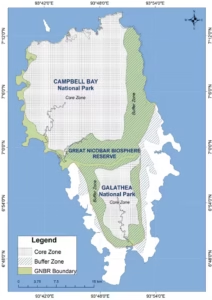
Biodiversity Findings

Ecological Significance of Great Nicobar

  • The island hosts:
    • 650 plant species and 1,800 animal species.
    • 24% endemism in some faunal groups.
  • It contains one of the best-preserved tropical rainforests in India.
  • Regular discoveries indicate high genetic diversity and ecological sensitivity.

Challenges of the Infrastructure Project

  • Habitat destruction: Large-scale construction may damage pristine forest ecosystems.
  • Threat to endemic species: Rare and newly discovered species face extinction risks.
  • Limited ecological data: Many species are poorly studied, making impact assessment difficult.
  • Disruption of tribal communities: Indigenous groups may lose access to traditional lands and resources.

Way Forward

  • Comprehensive biodiversity surveys: Conduct detailed ecological studies before project approval.
  • Protected status for rare species: Classify newly found species under IUCN Red List and national protection laws.
  • Eco-sensitive zoning: Restrict development in high-biodiversity zones and buffer areas.
  • Community-led conservation: Involve local tribes and researchers in monitoring and safeguarding habitats.

Conclusion

The Great Nicobar region is a biodiversity hotspot with many species still being discovered. Any development must balance economic goals with ecological responsibility, ensuring long-term sustainability and protection of India’s natural heritage.

PARLIAMENTARY DECLINE IN INDIA

TOPIC: (GS2) INDIAN POLITY: THE HINDU

The Winter Session of Parliament has begun amid possible deadlock over the Special Intensive Revision (SIR) of electoral rolls. Concerns are growing about falling productivity, weak deliberation, and rising executive control over the legislature.

Declining Health of Parliament

  • Frequent disruptions: Monsoon Session 2024 – Lok Sabha worked only 29% of scheduled time, Rajya Sabha 34%.
  • Question Hour weakened: LS completed 23%, RS only 6% of allotted time.
  • Bills passed with little debate:
    • Online Gaming Bill – cleared in one day with 6 minutes (LS) and 23 minutes (RS).
    • Merchant Shipping Bill – 20 minutes (LS), 10 minutes (RS).
  • Skewed priorities: Half of LS time spent on Operation Sindoor.

Numbers Indicate Structural Decline

  • Short-term variation: Budget Sessions 2023–24 had high productivity (111% LS, 112% RS), but Winter Session 2024 dropped sharply (52% LS, 39% RS).
  • 17th Lok Sabha (2019–24): LS worked 88% of scheduled time, RS 73%. Fewest sittings since 1952 (Covid impact). No Deputy Speaker – continued into 18th Lok Sabha.
  • Historical trend: 1952–70: Avg. 121 sittings/year. Since 2000: Avg. 68 sittings/year. 17th LS: Only 55 sittings/year.
  • Committee scrutiny weakened: Referral of Bills fell from 60% (14th–15th LS) to ~20% (16th–17th LS).

Importance of Parliamentary Proceedings

Ensuring Accountability of the Executive

    • Parliament holds the government responsible through Question Hour, Zero Hour, and debates.
    • Example: Questions raised during the Coal Allocation Scam (2012) exposed irregularities and forced government response.

Law-Making and Policy Deliberation

    • Parliamentary proceedings allow discussion before passing laws, ensuring diverse viewpoints.
    • Example: The Right to Information Act, 2005 was debated extensively, strengthening transparency in governance.

Representation of Citizens’ Voices

    • MPs bring regional and social concerns into national debate, making Parliament the “voice of the people.”
    • Example: Discussions on farmers’ issues during the 2020 farm laws debate reflected grassroots concerns.

Safeguarding Democracy and Constitutional Values

    • Parliamentary proceedings uphold democratic norms by checking executive dominance and protecting rights.
    • Example: The Emergency (1975–77)

Comparative Perspective

  • Westminster model (UK): PM’s Questions, strong committee oversight, mandatory testimony by ministers.
  • India’s divergence: Decline in accountability, reversal of Westminster spirit.

Challenges and Way Forward

  • Dialogue mechanisms: Regular communication between PM, LoP, and House leaders.
  • Mandatory sittings: At least 120 days/year to ensure debate.
  • Strengthen committees: Referral of major Bills must be compulsory.
  • Deputy Speaker election: Enforce Article 93 convention.
  • Revive Question Hour/Zero Hour: Ensure accountability sessions function fully.
  • Institutionalise PM’s Question Hour: Weekly accountability of executive before Parliament.

PARLIAMENTARY SESSIONS

Articles in the Constitution

  • Article 85 – Sessions of Parliament
    • President summons each House of Parliament.
    • Six months must not elapse between two sessions.
    • Provides for prorogation and dissolution of Lok Sabha.
  • Article 86 – Right of President to Address and Send Messages
    • President can address either House or both Houses together.
    • Can send messages to Parliament, which must be considered.
  • Article 87 – Special Address by the President
    • At the first session after each general election and at the first session of every year, the President addresses both Houses.
    • This is called the President’s Address.
  • Article 88 – Rights of Ministers and Attorney General
    • Ministers and Attorney General can participate in parliamentary proceedings, though they may not vote unless they are members.

Types of Parliamentary Sessions

  • Budget Session (Feb–May): Longest, focused on financial business.
  • Monsoon Session (July–Aug): Legislative business and discussions.
  • Winter Session (Nov–Dec): Shorter, often politically significant.

Conclusion

The decline of Parliament is structural, not episodic, weakening its constitutional role as the nation’s forum of accountability. Urgent reforms are needed to restore deliberation, strengthen oversight, and uphold the spirit of democracy envisioned by the Constitution.

RISE IN ELECTRICITY-RELATED FATALITIES IN INDIA

TOPIC: (GS3) ECONOMY: THE HINDU

In 2023, over 18,000 deaths occurred due to electrical accidents in India, with a rising fatality rate. Most incidents in 2025 were caused by accidental contact with live wires, highlighting safety lapses in power distribution.

Overview of the Issue

  • Electrocution is the leading cause of electrical deaths, followed by lightning strikes and electrical fires.
  • India’s electrical fatality rate has steadily increased over the years.
  • In 2023, 1 death per lakh population was recorded due to electrical accidents.
  • In contrast, developed countries like Japan, Australia, and the U.S. report rates between 0.01 and 0.04.

State-Level Variation

  • The four-year average fatality rate varies widely across States.
    • Some States report as low as 0.2 deaths per lakh, while others reach 2.6 deaths per lakh.
  • Indicates uneven safety standards and infrastructure across regions.

Urban Trends

  • Until 2013, data from 50+ megacities was available.
  • In 2013:
    • 13% of total electrical deaths occurred in megacities.
    • Electrical fires caused ~25% of urban deaths.
    • Electric shocks accounted for ~11%.

Distribution Network Risks

  • In 2025, 61% of accidents happened in distribution systems, and 30% in non-industrial consumer areas.
  • Data from DISCOMs shows Over 90% of victims were from the general public which Indicates poor safety enforcement and lack of public awareness.

Key Causes of Accidents

  • Accidental contact with live wires: 35% of cases.
  • Negligence or lack of supervision: 15% of cases.
  • Reflects inadequate safety protocols and insufficient monitoring by DISCOMs.

Conclusion

The rising trend in electrical fatalities calls for urgent reforms in safety standards, especially in distribution networks. Public awareness, strict enforcement, and DISCOM accountability are crucial to reduce such preventable deaths.

CITIZENSHIP SCRUTINY BY ECI

TOPIC: (GS2) INDIAN POLITY: THE HINDU

The Election Commission of India (ECI) told the Supreme Court that its constitutional powers allow it to verify citizenship for electoral rolls.

Background of the Issue

  • Opposition parties in Tamil Nadu, Kerala, and West Bengal argued that ECI is conducting a process similar to the National Register of Citizens (NRC).
  • They claimed only the Union Government has authority to determine citizenship under the Citizenship Act, 1955.
  • ECI refuted these claims in a detailed affidavit, stressing its independent constitutional mandate.

Limits of Central Authority

  • Section 9 of the Citizenship Act, 1955: Centre can decide only on cases where Indian citizens voluntarily acquire foreign citizenship.
  • This power is limited to termination of citizenship.
  • Other aspects of citizenship verification for electoral rolls fall within ECI’s jurisdiction.

ECI’s Constitutional Mandate

  • Article 324: Grants ECI plenary powers of superintendence, direction, and control over elections.
  • Article 326: Specifies that only Indian citizens can be registered as voters.
  • Representation of the People Act (ROPA), 1950: Section 16 disqualifies noncitizens from electoral rolls. Section 19 requires voters to be ordinarily resident in their constituency.
  • Hence, verifying citizenship is an intrinsic duty of ECI.

SPECIAL INTENSIVE REVISION (SIR)

  • Aim: Remove names of dead persons, permanently shifted individuals, and noncitizens to ensure accurate rolls.
  • Legal basis: Section 21(3) of ROPA allows intensive revision when rolls are inaccurate or inflated.
  • Purpose: Purification of voter lists, not determination of citizenship.
  • Process:
    • Booth Level Officers deliver prefilled forms to electors.
    • Voters confirm eligibility by signing forms.
  • ECI’s Response:
    • SIR is constitutional and necessary for free and fair elections.
    • Proof sought is minimal, only to confirm voter eligibility.
    • Not an NRClike exercise, limited to electoral purposes.

Conclusion

ECI asserts its constitutional duty to maintain clean and accurate voter rolls, a basic feature of democracy. The Supreme Court’s decision will clarify the balance of powers between the Centre and ECI in matters of citizenship and elections.

BUTTERFLY NEBULA

TOPIC: (GS3) SCIENCE AND TECHNOLOGY: THE HINDU

Recently, Chile’s Gemini South telescope imaged the Butterfly Nebula in extraordinary detail. The nebula lies 2,500–3,800 light-years away, formed by glowing gas expelled from a dying white dwarf star.

What are Space Observing Satellites?

  • Satellites designed to observe space objects like stars, galaxies, planets, and nebulae.
  • They operate above Earth’s atmosphere, avoiding distortion caused by air and pollution.
  • Examples: Hubble Space Telescope (USA), James Webb Space Telescope (USA/Europe), Gaia (Europe).
  • They provide data on cosmic evolution, star formation, and exoplanets.
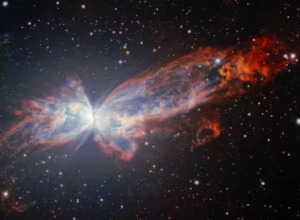
Butterfly Nebula

India’s Space Observing Efforts

  • Astrosat (2015): India’s first dedicated multi-wavelength space observatory.
    • Observes in X-ray, UV, and optical bands.
    • Helps study binary star systems, black holes, and galaxies.
  • Future Plans:
    • ISRO is planning XPoSat (X-ray Polarimeter Satellite) to study cosmic X-ray sources.
    • India is also collaborating internationally for deep space missions.

WHAT ARE NEBULAS?

  • Nebula = vast cloud of gas and dust in space.
  • Types:
    • Emission Nebula: glows due to ionized gas (e.g., Orion Nebula).
    • Reflection Nebula: reflects light of nearby stars.
    • Planetary Nebula: formed from dying stars (e.g., Butterfly Nebula).
    • Dark Nebula: dense clouds blocking starlight.
  • Importance:
    • Sites of star birth and death.
    • Provide clues about stellar evolution.

Light-year: Distance light travels in one year (~9.46 trillion km).

White dwarf: End stage of medium-sized stars, very dense and faint.

Astrosat: India’s first space observatory, important for UPSC science and tech section.

XPoSat: Upcoming Indian mission to study X-ray polarization.

Conclusion

With missions like Astrosat and XPoSat, India is steadily building capacity in space-based astronomy. Understanding nebulas and telescopes is crucial for UPSC aspirants, linking current affairs with science and technology.

BUTTERFLY NEBULA

TOPIC: (GS3) SCIENCE AND TECHNOLOGY: THE HINDU

Recently, Chile’s Gemini South telescope imaged the Butterfly Nebula in extraordinary detail. The nebula lies 2,500–3,800 light-years away, formed by glowing gas expelled from a dying white dwarf star.

What are Space Observing Satellites?

  • Satellites designed to observe space objects like stars, galaxies, planets, and nebulae.
  • They operate above Earth’s atmosphere, avoiding distortion caused by air and pollution.
  • Examples: Hubble Space Telescope (USA), James Webb Space Telescope (USA/Europe), Gaia (Europe).
  • They provide data on cosmic evolution, star formation, and exoplanets.

India’s Space Observing Efforts

  • Astrosat (2015): India’s first dedicated multi-wavelength space observatory.
    • Observes in X-ray, UV, and optical bands.
    • Helps study binary star systems, black holes, and galaxies.
  • Future Plans:
    • ISRO is planning XPoSat (X-ray Polarimeter Satellite) to study cosmic X-ray sources.
    • India is also collaborating internationally for deep space missions.

WHAT ARE NEBULAS?

  • Nebula = vast cloud of gas and dust in space.
  • Types:
    • Emission Nebula: glows due to ionized gas (e.g., Orion Nebula).
    • Reflection Nebula: reflects light of nearby stars.
    • Planetary Nebula: formed from dying stars (e.g., Butterfly Nebula).
    • Dark Nebula: dense clouds blocking starlight.
  • Importance:
    • Sites of star birth and death.
    • Provide clues about stellar evolution.

Light-year: Distance light travels in one year (~9.46 trillion km).

White dwarf: End stage of medium-sized stars, very dense and faint.

Astrosat: India’s first space observatory, important for UPSC science and tech section.

XPoSat: Upcoming Indian mission to study X-ray polarization.

Conclusion

With missions like Astrosat and XPoSat, India is steadily building capacity in space-based astronomy. Understanding nebulas and telescopes is crucial for UPSC aspirants, linking current affairs with science and technology.

NOROVIRUS

TOPIC: (GS3) SCIENCE AND TECHNOLOGY: THE HINDU

Recently, cases of norovirus (popularly called winter vomiting disease) have increased in the United States. The outbreak highlights the global concern over this highly contagious stomach infection.

About Norovirus

  • A common viral infection causing inflammation of stomach and intestines (gastroenteritis).
  • Also called stomach flu or winter vomiting bug.
  • Outbreaks usually occur in cold months.
  • Responsible for 90% of viral gastroenteritis outbreaks and nearly 50% of global cases.
  • People can get infected multiple times due to different strains.
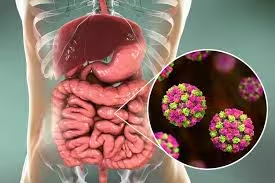
Norovirus

Transmission

  • Spread through:
    • Contact with infected persons.
    • Contaminated food or water.
    • Touching infected surfaces.
  • Common in crowded and closed environments.
  • Patients remain contagious from illness onset to 3 days after recovery.

Symptoms

  • Vomiting, diarrhoea, stomach cramps, nausea, fever, fatigue.
  • Severe cases may lead to dehydration.

Treatment

  • No specific medicine or vaccine available.
  • Focus on symptom relief and hydration.
  • Severe dehydration may require intravenous fluids.

Difference from Influenza (“Flu”)

  • Norovirus → causes gastroenteritis (stomach infection).
  • Influenza virus → causes respiratory flu (lungs and airways).

Conclusion

Norovirus is a seasonal, highly contagious infection with global impact. Preventive measures like hand hygiene, safe food practices, and awareness are crucial to reduce outbreaks.


Write a Review

Your email address will not be published. Required fields are marked *