
SUPREME COURT’S OBSERVATIONS ON THE ANTI-DEFECTION LAW
TOPIC: (GS2) INDIAN POLITY: THE HINDU
The Supreme Court has urged Parliament to review the role of Assembly Speakers and Chairmen in deciding disqualification cases under the Anti-Defection Law, citing delays and possible bias, and directed the Telangana Speaker to resolve pending petitions against 10 BRS MLAs who defected to the Congress in 2024.
Background
- Phrase origin: “Aaya Ram Gaya Ram” became famous in 1967 when a Haryana MLA changed parties thrice in one day.
- Law introduction: The Tenth Schedule was added through the 52nd Constitutional Amendment Act, 1985 to control political defections.
Key Provisions of the Anti-Defection Law
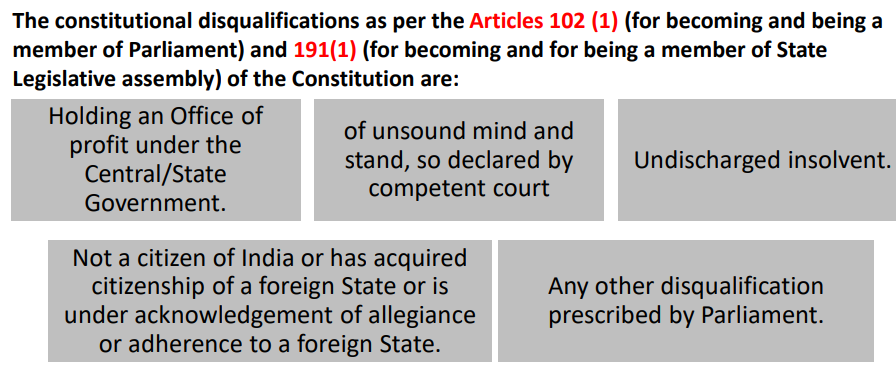
Grounds for Disqualification
- A legislator from a political party can be disqualified if they:
- Voluntarily give up party membership.
- Vote or abstain from voting against the party’s direction without permission.
- Exemptions:
- Prior party permission.
- Party condonation within 15 days of the act.
- Independent members: Disqualified if they join a political party after election.
- Nominated members: Disqualified if they join a political party after six months of nomination.
- Decision-making authority: Speaker/Chairman of the House.
Exceptions
- Original law had:
- Split by one-third members (removed in 2003 to strengthen law).
- Merger approved by at least two-thirds members of the legislature party.
Important Supreme Court Judgments
- Kihoto Hollohan v. Zachillhu (1992) – Speaker’s decision is subject to judicial review by High Courts and the Supreme Court.
- Keisham Meghachandra Singh v. Speaker, Manipur (2020) – Set a three-month limit for deciding disqualification cases.
Issues and Challenges
- Delays: No strict timeline for Speaker’s decision, enabling prolonged cases.
- Bias: Speaker is usually a ruling party member, raising impartiality concerns.
- Legislative autonomy vs. judicial intervention: Courts reluctant to interfere early.
- Freedom of speech: Law limits legislators’ ability to dissent within the party.
- Rigid whip system: Discourages internal party debate.
Way Forward
- Shift disqualification power to independent bodies or Election Commission to ensure neutrality.
- Set mandatory timelines for deciding cases.
- Reform whip system to allow greater debate on non-confidence or non-money bills.
- Promote internal party democracy to balance discipline with freedom of expression.
Representation of the People Act, 1951
- Offences like promoting enmity, bribery, electoral fraud.
- Offences like hoarding, adulteration, dowry crimes.
- Conviction of two years or more = disqualification during sentence + 6 years after release.
- Section 8(4) (three-month appeal window) struck down in Lily Thomas v. Union of India (2013), making disqualification immediate upon conviction.
Conclusion:
While the Anti-Defection Law has curbed opportunistic political defections, loopholes and delays in its enforcement weaken its purpose. A reformed framework with independent adjudication, fixed timelines, and greater space for intra-party debate is essential to protect both political stability and democratic freedom in India’s legislative process.
TAMIL NADU’S INCLUSIVE EDUCATION MODEL
TOPIC: (GS2) GOVERNANCE: THE HINDU
On July 31, 2025, Tamil Nadu felicitated 135 students from Adi Dravidar and Tribal Welfare Schools who secured admission to India’s top institutions, reflecting the State’s long-term focus on education as a tool for social justice.
Historical Foundations
Early reforms:
- 1920 – First mid-day meal served in a Chennai municipal school, inspired by Justice Party leader P. Theagaraya Chetty.
- 1921 – Communal Government Order ensured access to education for marginalised communities.
- Dravidian movement governments since 1967 expanded these reforms with inclusive education policies.
Key Education Initiatives
Food and Nutrition Support
- Mid-Day Meal Scheme evolved into one of the world’s largest school meal programmes.
- Free Breakfast Scheme (2022) to improve attendance, especially in rural and disadvantaged areas.
Financial Assistance
- Pudhumai Penn Thittam: ₹1,000 monthly stipend for girl students from government/aided schools pursuing higher education.
- Scholarships from primary to research level.
- Fee waivers and exam concessions for entry to premier institutions.
Access and Infrastructure
- Free education, textbooks, and uniforms to reduce cost burden.
- Safe hostels with food and accommodation for students from remote areas.
- Skill training programmes to enhance employability.
Academic Support
- Special coaching for competitive entrance exams (IITs, NITs, law, fashion, aviation).
- Illam Thedi Kalvi initiative post-COVID to bridge learning gaps.
Achievements
- 135 students from marginalised backgrounds admitted to IITs, NITs, NIFT, NLUs, Miranda House, etc.
- All 6 Scheduled Tribe seats at Rajiv Gandhi National Aviation University secured by Tamil Nadu students.
- Gross Enrolment Ratio (GER) in higher education:
- Overall: 47% (national average 28.4%)
- Women: 47.3% (national average 28.5%)
Significance
- Reflects a systemic change, not isolated success.
- Shows that equal opportunity + sustained support can help disadvantaged students excel.
- Strengthens Tamil Nadu’s image as a leader in inclusive higher education.
Conclusion:
Tamil Nadu’s governance model rooted in social justice, targeted schemes, and consistent investment in education has created one of India’s most inclusive higher education systems. The State aims to continue bridging inequalities and building a just, prosperous, and humane society through education.
INDIA’S DIGITAL SOVEREIGNTY CONCERNS IN INDIA-UK FTA
TOPIC: (GS2) INTERNATIONAL RELATIONS: THE HINDU
The recently concluded India–UK Free Trade Agreement (FTA), hailed as a “gold standard” by the commerce minister, is being criticised for possible compromises in India’s digital sovereignty, with experts warning of long-term strategic and security risks.
Background
- The India–UK FTA, also called the Comprehensive Economic and Trade Agreement (CETA), covers multiple sectors.
- While agriculture and manufacturing received attention, the digital sector provisions have raised concerns over loss of regulatory control and strategic autonomy.
Key Concerns
Source Code Disclosure Restrictions
- India has agreed not to demand pre-emptive access to source code of foreign digital goods or services, even in sensitive areas.
- Earlier, India had defended this right at global platforms like the WTO for regulatory, security, and safety reasons.
- Many countries, including the US, now allow exceptions for critical infrastructure, but the UK FTA applies restrictions to all software.
- This limits the ability of Indian regulators to inspect software in sectors like telecom, AI, and healthcare.
Access to Open Government Data
- The FTA grants equal and non-discriminatory access to UK parties for India’s government-held data.
- In the digital era, data is a critical economic and strategic resource for AI and emerging technologies.
- Such access could erode India’s advantage in creating domestic AI solutions and pose security threats if sensitive data is misused.
- Though the provision is currently non-binding, it sets a precedent for future obligations.
Data Flow and Localisation Commitments
- India has resisted pressure to allow free cross-border data flows and avoid data localisation requirements.
- However, the FTA commits India to extend similar concessions to the UK if it grants them to another nation, reducing policy flexibility.
- This could weaken India’s long-held strategic positions in digital trade negotiations.
Strategic Implications
- Digital trade rules, once agreed, are hard to reverse, locking India into external digital governance models.
- Lack of a strong political constituency for digital sovereignty means these issues get less attention than agriculture or manufacturing.
- The concessions may risk India becoming dependent on foreign digital ecosystems, repeating historical patterns of economic subordination.
Way Forward
- Formulate a comprehensive digital sovereignty and industrialisation policy before entering trade deals.
- Ensure digital experts are part of FTA negotiations alongside trade officials.
- Develop a roadmap for becoming a digital superpower, securing both economic and security interests.
- Treat national data as a strategic asset to be protected for domestic innovation and AI leadership.
Conclusion:
India’s digital concessions in the UK FTA highlight the urgent need for a clear national strategy on digital sovereignty to safeguard long-term independence and competitiveness in the global digital order.
SURROGACY (REGULATION) ACT, 2021 – AGE LIMIT DEBATE
TOPIC: (GS2) INDIAN POLITY: INDIAN EXPRESS
The Supreme Court has reserved its verdict on petitions challenging the age limit for intending parents under the Surrogacy (Regulation) Act, 2021, which regulates surrogacy in India alongside the Assisted Reproductive Technology (Regulation) Act, 2021.
About Surrogacy (Regulation) Act, 2021
- Surrogacy: A woman carries and delivers a child for an intending couple, handing over the child after birth.
- Allowed only for altruistic purposes or in cases of proven infertility/disease.
- Commercial surrogacy is banned (including for sale, prostitution, or exploitation).
Abortion Rules
- Permitted only with surrogate mother’s consent and approval of authorities.
- Must comply with the Medical Termination of Pregnancy Act.
Eligibility Criteria
For Intending Couples
- Must have married for at least 5 years.
- Wife: 23–50 years; Husband: 26–55 years.
- No existing living child (biological, adopted, or through surrogacy) — except if the child has disabilities or life-threatening conditions.
- Need an Essential Certificate from District Medical Board confirming infertility.
- Must provide 16 months’ insurance for the surrogate covering post-pregnancy complications.
- For Single Women: Age: 35–45 years.
For Surrogate Mother
- Must be a close relative of the couple.
- Married woman with at least one biological child.
- Age: 25–35 years.
- Can be a surrogate only once in her lifetime.
- Requires medical and psychological fitness certification.
Regulation & Penalties
- Establishment of National Surrogacy Board (NSB) & State Surrogacy Boards (SSB) to set standards and monitor clinics.
- Offences: Commercial surrogacy, sale of embryos, exploitation, child abandonment.
- Penalties: Up to 10 years imprisonment and ₹10 lakh fine.
Arguments in Favour of Age Limit
- Protects child welfare and ensures parents’ physical/mental capacity.
- Creates uniform regulations for clinics and surrogacy contracts.
- Reduces medical risks for older parents.
- Encourages responsible parenthood within a safe age bracket.
Arguments Against Age Limit
- Violates reproductive autonomy under Article 21.
- Ignores individual health variations and medical advances.
- Disadvantages late marriages and remarriages.
- Inconsistent — no age restriction for natural conception.
Way Forward
- Shift to case-by-case assessment based on medical fitness, psychological readiness, and social support.
- Balance child welfare with reproductive rights.
- Align laws with constitutional guarantees and changing social realities.
Conclusion:
While the Surrogacy (Regulation) Act, 2021 safeguards child welfare and medical safety, a more flexible, rights-based approach is needed to uphold reproductive autonomy and reflect evolving social and medical realities.
WHITE PAPER ON INDIA’S BLUE ECONOMY
TOPIC: (GS3) ECONOMY: THE HINDU
The white paper “Transforming India’s Blue Economy” outlines a strategy to harness India’s marine resources for sustainable growth, aiming to make the blue economy a key driver of national development by 2035.
What is the Blue Economy?
- Refers to sustainable use of ocean resources for economic growth, livelihood improvement, and job creation while maintaining healthy marine ecosystems.
- Covers activities such as fisheries, aquaculture, shipping, ports, marine biotechnology, coastal tourism, and renewable ocean energy.
Models of Blue Economy in India
Community-led Seaweed Farming (Odisha)
- Engages over 10,000 households in coastal areas. Provides supplementary income and livelihood diversification.
- Absorbs dissolved CO₂, helping in climate change mitigation. Improves local water quality and supports biodiversity.
Smart Port Development (Kochi)
- Adoption of digital twin technology for port operations.
- Improves efficiency, reduces ship waiting time, and optimises resource use.
- Enables real-time environmental monitoring for sustainable port management.
Green Ship Recycling (Alang, Gujarat)
- Upgraded to Hong Kong Convention standards. Ensures safe recovery of steel and metals from ships.
- Promotes safe disposal of hazardous waste and better worker safety.
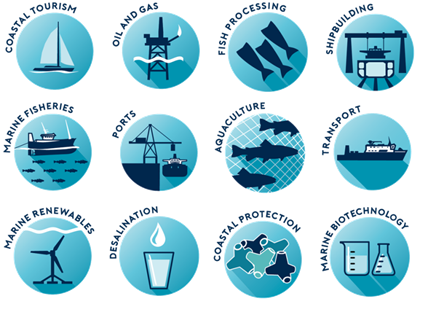
Major Government Initiatives for Blue Economy
- Deep Ocean Mission (DOM): Exploration of polymetallic nodules and deep-sea bioresources. Development of human submersibles for ocean mapping and sustainable mining.
- Sagarmala Programme: Modernises ports, improves cargo logistics. Develops coastal economic zones to boost trade and industry.
- Blue Economy 2.0: Focus on restoring mangroves and coral reefs. Promotion of sustainable aquaculture and mariculture, especially seaweed farming.
- Pradhan Mantri Matsya Sampada Yojana (PMMSY): Modernises fishing practices and infrastructure. Promotes sustainable fisheries and improves fishers’ income.
Significance
- Enhances coastal livelihoods and economic security.
- Strengthens food security through sustainable fishing.
- Supports climate change mitigation via carbon absorption by marine ecosystems.
- Positions India as a leader in ocean-based economic growth while protecting marine biodiversity.
Conclusion:
India’s Blue Economy vision integrates economic growth with environmental stewardship. By scaling up sustainable models and leveraging technology, India can transform its coasts and oceans into engines of inclusive and resilient development by 2035.
TAMIL NADU’S TRANSGENDER POLICY, 2025
TOPIC: (GS2) INDIAN POLITY: THE HINDU
Tamil Nadu has released the State Policy for Transgender Persons, 2025, which includes a proposal to amend the Hindu Succession Act, 1956 to grant equal inheritance rights to transgender and intersex persons.
Background
- Hindu Succession Act, 1956 – Governs inheritance for Hindus, Buddhists, Jains, and Sikhs.
- Current law recognises only male or female heirs, excluding non-binary transgender and intersex persons unless they legally identify as male or female.
Why the Act Needs Reform
Binary Nature of the Law
- Transgender and intersex individuals often excluded from inheritance rights.
- Many face homelessness and economic insecurity due to property denial.
Constitutional Conflict
- Article 15 prohibits discrimination on grounds of sex, which includes gender identity.
- The Act’s binary structure contradicts Articles 14, 15, and 21 of the Constitution.
Judicial Position
- NALSA v. Union of India (2014) – Recognised self-identification as a third gender.
- Despite this, inheritance laws remain unchanged.
- Cases like Mafatlal (2005) show the difficulty in claiming property rights.
Global and Regional Comparisons
- Pakistan and Bangladesh have extended inheritance rights to transgender persons.
- India’s legal recognition is progressive, but personal laws lag behind in codifying these rights.
Significance of Tamil Nadu’s Initiative
- Progressive Policy Framework: Tamil Nadu’s history: First Transgender Welfare Board. First to allow “third gender” in college applications. Recognition of transgender persons as socially and educationally backward for affirmative action.
- Legal Alignment: Supports the Transgender Persons (Protection of Rights) Act, 2019 by reinforcing state-level protections.
- Human Rights and Social Justice: Promotes equality, dignity, and non-discrimination. Addresses economic vulnerability through legal inheritance rights.
- Model for Other States: Could inspire similar reforms nationwide to ensure equal rights in personal laws.
Conclusion
Tamil Nadu’s proposal to amend the Hindu Succession Act is a significant step towards legal equality and social inclusion for transgender persons. By addressing property rights, it bridges a major gap between constitutional guarantees and personal law provisions, setting a precedent for other states to follow in ensuring comprehensive rights for all gender identities.
NYAYA BANDHU LEGAL AID PROGRAMME
TOPIC: (GS2) GOVERNANCE: THE HINDU
As of June 2025, around 14,888 women have registered as beneficiaries under the Nyaya Bandhu App, highlighting its growing role in providing free legal aid.
About the Programme
- Launch & Implementation: Started in 2017, implemented by the Department of Justice, Ministry of Law and Justice.
- Part of the DISHA Scheme (Designing Innovative Solutions for Holistic Access to Justice).
Purpose
- To connect Pro Bono Advocates (lawyers offering free legal services) with eligible beneficiaries.
- Ensures access to justice for marginalised groups, especially women and rural communities.
How It Works
- Registration: Both lawyers and beneficiaries must register on the Nyaya Bandhu Mobile App.
- Eligibility: Beneficiaries must qualify under Section 12 of the Legal Services Authorities Act, 1987 for free legal aid.
- Services Provided: Legal advice, representation, and assistance without any fee.
Enhancing Reach
- Pro Bono Clubs (PBCs) established in law schools.
- Students engage in community outreach, legal awareness, and basic legal help in rural areas.
- Aims to bridge the justice gap in remote and underserved regions.
Significance
- Promotes pro bono culture in the legal profession.
- Strengthens legal empowerment for vulnerable communities.
- Supports access to justice as guaranteed under Article 39A of the Constitution.
INDIA–MOROCCO AGREEMENT ON JUDICIAL COOPERATION
TOPIC: (GS2) INTERNATIONAL RELATIONS: THE HINDU
India and Morocco have signed a Mutual Legal Assistance Treaty (MLAT) and an MoU to strengthen cooperation in judicial and legal matters.
About the Agreement
Mutual Legal Assistance Treaty (MLAT) – Civil & Commercial Focus
- Facilitates service of judicial documents between the two countries.
- Allows taking of evidence through Letters of Request.
- Supports enforcement of judicial judgments, decrees, settlements, and arbitral awards.
Memorandum of Understanding (MoU) – Capacity Building
- Encourages exchange of legal knowledge, expertise, and research.
- Provides for training programmes for judicial officers and legal professionals.
Implementation Mechanism
- Establishment of a Joint Coordination Committee.
- Plans annual cooperation programmes to ensure effective execution.
Significance
- Strengthens legal and institutional linkages between India and Morocco.
- Enhances cross-border dispute resolution and legal assistance.
- Promotes capacity building in judiciary and legal systems of both nations.
- Contributes to India’s broader goal of expanding international legal cooperation.
About Morocco
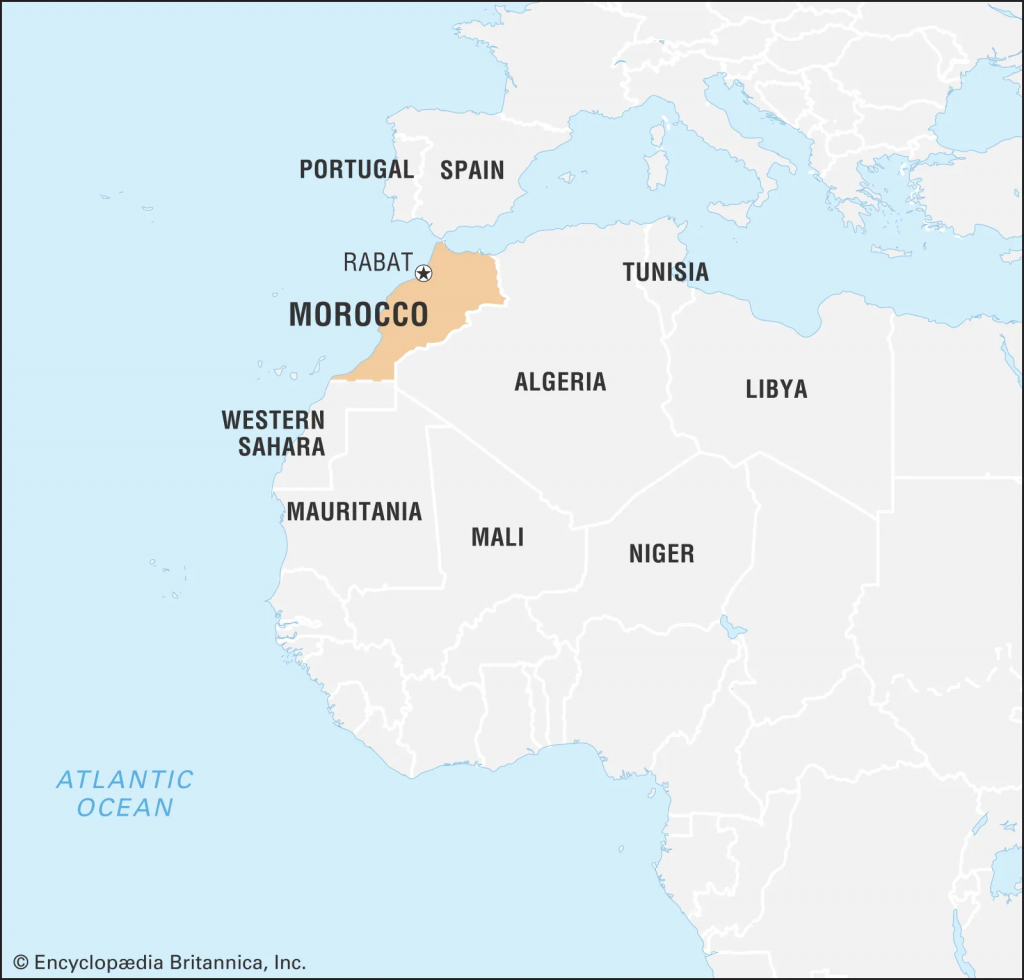
- Location: North Africa, across the Strait of Gibraltar from Spain.
- Borders: Algeria (east/southeast), Western Sahara (south), Atlantic Ocean (west), Mediterranean Sea (north).
- Unique Feature: Only African nation with coastlines on both the Atlantic Ocean and the Mediterranean Sea.