
RARE EARTH ELEMENTS (REES) AND INDIA’S SELF-RELIANCE
TOPIC: (GS3) ECONOMY: THE HINDU
The Union Cabinet has approved a ₹7,280 crore scheme to manufacture rare earth permanent magnets domestically, at a time when China’s export restrictions are disrupting global supply chains.
What are Rare Earth Elements?
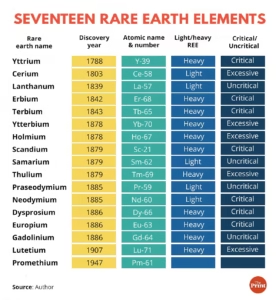
- REEs are a group of 17 minerals valued for their high density, conductivity, and melting point.
- They are moderately abundant but difficult to extract economically and sustainably.
- Essential for electric mobility, renewable energy, electronics, and defence industries.
China’s Dominance and Geopolitical Strategy
- Controls 70% of global REE production and 90% of processing, despite holding only 30% of reserves.
- Uses REEs as a strategic tool in global trade:
- 2009: Imposed export quotas, later struck down by WTO in 2015.
- 2020: Restricted graphite exports.
- 2021: Introduced export licensing to limit supplies to certain industries.
- 2025: Imposed restrictions on seven REEs and finished magnets, hitting EV and automobile sectors.
- Strategy: Employs REEs to achieve geopolitical, geostrategic, and geoeconomic objectives.
India’s Position and Ambitions
- Holds 8% of global REE reserves, mainly in monazite sands of Andhra Pradesh, Odisha, Tamil Nadu, and Kerala.
- Produces less than 1% of global output, leading to heavy imports (53,000 metric tonnes in FY 2024-25).
- Focus areas:
- Electric mobility (EV batteries, motors).
- Renewable energy (wind turbines, solar).
- Electronics manufacturing.
- Defence applications (missiles, radars).
Government Initiatives
- National Critical Mineral Mission (₹34,300 crore over 7 years) launched in 2025 to achieve self-reliance in lithium, cobalt, and REEs.
- Auctioning of new mining blocks and opening sector to private participation (since August 2023).
- Promotion of recycling initiatives from end-of-life electronics and appliances.
- CSIR and IITs working on refining technologies and innovative materials.
Challenges for India
- Lack of refining infrastructure and advanced processing facilities.
- Shortage of skilled labour and innovation capacity.
- Regulatory hurdles and slow environmental clearances.
- Long gestation period for setting up domestic manufacturing.
Way Forward
- Deregulate supply chain segments and fast-track approvals.
- Invest in exploration, refining, and recycling technologies.
- Build partnerships between government, industry, and academia.
- Leverage India’s indigenous biodiversity and monazite reserves for sustainable extraction.
Conclusion
India has the reserves and policy intent to become self-reliant in REEs, but success depends on overcoming infrastructure gaps, regulatory delays, and technological challenges. Meanwhile, China continues to use its REE dominance as a geopolitical lever, making India’s push for domestic capacity urgent and strategic.
SUPREME COURT ORDERS CBI PROBE INTO ‘DIGITAL ARREST’ SCAMS
TOPIC: (GS2) INDIAN POLITY: THE HINDU
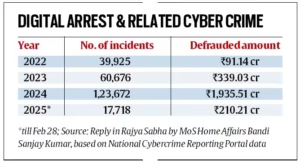
The Supreme Court has given the Central Bureau of Investigation (CBI) full authority to investigate digital arrest scams, overriding state consent.
Background
- Digital arrest scams involve fraudsters posing as law enforcement officers, threatening victims with fake charges, and extorting money.
- Victims are often elderly, targeted through fear tactics and misuse of technology.
- The Centre informed the Court that the scale of fraud had reached alarming levels, demanding urgent intervention.
Supreme Court Directions
- CBI Free Hand: Court ordered CBI to lead investigations into digital arrest scams first, followed by other cyber frauds like fake investments and job offers.
- Extraordinary Step: Normally, CBI needs state consent under Section 6 of the Delhi Special Police Establishment Act. Here, the Court directly directed states to grant consent, citing exceptional circumstances.
- States Involved: Bihar, Tamil Nadu, Karnataka, Kerala, West Bengal, Madhya Pradesh, Uttarakhand, Rajasthan, Punjab, Maharashtra, Meghalaya, Jharkhand, and Tripura must cooperate.
- Coordination: CBI to involve state police officers and domain experts for panIndia investigation.
Cybercrime Data & Prevention
- AI & ML: RBI asked to explore Artificial Intelligence and Machine Learning to track “layering” of funds across multiple accounts.
- Interpol Link: CBI to coordinate internationally to identify cybercrime hubs abroad.
- Online Platforms: Intermediaries directed to share data with CBI under IT Rules, 2021.
- Regional Centres: States/UTs to set up cybercrime coordination centres linked to the Indian Cybercrime Coordination Centre (I4C).
- Preventive Measures: Centres will compile data and help law enforcement agencies act swiftly.
Telecom Concerns
- SIM Card Misuse: Court criticized telecom operators for negligence in issuing multiple SIMs under the same name.
- Department Action: Telecom Department asked to propose stricter norms to prevent misuse.
Classification of Cyber Frauds
- Digital Arrest: Fake police threats to extort money.
- Fraudulent Investments: Attractive schemes to cheat investors.
- Parttime Job Scams: False job offers to lure gullible citizens.
Conclusion
The Supreme Court’s intervention highlights the seriousness of cyber frauds in India. By empowering the CBI and mandating AIbased monitoring, the Court aims to protect vulnerable groups, especially senior citizens, and strengthen India’s cybercrime response system.
INDIA’S GROWTH MOMENTUM
TOPIC: (GS3) ECONOMY: THE HINDU
India’s GDP growth for Q2 FY26 touched 8.2%, surpassing expectations and Q1 figures, but concerns remain due to a record trade deficit and uneven sectoral performance.
GDP Data
- Growth Rate: Real GDP grew 8.2% in Q2 FY26, higher than 7.8% in Q1 and above last year’s level.
- Drivers of Growth:
- Manufacturing expanded by 9.1%.
- Services sector grew 9.2%.
- Private consumption rose 7.9%, showing recovery in household demand.
- Government expenditure added modest support.
- Broad-based Activity: Domestic demand remained strong despite global uncertainties.
Concerns in Growth Composition
- Skewed Expansion: Growth concentrated in formal, high-skill sectors like banking and technology.
- Lagging Sectors: Labour-intensive industries and rural consumption remain weak.
- Employment Challenge: High-employment segments are not keeping pace, raising concerns about inclusive growth.
Risks Ahead
- Oil Prices: Rising crude costs as India diversifies away from Russian imports may pressure inflation.
- RBI Policy: Upcoming Monetary Policy Committee decisions could influence demand and investment.
- Global Headwinds: External shocks may affect exports and trade balance in coming quarters.
Sectoral Performance
- Construction: Grew 7.2%, reflecting infrastructure activity.
- Financial, Real Estate & Professional Services: Expanded by 10.2%, showing strength in capital-intensive sectors.
- Industrial Indicators: IIP rose 4% in September. Steel output grew 14.1%, cement 5.3%.
- Policy Support: RBI’s three repo-rate cuts in 2025, lowering rates to 5.5%, boosted investment.
External Challenges
- Trade Deficit: October 2025 saw a historic deficit of $41.68 billion, partly due to a surge in gold imports.
- Tariff Impact: U.S. tariffs on Indian goods (two-stage structure) may have distorted export data, with front-loading of orders inflating Q2 output.
- Inflation Effect: Retail inflation dropped to 0.25% in October, pushing the GDP deflator below 1%. This statistical effect widened real growth relative to nominal GDP.
WHAT IS GDP?
GDP measures the monetary value of all finished goods and services produced within a country’s borders in a given time.
- Indicator of economy: It shows the size and health of an economy.
- Types:
- Nominal GDP (current prices).
- Real GDP (adjusted for inflation).
- Per capita GDP (GDP divided by population).
- Methods of calculation:
- Production approach (value of output).
- Expenditure approach (consumption + investment + government spending + net exports).
- Income approach (wages + profits + taxes).
How Do We Forecast GDP Growth?
- Economic forecasting: Predicting future GDP using statistical models and economic indicators.
- Key indicators used:
- Inflation trends.
- Interest rates set by central banks.
- Industrial production and manufacturing output.
- Consumer confidence and retail sales.
- Employment and productivity levels.
HEART-RESILIENT URBAN PLANNING
TOPIC: (GS3) ECONOMY: THE HINDU
On World Habitat Day (October 8, 2025), the Ministry of Housing and Urban Affairs highlighted urban programmes like PMAY-U and Smart Cities Mission.
Rising Urban Health Crisis
- Cardiovascular diseases now account for a major share of urban deaths, with prevalence nearly double rural areas.
- Increasing cases among people below 50 years show early onset of lifestyle-related illnesses.
- Urban life — long commutes, pollution, shrinking green cover, and stress — is worsening health risks.
- Health care distribution follows profit logic, with hospitals concentrated in wealthy areas, leaving poorer regions underserved.
Need for Integrated Planning
- Current planning is fragmented: transport, housing, and health are treated separately.
- Car-centric expressways increase pollution and sedentary lifestyles.
- Fast-food clusters encourage unhealthy diets.
- Traffic congestion raises stress and exposure to pollutants.
- Integrated planning can reduce commute times, cut emissions, and promote active living.
Global and National Frameworks
- WHO’s Healthy Cities Network shows embedding health in governance reduces chronic diseases.
- India can revive this approach using AI-enabled tools for air quality and heat mapping.
- Heart-health planning complements national missions like:
- National Urban Health Mission (NUHM)
- Smart Cities Mission
- AMRUT
Measures for Heart-Healthy Cities
- Walkability & Active Mobility: safe footpaths, cycle lanes, shaded pedestrian routes.
- Green Infrastructure: parks, trees, and urban forests to cool areas and filter air.
- Mixed Land Use: combining housing, work, and recreation to reduce car dependence.
- Public Transport: affordable, clean-energy transit to cut emissions and sedentary travel.
- Healthy Food Ecosystems: local markets, community gardens, and limits on junk-food advertising.
Tackling Invisible Threats
- PM2.5 pollution from vehicles and industry triggers heart attacks and strokes.
- Heat islands from concrete-heavy layouts increase cardiovascular stress.
- Poor water and waste systems worsen metabolic disorders.
- Without action, Asia may see a 91% rise in cardiovascular mortality by 2050.
- Solutions: tree cover, renewable energy, modern waste systems, and digital monitoring tools.
Equity in Urban Health
- Low-income groups face worst conditions: polluted air, poor connectivity, limited greenery, and scarce health care.
- Disease burden among marginalised groups has risen 2.3 times.
- Risk of green gentrification where parks displace vulnerable communities.
- Equity audits, community participation, and inclusive planning are essential.
Way Forward
- India’s cities are at a turning point: unchecked growth may lock in unhealthy lifestyles.
- Health-centred planning can make cities resilient — shaded corridors in Delhi, cycling routes in Chennai, compact transit-linked neighbourhoods in Surat.
- Building on NUHM and the Asian Development Bank’s $10-billion urban investment plan, collaboration among MoHUA, health agencies, academia, and civil society is vital.
- Updating planning curricula, digital equity audits, and youth engagement can create a new generation of health-conscious urban designers.
Conclusion
Cardiovascular disease reflects how cities are built. Embedding health into urban planning — through mobility, greenery, equity, and technology — is key to creating cities that nurture the human heart.
END OF PROGRESS AGAINST EXTREME POVERTY
TOPIC: (GS3) ECONOMY: THE HINDU
Recent global poverty projections by the World Bank and IMF suggest that after 2030, the decline in extreme poverty may stall, with numbers expected to rise again, especially in Sub-Saharan Africa.
Background
- In 1990, nearly 2.3 billion people across the world were living in extreme poverty.
- Since then, global poverty has declined by about 1.5 billion people, mainly due to rapid economic growth in Asian countries.
- Extreme poverty refers to living below the international poverty line, where people struggle to meet basic needs.
- It means lacking essentials such as adequate food, clean drinking water, healthcare, electricity, and safe shelter.
Past Success Story
- China and Indonesia: In the 1990s, more than two-thirds of their populations were extremely poor; today, less than 10%.
- India, Pakistan, Bangladesh, Philippines: Strong growth reduced poverty significantly.
- Latin America and Africa (selected countries): Ghana, Brazil, Mexico, Bolivia, Cameroon also saw improvements.
- Economic growth was the main driver of poverty reduction.
Future Projections
- By 2030, extreme poverty is expected to decline slightly from 831 million to 793 million.
- After 2030, numbers may increase again due to stagnation in poor economies.
- Geographic shift: Earlier, most poor lived in Asia. Now, majority are in Sub-Saharan Africa, where population growth and weak economies worsen poverty.
- Without growth, hundreds of millions will remain trapped in poverty.
Current Challenges in Tackling Extreme Poverty
Stagnant Economies Trap the Poor
- Many of the world’s poorest populations are concentrated in countries with little or no economic growth.
- Example: Madagascar – GDP per capita today is almost the same as in 1950, meaning poverty levels have risen alongside population growth.
Redistribution Alone Cannot Work
- In economies where average income is below the poverty line, redistributing wealth cannot lift people out of extreme poverty.
- Example: In Madagascar, even if income were equally distributed, most citizens would still remain below the poverty threshold.
High Poverty Concentration in Sub-Saharan Africa
- Several African nations continue to have more than half their populations living in extreme poverty due to prolonged stagnation.
- Examples: Democratic Republic of Congo (DRC), Mozambique, Malawi, Burundi
Rising Population Intensifies Poverty Burden
- In stagnant economies, population growth increases the absolute number of people living in poverty.
- Example: Countries like DRC and Malawi show that despite decades of aid and programmes, poverty rates remain unchanged because economic growth has not kept pace with population expansion.
Way Forward
- Promote Inclusive Economic Growth: Focus on job creation in labourintensive sectors like agriculture, manufacturing, and services. Ensure growth benefits reach rural and marginalized communities.
- Strengthen Social Safety Nets: Expand schemes for food security, healthcare, education, and housing. Target vulnerable groups (women, children, elderly, PwDs) with direct support.
- Invest in Human Capital: Improve access to quality education, skill development, and vocational training. Empower people to participate productively in the economy and break the poverty cycle.
WHAT IS EXTREME POVERTY?
Extreme poverty is the most severe form of deprivation, where people lack basic needs like food, clean water, shelter, and healthcare. It is commonly measured by the World Bank’s international poverty line (currently around $2–$3 per person per day).
- World Bank Definition: Living below the international poverty line (earlier $1.90/day, updated in 2025 to $3/day for low-income countries).
- It is not only about income but also about access to essential services.
How is Extreme Poverty Measured?
- International Poverty Line:
- Low-income economies → $3/day.
- Lower-middle-income economies → $4.20/day.
- Upper-middle-income economies → $8.30/day.
- Indicators Used: Household surveys, consumption data, access to food, water, sanitation, healthcare, and education.
Conclusion
The fight against extreme poverty is at a turning point. Past decades saw remarkable progress, but unless the poorest economies achieve sustained growth, the decline will halt. Sub-Saharan Africa is now the global epicenter of poverty, making targeted policies, investment, and inclusive growth strategies critical for the future.
BIOREMEDIATION IN INDIA
TOPIC: (GS3) ENVIRONMENT: THE HINDU
India’s rapid industrialisation has caused severe environmental damage, with rivers like the Ganga and Yamuna still receiving untreated sewage and industrial waste. Bioremediation is being discussed as a sustainable solution to restore ecosystems and support national clean-up missions.
What is Bioremediation?
- Bioremediation means “restoring life through biology.”
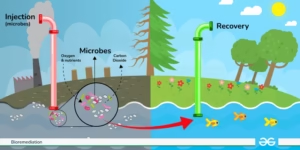
- It uses microorganisms (bacteria, fungi, algae, plants) to break down pollutants such as oil, pesticides, plastics, and heavy metals.
- Pollutants are converted into harmless by-products like water, carbon dioxide, or organic acids.
- Toxic metals can sometimes be transformed into less harmful forms that do not contaminate soil or groundwater.
Types of Bioremediation
- In situ bioremediation: Treatment occurs directly at the contaminated site (e.g., oil-eating bacteria sprayed on spills).
- Ex situ bioremediation: Contaminated soil or water is removed, treated in controlled facilities, and returned after cleaning.
Combining Microbiology and Biotechnology
- Traditional microbiology identifies natural microbes that degrade pollutants.
- Modern biotechnology enhances these processes by: Designing genetically modified microbes to break down tough chemicals like plastics or oil residues.
- Using digital tools to replicate biomolecules under controlled conditions (e.g., sewage plants, agricultural lands). This integration makes bioremediation faster, more efficient, and scalable.
Why India Needs Bioremediation
- Industrialisation impact: Oil leaks, pesticide residues, and heavy-metal contamination threaten ecosystems and public health.
- Limitations of traditional methods: Conventional clean-up is costly, energy-intensive, and creates secondary pollution.
- Advantages of bioremediation: Cheaper and eco-friendly. Scalable for large polluted areas.India’s biodiversity provides indigenous microbes adapted to local conditions (heat, salinity).
Government Initiatives
- Department of Biotechnology (DBT): Supports projects under the Clean Technology Programme.
- CSIR-NEERI: Works on bioremediation research and implementation.
- IITs: Developed nanocomposite materials for oil spill clean-up and identified pollutant-degrading bacteria.
- Startups: Firms like BCIL and Econirmal Biotech provide microbial solutions for soil and wastewater treatment.
Challenges in Adoption
- Lack of site-specific knowledge about pollutants.
- Complex nature of contamination (mixed chemicals).
- Absence of national standards for bioremediation protocols.
- Risks of releasing genetically modified organisms without proper biosafety checks.
- Need for trained personnel and public awareness.
Global Practices
- Japan: Integrates microbial and plant-based clean-up in urban waste management.
- EU: Funds cross-country microbial projects for oil spills and mining sites.
- China: Uses genetically improved bacteria for soil pollution control.
Way Forward
- Develop national bioremediation standards and certification systems.
- Create regional hubs linking universities, industries, and local governments.
- Strengthen biosafety guidelines for GM microbes.
- Promote public engagement to build trust and awareness.
- Align bioremediation with missions like Swachh Bharat and Namami Gange.
Conclusion
Bioremediation offers India a low-cost, eco-friendly, and scalable solution to pollution. With proper regulation, innovation, and public participation, it can restore rivers, reclaim land, and create jobs, making it a vital tool for sustainable development.

BOOTH LEVEL OFFICER (BLO)
TOPIC: (GS2) INDIAN POLITY: THE HINDU
Concerns have emerged after several deaths of Booth Level Officers (BLOs) were reported during the ongoing Special Intensive Revision (SIR) of electoral rolls in some states.
About BLO
- BLOs are grass-root representatives of the Election Commission of India (ECI).
- They help in updating electoral rolls using local knowledge.
- Usually appointed from local government/semi-government staff such as teachers, Anganwadi workers, Panchayat secretaries, village-level workers, electricity bill readers.
- They are not full-time election officials.
- Introduced under Section 13B(2) of the Representation of People Act, 1950 in August 2006.
Roles and Responsibilities
- Electoral Roll Revision: Collect field information and ensure accuracy of voter lists at booth level.
- Distribution of Voter Slips: Deliver slips to households before polling day.
- Postal Ballot Facility: Inform eligible voters (senior citizens above 85 years & PwDs with benchmark certificate) about home voting/postal ballot through Form 12D.
- Promote ECI Apps: Encourage use of voter-friendly apps like Voter Helpline, eVIGIL, Know Your Candidate, Saksham-ECI.
Conclusion
BLOs are the backbone of electoral roll management, ensuring transparency and accuracy at the booth level. Their welfare and safety during intensive revision drives need urgent attention to strengthen India’s electoral process.
SIM BINDING
TOPIC: (GS2) INDIAN POLITY: THE HINDU
The Department of Telecommunications (DoT) has directed major OTT communication apps like WhatsApp, Telegram, Signal, and others to implement SIM binding within 90 days to curb misuse of inactive or stolen mobile numbers by cybercriminals.
What is SIM Binding?
- SIM binding means securely linking a mobile device to its SIM card.
- It ensures that authentication is tied not only to the device but also to the unique identity of the SIM card.
- This reduces risks of unauthorized access and strengthens digital security.
Why is SIM Binding Important?
- Currently, apps verify SIM only once during installation.
- Even if the SIM is removed or deactivated, the app continues to function.
- Cybercriminals exploit this loophole by using inactive or old SIM-linked accounts to commit fraud.
- Without the SIM physically present, it becomes difficult to trace the location of the device.
- This gap allows hackers, spammers, and fraudsters to misuse Indian numbers for scams.
Government Directions
- DoT has ordered OTT communication platforms to complete SIM-binding integration within 90 days.
- Apps must stop working immediately if the SIM card is removed.
- Aim: Close loopholes that allow criminals to remain untraceable.
- Precedent: Banking and UPI apps already enforce strict active-SIM rules to prevent financial fraud.
Significance
- Enhances cybersecurity and user trust in communication platforms.
- Helps in tracking criminals and preventing misuse of Indian mobile numbers.
- Aligns with India’s broader push for digital safety and secure communication systems.
Conclusion
SIM binding is a crucial step to strengthen India’s digital security framework. By ensuring apps work only with active SIM cards, the government aims to reduce cyber fraud, protect users, and make communication platforms more accountable.