

A recent controversy over alleged misuse of MPLADS (Members of Parliament Local Area Development Scheme) funds by some MPs has reignited debate on whether the scheme should be scrapped or strengthened.
MPLADS Scheme
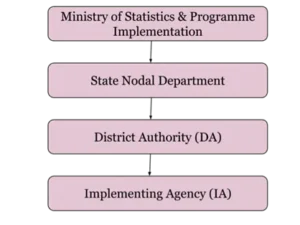
- MPLADS was launched in 1993 as a Central Sector Scheme, fully funded by the Government of India.
- It allows MPs to recommend developmental projects worth ₹5 crore annually in their constituencies, focusing on durable community assets like roads, schools, and water facilities.
- The scheme is monitored through the MPLADS dashboard, which tracks allocations and expenditures.
The Current Controversy
- Allegations surfaced that three MPs from Rajasthan allocated funds for projects in Kaithal district, Haryana, instead of their constituencies.
- Critics argued this violated the scheme’s intent, while the MPs cited 2023 guidelines, which permit up to ₹50 lakh annually outside the constituency/State, and up to ₹1 crore in case of severe calamities.
- The debate reflects broader concerns about political motivations and cross-State allocations.
Utilisation Trends
- 18th Lok Sabha (ongoing): ₹5,486 crore allocated; ₹1,453 crore spent so far.
- 17th Lok Sabha (2019–24): ₹4,837 crore allocated; ₹3,639 crore spent; 41,143 projects completed out of 96,211 recommended.
- 16th Lok Sabha (2014–19): Only 8.7% funds unused.
- 15th Lok Sabha (2009–14): 3.47% funds unused.
- 14th Lok Sabha (2004–09): Less than 1% funds unused.
- Data shows that despite some underutilisation (especially during COVID years), the scheme has largely been effective.
Examples of Effective Use
- Sant Balbir Singh Seechewal (Punjab): Spent over ₹9.34 crore to tackle water scarcity.
- Iqra Choudhary (Kairana): Maintained a transparent MPLADS profile with geotagged images.
- Tejasvi Surya (Bengaluru South): Utilised ₹19.36 crore, emerging as a top performer.
- Abhishek Banerjee (Diamond Harbour): Completed 173 projects, spending ₹6.13 crore.
Arguments Against Scrapping
- Utilisation Trends Remain Strong: While some misuse and incomplete projects exist, overall data shows high utilisation rates, indicating the scheme’s effectiveness in delivering development.
- Localised Development Impact: MPLADS directly addresses constituency-level needs, ensuring that funds are channelled into projects that improve everyday infrastructure and services.
- Accountability of MPs: By linking expenditure to constituency development, the scheme enhances the responsibility of MPs toward their voters.
- Loss of Flexibility if Scrapped: Discontinuation would remove a crucial funding mechanism for small-scale but high-impact projects that often do not get covered under larger government schemes.
Way Forward
- Capacity Building: Conduct structured workshops to train MPs and their teams on planning, prioritising, and effectively utilising MPLADS funds.
- Transparency Mechanisms: Promote geotagging of projects, real-time dashboards, and citizen-accessible records to strengthen public trust and reduce misuse.
- Robust Monitoring: Institutionalise stronger social audits and statutory audits to ensure accountability, detect irregularities early, and improve compliance with guidelines.
Conclusion
The MPLADS scheme has proven valuable in creating community assets and addressing local needs. While misuse cases exist, they are exceptions rather than the norm. Strengthening transparency and utilisation mechanisms is a better path than discontinuation.
India is preparing for a major industrial transition where electricity (electrons) will increasingly replace fossil fuels (molecules) in factories and industries.
Background
- For over a century, industries worldwide have relied on molecules — coal, oil, and gas — for energy.
- The emerging global trend is a shift toward electrons, i.e., clean and reliable electricity delivered through grids.
- This transition is crucial for reducing emissions, improving efficiency, and strengthening industrial competitiveness.
- Experts highlight that without rapid electrification, India risks losing competitiveness in global supply chains, especially under carbon-sensitive trade regimes like the EU’s CBAM.
Importance of Industrial Electrification
- Efficiency Advantage: Electric motors convert 90% of energy into useful work, compared to 35% in combustion engines.
- Automation & Control: Electrification enables better process control, digitalisation, and easier decarbonisation.
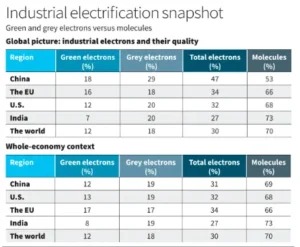
- Global Benchmark:
- China: Nearly 50% of industrial energy from electricity, with a high share of green electrons.
- India: Only 25% industrial energy from electricity; green electrons just 7–8% of final energy.
- U.S. & EU: Around 30–34% economy-wide electrification.
China’s Strategy vs India’s Position
- China’s Approach: Massive investment in grids, ultra-high-voltage transmission, and storage since 2010.
- India’s Status: Doubled grid capacity in a decade, leading in solar additions. unreliable power quality, and policy focus on generation rather than industrial electrification.
Roadmap for India
- Steel Sector: Expand EAF share beyond current 30%, improve scrap collection, and incentivise renewable-linked furnaces.
- Cement Sector: Pilot electrified kilns, scale waste-heat recovery, and prepare CCUS hubs.
- MSMEs: Replace coal boilers and diesel gensets with electric boilers and induction furnaces. Provide concessional finance and pooled renewable power purchase agreements.
- Digitalisation: Embed advanced controls in industrial clusters for efficiency and carbon data transparency.
Strategic Importance
- Competitiveness: Global buyers demand low-carbon supply chains; green electrons decide contract outcomes.
- Energy Security: Reduces dependence on imported oil and gas.
- Sovereignty: Industry can locate based on skills and logistics rather than fuel availability.
Conclusion
India must launch a National Mission on Industrial Electrification, raise grid investments, and mandate electrification in new industrial parks. The next industrial revolution will be powered by electrons, not molecules, and India must act decisively to stay competitive.
The 16th Finance Commission (FC) has retained the States’ share in vertical devolution at 41%, despite a rare consensus among States demanding an increase.
Background
- The Finance Commission recommends how tax revenues are shared between the Centre and States.
- The 16th FC kept the vertical devolution rate at 41%, the same as the 15th FC.
- However, the divisible pool excludes cesses, surcharges, and collection costs, which are rising sharply, reducing the effective share available to States.
Shrinking Divisible Pool
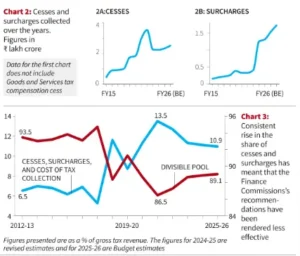
- Between 2013–2019, for every ₹100 collected, ₹93–95 came from shareable taxes; only ₹5–7 from cesses/surcharges.
- By 2021–22, shareable taxes fell to ₹86.5, while cesses/surcharges rose to ₹13.5.
- In FY26, projections show ₹89 from taxes and ₹11 from cesses/surcharges.
- Collections of cesses rose from ₹44,688 crore (FY15) to ₹3.52 lakh crore (FY22); surcharges rose from ₹15,702 crore (FY15) to ₹1.72 lakh crore (FY26 expected).
- This means the divisible pool’s share in gross tax revenue has stayed below 90% for six consecutive years, compared to consistently above 93% earlier.
States’ Demands
- 18 States including Odisha, Kerala, Tamil Nadu, Gujarat, and Haryana demanded an increase in vertical devolution to 50% of the divisible pool.
- Several other States sought a moderate rise to 45–48%, citing rising fiscal pressures and shrinking revenues.
- Their demand was based on the fact that the share of divisible pool in gross tax revenue has fallen below 90% for six consecutive years, compared to consistently above 93% between FY13–FY18, due to the Centre’s growing reliance on cesses and surcharges.
Centre’s Position
- The Centre argued for “moderation in tax devolution”, opposing any increase beyond the current 41%.
- Cesses and surcharges are required for emergencies such as war, famine, or pandemics.
- Defence and infrastructure spending needs have expanded, requiring greater central resources.
- As per Finance Ministry data, collections from cesses rose from ₹44,688 crore in FY15 to ₹3.52 lakh crore in FY22, while surcharges increased from ₹15,702 crore in FY15 to ₹1.72 lakh crore (FY26 expected).
Commission’s Reasoning
- The Commission said putting a fixed limit on cesses and surcharges would be risky, though depending on them for too long is not good.
- It stated that States already have enough funds to carry out their constitutional duties.
- As a way forward, it suggested that the Centre should gradually move back to collecting more regular taxes instead of relying heavily on cesses and surcharges, so that the shareable pool of revenue becomes larger.
Key Concerns Raised
- Constitutional Intent: Did the framers anticipate such a disproportionate rise in non-shareable revenues?
- Mediator Role: By refusing to cap cesses, has the FC left States without safeguards against shrinking revenues?
- Efficiency Claim: The Centre’s claim of infrastructure efficiency overlooks the fact that high-performing States lose out under current distribution.
- Consensus Ignored: Nearly all States, cutting across political lines, demanded a larger share — yet the FC maintained status quo.
Conclusion
The real issue is not just the 41% rate but the shrinking divisible pool due to rising cesses and surcharges. Strengthening fiscal federalism requires expanding shareable revenues and balancing national priorities with State needs.
The Union Budget 2026–27 has allocated a record ₹7.84 lakh crore for defence, with a sharp rise in capital outlay to strengthen military modernisation and domestic defence industry under the Aatmanirbhar Bharat initiative.
Background
- India’s defence budget has long faced the “guns vs butter” dilemma, balancing salaries and pensions with modernisation needs.
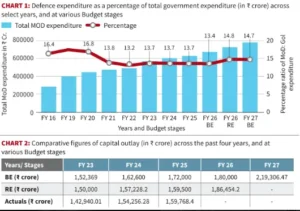
- The FY27 allocation of ₹7,84,678 crore marks the highest-ever defence spending, accounting for 14.7% of total government expenditure.
- This stabilises defence share compared to lean years (FY21–22) when it fell to 13.2%.
Capital Outlay Trends
- Capital outlay (funds for modernisation and big-ticket purchases) has risen to 27.9% of the defence budget, up from 24.9% in FY23.
- In absolute terms, capital spending is ₹2,19,306 crore, a jump of nearly ₹40,000 crore from FY26.
- This rise is significant as earlier trends showed lower revised estimates compared to budget estimates, but FY26–27 reflects higher demand at the RE stage.
Reasons for Increase
- Post-Operation Sindoor Needs: The 2025 conflict exposed shortages in precision-guided munitions and drones, requiring replenishment of war reserves.
- Institutionalised Emergency Procurement: Fast-track acquisitions, once ad hoc, are now becoming standard for critical technologies.
- Committed Liabilities: Payments for past contracts (e.g., Rafale jets, S-400 systems) consume large portions of capex. Higher allocation ensures funds for new projects like Advanced Medium Light Aircraft and Project 75I submarines.
Composition of Defence Spending
- Pensions: Share reduced to 21.8% in FY27, down from 26% in FY20.
- Salaries: Moderated to 22.4%, compared to 30% in FY20.
- Decline attributed to reforms like the Agnipath scheme, which caps revenue expenditure.
- Nearly 75% of capital acquisition budget earmarked for domestic industry, boosting Aatmanirbhar Bharat.
Challenges Ahead
- Absorption Capacity: Defence PSUs and private firms must deliver on time to meet operational needs.
- Buy Indian-IDDM Route: Promotes indigenous design and manufacturing, but tight delivery timelines remain critical.
- Industry Readiness: Heavy allocation reflects confidence in India’s defence industrial base, but execution will determine success.
Conclusion
By prioritising domestic industry and institutionalising emergency procurement, India aims to strengthen its military preparedness and reduce dependence on imports, though timely delivery and industry capacity remain key challenges.
India’s Defence Research and Development Organisation (DRDO) has successfully tested the Solid Fuel Ducted Ramjet (SFDR) technology off the Odisha coast.
Background
- The test was conducted at the Integrated Test Range, Chandipur at 10:45 a.m.
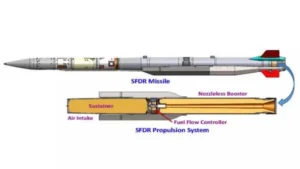
- SFDR technology is crucial for developing long-range air-to-air missiles, enhancing India’s aerial combat strength.
- Defence Minister Rajnath Singh hailed the achievement as a milestone in missile development.
What is SFDR Technology?
- Solid Fuel Ducted Ramjet (SFDR) is a propulsion system that allows missiles to maintain high speeds over long ranges.
- Unlike conventional rocket motors, SFDR provides sustained thrust, making missiles more effective against fast-moving aerial targets.
- It offers a decisive tactical edge in modern warfare.
Strategic Importance
- Places India in an elite group of nations with SFDR capability.
- Strengthens India’s self-reliance in defence technology under the Aatmanirbhar Bharat initiative.
- Enhances preparedness for two-front challenges and boosts deterrence against adversaries.
Conclusion
The successful SFDR test marks a major leap in India’s missile programme, ensuring stronger air defence and advancing indigenous technological capabilities.
Why in News?
The Prime Minister inaugurated Adampur Airport in Punjab and renamed it in honour of Guru Ravidas on his birth anniversary.

Early Life and Background
- Born in a family traditionally associated with leather work.
- Birthplace is now revered as Shri Guru Ravidass Janam Asthan.
- Associated with the Bhakti teacher Ramananda and lived around the time of Kabir.
- Also known by names such as Raidas and Rohidas in different regions.
- His birth anniversary is celebrated as Ravidas Jayanti.
Literary Contributions
- Composed devotional poetry in local dialects, making spirituality accessible to common people.
- 41 hymns attributed to him are included in the Guru Granth Sahib.
- His verses also appear in the Panch Vani tradition of the Dadu Panth.
- His poetry combines devotion (bhakti) with social reform messages.
Philosophy and Teachings
- Rejected caste discrimination and promoted human equality.
- Emphasised nirguna bhakti — worship of a formless, attribute-less divine.
- Advocated inner purity, humility and moral conduct over rituals.
- Vision of an ideal society called “Beghumpura” — a land without sorrow, inequality or fear.
- Symbol of resistance against untouchability and social injustice.
- Influenced spiritual figures like Mirabai, who is believed to have regarded him as her guru.
Ravidassia Religion
- His teachings form the base of the Ravidassia religion.
- Followers revere the Amrit Bani Guru Ravidass as their sacred text.
- The community emphasises equality, devotion and ethical living.
Significance in Indian Society
- Key figure of the Bhakti Movement that democratized religion.
- Strengthened the idea of social justice and dignity for marginalized groups.
- His teachings remain relevant for constitutional values of equality and fraternity.