
THE ECI MUST BE MORE TRANSPARENT AND IMPARTIAL
TOPIC: (GS2) INDIAN POLITY: THE HINDU
Concerns over the Election Commission of India’s (ECI) fairness and transparency have been raised after allegations of irregularities in the 2024 general elections. The Leader of Opposition, Rahul Gandhi, has claimed discrepancies and promised to reveal more details.
Importance of Trust in Elections
- In a democracy, trust in the election process is vital, especially for those who lose.
- Like a court verdict or a sports match, results must be seen as fair by all.
- If losing candidates believe the process was biased, it leads to a breakdown in trust.
Recent Allegations Against ECI
- Rahul Gandhi has alleged flaws in the 2024 Lok Sabha election process.
- Tejashwi Yadav, Bihar’s Leader of Opposition, claimed his name was missing from the draft voter list due to EPIC number mismatch.
- Such accusations, whether genuine or political, affect public confidence in democratic systems.
Challenges Facing the ECI
- Voter List Errors: Complaints over incorrect or missing names have emerged.
- VVPAT Transparency: Lack of clarity around how VVPAT machines are tallied with electronic votes.
- Impartiality Issues: Critics question whether ECI is enforcing the model code of conduct fairly.
- Poor Communication: ECI hasn’t clearly addressed key concerns or explained procedures.
What ECI Must Do
- Ensure complete transparency in all stages — from voter rolls to vote counting.
- Provide clear public communication on issues like VVPAT and EVM security.
- Build systems that don’t just satisfy political parties but reassure every citizen.
- Maintain neutrality to restore public faith in democratic processes.
WHAT IS THE ELECTION COMMISSION OF INDIA (ECI)?
ECI is a constitutional body established under Article 324 of the Indian Constitution. It is responsible for conducting free and fair elections in India.
Major Functions of the ECI
Conduct of Elections
- Conducts elections to:
- Lok Sabha and Rajya Sabha
- State Legislative Assemblies and Councils
- President and Vice-President of India
Preparation of Electoral Rolls
- Prepares and revises the electoral rolls regularly.
- Ensures that eligible citizens are included and ineligible names are removed.
Recognition of Political Parties
- Grants recognition to national and state political parties.
- Allots symbols to political parties and independent candidates.
Model Code of Conduct (MCC)
- Enforces the Model Code of Conduct during elections to ensure a level playing field.
- Ensures ethical campaigning by political parties.
Conclusion
The Election Commission must act firmly to restore public trust. A transparent and neutral electoral process is the backbone of Indian democracy.
AFTER A BRIEF PAUSE, PHYSICAL BANK BRANCHES ARE BACK
TOPIC: (GS3) ECONOMY: THE HINDU
After a slowdown during the COVID-19 years, physical bank branches in India are once again increasing, led mainly by private sector banks. This trend reflects a shift in the banking sector toward combining digital and physical services.
Background of Bank Branch Expansion
- Physical bank branches have traditionally played a key role in loan monitoring, building customer trust, and promoting financial literacy.
- Between 2008 and 2023, India saw a doubling in bank branch density – both geographically and per adult population.
- Expansion was also driven by government initiatives like Pradhan Mantri Jan Dhan Yojana, which helped increase account ownership to 94.6% by 2022-23.
Pause and Consolidation (2020–2022)
- From 2020 to early 2022, branch closures rose due to operational consolidation and digitalisation.
- Net branch openings nearly stagnated during this time.
- Public Sector Banks (PSBs) were mainly responsible for these closures, shutting down over 9,200 branches between 2019 and 2024.
- In contrast, private banks closed only 579 branches in the same period.
Resurgence in Physical Branches (2022–2024)
- Since mid-2022, banks started opening more branches again.
- HDFC Bank and ICICI Bank led this growth, opening 3,284 and 1,341 branches, respectively, between 2022 and 2024.
- Net new bank branches opened from Q3 2022 to Q4 2024 reached 11,963, a strong recovery from earlier stagnation.
Staffing Trends
- Despite branch growth, hiring has slowed.
- HDFC added over 40,000 employees in FY24, but only 994 in FY25.
- ICICI Bank reduced its workforce by 6,723 in FY25, signaling a leaner operational approach.
Role of Banking Correspondents (BCs)
- PSBs continue to serve rural areas through banking correspondents (BCs) even as branches close.
- Payment banks have become major players in this area, adding 1.5–3 lakh BCs annually from 2019–2024.
- PSBs added around 15,000–33,000, while private banks added fewer than 8,000 BCs per year.
Key Takeaways
- Physical branches remain essential for trust-building, deposit mobilization, and financial education.
- Banks are now adopting a “phygital” model — combining physical outreach with digital tools.
- PSBs are shifting to BC-based delivery while private banks expand physical branches selectively.
- Distance still plays a role in banking despite the digital shift.
Conclusion
India’s banking sector is entering a hybrid phase where both digital innovation and physical presence are important. The “phygital” model balances accessibility with technological efficiency.
WHY A PROGRESSIVE INDIAN POLICY ON MYANMAR IS MORE THAN PLAUSIBLE
TOPIC: (GS2) INTERNATIONAL RELATIONS: THE HINDU
India’s present policy toward Myanmar has come under criticism for supporting the military regime despite ongoing violence and displacement. Experts suggest that India can adopt a more humanitarian and democratic approach that aligns with both values and strategic interests.
Issue Brief
- Since the military coup in Myanmar in February 2021, the junta has killed over 5,000 people and displaced 2.5 million.
- Despite this, India continues formal ties with the junta while ignoring the democratic opposition.
- A shift to a more value-based foreign policy is being proposed to enhance India’s regional influence and moral standing.
Rethinking India’s Myanmar Strategy
Support for Federal Democracy
- India should leverage its image as a federal democracy to support Myanmar’s pro-democracy groups.
- These include the National Unity Government (NUG), ethnic resistance groups, and civil society bodies working for a new federal constitution.
- Through training, exchanges, and dialogue, India can offer democratic know-how that China cannot.
End Arms Supplies to the Junta
- India must stop exporting weapons and military supplies to Myanmar’s army.
- Reports show continued sales of equipment and naval fuel to the junta, despite their use against civilians.
- Ending arms trade would align India’s actions with its stated support for peace.
Open Humanitarian Corridors
- India should assist displaced people by setting up relief corridors across the border in Mizoram and Manipur.
- The Free Movement Regime (FMR), suspended earlier, should be restored.
- Aid like food, medicine, and shelter can be sent through existing civil society and NGO networks.
Protect Myanmar Refugees
- India should stop detaining and deporting asylum seekers, especially in Manipur and Assam.
- These people are fleeing war and deserve protection, not punishment.
- Though India hasn’t signed the Refugee Convention, it can still follow global norms like non-refoulement.
INDIA’S KEY PROJECTS IN MYANMAR
Kaladan Multi-Modal Transit Transport Project
- Connects India’s Kolkata Port to Sittwe Port in Myanmar (by sea).
- Then links Sittwe to Mizoram via Kaladan River and roadways.
- Improves access to North-East India and reduces dependency on the Siliguri Corridor.
- Strategic for trade and military logistics.
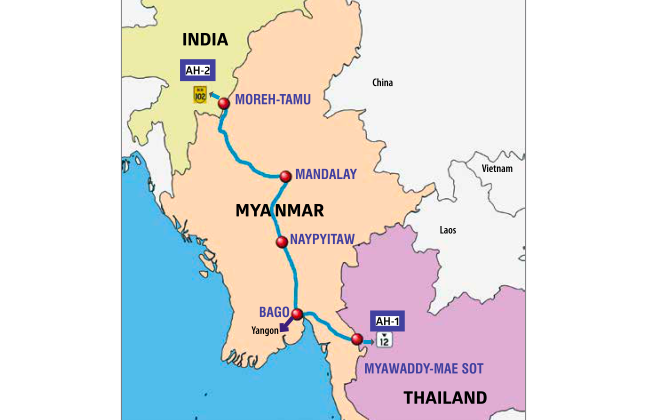
India-Myanmar-Thailand Trilateral Highway
- Connects Moreh in Manipur (India) to Mae Sot in Thailand via Myanmar.
- Boosts trade, tourism, and people-to-people contact among the three countries.
- Part of India’s Act East Policy.
Rhi-Tiddim Road Project
- India is building the Rhi-Tiddim road in Myanmar’s Chin State.
- Helps connect North-East India with western Myanmar.
- Aids in economic development and border trade.
Border Area Development Projects
- India supports small projects in border villages of Myanmar.
- Includes schools, health centers, and solar power.
- Aims to win hearts and minds of people in border areas.
Oil & Gas Exploration
- Indian companies like ONGC Videsh and GAIL involved in energy exploration in Myanmar.
- Ensures energy security for India.
Conclusion
India must act in line with its democratic values while securing its regional interests. A principled Myanmar policy can enhance both India’s image and its influence in Southeast Asia.
WOMEN’S INCLUSION IN ARMED FORCES A PRIORITY
TOPIC: (GS3) INTERNAL SEQURITY: THE HINDU
Defence Minister Rajnath Singh reaffirmed the government’s commitment to increasing women’s participation in the armed forces. Data reveals a steady rise in women’s representation across the Army, Navy, and Air Force since 2005.
Issue in Brief
- The Defence Ministry presented data showing women now form 13.4% of the Indian Air Force, 6.85% of the Army, and 6% of the Navy.
- This indicates progress, but further efforts are needed for inclusive, gender-neutral armed forces.
Need for Women in Armed Forces
- Gender Diversity improves team efficiency and reflects democratic values.
- Women bring unique skills in logistics, intelligence, cyber warfare, and humanitarian operations.
- Including women promotes equality, representation, and inspires future generations.
Global Examples
- United States: Women serve in all combat roles since 2016.
- Israel: Women are part of compulsory military service.
- UK & Australia: All roles, including combat, are open to women.
- These nations have shown how gender-inclusive forces enhance operational capability.
Current Status in India
- All branches in IAF and Navy (except submarines) are open to women officers.
- The Army has opened 12 branches, including some combat roles.
- Total women in 2024: Army – 1,735, IAF – 1,614, Navy – 674.
- Rise from 2005: Army – 767, IAF – 574, Navy – 154.
Challenges for Women in Forces
- Lack of infrastructure (separate facilities, toilets, etc.).
- Gender bias and societal perceptions.
- Limited roles in front-line combat and promotion hurdles.
- Physical fitness standards and hostile conditions.
Government Initiatives
- Permanent Commission for women in Army, Navy, and IAF.
- Entry through NDA, AFCAT, SSC, and technical routes.
- Defence training academies now admit women cadets.
- Role models like Col. Sofiya Qureshi and Wing Cmdr Vyomika Singh inspire young aspirants.
Recent Developments
- Gender-neutral reforms being adopted steadily.
- Suspension of restrictions in several branches.
- More inclusive training and recruitment policies.
Conclusion
Women’s participation in defence strengthens national security and equity. With supportive policies and social change, India can lead by example in military gender inclusion.
AGEING TREES THREATEN PALM OIL SUPPLY
TOPIC: (GS3) ECONOMY: THE HINDU
A report highlights declining palm oil production in Malaysia and Indonesia due to old plantations and ageing farmers. This could raise global prices and affect India, the largest importer of palm oil.
Issue In Brief
- Palm oil is a widely used vegetable oil found in cooking, cosmetics, and biofuels.
- Malaysia and Indonesia supply over 85% of the world’s palm oil.
- Production is slowing due to old trees, delayed replanting, and biodiesel demand.
- This poses risks for global supply and price stability.
Reasons For Decline in Production
- Ageing Trees: Trees over 20 years old produce less oil. Many plantations haven’t replaced these trees due to financial strain.
- Ageing Farmers: Many smallholders are elderly and avoid replanting as it takes 3–5 years for new trees to yield crops.
- Insufficient Replanting Support: Government subsidies for replanting have reduced over time. Indonesia has achieved only 10% of its replanting target (2.5 million ha by 2025).
- Biodiesel Mandates Indonesia is diverting more palm oil for domestic biodiesel production, reducing exports.
Impact on Global Supply
- Smallholders contribute around 40% of total plantation area in Malaysia and Indonesia.
- Exports from both countries could fall by 20% by 2030, affecting global supply chains.
- Market prices may increase, hurting consumers in developing nations like India.
India & Palm Oil: Production & Dependence
- India imports over 60% of its edible oil, with palm oil making up the largest share.
- India is the largest global importer of palm oil, mainly from Indonesia and Malaysia.
- Domestic production is limited due to climatic and ecological constraints.
Government Initiatives to Reduce Import Dependency
- National Mission on Edible Oils – Oil Palm (NMEO-OP): Launched in 2021 to increase palm oil cultivation in North East and southern states. Aims to bring 10 lakh hectares under palm cultivation by 2025–26.
- Incentives to Farmers: Subsidies on planting material, maintenance, and inputs. Assured pricing and viability gap funding to attract investment.
Strategies For India
- Encourage private investment in palm oil processing units.
- Promote R&D for climate-suitable varieties.
- Improve farmer training and support for sustainable practices.
- Diversify edible oil sources with soybean, mustard, and sunflower.
CONCLUSION
India must address its high edible oil import dependency by scaling up local production, improving farmer support, and diversifying oil sources to ensure food security and price stability.
BIO-FORTIFIED POTATOES
TOPIC: (GS3) AGRICULTURE: THE HINDU
Bio-potatoes enriched with iron are set to be introduced in Indian markets, as announced by the Director-General of the International Potato Center (CIP), Peru. These are currently under evaluation by ICAR for Indian conditions.
Issue In Brief
- Malnutrition and micronutrient deficiencies are widespread in India.
- Bio-fortified crops like iron-rich potatoes aim to tackle this issue through naturally nutrient-rich food solutions.
- The initiative aligns with national goals for improving nutrition and food security.
What Is Bio-Fortified Potatoes?
- Potatoes enhanced with iron through breeding or biotechnology.
- Aimed at combating iron deficiency, a major cause of anaemia in India.
- First released in Peru, now under review by ICAR for Indian agro-climatic suitability.
International & Regional Initiatives
International Potato Canter (CIP)
- A global R&D body based in Lima, Peru, established in 1971.
- Focus: Potato, sweet potato, and other tubers to improve nutrition and food security.
South Asia Regional Centre (CSARC), Agra
- Supports Indian farmers in major potato-producing states (UP, Bihar, West Bengal).
- Works with Nepal, Bhutan, and Bangladesh to promote potato productivity, storage, and marketing.
- Aims: Increase nutrition, farmer income, and employment.
What Is Biofortification?
- The process of breeding crops to naturally contain higher levels of essential nutrients.
- Unlike processed food fortification, it improves nutrition at the crop level.
- Example: Golden Rice (vitamin A), Iron-rich millet, Zinc-fortified wheat.
Benefits of Biofortified Crops
- Natural and cost-effective way to reduce malnutrition.
- Affordable and does not need extra processing.
- No yield loss – high-performing varieties.
- Suitable for areas with weak health infrastructure.
- Supports long-term nutritional security.
Challenges
- Climate adaptability varies across regions.
- Low awareness among consumers and farmers.
- Weak market incentives and price support.
- Poor integration with schemes like PDS, Mid-Day Meal, and ICDS.
- Less investment in biofortification R&D compared to GM crops.
Way Forward
- Boost seed availability and awareness among farmers.
- Link biofortified crops with government nutrition programs.
- Create market demand through awareness campaigns.
- Strengthen research for region-specific varieties and nutritional outcomes.
Initiatives by Indian Government
- ICAR (Indian Council of Agricultural Research) developed more than 80 biofortified crop varieties.
- PM Modi in 2020 promoted biofortified crops as part of POSHAN Abhiyaan.
- Inclusion of biofortified varieties in mid-day meal schemes and public distribution system (PDS) is being considered.
Conclusion
Bio-fortified potatoes hold the potential to fight micronutrient deficiency in India sustainably. With proper research, awareness, and policy support, they can contribute to India’s goals of nutritional security and better health outcomes.
SHIFTS IN INDIA’S PESTICIDE MARKET
TOPIC: (GS3) ECONOMY: THE HINDU
India’s pesticide sector is undergoing major changes due to rising labour costs, changing crop patterns, and stricter regulations. The increasing use of herbicides and biopesticides marks a structural shift in the market.
Issue In Brief
- India’s pesticide use is changing due to labour shortages, rising wages, and shift in pest types.
- Herbicide demand is increasing rapidly as farmers replace manual labour with chemical solutions.
What are pesticides:
- Pesticides help protect crops from pests and diseases, improving yields.
- Types include:
- Insecticides – for insects
- Fungicides – for fungal diseases
- Herbicides – for weed control
- Usage in India increased during the Green Revolution and has evolved over time due to bans on harmful chemicals and cost pressures.
Current Status of Pesticide Market
- India’s crop protection market is worth around ₹24,500 crore. Insecticides: ₹10,700 crore Herbicides: ₹8,200 crore (fastest-growing segment at 10%+ per year), Fungicides: ₹5,600 crore
- Globally, Asia leads in pesticide use, with India and China as major players.
Reasons for Increased Herbicide Use
- Manual weeding is labour-intensive and costly (8–10 hours/acre).
- Wages rose to ₹447/day in Dec 2024 (from ₹326/day in 2019).
- Migration and labour shortages make timely weeding difficult.
- Herbicides act as labour substitutes, like tractors or harvesters.
Regulatory Framework
- Insecticides Act, 1968 regulates pesticide registration and use.
- 46 pesticides are banned; others like Paraquat and Glyphosate are under review.
- CIB&RC (Central Insecticide Board & Registration Committee) approves new products.
- Anupam Verma Committee reviewed pesticides banned in other countries but allowed in India.
Govt Schemes for Safe Usage
- National Mission on Sustainable Agriculture (NMSA) – promotes Integrated Pest Management (IPM).
- PKVY – supports organic farming and biopesticides.
- Kisan Drone Scheme – subsidizes drones for precision pesticide spraying.
- Kisan Kavach Kit – provides safety gear for pesticide handlers.
Challenges
- Health & Environment Risks – overuse can harm soil, water, and human health.
- Weak Regulation – lacks a strong approval system like the EPA (USA) or EFSA (EU).
- Dependence on Imports – India relies on MNCs for active ingredients.
- Low R&D – domestic innovation is still limited.
Way Forward
- Promote Biopesticides – simplify approval, give incentives.
- Stronger Monitoring – prevent sale of fake or poor-quality pesticides.
- Farmer Training – improve knowledge on safe and need-based use.
- Digital Tracking – QR codes from manufacturer to user for transparency.
Conclusion
India’s pesticide sector must evolve with a balanced approach—ensuring crop protection without compromising health and the environment. Better policies, innovation, and farmer awareness will help move toward sustainable and safe agriculture.
POSH AND POLITICAL PARTIES
TOPIC: (GS2) INDIAN POLITY: THE HINDU
The Supreme Court allowed the withdrawal of a petition seeking the inclusion of political parties under the POSH Act, 2013. The Court advised the petitioner to pursue a legislative route by involving women parliamentarians and pushing for a private member’s bill.
Issue In Brief
- Women political workers currently lack legal protection from sexual harassment under the POSH Act.
- The plea sought to bring political parties under its purview, arguing they function as workplaces for thousands of women workers.
About The Posh Act, 2013
- Aimed at preventing and addressing sexual harassment at the workplace.
- Sexual harassment includes physical, verbal, or non-verbal misconduct, demands for sexual Favors, and inappropriate remarks.
- Applies to all sectors: government, private, NGOs, educational institutions, and informal sectors.
Key Features:
- Internal Complaints Committee (ICC): Mandatory for workplaces with 10+ employees.
- Local Committee (LC): At the district level for workplaces with <10 employees.
- Time-bound action: Inquiry to be completed within 90 days.
- Annual reporting to district officials is mandatory.
- Penalties: Non-compliance can attract fines up to ₹50,000 and license suspension.
Challenges In Political Parties
- No formal employment: Party workers are usually unpaid volunteers, not formal employees.
- Vague definition of workplace: Parties are not considered formal workplaces under labour laws.
- Informal operations: Most political work is voluntary and lacks documentation or contracts.
- Lack of transparency: Political parties do not publish complaint data or redressal measures.
- Accountability gap: No external monitoring of party internal practices regarding harassment.
Way Forward
- Election Commission Guidelines: ECI can issue directions for internal mechanisms to handle harassment.
- Voluntary Party Reforms: Parties should add anti-harassment provisions in their internal rules.
- Private Member Bill: Legislators can introduce amendments to formally include political organizations under the POSH framework.
- Public Pressure: Civil society and media can hold parties accountable for ensuring women’s safety.
Conclusion
Ensuring safety for women in political spaces is essential for inclusive democracy. Political parties must go beyond tokenism and take real steps to implement harassment redressal systems.