
DO WE NEED TO CHANGE HOW CITIES ARE GOVERNED IN INDIA?
TOPIC: (GS2) INDIAN POLITY: THE HINDU
Recent changes in municipal structures, such as delays in BMC elections, merger of municipalities in Hyderabad, and division of BBMP in Bengaluru — have intensified concerns about weak urban governance.
Why Are Mayors in India So Invisible?
- India was historically rural-oriented, so urban governance never became a political priority.
- Today the Chief Minister’s Office (CMO) controls most major decisions affecting cities, not municipal councils.
- Earlier, Mayors had more prominence, and many national leaders began as Mayors.
- Now, political power revolves around State Assemblies, pushing city-level leaders into the background.
Limited Constitutional Impact
- Despite the 74th Constitutional Amendment, effective decentralisation never materialised.
- Municipalities exist constitutionally but lack autonomy, funds, and authority.
Why Urban Governance Remains Weak?
- Low Public Demand: Citizens rarely demand strong local governments, and municipal reform is not an election issue. Lack of awareness about roles of different government levels weakens accountability.
- Dominance of MLAs and MPs: Legislators often sit as ex-officio members in municipal bodies, making Mayors and corporators subordinate to higher-level politicians.
- Weak Local Finances: Municipalities have small tax bases and rely heavily on State governments for funds.
Will Strong, Directly Elected Mayors Improve Governance?
- Need for Fiscal Decentralisation: Even ward offices struggle for basic funds; earlier cities like Bombay and Hyderabad had more financial freedom.
- Mismatch Between Constitutional Design and Political Reality: The 74th Amendment assumed decentralisation would naturally follow, but State politics overpowered municipal autonomy.
Do Mergers or Splitting of Corporations Help?
- Political, Not Governance-Motivated Moves: Frequent division or merger of municipalities (e.g., Bengaluru and Hyderabad) is often used to delay elections through delimitation or structural changes.
- Lack of Clear Division of Powers: Overlapping responsibilities between State departments, parastatals, and municipal bodies create confusion and weaken accountability.
- Until roles and authority are clearly separated, structural redesigns will not improve governance.
MAYORS
Who they are and how they are elected
- Mayors are the elected heads of municipal corporations or city governments.
- They represent the city and oversee local governance and development.
- They are usually elected either directly by city voters or by elected council members, depending on the state law.
Jurisdiction of work and areas:
- Oversee municipal services like water supply, sanitation, waste management, and roads.
- Implement local development projects, health, education, and housing schemes.
- Prepare and manage the city budget and approve local taxes and fees.
- Coordinate with state and central government for urban planning, disaster management, and infrastructure projects.
Conclusion
Indian cities require true decentralisation, not merely structural reshuffling. Strengthening local finances, clarifying power distribution, reducing State-level dominance, and building public awareness are essential to making Mayors and municipalities effective institutions.
WORLD SOIL DAY 2025
TOPIC: (GS3) ENVIRONMENT: THE HINDU
The world is observing World Soil Day on 5 December, with FAO highlighting the 2025 theme “Healthy Soils for Healthy Cities”.
About World soil day
- Established by the FAO of the United Nations to promote global awareness on soil conservation.
- Serves as a reminder that soil is a living, finite, and essential natural resource.
- Helps draw attention to soil degradation, contamination, and sustainable management practices.
Why focus on urban soils?
- With 56% of the world’s population now living in cities, urban ecosystems face problems like heat stress, pollution, flooding and food insecurity.
- Urban soil plays a crucial but often ignored role in making cities climate-resilient and livable.
Role of urban soil
- Combatting Heat & Climate Change: Healthy soils under trees, parks and green spaces reduce urban heat island effect. They store carbon, cool surfaces, and enhance city climate resilience.
- Flood Protection & Water Regulation: Urban soil acts like a sponge, allowing rainwater to seep in. Reduces stormwater flooding, recharges groundwater and filters pollutants.
- Supporting Urban Food & Biodiversity: Soil-based urban agriculture (rooftops, community farms) shortens food supply chains. Urban soil houses diverse organisms — microbes, worms, insects — supporting plant growth.
- Enhancing Mental & Physical Health: Urban greenery improves mental well-being, reduces stress, encourages outdoor activity. Soil-based green spaces offer “Vitamin N” (Nature).
Challenges to urban soils
- FAO warns that one-third of global soils are degraded.
- Urban soils face:
- Industrial pollution
- Excessive construction and soil compaction
- Loss of organic matter
- Soil sealing by asphalt and concrete
- This weakens plant growth, reduces biodiversity and increases vulnerability to floods and heat.
Actions suggested under 2025 theme
- Restore and Protect Urban Soils: Rehabilitate degraded soil with compost, organic inputs and soil testing. Restrict further soil sealing in city planning.
- Promote Green Infrastructure: Expand parks, rain gardens, tree belts and permeable surfaces. Prioritize soil-based systems over concrete structures for cooling and drainage.
- Encourage Urban Agriculture: Support community gardens, backyard composting, rooftop farms and home plantations.
- Responsible Soil Management: Reduce chemical fertilizers and pesticides. Plant native species and protect topsoil with mulching.
- Strengthen Soil Literacy: Schools should conduct soil workshops. Households can compost organic waste to enrich urban soil.

SOIL
Soil is the upper loose layer of the Earth made from the breaking down of rocks over thousands of years, mixed with minerals, organic matter, water, and air.
- It supports plant growth, stores water, hosts microorganisms, and is essential for agriculture and ecosystems.
Why Soils Differ From Each Other?
- Soils are not the same everywhere because different natural factors shape them differently. They differ mainly due to:
- Parent Rock (Original Material): Soil formed from hard rocks (e.g., granite) is coarse; Soil from soft rocks (e.g., shale) is fine.
- Climate: Rainfall affects how many nutrients are washed away. Temperature affects how fast rocks break down. Example: Wet areas → red/yellow soil; Dry areas → black soil.
- Topography (Landscape): Flat areas allow soil to accumulate → deep soils. Slopes lose soil due to erosion → thin soils.
- Biological Activityl: More plants, animals, and microbes → more organic matter (humus).
Time
- Older soils are more weathered.
- Young soils are less developed.
CONCLUSION
World Soil Day 2025 calls for citizens, planners and governments to collectively protect this essential resource, ensuring a safer, greener future for urban populations.
CHINA’S RURAL REVITALISATION
TOPIC: (GS3) AGRICULTURE: THE HINDU
China is preparing its 15th Five-Year Plan, meant to consolidate the goal of “socialist modernisation” by 2035.
Vision Behind Rural Revitalisation
- Xi Jinping’s Development Philosophy: Stress on poverty removal and better rural living standards since 2012.
- Idea of “turning barren land into gold” inspired difficult regions like Xichou, giving rise to the ‘Xichou Spirit’.
- Urban–Rural Divide: East coastal China → highly modernised (Shanghai, Shenzhen, Beijing). Central & Western China → natural beauty but historically lagging in development.
Evolution of China’s Poverty Reduction Programme
- Institutional Setup: 1986: Creation of special poverty-relief agencies to identify poor counties and design schemes.
- Major Policy Milestones: 1994: Seven-Year Plan → aimed to lift 80 million people out of poverty. 2001: “Development-oriented poverty alleviation” with focus on western & central regions.
- 2001–2010 Outcomes: Poverty rate dropped 10.2% → 3.8%. Farmers’ income increased by ~7.6% annually.
China’s Village Development
- Investments in remote areas: Villages in Yunnan and Sichuan got new roads, green energy, schools, healthcare, and basic services.
- Government support: Central funding, training, enterprises, and interest-free loans helped lift many counties out of extreme poverty by 2020.
- Community-led growth: Villagers formed cooperatives, like in Jiwozhai, to process and sell tea, sharing profits and increasing household income.
How China’s Rural Revitalisation Is Important for India:
- Model for integrated rural development: China shows how coordinated investments in agriculture, infrastructure, digital services, and rural industries can raise incomes and reduce rural–urban gaps.
- Boost to agri-value chains: China’s success in agro-processing, cooperatives, branding, and e-commerce offers lessons for India to increase farmer income and reduce post-harvest losses.
- Population retention in villages: China’s approach of creating rural jobs and improving public services helps curb migration pressure on cities — useful for India as urban infrastructure is already overburdened.
Challenges for India in Adopting Similar Approaches
- Fragmented landholdings & low farm productivity: India’s small farm sizes and uneven mechanisation make large-scale rural modernisation harder.
- Governance and funding constraints: Unlike China’s centralised planning and large state funding, India faces bureaucratic delays, limited resources, and coordination issues between Centre–state–local bodies.
- Digital and infrastructure gaps: Rural India still struggles with uneven connectivity, logistics, cold chains, and service delivery, slowing the creation of vibrant rural industries.
Conclusion
China’s rural rise is a mix of State planning, financial investment, strong community involvement, and targeted poverty schemes. Urban China shows market-led growth, but rural China demonstrates how policy continuity + people’s effort can drive balanced national development.
INDIA’S SECURITY CHALLENGES
TOPIC: (GS3) SEQURITY: THE HINDU
India is facing a dual challenge: increasing diplomatic isolation in global affairs and the re-emergence of urban terror modules within the country.
India’s Diplomatic Position
- India, despite its strong diplomatic reputation, appears sidelined in major global discussions on peace and security, especially in West Asia, Europe, and the Indo-Pacific.
- South Asia itself is unstable, with countries like Afghanistan, Nepal, Maldives, and Myanmar facing turmoil, leaving India with fewer reliable allies.
- This situation increases India’s vulnerability to external threats, including cyber and regional instability.
Hostility from Neighbours
- Pakistan:
- Recent constitutional changes have strengthened military control, elevating Field Marshal Asim Munir as Chief of Defence Forces with authority over nuclear assets.
- This concentration of power raises risks of miscalculation and adventurism, making peace prospects bleak.
- Bangladesh:
- The interim government has shown unfriendly signals towards India.
- Bangladesh’s growing ties with Pakistan, including a naval visit after decades, could allow Pakistan to re-establish influence in the Bay of Bengal.
- Together, these developments on India’s western and eastern borders heighten regional tensions.
Return of Urban Terror
- A new terror module has emerged, involving medical professionals linked to Al-Falah University, Faridabad.
- Unlike earlier attacks (1993 Mumbai blasts by lumpen groups or 2008 Mumbai attacks sponsored by Pakistan), this network is indigenous and educated, marking a disturbing trend.
- The group reportedly stockpiled nearly 3,000 kg of explosives and attempted attacks near Delhi’s Red Fort.
- Inspiration was drawn from the Babri Masjid demolition (1992), showing how historical grievances continue to fuel radicalisation.
- Investigations reveal use of encrypted communication, professional networks for fundraising, and links extending to Pakistan, UAE, Saudi Arabia, and Türkiye.
Implications for India
- The rise of educated professionals in terror activities represents a qualitative leap in terrorism.
- It challenges the belief that local recruitment in Jammu and Kashmir had ceased.
- The combination of external hostility and internal radicalisation poses a multi-dimensional security threat.
How India is addressing border security challenges
- Strengthening infrastructure: Building roads, tunnels, bridges, advanced posts, and all-weather connectivity along borders, especially with China and Pakistan.
- Modernising surveillance: Using drones, satellites, thermal cameras, radar systems, and smart fencing (e.g., CIBMS) to detect infiltration and monitor difficult terrain.
- Improving force capability: Upgrading equipment for BSF, ITBP, and Army; increasing troop deployment; and enhancing coordination with local agencies and intelligence networks.
Conclusion
India today faces both external pressures from hostile neighbours and internal dangers from new forms of urban terror. Eternal vigilance, stronger intelligence coordination, and careful diplomacy are essential to safeguard national security and prevent further destabilisation.
INDIA’S HIGH-DENSITY RAIL CORRIDORS
TOPIC: (GS3) ECONOMY: THE HINDU
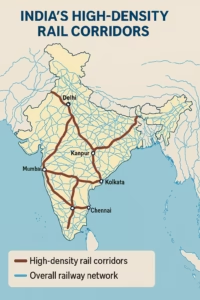
The Government has sanctioned third and fourth rail lines on the Badlapur–Karjat stretch in Maharashtra, a key part of the Mumbai–Chennai High-Density Network (HDN). This move is part of a broader national strategy to ease pressure on India’s seven most overloaded HDN corridors
What is the High-Density Network (HDN)?
- HDN consists of railway routes where freight and passenger trains run far beyond designed limits.
- These routes are the busiest in the country, forming 11,051 route-km, around 16% of Indian Railways.
- The network is divided into 237 sections, most of which are saturated or near saturation.
Why HDN Is Extremely Congested
- Railways operate smoothly at 70–80% utilisation.
- On the HDN:
- Only 4.6% of sections fall below 80% load.
- 95% run above optimal capacity.
- A large number operate at 120–150%, and some even exceed 150%, causing delays and slowdowns.
- Example – Karjat–Lonavala: Capacity: 40 trains/day/direction, Actual: 67 trains/day → 167% utilisation, showing severe overload.
How HDN Differs from the Overall Rail Network
- As per the National Rail Plan (2051): Across India, 45% of rail lines function at comfortable levels (<70%). Only 1% exceeds 150% capacity.
- In comparison, HDN corridors are far more burdened, with almost no spare paths for new trains.
India’s Seven High-Density Corridors
- Howrah–Delhi → Almost entire corridor above 80% load; extremely saturated.
- Howrah–Mumbai → Major part overloaded due to heavy freight on this Golden Diagonal.
- Mumbai–Delhi → Less severe; Western DFC absorbs freight burden.
- Delhi–Guwahati → Nearly 96% above 80% utilisation; critical lifeline for Northeast.
- Delhi–Chennai → Over 52% between 120–150% load.
- Howrah–Chennai → About half of it moderately to heavily saturated.
- Mumbai–Chennai → Around 90% operates above optimal limits.
Congestion Forecast: 2031 & 2051
By 2031
- 50% of HDN → above 150% capacity
- 39% → between 100–150%
- Only 9% in a manageable (70–100%) range
By 2051
- No HDN section will remain below 100% load.
- 92% will cross 150% utilisation, signalling a near-collapse of capacity without intervention.
Government Measures to Reduce HDN Pressure
- Line Expansion – The Most Crucial Solution: Methods: doubling, tripling, quadrupling, and even five- or six-line tracks.
- Dedicated Freight Corridors (DFCs): Eastern DFC → fully operational. Western DFC → nearly 96% complete.
- DFCs divert freight trains away from HDNs, opening capacity for passenger services.
Conclusion
Rapid expansion of lines and completion of Dedicated Freight Corridors are essential to restore efficiency and support rising passenger and freight demands.
ALAKNANDA GALAXY
TOPIC: (GS3) SCIENCE AND TECHNOLOGY: THE HINDU
Scientists at NCRA–TIFR, Pune, have identified a new spiral galaxy using the James Webb Space Telescope. The galaxy has been named “Alaknanda”, after the Himalayan river and a Hindi term linked to the Milky Way.
What is the Alaknanda Galaxy?
- It lies nearly 12 billion light-years away, meaning we see it as it existed in the early universe.
- The galaxy shows a classic two-armed spiral design with a bright central region.
- Its diameter is around 30,000 light-years, making it roughly half the size of the Milky Way.
- It is actively producing new stars at a fast pace—around 60 times the mass of our Sun each year.
- Scientists note that it resembles a young version of the Milky Way, formed when our galaxy was only 10% of its present age.

What Is a Spiral Galaxy?
- Spiral galaxies are rotating systems of stars, dust, and gas, arranged in spiral arms that extend from the centre.
- They contain younger, hot, and bright stars, especially along the spiral arms.
- Central Bulge: Packed with older and dimmer stars. Often hosts a supermassive black hole.
- Disk: A flat, rotating structure where stars orbit the central bulge. Spiral arms emerge from this disk and are rich in dust and gas.
- Nearly two-thirds of spiral galaxies—including the Milky Way—have a bar-shaped structure through the centre.
Significance of the Discovery
- Offers rare insight into how young spiral galaxies formed soon after the Big Bang.
- Helps astronomers understand early star formation, galaxy evolution, and similarities with our Milky Way.
- Demonstrates the advanced detection capability of the James Webb Space Telescope (JWST).
RBI INTEGRATED OMBUDSMAN SCHEME
TOPIC: (GS3) ECONOMY: THE HINDU
The RBI Annual Report shows that complaints handled under the Integrated Ombudsman Scheme (RB-IOS) rose by 13.55% in FY25.
What is the RBI Integrated Ombudsman Scheme?
- Introduced on 12 November 2021, it merges three earlier mechanisms:
- Banking Ombudsman Scheme (2006)
- NBFC Ombudsman Scheme (2018)
- Digital Transactions Ombudsman Scheme (2019)
- The scheme adopts a “One Nation, One Ombudsman” model, removing jurisdiction-based barriers.
- Purpose: To give customers a quick, affordable, and fair platform for resolving complaints against regulated financial institutions.
Features of the Scheme
- Ground for Complaint: Complaints can be filed for any “deficiency in service”, except for the specific exclusions listed by RBI.
- Institutions Covered: All commercial banks, NBFCs, Regional Rural Banks, Payment System Participants (UPI, card networks, etc.), Credit Information Companies, Most Urban Cooperative Banks with deposits above ₹50 crore
- Centralised System: A Centralised Receipt and Processing Centre (CRPC) in Chandigarh handles all physical and email complaints in any Indian language, ensuring uniform processing.
- Compensation: Up to ₹20 lakh for financial loss. Additional ₹1 lakh for harassment, time loss, or expenses suffered by the complainant.
Significance
- Strengthens consumer protection in the financial sector.
- Provides a single, simplified platform instead of multiple schemes.
- Encourages financial institutions to improve service quality and transparency.
SUPERMOON
TOPIC: (GS1) GEOGRAPHY: THE HINDU
Yesterday, people in many parts of India and the world observed a Supermoon, a full moon that appears larger and brighter than usual.
What is a Supermoon?
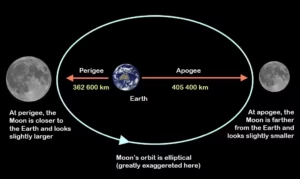
- A Supermoon happens when the full moon occurs at or near perigee, the Moon’s closest point to Earth in its orbit.
- Due to this shorter distance, the Moon appears up to 14% bigger and 30% brighter than a regular full moon.
- The Moon’s orbit around Earth is elliptical, causing varying distances—perigee (closest) and apogee (farthest).
- The term is not scientific but is widely used in astronomy outreach and media.
Why Yesterday’s Supermoon Was Important
- The Moon was closer than usual, making it visibly larger even to casual observers.
- Clear weather in many regions allowed uninterrupted viewing.
- It generated high public interest, photography trends, and scientific discussions on lunar orbits.
Types of Supermoons
- Full Supermoon: When the Moon is full and near perigee (most common).
- New Supermoon: When a new moon occurs near perigee, often linked with stronger tides though not visible.
Scientific Explanation
- The average distance between Earth and the Moon is 384,400 km.
- During perigee, this distance reduces to around 356,000 km, making the Moon appear bigger.
- Stronger gravitational pull during a Supermoon can cause slightly higher ocean tides, known as perigean spring tides.
- No major natural disasters are caused solely by a Supermoon, as the effect is small.
Significance of a Supermoon
- Encourages public interest in astronomy and space science.
- Useful for studying lunar surface features due to increased brightness.
- Helps illustrate concepts like elliptical orbits, tidal forces, and lunar phases to students and enthusiasts.