
A GROWING SHADOW OVER DIGITAL CONSTITUTIONALISM
TOPIC: (GS2) GOVERNANCE: THE HINDU
The government withdrew its order directing smartphone companies to pre-install the ‘Sanchar Saathi’ app after strong public backlash over privacy, data misuse, and surveillance concerns.
What Is Digital Constitutionalism?
- Applying core constitutional values—liberty, dignity, privacy, equality, accountability—to the digital world.
- Ensuring technology, algorithms, and data systems do not violate individual freedoms.
- Limiting state and corporate power in digital governance through oversight, transparency, and rights-based laws.
Why Digital Constitutionalism Matters Today
- Increasing Digital Governance: Everyday tasks—KYC, welfare distribution, hospital records, jobs—depend on automated digital systems. People have little control over how their data is used or shared.
- Surveillance Becoming Invisible: Modern surveillance uses metadata, location tracking, facial recognition, and predictive algorithms. Citizens often do not know they are being monitored, leading to self-censorship.
- Concentration of Power: Tech companies, app designers, and enforcement agencies hold enormous data power. Citizens become “data subjects” rather than active rights-holders.
Concerns
- Weak Data Protection Laws: Digital Personal Data Protection Act, 2023 gives wide exemptions to government. Independent oversight is limited; individual remedies are weak.
- Loss of Personal Control: Consent has become a meaningless “click to agree”. Data is shared across platforms without clear purpose limits.
- Risks of Facial Recognition: Misidentification, bias against women and minority groups, and wrongful profiling. Used extensively in India without a comprehensive surveillance law.
- Algorithmic Bias: Algorithms decide welfare benefits, job shortlisting, policing profiles, and content moderation. Decision-making is a black box with no transparency or appeal.
- Inadequate Legal Safeguards: IT Act, 2000 and new digital rules focus more on regulating platforms, not protecting individual rights. No independent institution audits high-risk AI or surveillance tools.
Way Forward
- Strengthening Legal Protections: Create an independent Digital Rights Commission to monitor violations. Make surveillance legal only in exceptional national security cases with judicial warrants.
- Ensuring Transparency and Accountability: Mandatory transparency reports, parliamentary oversight, and timely grievance systems. Citizens must have the right to explanation and right to appeal algorithmic decisions.
- Expanding Digital Literacy: Citizens need awareness about privacy, data rights, and risks of digital systems. Without literacy, rights remain theoretical.
Data Privacy
- Digital Personal Data Protection Act, 2023 (DPDP Act): India’s newest and main data protection law, defining how personal data must be collected, stored, processed, and protected.
- Right to Privacy as a Fundamental Right (2017): The Supreme Court in Puttaswamy judgment declared privacy a fundamental right under Article 21, shaping all future data laws.
- IT Act, 2000 & IT Rules (2021): Provide rules for data security practices, breach reporting, and responsibilities of digital platforms, though limited in scope compared to full data protection laws.
- Sector-Specific Guidelines: RBI, TRAI, and health/telecom standards also regulate data handling (e.g., financial data, telecom data, health records), adding layers of privacy protection.
PUTTASWAMY, 2017
- Privacy is a Fundamental Right: The Supreme Court declared the Right to Privacy as part of Article 21 (Right to Life and Personal Liberty).
- Applies to All Aspects of Life: Privacy includes autonomy over personal data, bodily privacy, intimate choices, lifestyle, and communication.
- Limits on State Power: Government can restrict privacy only if the action meets three tests — legality, necessity, and proportionality.
- Foundation for Future Laws: The judgment laid the constitutional basis for India’s data protection laws and shaped debates on Aadhaar, surveillance, and digital rights.
Conclusion
Digital systems now shape welfare access, identity, political participation, and freedom of expression. Digital constitutionalism ensures technology remains a tool for empowerment—not an instrument of silent control. India must safeguard constitutional values as governance becomes more data-driven.
GOVT. TO STREAMLINE ITS PUBLIC COMMUNICATIONS FRAMEWORK
TOPIC: (GS2) GOVERNANCE: THE HINDU
The Union government has started a major overhaul of its public communication system to make it quicker, coordinated, and technology-driven. This revamp includes restructuring the Indian Information Service (IIS) and improving media outreach in India and abroad.
New Public Communications Framework
Expanded IIS Cadre
- The government plans to recruit more IIS officers to manage the rising volume of media work across ministries.
- A proposal to restructure the IIS cadre—adding new posts, revising roles, and improving promotion pathways—is close to final approval.
- The last major restructuring happened in 2016; this will be the most significant update since then.
Strengthening Technological Capacity
- Shift toward real-time media monitoring using digital tools and data analytics.
- Focus on targeted, data-driven communication campaigns rather than traditional one-way messaging.
- Upgrading online infrastructure to track misinformation, social media trends, and public sentiment swiftly.
Possible Creation of a Media Communications Board
- A proposed board may supervise transfers, postings, and overall policy related to government communication.
- The aim is to bring uniformity across ministries and avoid contradictory messaging.
Overseas Communication Strengthening
- The government may create IIS posts in 40+ Indian embassies.
- Purpose: Strengthen India’s global outreach, explain government initiatives abroad, and counter negative narratives.
How This Is Different from the Present System
- Currently, communication is fragmented across ministries; coordination is inconsistent.
- IIS officers are fewer in number, limiting rapid response capacity.
- Most overseas communication happens through MEA alone; IIS presence abroad is minimal.
- Technology use is uneven and lacks a unified dashboard for media tracking.
Present Challenges
- Growing misinformation and fake news on social media.
- Limited manpower to handle 24×7 communication needs.
- Slow decision-making in postings and cadre management.
- Inadequate coordination between ministries during crises.
- Low presence of professional communication teams overseas.
Way Forward
- Fast-track IIS cadre restructuring and boost recruitment.
- Create a unified digital media monitoring platform across ministries.
- Set up the communications board for consistency and accountability.
- Train IIS officers in global media practices, crisis communication, and data analytics.
- Expand communication wings in embassies to project India’s narrative worldwide.
Conclusion
The revamped public communications framework will make government messaging faster, more coordinated, and technologically equipped to handle today’s information challenges. By strengthening the IIS cadre and expanding global outreach, India aims to build a more credible, unified, and responsive communication system.
ACID ATTACK VICTIMS AND SYSTEMIC FAILURES
TOPIC: (GS2) GOVERNANCE: THE HINDU
The Supreme Court expressed shock that an acid attack survivor has waited 16 years for justice, calling the delay a “mockery of the system.” The Court demanded urgent reforms, including special courts and stricter punishment for perpetrators.
Acid Attacks
- A premeditated crime where corrosive chemicals are thrown or forced on a person.
- Causes permanent physical disfigurement, psychological trauma, and disability.
- Mostly targets women and minors, linked to revenge, rejected proposals, or personal disputes.
- Categorized as one of the gravest forms of gender-based violence.
Key Observations by the Supreme Court
- Courts must show zero sympathy to acid attackers due to the lifelong suffering they cause.
- The judicial system must respond collectively—police, prosecutors, and courts must ensure timely action.
- Suggested setting up exclusive fast-track courts to hear acid attack cases daily.
- Asked High Courts to submit data on all pending acid attack trials.
- Encouraged the Centre to consider an ordinance to strengthen protections.
Legal Provisions and Previous Directions
- Bharatiya Nyaya Sanhita (BNS) Section 124 deals with acid attacks and prescribes strict punishment.
- In Laxmi vs Union of India, the Supreme Court ordered regulation of acid sale and mandated free treatment and rehabilitation for survivors.
- Despite these measures, enforcement remains weak and illegal sale of acid continues.
Present Challenges
- Slow trials—cases drag on for years, causing emotional and financial stress.
- Low conviction rates due to weak investigation and poor evidence collection.
- Survivors struggle with cost of surgeries, long-term medical care, and social stigma.
- Acid is still easily available despite restrictions.
Alarming Data
- NCRB 2023 reported 207 acid attack cases.
- West Bengal recorded the highest (57), followed by Uttar Pradesh (31).
- Numbers indicate continuing prevalence of this brutal crime.
Way Forward
- Establish dedicated fast-track courts with day-to-day hearings.
- Strict monitoring of acid sale with real-time tracking and heavy penalties for violations.
- Ensure free medical care, compensation, rehabilitation, and job support for survivors.
- Strengthen police training for rapid investigation and evidence preservation.
SC PENDING CASES
Decades-old Constitutional Cases Still Unresolved
- The Challenge to the Citizenship Amendment Act (CAA), 2019 is still pending despite multiple hearings.
- The NRC/Assam Accord-related petitions have been waiting for final disposal for years, showing delays in high-impact cases.
Historic Cases Pending for Over 20–30 Years
- The “One Rank One Pension” (OROP) anomalies case took several years for final adjudication.
- Thousands of civil appeals, including land acquisition and service matters, remain pending for 10–20+ years, as noted in the Court’s 2023 annual report.
Systemic Backlog Continues to Rise
- As of 2024, the Supreme Court has over 80,000 pending cases, the highest ever recorded.
- Nearly 20% of these are over 10 years old, reflecting chronic delays due to complex procedures, frequent adjournments, and shortage of judges.
Conclusion
Acid attack survivors live with irreversible scars and lifelong trauma. The justice system must provide quicker trials, stricter enforcement, and compassionate rehabilitation to uphold their dignity and rights.
CHILE’S LESSON FOR INDIA’S COAL CONUNDRUM
TOPIC: (GS3) ENVIRONMENT: THE HINDU
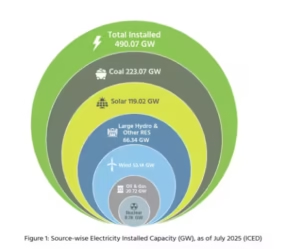
India slipped 13 places to 23rd in the Climate Change Performance Index (CCPI) 2025, mainly because it has not reduced coal dependence.
India’s Coal Challenge
- Coal still supplies over half of India’s total energy use and nearly 75% of electricity generation (2024).
- India has doubled renewable capacity (2021–25), but clean energy contributes only one-fifth of actual electricity, showing limited utilisation.
- India is also increasing domestic coal production, reflecting high demand and energy security concerns.
Why Coal Transition is Difficult
- Coal-rich regions (Jharkhand, Chhattisgarh, Odisha, West Bengal) depend heavily on coal for jobs and local revenue.
- Rapid closures can create social instability, unemployment, and regional inequality.
- Lack of alternative industries in mining districts makes transition harder.
Chile’s Experience: What India Can Learn
Shift Away from Coal
- Chile cut coal’s share in power generation from 43.6% (2016) to 17.5% (2024).
- Renewables now form 60%+ of its power mix, mostly solar and wind.
Policies Behind Chile’s Success
- Introduced a carbon tax of $5/tonne (2014).
- Imposed strict emission standards, raising coal plant costs by 30%, discouraging new plants.
- Conducted competitive auctions that lowered renewable energy prices.
- Invested heavily in energy storage for grid stability.
- Set a clear target to phase out coal by 2040.
- Political stability and earlier privatisation allowed fast market reforms.
- Developed new industries and created alternative jobs for workers.
Why India Needs a Coal Phase-Out
- Climate change may reduce India’s GDP by 3–10% by 2100 due to heat stress and productivity losses.
- A 1 GW rise in coal capacity can increase infant mortality by 14% in nearby districts.
- Phasing out coal is a “no-regrets” policy for long-term economic and public health benefits.
Decarbonisation Strategy
- Gradually shut down old, inefficient coal plants, similar to how Germany retired units older than 40 years to cut emissions and improve air quality.
- Stop approvals for new coal projects, as seen in the U.K., which halted all new coal permits in 2015.
- Replace coal-based electricity with “firm” renewable power, supported by battery storage; for instance, Rajasthan’s 1,000 MWh storage projects show that renewables can now deliver round-the-clock supply.
Strengthening Renewable Capacity
- Expand storage and upgrade transmission lines—India already evacuated over 14 GW of renewable power in 2024 due to weak grid infrastructure, highlighting the need for stronger networks.
- Promote electrification of transport, industry, and households, similar to Norway where electric vehicles now make up over 80% of new car sales, helping shift energy demand toward clean power.
Market & Regulatory Reforms
- Introduce carbon pricing like Chile’s $5/tonne carbon tax, which helped push industries towards cleaner energy options.
- Reduce coal subsidies, which currently exceed ₹15,000 crore annually, making coal artificially cheap.
- Set dispatch rules that prioritise renewable energy, following Europe’s “clean-first dispatch” model.
- Rework electricity markets to penalise the most polluting units—for example, China’s emission-linked tariff system charges higher rates for dirtier plants.
Just Transition for Workers
- Create a dedicated transition fund, on the lines of the EU’s €17.5-billion Just Transition Fund, to support India’s coal districts.
- Provide retraining and new livelihood pathways—for instance, 3,000 former coal workers in Spain were successfully reskilled for solar and wind industries.
- Channel District Mineral Foundation (DMF) funds—which hold over ₹70,000 crore—towards local enterprises, skill centres, and small-scale industries in coal-dependent regions.
Conclusion
India’s progress in renewable energy is impressive, but without a clear and socially fair coal phase-out plan, its climate goals remain uncertain. Learning from Chile, India needs a time-bound coal exit roadmap, strong market reforms, and a people-centred transition strategy.
HEALTH SECURITY & NATIONAL SECURITY CESS BILL, 2025
TOPIC: (GS2) INDIAN POLITY: THE HINDU
The Lok Sabha has passed the Health Security and National Security Cess Bill, 2025, introducing a special cess on pan masala manufacturing units. The aim is to generate dedicated funds for public health programmes and national security needs.
Features of the Bill
- The Bill replaces the existing GST Compensation Cess for this category. Pan masala has high health costs and is difficult to tax through normal excise due to underreporting and informal manufacturing.
- Nature of the Cess: A special cess will be imposed on production capacity of machines, not on the quantity sold. This system helps prevent tax evasion as factories often misreport actual output.
- Funds will be used for: Public health programmes (disease control, tobacco de-addiction, cancer care). National security expenditure (defence preparedness, border safety).
- Revenue Sharing with State: Since health is a State subject, a portion of the cess will be shared with State governments. GST revenue will not be affected, as this cess is over and above normal GST.
- Possible Expansion: Initially applicable only to pan masala, but the Centre may extend it to other harmful products if needed.
WHAT IS A CESS?
A cess is a special-purpose tax imposed for a specific objective. It is usually temporary and collected for targeted spending (e.g., education, health).
- Example: Education Cess used to fund Sarva Shiksha Abhiyan.
Opposite of Cess: Surcharge
- A surcharge is an extra tax on taxpayers (mainly high-income individuals).
- Unlike cess, surcharges go entirely to the Union Government and are not shared with States.
Cesses & Their Use
- Education Cess (2%) → Funding universal schooling and literacy programmes.
- Swachh Bharat Cess (0.5%) → Sanitation, toilets, waste management.
- Health & Education Cess (4%) → Health schemes, nutrition missions.
Conclusion:
The new cess aims to curb a hazardous product while creating stable funds for two national priorities—health security and national security—without disturbing existing GST revenues.
ASSAM ACCORD
TOPIC: (GS2) INDIAN POLITY: THE HINDU
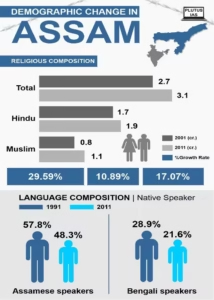
The Supreme Court recently questioned the Union Government on whether its new order permitting persecuted minorities from neighbouring countries to enter India violates the Assam Accord’s cut-off date of 24 March 1971.
Background
- The Assam Accord was signed on 15 August 1985 between the Government of India, the Assam Government, the All Assam Students’ Union (AASU), and the All Assam Gana Sangram Parishad.
- It ended the six-year-long Assam Movement (1979–85), which demanded the removal of illegal migrants from Assam.
Objectives of the Accord
- To identify, register, and take action against illegal immigrants in Assam.
- To protect the cultural and demographic identity of Assamese people.
- To restore political stability after years of social tension.
Key Provisions
Cut-off Dates for Detecting Foreigners
- 1 January 1966: People entering Assam before this date were to be recognised as Indian citizens.
- 1 January 1966 to 24 March 1971:
- Such individuals were to be detected under the Foreigners Act, 1946, and Foreigners Tribunal Order, 1939.
- Their names were to be removed from the electoral roll for 10 years.
- They must register under the Registration of Foreigners Act, 1939.
- After 25 March 1971:
- Migrants entering after this date were to be detected and expelled as per law.
Citizenship Rights
- People who arrived before 1966 gained citizenship automatically.
- Those who came between 1966–1971 could regain voting rights only 10 years after detection.
Clause 6 – Cultural & Identity Safeguards
- Promises constitutional, administrative, and legislative protections to preserve Assam’s language, culture, and heritage.
- Aims to ensure that immigration does not dilute the identity of Assamese communities.
Why the Issue Has Re-Emerged?
- The Centre’s move to allow persecuted minorities from neighbouring countries entry has raised concerns about violating the Accord’s 1971 deadline, prompting judicial scrutiny.
Conclusion:
The Assam Accord remains a central framework for balancing humanitarian concerns with Assam’s demographic protection, but new policy changes continue to test its relevance and implementation.
DIGITAL HUB FOR REFERENCE AND UNIQUE VIRTUAL ADDRESS (DHRUVA)
TOPIC: (GS3) SCIENCE AND TECHNOLOGY: THE HINDU
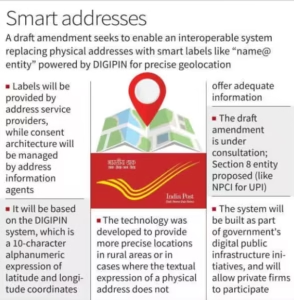
The Department of Posts has released a draft amendment to the Post Office Act, 2023 proposing a new digital addressing system called DHRUVA. The initiative aims to create a standardised, geo-coded, and user-controlled digital address platform across the country.
What is DHRUVA?
- DHRUVA is a nationwide Digital Address Digital Public Infrastructure (DPI) developed by the Department of Posts.
- It acts as a modern, uniform, and interoperable digital address system for citizens, businesses, and government agencies.
Key Features
Address-as-a-Service (AaaS)
- Provides a structured system for creating, verifying, storing, and sharing digital addresses.
- Makes address information usable across government departments, private companies, logistics providers, and service apps.
Interoperability & Standardisation
- Unifies different address formats used in banking, e-commerce, urban local bodies, and delivery services.
- Brings all addresses under a standard, geo-tagged, machine-readable system.
User-Controlled Data Sharing
- Uses consent-based access, allowing citizens to decide who can view or use their digital address.
- Users can update, modify, or revoke access to their address anytime.
Digital Public Infrastructure Integration
- Treated as a core infrastructure similar to Aadhaar and UPI.
- Supports smoother digital transactions such as KYC, e-governance, emergency services, and delivery networks.
Accessible & Citizen-Friendly
- Mobile-first interface, multilingual support, and optional integration with Aadhaar for verification.
- Designed to be usable even by rural populations.
Link with DIGIPIN
- DHRUVA builds on DIGIPIN, a geo-coded addressing system created with IIT Hyderabad and NRSC–ISRO.
- DIGIPIN divides India into 4m x 4m grids, assigning each a 10-character alphanumeric code based on latitude–longitude.
- Helps in faster emergency response, better logistics planning, and efficient government services.
Significance
DHRUVA aims to eliminate address mismatches, improve delivery efficiency, support smart governance, and create a secure, digital-first addressing ecosystem for India’s growing digital economy.
KEOLADEO NATIONAL PARK
TOPIC: (GS3) ENVIRONMENT: THE HINDU
After good monsoon rains this year, a large number of migratory birds—including bar-headed geese, pelicans, cranes, and painted storks—have arrived early at Keoladeo National Park. This has revived wetland habitats that were drying due to irregular rainfall and water shortages in recent years.

Introduction
- Keoladeo National Park, located in Bharatpur district of Rajasthan, is one of India’s most important wetland bird habitats.
- It is famous worldwide for attracting thousands of migratory birds each winter and is often called a “bird-watcher’s paradise.”
Historical Background
- Established in the late 19th century by Maharaja Suraj Mal as a duck-shooting reserve for the Bharatpur rulers.
- Declared a bird sanctuary in 1956 and upgraded to a national park in 1981.
- The park gets its name from the Keoladeo Temple dedicated to Lord Shiva located inside the reserve.
Features of the Park
- Total area: 29 sq. km, fully enclosed by a 2-metre boundary wall, making it unique among Indian national parks as it prevents encroachment and cattle grazing.
- Listed as both a UNESCO World Heritage Site and a Ramsar Wetland of International Importance.
- A major stopover on the Central Asian Flyway, making it crucial for global bird migrations.
Habitat & Vegetation
- Contains a mix of wetlands, marshes, shallow lakes, woodland patches, and grasslands.
- Dominant vegetation belongs to dry deciduous type, with medium-height trees and shrubs.
- Common trees: kadam, jamun, babul, kandi, ber, kair, piloo.
Ecological Importance
- Acts as a major breeding and feeding ground for waterfowl.
- Stabilises local micro-climate and recharges groundwater.
- Helps in conservation education and ecological research on migratory patterns.
Conservation Concerns
- Seasonal water shortages, dependence on external water supply, tourism pressure, invasive vegetation like Prosopis juliflora, and climate-driven changes in rainfall.