SPECIAL INTENSIVE REVISION (SIR) OF THE ELECTORAL ROLLS
TOPIC: (GS2) INDIAN POLITY: THE HINDU
The Election Commission of India has started a Special Intensive Revision (SIR) of the electoral rolls in Bihar ahead of the Assembly elections due in November 2025. This is to ensure voter rolls are clean and accurate, especially considering issues like migration and duplication.
What is an Electoral Roll?
- The electoral roll is an official list of eligible voters in a constituency.
- As per Article 324 of the Constitution, the Election Commission (EC) manages the preparation and revision of these rolls.
- Article 326 allows all citizens aged 18 or above to vote.
- Under the Representation of the People Act, 1950:
- Section 16 disqualifies non-citizens.
- Section 19 requires the person to be an ordinary resident.
- Section 20 defines ordinary residency—not just ownership, but actual residence.
Why was Special Intensive Revision (SIR) launched?
- Over the years, urbanisation and migration have led to a rise in duplicate entries and inaccuracies.
- The EC aims to ensure that only eligible citizens are listed.
- Bihar is the starting point because its elections are due soon.
- The last SIR in Bihar was in 2003; now the qualifying date is July 1, 2025.
Issues and Challenges
- Execution Difficulty: All 8 crore voters must submit forms; about 3 crore must also give extra documents. Migrants, students may miss deadlines, causing wrong exclusions.
- Aadhaar Not Accepted: Supporters: Aadhaar doesn’t prove citizenship or birth date. Critics: Aadhaar is widely used and may be the only ID for the poor.
- Impact on Migrants: RP Act allows temporary migrants to stay enrolled in their home constituency. Deletion of such names may deny them their voting rights.
Way Forward
- EC should ensure sufficient time, trained BLOs, and smooth verification.
- Be flexible in document requirements, especially during claims and objections.
- Use Aadhaar-linking to prevent duplicate entries.
- Migrants must be protected from wrongful removal.
Conclusion:
A clean electoral roll is essential, but it must not come at the cost of excluding legitimate voters. The process must balance accuracy and inclusion to strengthen democracy.
BRICS SUMMIT DECLARATION
TOPIC: (GS2) INTERNATIONAL RELATIONS: THE HINDU
The BRICS Leaders’ Declaration adopted at the summit in Rio de Janeiro echoed India’s major concerns on cross-border terrorism and global governance reforms, with PM Modi highlighting the underrepresentation of the Global South in key global institutions.

Background of the Summit
- Held in Rio de Janeiro, Brazil, the BRICS 2025 summit brought together leaders of Brazil, Russia, India, China, and South Africa.
- The Declaration addressed global challenges like terrorism, international law, and reforming outdated global institutions.
India’s Key Concerns Raised
Reforming Global Institutions
- PM Modi pointed out that two-thirds of the global population lacks fair representation in bodies like the UN Security Council.
- He stressed that credibility and effectiveness of these institutions are at risk due to outdated frameworks.
- India called for a stronger voice for the Global South in international decision-making.
Support for India’s Role in UN
- The declaration noted Russia and China’s support for India and Brazil’s aspiration to play a greater role in the UN, including the Security Council.
Terrorism and Regional Stability
- The BRICS declaration strongly condemned the Pahalgam terror attack in Jammu & Kashmir.
- Reaffirmed commitment to fighting cross-border terrorism.
- Called for early finalization of the Comprehensive Convention on International Terrorism (CCIT) at the UN.
Geopolitical Stances
- BRICS criticized the Israel-U.S. airstrikes on Iran, calling them violations of international law.
- Reaffirmed that Gaza is part of the Occupied Palestinian Territory and supported unifying Palestinian lands under one authority.
Two-State Solution for Palestine
- The declaration backed the two-state solution to the Israel-Palestine conflict.
- Emphasized peaceful resolution, the right to self-determination, and the creation of an independent Palestinian State.
Functions of BRICS
- Push for reform of global institutions like the UN Security Council, IMF, and World Bank. Enhance trade and investment among member nations.
- Political & Security Cooperation: Coordinate on international stability, peacekeeping, and shared diplomatic positions.
- Economic & Financial Integration: Includes the New Development Bank (NDB) and Contingent Reserve Arrangement (CRA) to finance infrastructure and assist during financial emergencies
- Cultural & PeopletoPeople Exchange: Promotes education, civil forums, parliamentary cooperation, and social development initiatives.
India’s Role in BRICS
- India is a founding member and plays a key balancing role between Russia-China and other members.
- Highlights issues like cross-border terrorism, global South representation, and digital public infrastructure.
- Hosts BRICS summits (last hosted in 2021 virtually due to COVID-19).
- Advocates for inclusive multilateralism and reforms in global governance.
Significance of BRICS in the World
- Represents about 42% of the world’s population.
- Combined GDP accounts for around 25% of global GDP (PPP terms).
- Key energy producers and consumers.
- Offers an alternative to Western-dominated institutions like G7 or NATO.
WHAT IS BRICS?
BRICS stands for Brazil, Russia, India, China, and South Africa. It’s a group of influential emerging economies collaborating to boost political and economic coordination
Inception and Evolution
- The acronym BRIC was coined in 2001 by British economist Jim O’Neill, then at Goldman Sachs, who predicted that these four nations would drive global economic growth
- The first official BRIC summit took place in Yekaterinburg, Russia, in June 2009, with leaders from Brazil, Russia, India, and China
- South Africa joined in 2010, turning BRIC into BRICS. The formal inclusion took place at the 3rd BRICS Summit in 2011
New Members (BRICS Expansion)
- At the 2023 BRICS Summit in South Africa, six new countries were invited: Egypt, Ethiopia, Iran, UAE, Saudi Arabia, and Argentina, although Argentina later declined
- As of January 2024, five of them—Egypt, Ethiopia, Iran, Saudi Arabia, and UAE—became full BRICS members
- Indonesia officially joined early 2025, marking the first Southeast Asian entry into BRICS The BRICS Triad: Core Pillars
Conclusion
India used the BRICS platform to push for inclusive global governance and highlight security concerns, aligning its stand with other emerging powers on building a fairer international order.
NATIONAL COMMISSION FOR MINORITIES (NCM)
TOPIC: (GS2) INDIAN POLITY: THE HINDU
The National Commission for Minorities (NCM) has been without a chairperson or members since April 2025, raising concerns about the government’s delay in appointments and commitment to safeguarding minority rights.
What is the National Commission for Minorities (NCM)?
- Constituted under: National Commission for Minorities Act, 1992
- Status: Statutory body under the Ministry of Minority Affairs
- Purpose: Protect the rights and interests of religious minorities in India.
Composition:
- Total 7 members: including a Chairperson, Vice-Chairperson, and 5 members
- At least one member each from the six notified minority communities: Muslims, Christians, Sikhs, Buddhists, Parsis, Jains (added in 2014)
Powers:
- Quasi-judicial authority with the power to investigate and take up complaints.
- Can summon individuals, demand records, and make recommendations to the government.
Quasi-judicial means having the powers similar to a court to make legal decisions, but not being a full-fledged court.
Current Situation and Concerns
- The last Chairperson Iqbal Singh Lalpura retired in April 2025; no replacements appointed.
- Since December 2024, five posts, including the head, remain vacant.
- Similar delays occurred in 2017, and the Delhi High Court in 2021 asked the Centre to fill vacant posts.
- Critics say such bodies are treated as symbolic roles or post-retirement posts for political loyalists.
Issues Raised by Experts
- Former members claim appointments are politically influenced.
- Efficiency is reduced without leadership; the body’s role becomes inactive.
- Concerns are rising amid increased hate crimes and hate speech incidents.
Impact on Other Minority Bodies
- The National Commission for Minority Educational Institutions (NCMEI) is also suffering.
- Has been working with only one member since 2023 after Chairperson’s retirement.
- NCMEI should have 3 members, including a Chairperson (at least a retired High Court Judge).
- This affects protection of minority education rights.
Criticism and Political Response
- Activists argue that the delay shows apathy toward minority welfare.
- Critics say minorities need active institutional support, especially in times of rising religious tension.
- Former heads of NCM criticized it as a mere formality with limited practical impact.
Way Forward
- Immediate appointments must be made to ensure the Commission functions effectively.
- Ensure non-political, diverse, and expert-based appointments for better credibility.
- Strengthen legal powers and independence of NCM and NCMEI.
Conclusion
The absence of leadership in the NCM and NCMEI undermines their core mission of protecting minority rights. Restoring these institutions with committed and capable members is essential for inclusive governance and constitutional values.
COOPERATIVE SECTOR
TOPIC: (GS3) ECONOMY: THE HINDU
At the 4th foundation day celebration of the Ministry of Cooperation in Anand, Gujarat, Union Minister Amit Shah emphasized that India’s cooperative sector should become the backbone of the economy, and unveiled a five-point growth roadmap for its transformation.
Strengthening the Cooperative Sector
- The Ministry of Cooperation was formed in 2021 to streamline and promote India’s cooperative movement.
- The event was held at Amul Dairy, a symbol of cooperative success in India.
- The focus was on making cooperatives more transparent, tech-driven, and people-centric.
Five-Point Roadmap for Cooperatives
- People – All cooperative actions should directly benefit common citizens.
- PACS (Primary Agricultural Credit Societies) – Strengthen grassroots cooperative networks.
- Platforms – Build strong digital infrastructure for cooperatives.
- Policy – Reform outdated cooperative laws and frameworks.
- Prosperity – Ensure growth and well-being of farmers, labourers, and rural communities.
Success Stories & Achievements
- Over 2 lakh PACS registered in the last 3 years.
- India’s first cooperative university has been established.
- Three national-level dairy cooperatives have been created.
- Amul’s turnover is projected to cross ₹1 lakh crore, reflecting the cooperative model’s strength.
- New Amul units, like a mozzarella plant, were inaugurated.
Political Message & Historical Context
- Shah paid tribute to Syama Prasad Mookerjee, connecting his legacy to Article 370’s removal and J&K’s integration.
- Called for a cooperative model that includes every village from Kashmir to Kamakhya.
What are Cooperative Societies? (Simple Meaning)
- A cooperative society is a voluntary association of individuals who come together to achieve a common economic interest, such as farming, credit, marketing, housing, or production.
- It works on the principles of self-help, mutual help, democratic control, and equal sharing of surplus.
- Each member typically has one vote, regardless of shareholding – ensuring equality.
Constitutional Provisions Related to Cooperative Societies
Part IV – Directive Principles of State Policy (DPSP)
- Article 43B (inserted by 97th Constitutional Amendment Act, 2011): “The State shall endeavour to promote voluntary formation, autonomous functioning, democratic control, and professional management of cooperative societies.”
Part III – Fundamental Rights
- Article 19(1)(c) (Amended by 97th Amendment): Added the right to form cooperative societies as a Fundamental Right along with associations and unions.
Part IXB – Cooperative Societies
- Articles 243ZH to 243ZT were added to the Constitution by the 97th Constitutional Amendment Act, 2011.
- It gave a constitutional status to cooperative societies and provided for:
- Maximum number of board members: 21
- Election within 6 months of supersession
- Tenure of board: 5 years
- Regular auditing and accountability
- State-level and multi-state cooperative societies
PACS (PRIMARY AGRICULTURAL CREDIT SOCIETIES)
- Grassroots Rural Institutions:
PACS are the lowest tier in the three-tier cooperative credit structure, operating at the village level to provide short-term and medium-term credit to farmers. - Support to Farmers:
They give loans for agricultural inputs, seeds, fertilizers, irrigation, and minor farm development works, often at lower interest rates. - Link to Cooperative Banks:
PACS are linked to District Central Cooperative Banks (DCCBs) and State Cooperative Banks, forming a network that helps in the distribution of credit and agricultural support at the local level.
Conclusion
The Union government sees cooperatives as key to inclusive and rural economic growth. With strong support from technology, reforms, and grassroots engagement, the sector is expected to play a vital role in India’s development journey.
ENVIRONMENT IMPACT STUDY FOR NICOBAR PROJECT
TOPIC: (GS3) ENVIRONMENT: THE HINDU
The Environmental Impact Assessment (EIA) for the ₹72,000-crore Great Nicobar Infrastructure Project (GNIP) has been criticized for underestimating earthquake and tsunami risks in a geologically sensitive zone. Experts argue the study overlooks critical findings from earlier scientific reports..
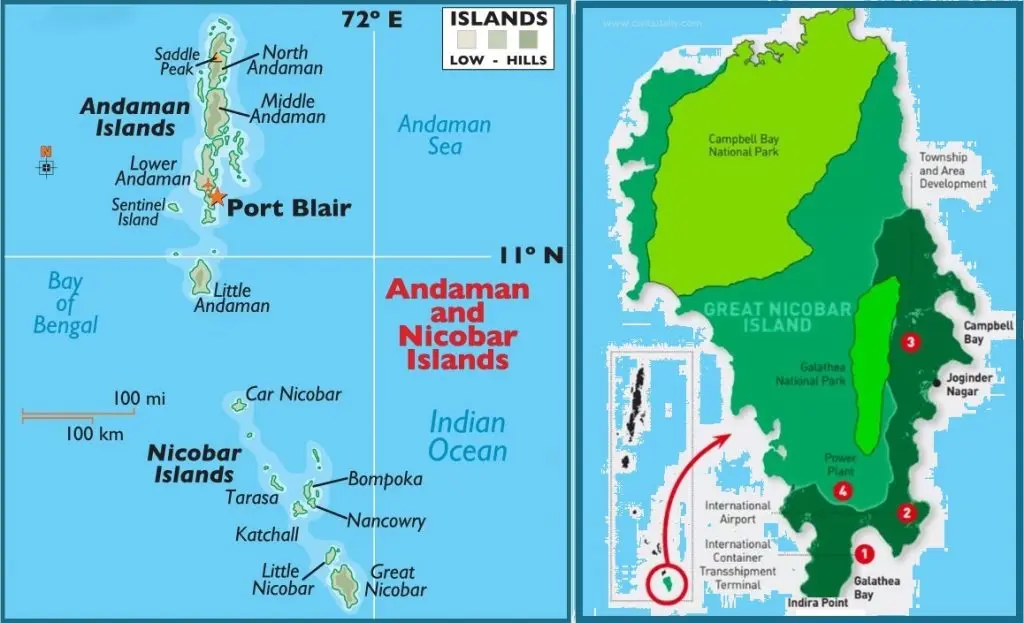
Great Nicobar Infrastructure Project (GNIP):
- Aims to build a transshipment port, international airport, township, and a 450 MVA gas + solar power plant in Great Nicobar Island.
- Being implemented by Andaman and Nicobar Islands Integrated Development Corporation (ANIIDCO).
- Project cost: ₹72,000 crore.
- Received environment and forest clearance, but is under review by the National Green Tribunal (NGT) due to ecological concerns.
Concerns Over Earthquake and Tsunami Risks
- The EIA report claims the chance of a 2004-like mega-earthquake is “low”, citing long return periods (420–750 years).
- However, it uses outdated or partial data, mostly based on a 2019 IIT-Kanpur study.
- Key findings of that IIT study, such as evidence of 7 large tsunamis in the past 8,000 years and data gaps, were excluded from the EIA.
What Experts Say
- Prof. Javed Malik (IIT-Kanpur): Infrastructure must be preceded by site-specific seismic studies, as risks vary based on quake location.
- Prof. C.P. Rajendran (NIAS): Fault lines near Nicobar remain poorly understood. The area is extremely geodynamic and prone to sudden quakes. Building major ports here is too risky.
- A Ministry of Earth Sciences scientist accepted that no new on-site study was conducted but said the project involves a “calculated risk.”
Other Environmental Concerns
- Large-scale tree cutting and threat to biodiversity hotspots.
- Impact on tribal communities, especially the Shompen tribe.
- NGT has asked for a fresh review due to these social and ecological issues.
ENVIRONMENTAL IMPACT ASSESSMENT (EIA)
What is Environmental Impact Assessment (EIA)?
- EIA is a process that evaluates the likely environmental impacts (positive or negative) of a proposed project or development before it is started.
- The goal is to identify, predict, and prevent harm to the environment, and to ensure sustainable development.
- It considers aspects like air, water, soil, forests, wildlife, local communities, etc.
Legal Framework of EIA in India
Environment (Protection) Act, 1986
- This is the umbrella law under which EIA is conducted.
- It gives the central government the power to take measures to protect and improve the environment.
EIA Notification, 1994 (replaced in 2006)
- Issued under the Environment Protection Act.
- Made EIA mandatory for certain categories of projects (like industries, mining, ports, airports, dams).
- Introduced the concept of environment clearance.
EIA Notification, 2006 (still in force with amendments)
- Classified projects into Category A (Central Govt.) and Category B (State Govt.) based on size and impact.
- Made public hearing and Environment Management Plan (EMP) mandatory.
- Laid down detailed procedure:
- Screening
- Scoping
- Public Consultation
- Appraisal
- Grant/Rejection of Clearance
Other Related Laws and Bodies
- Forest Conservation Act, 1980: regulates deforestation and diversion of forest land.
- Wildlife Protection Act, 1972: checks the impact of projects near wildlife habitats.
- Water and Air Acts: regulate pollution during project execution.
- MoEFCC (Ministry of Environment, Forest and Climate Change): nodal agency for EIA.
- State Environment Impact Assessment Authorities (SEIAA): clear projects at the state level.
Conclusion
While development is important, ignoring scientific warnings in an earthquake-prone region like Nicobar could lead to disastrous consequences. A thorough site-specific seismic and ecological assessment is essential before moving forward.
GOOGLE AI OVERVIEWS AND EU ANTITRUST COMPLAINT
TOPIC: (GS3) SCIENCE AND TECHNOLOGY: THE HINDU
Google’s AI Overview feature has triggered an antitrust complaint by independent publishers in the European Union, who claim it is harming fair competition and affecting media revenues.
What is Google AI Overviews?
- Google has launched a new feature called AI Overviews in its search engine results.
- These are AI-generated summaries that appear above the usual search links, giving users quick, direct answers.
- The feature was first tested as the Search Generative Experience (SGE) in 2023 and is now widely implemented.
How Does It Work?
- When a user types a search, Google decides if AI can provide a more helpful summary.
- It uses its Gemini AI model and a method called Retrieval-Augmented Generation (RAG).
- This technique gathers real-time web content and produces a summarized answer.
- These summaries also include links to source websites, allowing deeper exploration.
Why Are Publishers Upset?
- Loss of traffic: Users read the AI summary and often skip visiting publisher websites.
- This leads to a drop in advertising income and subscriptions, which are vital for publishers.
- Publishers claim Google is using their content without fair payment.
- Since May 2024, ads are shown within AI Overviews, further monetizing publisher content.
- Opting out of AI Overviews means losing visibility in Google search, which is not practical for most websites.
Role of Regulators
- A formal complaint has been filed with the European Commission and the UK’s Competition and Markets Authority (CMA).
- CMA is assessing if Google should be given “strategic market status”, enabling tighter controls.
- Publishers demand interim relief to pause AI Overviews while investigations are ongoing.
Google’s Response
- Google says AI Overviews help users ask more questions and explore more websites.
- The company claims it still sends billions of clicks to publishers and that AI-driven traffic is more relevant and high-quality.
Need to Regulate AI
- Loss of User Privacy: AI systems often collect large amounts of personal data, including sensitive information. Without clear rules, this data can be misused, leading to privacy breaches and identity theft.
- Continuous Surveillance & Consent Issues: Many AI tools track user behavior in real-time (e.g., location, voice, preferences). Often, users are unaware of being monitored or don’t give informed consent.
- Lack of Accountability for Data Misuse: When AI systems leak, sell, or misuse data, it’s difficult to fix responsibility. There’s no global legal framework to ensure accountability or provide user protection.
Conclusion
While AI Overviews aim to improve user experience, they also raise important concerns about fair access, publisher rights, and digital competition—crucial issues in the age of AI-driven information.
HOW INDIA’S TOY INDUSTRY BECAME A GLOBAL EXPORTER
TOPIC: (GS3) ECONOMY: THE HINDU
India’s toy industry has significantly evolved in recent years, with exports rising by 40% from FY19 to FY24 and toys now being exported to 153 countries. Imports, meanwhile, have declined by 79%, showing India’s growing self-reliance.
India’s Toy-Making Legacy
- Toy-making in India dates back to Indus Valley Civilization (2500 BCE) with toys made of clay, wood, and cloth.
- Traditional toys like Channapatna (Karnataka) and Kondapalli (Andhra Pradesh) are well known for their eco-friendly materials and cultural themes.
- Different regions in India have toy-making linked to local culture, stories, and craftsmanship.
Industry Evolution
- During British rule, toy-making moved from hand-made to mechanised production.
- After Independence, many small-scale units making wooden and metal toys emerged.
- In the 1980s, plastic toys and Indian brands like Funskool became popular.
- The 1990s liberalisation brought international brands into India.
- The 2000s saw growth in educational and tech-based toys.
- Today, many Indian startups make eco-conscious and learning-based toys.
Present Scenario
- India’s toy market is worth around $1.9 billion in 2024, expected to grow to $4.7 billion by 2033.
- About 90% of the market is still unorganised (local units, cottage industries).
- However, the organised sector is expanding due to digital access, branding, and urbanisation.
Government Initiatives
- ‘Make in India’ and ‘Atmanirbhar Bharat’ aim to boost domestic toy production.
- Import duties increased from 20% to 60% to discourage cheap imports.
- Quality Control Orders (QCOs) ensure toys meet BIS safety standards.
- PLI Scheme gives financial support to firms making high-quality export-ready toys.
Challenges
- Industry still suffers from: Lack of modern technology, Market fragmentation, Poor branding due to dominance of unorganised players
- Traditional artisans struggle with: Low demand, Competition from cheap plastic toys, Limited market reach
Conclusion
India’s toy sector is changing fast. With government support, digital tools, better designs, and quality control, it can become a global toy hub. Emphasis on education-based, eco-friendly, and culturally rooted toys will help India lead the future of the global toy market.
HAM RADIO COMMUNICATION
TOPIC: (GS3) SCIENCE AND TECHNOLOGY: THE HINDU
Indian astronaut Shubhanshu Shukla communicated with school students in India using Ham Radio from the International Space Station (ISS).
This event highlighted Ham Radio’s educational and emergency communication value.
What is Ham Radio?
- Also called Amateur Radio.
- It’s a licensed communication system using radio frequencies for non-commercial use.
- Mainly used for education, experiments, and emergency communication.
- Two licensed users can connect using a transceiver and antenna.
- Allows local, global, and even space-based communication.
Ham Radio in India
- Any Indian citizen above 12 years can apply for a license.
- Licenses are issued by the Ministry of Electronics and IT.
- Requires passing an exam to become a licensed Ham operator.
Use in Space Missions
- Amateur radio first used in space in 1983 aboard a NASA shuttle.
- The ARISS (Amateur Radio on the ISS) project enables astronauts to talk to students globally.
- Supported by space agencies from USA, Europe, Russia, Japan, and Canada.
- Communication gaps are scheduled during sensitive ISS operations to avoid interference.
Axiom-4 Mission and India
- Astronauts from India, Poland, and Hungary will use Ham radio during their 14-day stay at the ISS.
- They will connect with students when the ISS passes overhead for short windows of 5–8 minutes.
Importance of Ham Radio
- Works even when mobile networks and internet fail.
- Proven helpful in disasters like:
- 2001 Bhuj earthquake
- 2004 tsunami
- 2013 Uttarakhand floods
- Useful for emergency alerts and community-level communication.
