
A recent UN report warns that Artificial Intelligence (AI) may increase economic and social inequality in the Asia-Pacific region. It highlights huge differences in AI preparedness, digital access, and skills between and within countries.
Background of the Issue
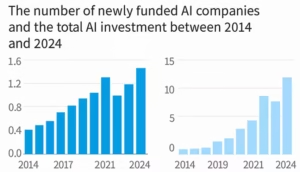
- Over the last 10 years, the number of AI-based start-ups and overall AI investment has grown sharply across the world.
- The Asia-Pacific region is also adopting AI, but countries begin from highly unequal levels of readiness.
- The IMF’s AI Preparedness Index shows variations from 70% plus in advanced economies to below 20% in fragile states.
Unequal Preparedness for AI
- Better-Prepared Countries: Nations like Singapore, South Korea, and China have strong digital systems, skilled manpower, and robust AI policies.
- Low-Prepared Countries: Many South Asian and Pacific countries lack: Reliable electricity, Data storage systems, Basic internet connectivity, Adequate computing power. These gaps reduce their ability to use AI effectively.
Inequalities Within Countries
- Income inequality is severe, with the top 10% controlling a major share of wealth across Asia-Pacific.
- This means only a small portion of people and businesses can access advanced technologies.
- Digital access is uneven: despite rapid internet expansion, poor communities and rural areas remain far behind.
- Gender Impacts: The UN report warns that women are more vulnerable to job loss from AI-led automation compared to men. Women’s limited access to digital skills worsens this risk.
Hard and Soft Infrastructure Needs
- Hard Infrastructure: Affordable and fast internet for all, Reliable and clean electricity, Cooling systems for data centres
- Soft Infrastructure: Skilled workforce and digital literacy, Strong government institutions, Clear laws on data protection, fairness, and safe AI use
How to Develop Inclusive AI
- Build Equal Access to Digital Infrastructure: Ensure affordable internet for all countries and communities. Example: India’s Digital Public Infrastructure (UPI, Aadhaar, ONDC) shows how low-cost technology can reach millions, unlike AI models accessible only to rich nations.
- Create Fair& Ethical AI Governance: Make global rules for privacy, bias reduction, and responsible AI use. Example: The EU AI Act and UNESCO Ethical AI Framework guide nations to adopt safe AI without geopolitical discrimination.
- Invest in Human Skills Train people—especially women, rural youth, and small businesses—to use AI tools. Example: India’s Bhashini project allows AI to work in Indian languages, ensuring rural users also benefit.
Conclusion
AI can drive growth, but without inclusive policies, it may deepen existing inequalities in Asia-Pacific.
Bridging digital, social, and gender divides is essential for a fair and balanced AI transition.
New global developments in Brain-Computer Interface (BCI) research, including Neuralink’s human trials and China’s Brain Project, have renewed debate on neurotechnology’s future. India is exploring medical, research, and innovation opportunities as neurological disorders rise nationwide.
What is Neurotechnology?
- Neurotechnology refers to devices or systems that interact directly with the brain to record, interpret, or influence neural activity.
- It combines neuroscience, AI, engineering, and computing to understand brain functions or restore lost abilities.
What is a Brain-Computer Interface (BCI)?
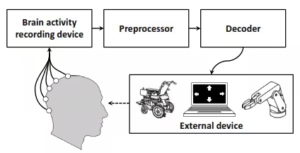
- A BCI is a tool that converts brain signals into digital commands that can operate external devices.
- Allows users to control items such as cursors, robotic arms, wheelchairs, or communication systems through thoughts.
- BCIs can be:
- Non-invasive: EEG headsets placed on the scalp.
- Invasive: Electrodes implanted inside the brain for higher precision.
Applications of BCIs
- Therapeutic Uses: Helps paralysed patients move prosthetic limbs, Assists stroke or spinal injury patients in rehabilitation. Stimulates specific brain areas to treat Parkinson’s disease, epilepsy, or depression.
- Diagnostics: Records brain signals to study memory, cognition, sleep disorders, or psychiatric conditions.
- Future Uses: Could be used for human enhancement, faster learning, or military communication, but these raise strong ethical concerns.
Why Does India Need Neurotechnology?
- India faces a high and rising burden of neurological diseases such as stroke, spinal cord injuries, mental health disorders, and degenerative diseases.
- BCIs can help restore communication and mobility for patients with paralysis or neurological damage.
- India has growing strengths in biotech, AI, medical engineering, making neurotech a major economic and research opportunity.
Where India Stands
- IIT Kanpur developed a BCI-enabled robotic hand for stroke patients.
- National Brain Research Centre (NBRC) and IISc lead cutting-edge brain studies.
- Startups like Dognosis use neurotech to decode brain signals in animals for cancer detection research.
Global Developments
- U.S. leads BCI research through the NIH BRAIN Initiative and Neuralink’s human implantation trials.
- China’s Brain Project (2016–2030) focuses on cognition research and brain-inspired AI.
- EU and Chile are creating legal frameworks for neurorights and safe BCI use.
Regulatory Needs for India
- Requires strong ethical and data protection rules for neural information.
- Public awareness and dialogue on benefits and risks are essential.
- Different BCI types need separate regulatory pathways depending on their medical or commercial risk.
Conclusion
Neurotechnology offers India a major chance to address neurological illness while driving innovation. With proper safeguards and clear regulations, India can become a leading hub in the global brain-tech ecosystem.
India Post has proposed the Digital Hub for Reference and Unique Virtual Address (DHRUVA) to standardise physical addresses through digital “labels.” A draft amendment to the Post Office Act, 2023 has been released to legally enable this new digital address ecosystem.
What is DHRUVA?
- DHRUVA is a proposed Digital Public Infrastructure (DPI) similar to Aadhaar and UPI.
- It aims to convert physical addresses into digital labels (e.g., amit@dhruva), which can be shared with public and private platforms.
- It links descriptive addresses with geo-coded DIGIPIN, ensuring accuracy in delivery and service identification.
What is DIGIPIN?
- DIGIPIN is a 10-character alphanumeric digital pin created by India Post based on precise geo-coordinates.
- Every 12 sq. metre area in India has a unique DIGIPIN.
- Useful in areas with unclear or inconsistent descriptive addresses, especially in rural and remote regions.
Components of the DHRUVA Ecosystem
- Address Service Providers (ASPs): They create digital proxy addresses or “labels.”
- Address Validation Agencies: Verify and authenticate descriptive and geo-coded addresses.
- Address Information Agents: Manage users’ consent for sharing address data with platforms.
- Governance Entity: A body similar to NPCI to oversee standards, security, and operations.
Benefits
- Consent-Based Address Sharing: Like UPI tokenises bank accounts, DHRUVA tokenises addresses. Users control who can access their address, for what purpose, and for how long.
- Better Logistics and Deliveries: E-commerce, gig services, courier companies, and India Post can use digital labels instead of long written addresses. Helps ensure precise doorstep delivery.
- Seamless Address Updating: When people move homes, they can simply update their digital label, and all subscribed services shift automatically.
- Service Discovery: Platforms can show what location-based services (health, postal, emergency, government schemes) are available at a user’s address.
Concerns and Limitations
- Data Privacy Issues: Since DHRUVA links addresses to personal information, a strong consent and data protection framework is essential.
- Challenge for Urban Governance: Experts argue it may not fully aid city planning because labels are person-linked, not based on surveyed physical structures.
- If citizens refuse to generate labels, datasets may remain incomplete.
Conclusion
DHRUVA has the potential to transform how India identifies, shares, and verifies addresses in the digital age. However, its success will depend on strong privacy safeguards and widespread adoption across regions and sectors.
Global health agencies reported that measles caused nearly 95,000 deaths in 2024, mostly among unvaccinated children under five. The rise in cases highlights low vaccination coverage and gaps in routine immunisation in several countries.
Measles
- Measles is a highly infectious viral illness spread through the air.
- It is caused by a virus belonging to the paramyxovirus family.
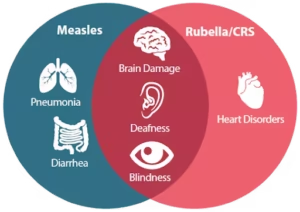
- The disease mainly affects the respiratory system before spreading throughout the body.
Transmission
- Measles spreads through droplets from an infected person while coughing or sneezing.
- The virus can stay active in the air or on surfaces for up to two hours, making it extremely contagious.
- Even being in the same room where an infected person recently stayed can lead to infection.
Symptoms
- Early signs appear 10–14 days after exposure and include: High fever, Runny nose, Cough, Red watery eyes, Tiny white spots inside the mouth (Koplik spots)
- A red rash starts on the face and neck, spreads across the body, and lasts 5–6 days before fading.
Who is at Risk?
- People who are not vaccinated or lack immunity.
- Young children, pregnant women, and malnourished individuals are more prone to complications.
- Measles remains widespread in parts of Africa, Middle East, and Asia.
Treatment and Prevention
- There is no specific antiviral cure for measles
- Prevention depends on the Measles-Rubella (MR) vaccine, which provides long-lasting immunity.
- India added the measles vaccine to the Universal Immunisation Programme (UIP) in 1985.
Conclusion:
Measles remains a major global health concern mainly due to gaps in vaccination coverage. Strengthening routine immunisation and public awareness is the only sustainable way to prevent future outbreaks.
Scientists at the University of Oxford have identified a ~50-million-light-year-long cosmic filament containing at least 14 galaxies. This finding gives fresh clues about how the cosmic web guides the growth and movement of galaxies.
Cosmic Filaments
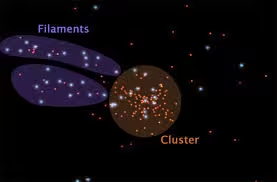
- Cosmic filaments are the largest thread-like structures in the universe forming part of the “cosmic web.”
- They are made of galaxies, gases, and dark matter, stretching for hundreds of millions of light-years.
- These super-structures act as cosmic highways through which matter flows across the universe.
Characteristics
Scale and Structure
- Each filament spans vast distances, making them among the biggest known structures in the cosmos.
- They link massive galaxy clusters, forming a web-like network.
- Filaments separate huge empty spaces known as voids.

Composition
- Built from dark matter, intergalactic gas, and many galaxies.
- They provide a scaffolding that shapes the distribution of matter in the universe.
Formation
Gravity-Driven Process
- Gravity pulls gas, dark matter, and galaxies into elongated, narrow strands over billions of years.
- Filaments form where gigantic sheets of matter intersect and collapse.
Pathways of Motion
- Smaller galaxies and gas streams move along filaments toward larger clusters.
- Filaments act as channels feeding fresh gas into galaxies.
Significance
- Galaxy Growth: Filaments supply pristine gas, helping galaxies form new stars. They influence where galaxies appear and how fast they grow.
- Cosmic Evolution: Studying filaments helps scientists understand the large-scale structure of the universe. They reveal how matter is organised and how it flows across cosmic time.