
Daily Current Affairs 09-September-2025

Share this Post

RED SEA CABLE CUTS AND IMPACT ON INDIAN NETWORKS

TOPIC: (GS3) SCIENCE AND TECHNOLOGY: THE HINDU

Recently, cuts in undersea cables in the Red Sea slowed India–Europe internet traffic by increasing latency, though major outages were avoided through alternate routes.
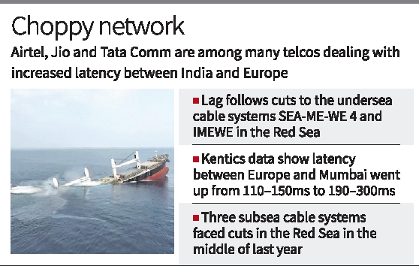
Choppy Network

What are Undersea Cables?

  • Fiber-optic cables laid on the seabed, carrying ~99% of international internet traffic.
  • Form the global internet backbone, connecting continents for data transfer.
  • Provide fast, high-capacity, and reliable communication compared to satellites.

About SEA-ME-WE 4 and IMEWE Cables

  • Current Issue: Red Sea Cable Cuts: Cables in the Red Sea have been cut amid regional tensions, including Houthi-linked incidents.
  • SEA-ME-WE 4 (South-East Asia–Middle East–Western Europe 4): Connects Southeast Asia to Europe via India, West Asia, and Egypt. Lands in Chennai and Mumbai in India.
  • IMEWE (India–Middle East–Western Europe): A high-capacity cable linking India (Mumbai) with West Asia and Europe. Operated by a consortium including Bharti Airtel and Tata Communications.

Impact on India:

  • Latency between Mumbai and Europe rose from ~110–150 ms to ~190–300 ms.
  • Airtel, Jio, and Tata Communications networks were affected.
  • Video calls, cloud services, and streaming experienced noticeable slowdowns.
  • Mitigation: India has over 12 subsea cable systems, allowing telecoms to reroute traffic through alternate but less efficient paths.

Strategic Concerns

  • Recurring Problem: This is the second disruption in the Red Sea in two years, raising concerns over security of global internet infrastructure.
  • Geopolitical Angle: Red Sea is a crucial chokepoint for digital connectivity in addition to oil and trade routes.

India’s Challenge:

  • Heavy reliance on a few critical cables.
  • Need to diversify routes and invest in redundant, secure infrastructure.

Way Forward

  • Strengthen regional cooperation for undersea cable protection.
  • Encourage investment in alternate cable routes via Africa and Central Asia.
  • Enhance cyber and physical security frameworks for critical internet infrastructure.

Conclusion:

The Red Sea cable cuts highlight India’s vulnerability in digital connectivity. While immediate disruptions were controlled, long-term resilience needs stronger infrastructure and diversified routes.

INDIA–CHINA: THE NEED FOR A BORDER SETTLEMENT

TOPIC: (GS2) INTERNATIONAL RELATIONS: THE HINDU

On August 19, 2025, India and China held the 24th round of Special Representatives’ (SR) talks to settle the boundary dispute.

Background of Border Talks

  • In 2003, PM Vajpayee and Chinese leadership created the Special Representatives mechanism to give a political push to border negotiations.
  • The 2005 Political Parameters Agreement remains the only structured framework, highlighting:
    • Recognition of strategic interests of both sides.
    • Protection of settled populations in disputed areas.
    • Settlement guided by natural, identifiable geographical features.
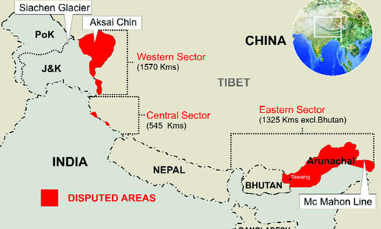
INDIA–CHINA BORDER SETTLEMENT

Key Sticking Points

  • Framework discussions suggested a swap: India accepts Chinese control over Aksai Chin, while China recognizes India’s sovereignty over Arunachal Pradesh.
  • However, China’s demand for Tawang has stalled progress, undermining Article VII that safeguarded settled populations.
  • Even though an 18-point consensus was once reached, political approval to finalize it never materialized.

Progress and Challenges

  • Agreements were reached on some areas like the Sikkim-Tibet border alignment and consultation with third countries for tri-junctions.
  • Despite occasional détente, incidents such as Chumar (2014), Doklam (2017), and Galwan (2020) reignited mistrust.
  • Military buildups along the LAC continue, raising costs for both sides.

The Way Forward

  • Current talks focus on: Early harvest agreement for the Sikkim-Tibet border. Developing new border management mechanisms after the failures of 2020.
  • A final settlement depends on political will in both countries to accept that a prolonged stalemate benefits neither.

Conclusion:

India and China already possess a workable framework. Only a decisive political push can transform the disputed LAC into a stable, recognized international border.

GST 2.0 AND ITS IMPACT ON DIETARY HEALTH

TOPIC: (GS3) ECONOMY: THE HINDU

From September 22, 2025, India’s GST 2.0 will simplify tax slabs but may risk public health by making sugary and processed foods cheaper.

GST 2.0: Key Features

  • Two broad slabs: 5% and 18%, with 40% for aerated and sugar-heavy drinks.
  • Many processed foods such as confectionery, chocolates, jams, jellies shifted to the 5% bracket.
  • Some items like pizza bread moved from 5% to zero tax.

Public Health Concerns

  • Lower GST on foods with high sugar, salt, or refined flour makes them more accessible.
  • Such tax cuts go against India’s goal of tackling non-communicable diseases (NCDs).
  • For example, healthy bread options (like sourdough) and unhealthy ones (made of maida) are taxed equally

Food Labelling and Consumer Awareness

  • Front-of-Pack Labelling (FOPL) has been pending since 2022.
  • The Supreme Court directed the FSSAI to finalize FOPL rules with a preference for warning labels over star ratings.
  • Warning labels based on WHO-SEARO and ICMR-NIN standards can help consumers identify products high in sugar, salt, or fat.

Linking GST with Health Policy

  • Tax incentives should be tied to labelling compliance: Foods labelled “high in sugar/salt/fats” should not get the 5% GST rate. Healthier products can be taxed lower to encourage reformulation.
  • Without this link, reducing beverage consumption through high taxes may only shift demand to cheaper sugary foods.

Advertising and Market Influence

  • Current rules restrict HFSS food sales/ads near schools and ban misleading promotions.
  • However, India lacks a comprehensive child-focused ad ban.
  • Global practices (e.g., Chile) show restricting ads of “high in” products to children works better.

Way Forward

  • Make warning labels mandatory with strong, category-based thresholds.
  • Align GST rates with nutritional quality—unhealthy foods should face higher taxes.
  • Strengthen advertising restrictions for HFSS foods across media.
  • Redirect sin-tax revenues to fund NCD prevention and nutrition awareness.

Conclusion:

GST 2.0 may simplify taxation, but without clear food labels, strict ad rules, and health-linked taxation, it risks worsening dietary health instead of improving it.

RANKING ON HIGHER EDUCATION (NIRF 2025)

TOPIC: (GS2) INDIAN POLITY: THE HINDU

The India Rankings (IR) 2025 under the National Institutional Ranking Framework (NIRF) were released, once again dominated by older public universities. Experts, however, point out flaws in the ranking system, particularly in peer perception and inclusivity.

National Institutional Ranking Framework (NIRF)

  • A framework to rank higher education institutions in India based on objective parameters like teaching, research, graduation outcomes, outreach, and perception.
  • It provides rankings across categories such as universities, colleges, engineering, management, law, medical, and overall.
  • Introduced in 2015 and the first rankings were published in 2016.
  • Which Ministry oversees it: Ministry of Education (MoE) oversees the entire framework and rankings.

Who gives the rating?

  • The rankings are released by the Ministry of Education (MoE), Government of India.
  • The actual process is carried out by the National Institutional Ranking Framework (NIRF) team under the Ministry.

When launched?

Ranking based on five parameters:

  • Teaching, Learning & Resources – 30%
  • Research & Professional Practice – 30%
  • Graduation Outcomes – 20%
  • Outreach & Inclusivity (OI) – 10%
  • Peer Perception – 10%

Issues with Current Framework

Peer Perception

  • Accounts for 10% weightage.
  • Based on feedback from experts and employers; subjective and reputation-driven.
  • Disadvantages smaller, State-run or suburban institutions.

Outreach & Inclusivity (OI)

  • Focuses mainly on regional and gender diversity.
  • Neglects economically weaker sections, socially disadvantaged groups, and persons with disabilities.
  • Only JNU and AIIMS Delhi scored above 70 in OI among the top 10.
  • Reservation in faculty recruitment is inadequately considered.

Structural Gaps in Higher Education

  • Regional disparities and faculty shortages outside top institutions.
  • Over 58% of management colleges had no research publications.
  • Legacy institutions are not mentoring newer ones effectively.
  • Risk of false data submission by some institutions.

Way Forward

  • Review weightage of peer perception to avoid bias.
  • Strengthen OI parameter to include social and economic disadvantage.
  • Ensure compliance with reservation norms in recruitment.
  • Use rankings to address systemic challenges, not just branding.
  • Enforce penalties on false reporting by institutions.

Conclusion

Unless corrected, the NIRF risks becoming a branding exercise for private institutions, rather than a tool to improve quality and equity in Indian higher education.


THE ‘DOMESTIC SPHERE’ IN NEW INDIA

TOPIC: (GS2) INDIAN POLITY: THE HINDU

The debate on women’s role in the domestic sphere resurfaced after the RSS chief’s August 2025 remark that families should have at least three children for “civilizational survival.”

Concerns in the Domestic Sphere

Violence Against Women

  • Dowry deaths: Around 7,000 women die every year due to dowry-related violence (2017–2022), adding up to 35,000 deaths in five years.
  • Domestic violence: NFHS-5 reports that 30% of women face partner violence, but only 14% file police complaints.
  • Policy silence: Political leaders often avoid addressing violence within families, while focusing on issues like “love jihad.”

Historical and Cultural Barriers

  • Hindutva ideology often promotes marriage as a sacrament, discouraging divorce or women leaving violent marriages.
  • Resistance to reforms: Opposition to Ambedkar’s Hindu Code Bill reforms historically reflected these views.
  • Current debates: Efforts to dilute domestic violence laws and resistance to criminalising marital rape are justified as protecting “Indian culture.”

Women’s Unpaid Work – Findings of TUS 2024

  • Employment: Only 25% of women (15–59 yrs) engaged in employment, averaging 5 hours daily (compared to 75% of men, averaging 8 hours).
  • Unpaid domestic work: 93% of women spend ~7 hours daily on household chores. 41% of women do 2.5 hours of unpaid caregiving.
  • Men’s participation: 70% of men do no domestic work; those who do spend only ~1.5 hours. In caregiving, 79% of men contribute nothing; others spend ~1 hour.
  • Result: Women’s total working hours exceed men’s, leaving them with less time for rest and leisure.

Policy Response and Undervaluation

  • Government narratives glorify unequal burden as part of the “Indian social fabric.”
  • Women in public services like anganwadi, mid-day meals, ASHAs are treated as volunteers, not workers, receiving honorariums instead of minimum wages.
  • Economic undervaluation: SBI survey (2023) estimated women’s unpaid work at ₹22.5 lakh crore (~7% of GDP), yet it is excluded from wage calculations.

Way Forward

  • Eliminate domestic violence through strong legal and cultural interventions.
  • Recognise women as equal workers with fair wages and job security.
  • State-provided universal care services for children and the elderly.
  • Improve healthcare and education to reduce women’s unpaid care burden.
  • Promote shared responsibilities within households instead of reinforcing traditional roles.
  • Ensure justice for scheme workers by giving them minimum wages and government employee status.

Conclusion

The struggles within the domestic sphere highlight how patriarchal norms, policy neglect, and undervaluation of women’s work undermine gender equality. Addressing these concerns is essential for realising genuine women-led development in India.

KERALA’S MATERNAL MORTALITY RATIO (MMR) RISES

TOPIC: (GS1) SOCIAL ISSUES: THE HINDU

The latest SRS bulletin (2021-23) reports that Kerala’s maternal mortality ratio has risen from 18 to 30 per one lakh live births. This rise is linked to fewer live births and the impact of COVID-19-related maternal deaths in 2021.

Maternal Mortality Ratio (MMR)

  • MMR is the number of maternal deaths per 1,00,000 live births in a given time period.
  • Maternal death refers to the death of a woman during pregnancy, childbirth, or within 42 days of termination of pregnancy, due to causes related to or aggravated by the pregnancy.
  • It is a key indicator of maternal health, quality of healthcare systems, and progress towards SDG 3.1 (Reduce global maternal mortality ratio to less than 70 by 2030).
  • India has been working to reduce MMR through schemes like Janani Suraksha Yojana (JSY), LaQshya, Pradhan Mantri Surakshit Matritva Abhiyan (PMSMA), and Poshan Abhiyaan.
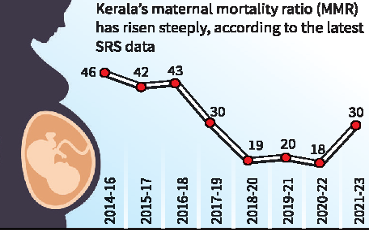
KERALA’S MATERNAL MORTALITY RATIO (MMR) RISES

Recent Findings on Kerala

  • Kerala’s MMR rose from 18 (2020-22) to 30 (2021-23) per one lakh live births.
  • Despite the rise, Kerala and Andhra Pradesh continue to have the lowest MMR in India.
  • In 2021, 97 maternal deaths due to COVID-19 were reported in Kerala.
  • The decline in the number of live births is amplifying the MMR figures.

Declining Live Births in Kerala

  • Kerala earlier recorded 5–5.5 lakh births annually.
  • Births have now reduced to below 4 lakh.
  • In 2023, 3,93,231 live births were registered.
  • Health data projects further decline to around 3.54 lakh (2024-25).

Trends in Maternal Deaths

  • Kerala reports 120–140 maternal deaths annually on average.
  • In 2021-22, maternal deaths rose to 220, pushing MMR to 51, largely due to COVID-19 complications.
  • Otherwise, the State’s MMR has remained around 30–32 for many years.

Variance in Data Sources

  • SRS (Sample Registration System): Based on sample surveys, often cited in national reports.
  • Kerala Health Department: Maintains a district-level line list, recording every maternal death.
  • State officials argue that their figures present the realistic picture compared to SRS estimates.

Policy Concerns

  • With declining births and steady maternal deaths, MMR is expected to appear higher in future.
  • Kerala had earlier cautioned that the SRS-reported MMR of 18 was an underestimation.
  • Safe motherhood programmes remain a priority, but reducing maternal deaths further is challenging due to changing social and demographic patterns (e.g., late pregnancies, lifestyle diseases).

Significance of the Issue

  • Highlights how demographic transition (falling fertility rates) can distort health indicators.
  • Reinforces the need for strengthened maternal healthcare services, especially for high-risk pregnancies.
  • Reflects the importance of accurate data sources in shaping health policies.

Conclusion

Kerala’s rise in MMR does not reflect worsening maternal care but is mainly due to declining births and the exceptional impact of COVID-19. The State still leads in maternal health outcomes, yet faces new challenges in sustaining progress as its population dynamics change.

ACCEPTING AADHAAR AS IDENTITY PROOF IN ELECTORAL ROLLS

TOPIC: (GS2) INDIAN POLITY: THE HINDU

The Supreme Court has directed the Election Commission (EC) to allow Aadhaar as an additional identity proof for filing claims or objections in the revision of electoral rolls in Bihar. The court clarified that Aadhaar will only serve as proof of identity, not as proof of Indian citizenship.

Background of the Issue

  • The Election Commission had listed 11 documents that citizens could use as proof of identity for inclusion or exclusion in voter rolls.
  • Petitioners questioned why Aadhaar was not included, even though other non-citizenship documents were permitted.
  • Around 65 lakh voters were excluded from the draft rolls in Bihar, prompting legal concerns over the fairness of the process.

Supreme Court’s Observations

  • Aadhaar, like most of the other 11 documents, is not proof of citizenship but can serve as an identity document.
  • Only passport and birth certificate can be treated as citizenship-related proof.
  • The Bench highlighted that since Aadhaar is widely used and verifiable, there was no valid reason to exclude it.
  • The SC emphasized that Aadhaar should be used only for identity verification and not to determine nationality.

Directions to the Election Commission

  • The EC must include Aadhaar as the 12th valid document for identity proof during the Special Intensive Revision (SIR) of electoral rolls in Bihar.
  • Electoral officers at every level (Registration Officers to Booth Level Officers) must accept Aadhaar from applicants submitting claims or objections.
  • EC officials are permitted to check the authenticity of Aadhaar in the same manner as with other documents.
  • The EC was also asked to issue clear instructions to ensure smooth implementation.

Context in Bihar

  • Bihar has 7.89 crore registered voters.
  • Of these, nearly 65 lakh names were missing in the draft rolls published on August 1.
  • The deadline for filing claims and objections was September 1, but the EC later clarified that applications could be considered beyond the cut-off date.

Significance of the Ruling

  • Provides relief to large sections of voters by easing documentation requirements.
  • Enhances inclusivity in the voter registration process.
  • Reiterates the legal position that Aadhaar is not proof of citizenship, ensuring safeguards against misuse.
  • Reinforces the importance of transparency in electoral roll management, especially in poll-bound states.

Aadhaar

What is Aadhaar?

  • A 12-digit unique identification number issued to residents of India based on their biometric and demographic data.
  • Serves as proof of identity and residence, but not citizenship.

When did Aadhaar come?

  • The Aadhaar project was launched in 2009 by the Government of India.
  • The first Aadhaar number was issued in 2010.

Who regulates Aadhaar?

  • Managed and regulated by the Unique Identification Authority of India (UIDAI).

Which Ministry?

UIDAI functions under the Ministry of Electronics and Information Technology (MeitY).

Conclusion

The Supreme Court’s order balances voter inclusivity with legal safeguards by permitting Aadhaar as proof of identity. While it widens access for citizens in electoral processes, it also maintains the distinction that Aadhaar does not establish Indian citizenship.

BLOOD MOON

TOPIC: (GS1) GEOGRAPHY: THE HINDU

A total lunar eclipse is expected in September 2025, during which the Moon will appear blood red. Millions across Asia and Europe will witness this rare astronomical event.
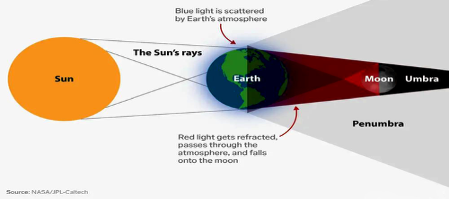
BLOOD MOON

What is a Blood Moon?

  • A Blood Moon refers to the reddish glow of the Moon seen during a total lunar eclipse.
  • It occurs when Earth aligns between the Sun and the Moon, completely blocking direct sunlight.

How Does it Occur?

  • During the eclipse, sunlight passes through Earth’s atmosphere before reaching the Moon.
  • Rayleigh scattering removes shorter blue wavelengths, while longer red wavelengths bend toward the Moon.
  • As a result, the Moon appears red, orange, or copper in colour.
  • The effect is strongest when the Moon is in Earth’s umbra (the darkest part of its shadow).

Factors Affecting Appearance

  • Atmospheric conditions, dust, and pollution levels can alter the Moon’s shade.
  • It may look deep red, bright orange, or dull copper, depending on visibility.

Rayleigh Scattering Explained

  • Proposed by Nobel laureate Lord Rayleigh in the 19th century.
  • Explains how light interacts with particles smaller than its wavelength.
  • Intensity of scattering is inversely proportional to wavelength.
  • This is also why Earth’s sky appears blue, as blue light scatters more than red.

Significance of Blood Moon

  • Offers a natural laboratory to study Earth’s atmosphere.
  • Provides opportunities for astronomical observation and public engagement with science.
  • Holds cultural and mythological importance across civilizations.

Conclusion:

A Blood Moon is not just a celestial spectacle but also an important event for science, helping us understand Earth’s atmosphere and the interaction of light with matter.


Write a Review

Your email address will not be published. Required fields are marked *