Daily Current Affairs 10-December-2025

Share this Post

INDIA–US RICE TRADE DISPUTE

TOPIC: (GS2) INTERNATIONAL RELATIONS: THE HINDU

The US President accused India of “dumping rice” in the American market and hinted at fresh tariffs on Indian rice.

India’s Position in Global Rice Trade

  • India continues to be the largest rice exporter, sending nearly 20 million tonnes abroad in 2024–25.
  • The country commands ~40% of global rice trade, supported by rising yields, improved seeds, and favourable monsoons.
  • With a production of 150 million tonnes (≈28% of global output), India supplies rice to 172 nations and plans expansion into 26 new markets.

Rice Market Structure in the United States

  • The US grows only 7 million tonnes of rice but still exports more than it imports, disproving claims of market flooding.
  • American rice imports (worth $1.5 billion) come mainly from Thailand, with Indian rice forming a small share.
  • The overall data shows no abnormal increase in Indian rice inflow.

Nature of Rice Imported by the US

  • The US purchases premium aromatic varieties such as Thai Jasmine and Indian Basmati, not cheap bulk rice.
  • These imports are high-value products costing between $690–$1,125 per tonne, much above standard export rice prices.
  • Hence, imports cannot be labelled as low-priced dumping, and the claim lacks economic basis.

Limited Role of the US in India’s Rice Export Basket

  • India sends only a small proportion of its rice exports to the US:
    • Basmati: around 4.5% of total exports.
    • Non-basmati: barely 0.4% of total shipments.
  • India’s major destinations remain West Asia (for basmati) and Africa (for non-basmati).
  • This makes the US a minor and non-critical buyer in India’s rice trade.

Expected Impact of Potential US Tariffs

  • Tariffs would have negligible impact on India because its rice exports are highly diversified and not dependent on the US.
  • US consumers, however, may face higher prices for specialty rice varieties.
  • Analysts view the tariff warning as political messaging to American farmers rather than a real trade issue.

Conclusion

India’s rice exports are strong, diversified, and minimally dependent on the US market, making dumping allegations economically weak. Any tariff from Washington would hurt American consumers more than Indian exporters, indicating that the dispute is driven more by politics than trade realities.

ONE NATION, ONE LICENCE

TOPIC: (GS3) ECONOMY: THE HINDU

A DPIIT-led committee has released a working paper proposing a nationwide licensing framework for AI training data in India.

Why India Needs a New Framework

  • The rapid growth of AI models and LLMs has triggered global disputes over the use of copyrighted books, news articles, music, and images for AI training.
  • Countries are still unsure how to regulate the intersection of AI, copyright, innovation, and fair compensation, prompting India to consider a statutory system.

“One Nation, One Licence, One Payment”

  • India proposes a mandatory blanket licence that all AI developers must take before using copyrighted data.
  • Royalties become compulsory for training AI systems, with no opt-out for content freely accessible on the internet.
  • The model draws inspiration from compulsory radio broadcasting licences under India’s copyright law.
  • The committee rejects voluntary or bilateral licensing deals, arguing:
    • High negotiation costs
    • Big tech would dominate
    • Smaller creators and start-ups would be left out

New Institutional Body – CRCAT

  • A new non-profit body called CRCAT (Copyright Royalties Collective for AI Training) will be created.
  • Functions: Collect royalties from AI companies, Distribute payments to copyright owners, Maintain transparent records
  • Membership limited to organisations, representing different classes of works (text, audio, visual).

Royalty Rate-Setting Mechanism

  • A government-appointed committee will fix royalty rates.
  • It will include legal, economic, copyright, technology, and AI experts.
  • Rates must be fair, predictable, transparent, and reviewed every 3 years.
  • Likely model → flat fee + share of global revenue earned from commercial AI systems.

Retroactive Royalties

  • Royalties may apply retrospectively, meaning AI developers who already trained on copyrighted material must pay dues.
  • Seen as corrective rather than punitive—aimed at fairness and accountability.

Data Transparency Requirements

  • AI companies must submit a Sufficiently Detailed Summary of all datasets used, including:
    • Type of content (text, image, music, video)
    • Sources (social media, libraries, news portals, datasets)
    • Purpose and nature of usage
  • CRCAT will distribute royalties based on extent of usage—with high-use sectors like news, music, audiovisual media receiving larger shares.
  • A legal presumption will favour creators in disputes; AI firms must prove non-infringement.

Stakeholder Reactions

  • Supporters say: Ensures equal access to training data, Prevents royalty capture by big companies, Creates regulatory certainty for the AI ecosystem
  • Critics argue: NASSCOM: calls it a “tax on innovation”, demands opt-out for creators Creative industries fear government-fixed rates may undervalue premium content

Key Challenges & Way Forward

  • Risk of over-regulation, slowing AI innovation, Difficulty in fairly distributing royalties
  • Resistance from both AI developers and content creators, Need to align with global AI copyright norms to avoid India becoming an outlier

Conclusion

India’s proposed One Nation, One Licence model is an ambitious attempt to balance AI growth with creator compensation. Its success will depend on reasonable royalty rates, strong transparency, and flexible governance, making it an important test case for future AI regulation in the Global South.

CARE, DIGNITY AND DISABILITY JUSTICE IN MENTAL HEALTH

TOPIC: (GS2) SOCIAL JUSTICE AND HEALTH: THE HINDU

A recent commentary emphasises that India must shift from a narrow medical view of mental illness to a dignity-centred, disability-justice approach.

Background

  • Many individuals with psychosocial disabilities experience abandonment, trauma, and neglect throughout their lives.
  • Traditional mental health systems often treat people as “cases” rather than as individuals shaped by social, cultural, and economic contexts.
  • Despite new therapies and medicines, the global mental healthcare gap remains 70–90%, showing deep systemic problems.

Issues in Current Mental Health Approaches

Dominant “Deficit Lens”

  • People are often judged based on their limitations, not their strengths.
  • Focus is only on “integration” into society’s narrow idea of normalcy.
  • This ignores discrimination, poverty, homelessness, and social injustices that cause distress.

Ignoring Deep Social and Emotional Realities

  • Suffering due to shame, family conflict, rejection, and abuse is rarely addressed.
  • NCRB data shows nearly one-third of suicides are due to family problems, showing the emotional roots of distress.

Oversimplified Explanations

  • Mental distress is biological, social, cultural, political, and historical — not caused by one factor alone.
  • Caste, class, gender, and queer identities deeply shape mental health experiences and access to care.

Reimagining Mental Health as Disability Justice

  • Centre Dignity and Equity: Care must support people to live with meaning, safety, connection, and agency. It should focus on “what this person needs to live well”, not just symptom control.
  • Combine Material and Relational Support: Medication, housing, cash transfers, and healthcare must go hand-in-hand with relational support. People need space to explore vulnerabilities, purpose, and identity.
  • Personalisation with Standard Protocols: Systems must follow universal ethical standards while tailoring care to individual needs and contexts. This helps address long-term issues like alienation, homelessness, and disengagement.

Reforms Needed in Care, Education, and Research

  • Training should prepare practitioners to deal with uncertainty, complex social contexts, and diverse healing approaches.
  • Research should focus on real-world experiences, not only large datasets.
  • People with lived experience must be recognised and compensated as practitioners, as they bring unique insight that formal training cannot replicate.

Conclusion

A justice-based mental health system must address the social roots of suffering while restoring dignity and agency. True care is not only treatment — it is shared responsibility, solidarity, and restoring human connection.

INDIA’S AGENDA ON THE RIGHT TO HEALTH

TOPIC: (GS2) INDIAN POLITY: THE HINDU

A National Convention on Health Rights (Dec 11–12, 2025) in New Delhi is bringing together health experts, civil society groups and community leaders to strengthen the movement for the right to health, review lessons from COVID-19.

Background

  • The convention is organised by the Jan Swasthya Abhiyan (JSA), a 25-year-old national network working across 20+ States for people-centred health care.
  • It emphasises that health must be treated as a fundamental right, supported by strong public systems, fair financing, and regulation of the private sector.

Challenges to Public Health in India

Rapid Privatisation of Health Services

  • Public–private partnerships are expanding, with medical colleges and hospitals increasingly handed to private players.
  • This weakens public health institutions and increases the cost of care for millions.
  • Activist groups from several States are highlighting how privatisation reduces access and fuels inequality.

Weak Regulation of Private Sector

  • Private hospitals have expanded rapidly due to rising foreign and domestic investments.
  • The Clinical Establishments Act (2010) is weakly implemented, resulting in: Overcharging and unnecessary tests/procedures (e.g., high C-section rates).
  • Non-transparent pricing. Frequent violations of patient rights. The convention calls for stronger price regulation, strict patient-rights enforcement, and easy grievance-redress systems.

Insufficient Public Health Investment

  • India spends only 2% of the Union Budget on health; per capita spending is just $25. Out-of-pocket expenditure (OOPE) stays high despite numerous insurance schemes.
  • Participants demand higher government financing, reduced household burden, and equitable health access for all.

Health Workforce Concerns

  • COVID-19 highlighted the critical role of frontline health workers, yet many still face low pay, job insecurity, and poor working conditions.
  • Health worker unions seek fair wages, regular employment, and safer workplaces to strengthen resilient health systems.

Access to Affordable Medicines

  • Medicines form up to 50% of household medical spending. Nearly 80% of essential drugs remain outside price control.
  • Key challenges include irrational drug combinations, unethical marketing, and high retail markups.
  • The convention supports removal of GST on medicines, enhanced public-sector drug production, and tighter regulations.

Strengthening Public Health Systems

  • Over 80 crore people rely on public health services. The convention highlights community-led and successful State-level models that improve service delivery.
  • Priorities include decentralised planning, community involvement, and universal, high-quality health care.

Addressing Discrimination in Health Access

  • Health access is shaped by inequalities based on caste, gender, religion, disability, and sexuality.
  • Sessions emphasise inclusive health systems and links between health, food security, environment, and climate change.

Conclusion

The convention reaffirms that health is a fundamental human right, not a market-driven commodity. A people-centric, well-funded, equitable public health system is vital for ensuring dignity and justice for all Indians.

INDIGO PILOT SHORTAGE CRISIS

TOPIC: (GS2) GOVERNANCE: THE HINDU

IndiGo faced a major operational breakdown in November 2025, cancelling thousands of flights after failing to comply with the new pilot duty and rest rules. The crisis raised questions about the airline’s manpower planning, financial priorities, and preparedness for regulatory changes.

What Triggered the Crisis?

  • New Phase-II pilot duty regulations came into force on 1 November 2025.
  • Weekly rest hours were increased from 36 to 48 hours, and the number of night landings was limited.
  • These rules reduced the total flying hours available per pilot.
  • IndiGo admitted to “planning errors” and inadequate preparation for the revised norms.

Impact on Operations

  • IndiGo reduced daily flights from 2,300 to around 1,800–1,900, cutting nearly 400–500 services daily.
  • Passengers experienced large-scale disruptions due to IndiGo’s dominant market share of 60%+.
  • Competitors like Air India (around 14%) lacked the capacity to absorb excess demand.
  • The industry overall struggled as aircraft shortages and scaling limitations persisted.

Was the Crisis Preventable?

Mismatch Between Growth and Pilot Strength

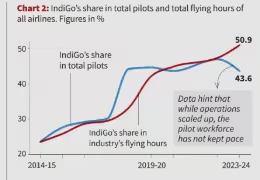
  • From 2019–20 to 2023–24, IndiGo’s flight operations expanded sharply, but its pilot proportion slightly declined.
  • Example: Flight hours increased from 42% to over 50%, but pilot share stagnated around 43%.
  • This indicates operational expansion outpacing pilot recruitment.
INDIGO PILOT SHORTAGE CRISIS

Expert Views

  • Aviation expert Capt. A. Ranganathan observed that the airline ignored the need for hiring before November 2025.
  • He added that IndiGo even increased winter flights despite being understaffed.
  • Delays in promoting co-pilots to captains and cuts in allowances caused some pilots to leave.

Could IndiGo Afford More Pilots?

  • In 2023-24, IndiGo spent ₹31,217 million on around 5,038 pilots (avg. ₹6.2 million per pilot annually).
  • Hiring 900 additional pilots would cost roughly ₹5,500 million per year.
  • This equals only 6–8% of IndiGo’s annual profit (₹72–81 billion).
  • Thus, the cost was small compared to the massive economic and reputational loss caused by the crisis.

Conclusion

The crisis was largely avoidable. IndiGo’s aggressive expansion without proportional staffing, delayed promotions, and cost-focused decisions contributed to the breakdown.

GOOGLE’S QUANTUM ECHOES EXPERIMENT

TOPIC: (GS2) GOVERNANCE: THE HINDU

Google unveiled the results of its Quantum Echoes experiment, using a 65-qubit processor to study how quantum information spreads. This triggered confusion about whether it accelerates Q-Day, prompting experts to clarify that it does not pose any encryption threat.

Google’s Quantum Echoes Experiment

  • Google used a 65-qubit quantum processor to observe how information moves and gets scrambled in a quantum system.
  • Unlike the 2019 Sycamore test that focused on speed (quantum supremacy), this study examined qubit behaviour and quantum interactions.
  • Researchers measured Out-of-Time-Order Correlators (OTOC) → tiny “echo signals” that show how disturbances travel across qubits.
  • Scientists gave the system a small perturbation, reversed its evolution, and detected a faint echo, indicating how fast information spreads.
  • These findings help advance research in superconductors, novel materials, chemical reactions, and quantum thermodynamics.

Why This Does Not Bring Q-Day Closer

  • Q-Day = the moment quantum computers can break modern encryption (e.g., RSA-2048).
  • The experiment studied quantum dynamics, not cryptography or code-breaking.
  • Current quantum machines are too small, too noisy, and lack error-corrected qubits, making code-breaking impossible today.

What Exactly Is Q-Day?

  • Q-Day marks when quantum computers can run Shor’s Algorithm at scale to crack encryption.
  • Main risk → “Harvest Now, Decrypt Later”: hackers may store encrypted data today for future decryption.
  • Experts estimate a timeframe of 5–8+ years, depending on advances in qubit stability.

How Governments Are Preparing

  • Countries are shifting to Post-Quantum Cryptography (PQC).
  • The US NIST has standardised two major PQC algorithms:
    • CRYSTALS-Kyber → secure encryption
    • Dilithium → digital signatures
  • These rely on mathematical problems too hard for quantum computers.

Why Quantum Computers Threaten RSA

  • RSA encryption is based on the difficulty of prime factorisation.
  • Quantum computers can run Shor’s Algorithm, which uses the Quantum Fourier Transform (QFT) to factor numbers exponentially faster.
  • But running this algorithm at real-world scale requires millions of error-corrected logical qubits.

Limitation Today: Too Few and Too Noisy Qubits

  • Current machines (Google’s Willow, IBM’s Condor) have only hundreds of physical qubits, all with significant error rates.
  • Google’s own estimate (2019): 20 million physical qubits, Perfect error correction, 8 hours runtime
  • Logical qubits, essential for stable computation, are extremely hard to build.

Shor’s Algorithm vs. Quantum Echoes – Fundamental Difference

  • Shor’s Algorithmcomputational, aimed at breaking encryption.
  • Quantum Echoesphysical experiment, studying information flow inside entangled qubits.
  • Their goals are completely different.

Conclusion

Google’s Quantum Echoes experiment is a major scientific milestone, but it does not move the world closer to Q-Day or threaten encryption.
The focus for governments must remain on building quantum-safe digital systems, while quantum hardware continues its slow, incremental progress.

UN ENVIRONMENT ASSEMBLY (UNEA)

TOPIC: (GS3) ENVIRONMENT: THE HINDU

The 7th UN Environment Assembly (UNEA-7) has recently begun in Nairobi, Kenya. This session is crucial as countries discuss solutions for strengthening global environmental resilience.

UN Environment Assembly

  • UNEA is the top decision-making forum in the world for environmental matters.
  • It has universal membership with all 193 UN member states, along with participation from major groups, civil society, and stakeholders.
  • The Assembly meets once every two years at the UN Environment Programme (UNEP) headquarters in Nairobi.
  • Origin: Formed in 2012 as a key outcome of the Rio+20 Conference in Brazil to strengthen global environmental governance.
UN ENVIRONMENT ASSEMBLY (UNEA)

Key Functions of UNEA

Sets the Global Environmental Priorities

  • Decides global policies and directions on issues like pollution, climate change, biodiversity loss, and sustainable resource use.
  • Identifies emerging environmental threats and recommends coordinated solutions.

Provides Strategic Guidance to UNEP

  • Offers overall direction for the future work of UNEP.
  • Reviews progress and evaluates global environmental performance.

Enables International Dialogue & Cooperation

  • Acts as a platform for governments to share best practices, successful policies, and scientific insights.
  • Encourages global consensus-building on environmental rules and standards.

Strengthens Partnerships for Implementation

  • Facilitates collaboration among countries, industries, research institutions, and NGOs.
  • Supports resource mobilisation for environmental projects, especially in developing countries.

Organisational Structure

  • Headed by a President, supported by 8 Vice-Presidents, together forming the UNEA Bureau.
  • The Bureau manages agenda-setting, negotiations, and coordination during sessions.

UNEA-7 Theme (2025)

  • “Advancing Sustainable Solutions for a Resilient Planet”
    Focuses on promoting technologies, policies, and partnerships that help nations adapt to environmental shocks and build long-term ecological resilience.

SUDDEN STRATOSPHERIC WARMING (SSW)

TOPIC: (GS1) GEOGRAPHY: THE HINDU

Meteorologists have warned of a possible Sudden Stratospheric Warming (SSW) later this month. This event may trigger below-normal temperatures across several regions of the United States, with potential spillover effects on Europe and Asia.

What is Sudden Stratospheric Warming (SSW)?

  • SSW refers to a fast and significant rise in temperatures in the stratosphere, usually over the Arctic region.
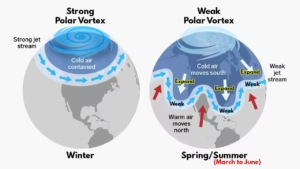
  • This sudden warming disrupts the polar vortex, a large circulation of cold air normally centred over the North Pole.

How Does SSW Occur?

  • Role of Atmospheric Waves: Large-scale atmospheric waves, known as Rossby waves, move upward from the troposphere into the stratosphere.
  • When these waves grow strong, they disturb the polar vortex and can even cause the winds inside it to reverse direction from west-to-east.
  • Rapid Heating: As the vortex weakens, cold air sinks downward, compresses, and warms quickly—this creates the “warming” in the stratosphere.

Displacement or Splitting of Polar Vortex

  • The polar vortex may either move away from the pole or split into two parts.
  • This breakdown allows Arctic cold air to spill into mid-latitude regions like the U.S., Europe, and parts of Asia.

What is the Polar Vortex?

  • A large circulation of cold, low-pressure air present around both poles.
  • Extends from the tropopause up to the mesosphere (~50 km and above).
  • Stronger in winter and weaker in summer.
  • When unstable, it pushes cold air southward along the jet stream, causing severe cold waves in the Northern Hemisphere.
SUDDEN STRATOSPHERIC WARMING (SSW)

Impact of SSW

  • Leads to sharp temperature drops, snowstorms, and prolonged winter conditions.
  • Influences weather patterns far beyond the Arctic, making it a key factor in extreme winter events.


Write a Review

Your email address will not be published. Required fields are marked *