Daily Current Affairs 10-November-2025

Share this Post

SCHOOLS CHANGE ATTENDANCE NORMS

TOPIC: (GS2) POLITY: THE HINDU

Why in News?

The issue gained focus after the Delhi High Court’s judgment in In Re: Suicide Committed by Sushant Rohilla (2025) revisited how universities should enforce attendance and disciplinary rules.
The judgment stressed that disciplinary powers must align with constitutional values, fairness, and student welfare.

Background of the Case

  • In 2016, a law student was barred from writing exams due to attendance shortage, despite medical reasons and academic performance.
  • This resulted in severe emotional distress and eventually suicide.
  • The Court treated the case as a public interest matter, examining whether universities use disciplinary action in a fair and just manner.

Key Observations of the Delhi High Court

  1. Attendance itself was not the issue; the issue was how attendance rules were enforced.
  2. Many institutions debar students automatically once attendance drops below a required percentage.
  3. The Court emphasized:
    • Universities are public authorities.
    • They must act with constitutional accountability.
    • Decisions must be fair, reasoned, proportionate, and just.

This aligns with Article 14 (Non-arbitrariness and Equality before Law) and Principles of Natural Justice.

Constitutional and Legal Principles Involved

1. Article 14 – Rule of Non-Arbitrariness

  • Government bodies (including public universities) cannot act on rigid, mechanical rules.
  • Actions must consider individual circumstances.

2. Procedural Fairness / Natural Justice

Two core principles:

  • Audi Alteram Partem (Right to be heard)
  • Reasoned Decision-making

3. Right to Dignity (Article 21)

  • Education spaces must respect mental and emotional well-being of students.

What Did the Court Clarify About Attendance Rules?

  • The 70% attendance requirement under Legal Education Rules remains valid.
  • However, strict mechanical enforcement without:
    • warning,
    • counselling,
    • support,
    • chance to explain
      is unconstitutional.
  • Universities must offer:
    • Remedial classes
    • Medical/emotional support
    • Grievance Redress Committees
    • Opportunity for representation before any punitive action

Debarring students should be the last step, not the first.

Implications for Universities

1. Institutional Changes

  • Attendance enforcement must be flexible and context-sensitive.
  • Universities should create supportive environments, not punitive ones.

2. Grievance Redressal Mechanisms

  • Must include student representatives.
  • Debarment/punishment must be personalized and reasoned, not automatic.

3. Academic Culture Change

  • Attendance should be linked with engagement, not just physical presence.
  • Recognized academic work (legal internships, research, court activities) should count towards attendance.

4. Alignment with National Policy

  • National Education Policy (NEP) 2020 advocates:
    • Flexible learning paths
    • Student well-being
    • Academic autonomy with accountability

The Court directed the Bar Council of India (BCI) to reconsider strict attendance norms in light of NEP reforms.

Significance

  • Shift to Student-Centric Governance: The judgment moves universities away from rigid, punitive discipline and towards policies that prioritize student well-being and academic support.
  • Promotes Counselling Mechanisms: It encourages institutions to provide counselling, mentorship, and emotional support instead of instantly imposing penalties.
  • Strengthens Procedural Fairness: Any action such as debarment must follow due process, giving students the right to be heard and the right to appeal decisions.
  • Encourages Dialogue-Based Conflict Resolution: Universities are expected to address attendance concerns through discussion, guidance, and flexible academic options rather than intimidation or threat of suspension.
  • Fosters Inclusive and Compassionate Learning Environment: By recognizing challenges like health issues, stress, or personal hardship, the judgment promotes an educational culture built on empathy, dignity, and mutual respect.

Conclusion

The Sushant Rohilla judgment highlights that educational institutions must balance discipline with compassion and constitutional responsibility. Attendance norms should encourage learning—not penalize students unfairly. Strengthening fairness, representation, and support systems is essential for building humane and inclusive academic environments.

This article has been updated and published in detail on our new platform. Please visit the link below for the latest version:

👉 Read the full article on ekamiasacademy.in

UKRAINE SCRAMBLES FOR POWER AFTER RUSSIAN STRIKES

TOPIC: (GS2) INTERNATIONAL RELATIONS: THE HINDU

Why in News?

Russia has launched large-scale strikes targeting Ukraine’s energy infrastructure, severely damaging power plants and transmission lines, leading to widespread electricity and heating shortages.
The situation has raised concerns regarding civilian safety, energy security, and nuclear plant risks during winter.

What Happened?

  • Russia carried out missile and drone attacks on multiple thermal and hydroelectric power plants across Ukraine.
  • Power generation in some regions has fallen to zero, forcing 8–10 hours of daily power cuts.
  • About 200,000+ households have lost access to electricity and heating.
  • Ukraine called this “one of the most difficult energy crises” since the war began in 2022.
  • Electricity supply to areas around Khmelnytskyi and Rivne nuclear plants has been disrupted.
  • Ukraine has appealed to the International Atomic Energy Agency (IAEA) to convene an emergency meeting, accusing Russia of risking nuclear safety.

Immediate Humanitarian Concerns

  • Winter temperatures in Ukraine can fall below –10°C, making heating essential for survival.
  • Electricity shutdowns affect:
    • Water supply & sanitation
    • Hospitals & emergency services
    • Communication networks
  • This situation risks mass displacement, especially among vulnerable groups (elderly, children).

Geopolitical and Strategic Dimensions

Why Russia Targets Infrastructure

Russia aims to:

  • Weaken Ukraine’s ability to sustain the war
  • Lower civilian morale
  • Force diversion of funds from defense to emergency services
  • Create pressure on Western allies supporting Ukraine

This reflects the use of energy infrastructure as a strategic tool in warfare.

Energy Security

Energy security refers to uninterrupted availability of energy at affordable prices, including:

  • Reliable supply
  • Resilience to disruptions
  • Diversified energy sources

Ukraine’s Vulnerabilities

  • Heavy dependence on centralized power stations, easier to target.
  • Limited grid interconnections and backup systems.
  • Ongoing war has disrupted coal and gas transportation routes.

This exposes the importance of distributed renewable energy systems, micro-grids, and storage networks in conflict-prone regions.

International Humanitarian Law (IHL)

Under the Geneva Conventions, attacks that disproportionately harm civilians are prohibited.

  • Targeting civilian energy systems can be classified as:
    • Collective punishment
    • Violation of civilian immunity norms

However, enforcement mechanisms remain weak in active war zones.

Way Forward

  • Scale up mobile heating centers and emergency shelters for winter safety.
  • Strengthen air defense systems to protect remaining infrastructure.
  • Expand cross-border electricity links with Europe.
  • Increase renewable micro-grids to reduce risk from centralized power failures.
  • Continue diplomatic and IAEA engagement to prevent nuclear safety incidents.

Conclusion

Russia’s recent strikes highlight the fragility of civilian infrastructure during war, especially energy systems crucial for survival in winter.MEnsuring energy security, nuclear safety, and humanitarian protection is not only Ukraine’s challenge but a global responsibility.NThe crisis underscores the need for stronger international safeguards to protect critical infrastructure in armed conflicts.

This article has been updated and published in detail on our new platform. Please visit the link below for the latest version:

👉 Read the full article on ekamiasacademy.in

DEVELOPMENT JOURNEY OF UTTARAKHAND

TOPIC: (GS2) POLITY: PIB

Why in News?

PM launches projects worth ₹8,140 crore, says the State can become ‘spiritual capital of the world’, lauds Pushkar Singh Dhami government for bringing Uniform Civil Code, anti-conversion law

Key Highlights

1. Large-scale Infrastructure Push

  • PM launched and inaugurated ₹8,140 crore worth of projects.
  • Projects worth ₹22 lakh crore are currently ongoing in the State (long-term infrastructure pipeline).
  • Focus sectors include:
    • Roads and highways (e.g., Rishikesh-Karnaprayag rail project, Chardham road connectivity).
    • Ropeways to pilgrimage sites.
    • Water supply and irrigation systems.
    • Town redevelopment and disaster-resilient infrastructure.

2. Promotion of Spiritual & Pilgrimage Tourism

  • Rise in pilgrim footfall is driving service economy and rural employment.
  • PM stated Uttarakhand can become the “Spiritual Capital of the World.”
  • Film tourism is increasing, with the Himalayas emerging as a “destination for weddings and documentary shoots.”

3. Cultural Identity & Local Participation

  • Emphasis on Pahari culture, food, music, and local traditions.
  • Recognition of sacrifices of soldiers from the region, reinforcing cultural respect and emotional connect.

Uttarakhand UCC: Key Highlights

1. Applicability and Scope

  • Applicable to all residents of Uttarakhand, except Scheduled Tribes protected under Part XXI of the Constitution.
  • Covers marriage, live-in relationships, divorce, maintenance, inheritance, and succession.

2. Marriage and Live-in Relationship Regulations

  • Mandatory registration of marriages within 60 days.
  • Live-in relationships must be registered within one month of cohabitation.
  • Children born out of void or voidable marriages and live-in relationships receive legal recognition, protecting their inheritance and identity rights.
  • The Code currently excludes the LGBTQIA+ community from marriage and partnership provisions.

3. Ban on Discriminatory Practices

  • Explicitly prohibits bigamy and polygamy.
  • Bans nikah-halala and instant triple talaq, strengthening women’s protection.

4. Equal Inheritance Rights

  • Sons and daughters receive equal property inheritance, ending gender-based discrimination.
  • Moves away from the traditional coparcenary system towards uniform intestate succession.

What is a UCC?

A Uniform Civil Code seeks one common personal law for citizens irrespective of religion in matters like:

  • Marriage & divorce
  • Maintenance
  • Adoption
  • Inheritance & succession

Current Personal Laws in India

Community

Governing Law

Hindus, Sikhs, Jains, Buddhists

Hindu Succession Act, 1956

Muslims

Muslim Personal Law (Shariat)

Christians, Parsis, Jews

Indian Succession Act, 1925

All Inter-faith Marriages

Special Marriage Act, 1954

Landmark Judgments on UCC

  • Shah Bano Case (1985): Highlighted need for a gender-just civil law.
  • Sarla Mudgal (1995): Urged UCC for preventing polygamy via religious conversion.
  • Paulo Coutinho (2019): SC reiterated need for uniformity in civil laws.
  • Law Commission (2018): Suggested reform of personal laws, not immediate UCC.

Arguments Supporting UCC

  • Ensures Gender Equality by removing discriminatory religious practices.
  • Promotes National Unity through common citizenship.
  • Strengthens Secularism by separating religion from civil matters.
  • Simplifies Legal Processes, making justice more accessible.

Arguments Against UCC

  • Threat to cultural diversity and religious autonomy under Article 25.
  • Lack of social consensus may lead to unrest.
  • Concerns of central interference in personal laws and federal structure.

Way Forward

  • Inclusive multi-stakeholder dialogue with religious and tribal groups.
  • Gradual harmonization of personal laws instead of immediate uniformity.
  • Public awareness campaigns to clarify misconceptions.
  • Implement in phased manner, ensuring justice, equality, and non-discrimination remain primary.

This article has been updated and published in detail on our new platform. Please visit the link below for the latest version:

👉 Read the full article on ekamiasacademy.in

SOIL ORGANIC CARBON (SOC) DECLINE IN INDIA: ICAR STUDY

TOPIC: (GS3) ENVIRONMENT: THE HINDU

Why in News?

A recent ICAR (Indian Council of Agricultural Research) study has found that climate change and imbalanced use of fertilizers are leading to a decline in soil organic carbon (SOC) levels across India, especially in arable farmlands. The findings are based on 2.54 lakh soil samples taken from 620 districts across 29 States.

Soil Organic Carbon (SOC) Decline in India: Key Findings of ICAR Study

1. Background of the Study

  • Conducted by scientists from ICAR–Indian Institute of Soil Science, Bhopal.
  • Considered one of the largest soil sample analyses in the world.
  • The study compared SOC levels in both arable (cropped) and non-arable (barren and natural vegetation) lands.

2. Decline in Organic Carbon Levels

  • Organic carbon content was found to be significantly lower in arable lands compared to barren or natural lands.
  • This is largely due to intensive agriculture, repeated tilling, and removal of crop residue.
  • The study indicates that continuous cropping without balanced nutrient replenishment accelerates SOC depletion.

Factors Causing Organic Carbon Loss

1. Imbalanced Fertilizer Application

  • Overuse of Urea (Nitrogen) and underuse of Phosphorus (P) and Potassium (K) leads to:
    • Soil nutrient imbalance
    • Microbial decline
    • Loss of soil structure
  • States like Haryana, Punjab, and Western Uttar Pradesh showed the highest imbalance due to fertilizer-intensive farming.

2. Climate Change Effects

  • Rising temperatures accelerate decomposition of organic matter.
  • Changes in rainfall patterns affect soil moisture and microbial activity.
  • Semi-arid regions like Rajasthan and Telangana show particularly low SOC due to high temperatures and low rainfall.

3. Land Use Change

  • Conversion of natural forests and grasslands into croplands reduces carbon input to soil.
  • Mechanized farming leads to reduced organic residue return to soil.
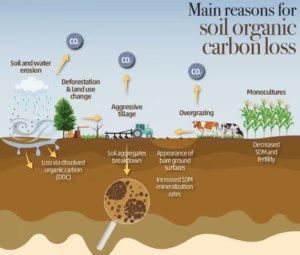
Main Reasons For Soil Organic Carbon Loss

What is Soil Organic Carbon?

SOC represents the carbon stored in soil organic matter (plant residues, microorganisms, humus).

It is a key indicator of soil fertility, structure, and water-holding capacity.

Benefits of High SOC

Benefit

Effect

Better Soil Fertility

Increases nutrient availability

Improved Water Retention

Enhances drought resilience

Supports Microbial Life

Maintains soil health and productivity

Climate Mitigation

Acts as a major carbon sink

Global Context

  • Soils store 2–3 times more carbon than the atmosphere.
  • SOC loss contributes to global warming by releasing CO₂.

Links with Government Schemes

Scheme

Relevance

Soil Health Card Mission

Promotes balanced fertilizer use

PM–PRANAM (2023)

Incentivizes alternative fertilizer use

National Mission for Sustainable Agriculture (NMSA)

Promotes climate-resilient farming

Paramparagat Krishi Vikas Yojana (PKVY)

Encourages organic farming

Way Forward

  1. Balanced Nutrient Management
    • Promote soil test–based fertilizer use.
    • Increase availability of bio-fertilizers and nano-fertilizers.
  1. Increase Organic Matter Input
    • Encourage mulching, composting, and farmyard manure use.
    • Reduce crop residue burning; promote in-situ residue management.
  1. Climate-Resilient Cropping Systems
    • Adopt agroforestry, crop rotation, and intercropping.
  1. Awareness & Incentives
    • Farmer training via Krishi Vigyan Kendras (KVKs).
    • Incentivize regenerative agriculture practices.

Conclusion

The ICAR study highlights that soil organic carbon loss is both an agricultural and environmental challenge. Climate change, along with imbalanced fertilizer use, is degrading soil health and reducing long-term productivity. Restoring SOC through balanced nutrition, organic amendments, and sustainable farming is essential for securing India’s food systems and climate goals.

This article has been updated and published in detail on our new platform. Please visit the link below for the latest version:

👉 Read the full article on ekamiasacademy.in

PIPRAHWA RELICS

TOPIC: (GS1) ART AND CULTURE: INDIAN EXPRESS

Why in News?

A portion of the Piprahwa Relics of Lord Buddha was recently enshrined at Tashichhodzong Monastery in Thimphu, Bhutan, strengthening cultural and spiritual ties between India and Bhutan.

Piprahwa Relics of Lord Buddha

About Piprahwa Relics

  • The relics were discovered in 1898 at the Piprahwa Stupa, located in Siddharthnagar district, Uttar Pradesh, believed to be a site of ancient Kapilavastu, the homeland of Prince Siddhartha (Buddha).
  • Excavation was conducted by William Claxton Peppé, revealing a stone coffer containing:
    • Bone fragments
    • Crystal reliquary
    • Gold, gems, and ornaments
  • A Brahmi inscription linked the relics to the Sakya clan, suggesting they were enshrined by Buddha’s own followers after his Mahaparinirvana in the 5th century BCE.

Custody and Preservation

  • Many relics now reside in the Indian Museum, Kolkata, and the National Museum, New Delhi.
  • Under Indian heritage law, the relics are classified as ‘AA’ antiquities, meaning they cannot be sold or exported.
  • Recent diplomatic and cultural cooperation enabled the repatriation of relics previously held in private foreign possession.

Spiritual and Cultural Significance

  • The relics hold deep importance for Theravada and Mahayana Buddhist communities.
  • They symbolize:
    • The historical presence of Buddha
    • India’s role as the birthplace of Buddhism
    • Shared civilizational bonds in South Asia.

Conclusion

The Piprahwa relics are not just archaeological objects—they are sacred heritage symbols. Their enshrinement abroad helps strengthen cultural diplomacy, enhance Buddhist tourism, and reinforce India’s identity as the cradle of Buddhism.

This article has been updated and published in detail on our new platform. Please visit the link below for the latest version:

👉 Read the full article on ekamiasacademy.in

RHESUS MACAQUE

TOPIC: (GS3) ENVIRONMENT: THE HINDU

Why in News?

The Standing Committee of the National Board for Wildlife (SC-NBWL) has recommended restoring the Rhesus Macaque to Schedule II of the Wildlife (Protection) Act, 1972, due to rising human–macaque conflict and conservation concerns.

Rhesus Macaque

About the Species

  • Scientific Name: Macaca mulatta
  • One of the most widespread Old World monkeys.
  • Easily recognized by brown fur, reddish face, and expressive features.
  • Found in India, Nepal, Bangladesh, Pakistan, and parts of SE Asia.

Habitat & Behavior

  • Occupies diverse ecosystems—forests, scrublands, grasslands, riverbanks, and cities.
  • Thrives in human-dominated landscapes, making it a major species involved in urban wildlife conflict.
  • Lives in large social troops with a clear dominance hierarchy.
  • Omnivorous diet: fruits, seeds, crops, and human food waste.

Conservation Status

Organization

Status

IUCN Red List

Least Concern

Wildlife (Protection) Act, 1972

Schedule II (Recommended)

Challenges

  • Increasing crop raids, temple-site food dependence, and urban adaptation.
  • Feeding by humans disrupts natural foraging behavior.
  • Rising conflict has led to calls for scientific population control.

This article has been updated and published in detail on our new platform. Please visit the link below for the latest version:

👉 Read the full article on ekamiasacademy.in

KORAGA TRIBE

TOPIC: (GS2) SOCIETY: INDIAN EXPRESS

Why in News?

A new genomic research study suggests that the Koraga tribe has ancestral genetic links to ancient populations, potentially tracing back to the Indus Valley Civilization, offering new insights into India’s early human settlement.
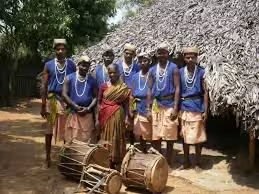
Koraga tribe

About the Tribe

  • Primarily found in Dakshina Kannada and Udupi (Karnataka) and Kasaragod (Kerala).
  • Classified as a Particularly Vulnerable Tribal Group (PVTG).
  • Population (2011): 1,582 individuals.

Language and Culture

  • Speak Koraga Bhasha or Tulu.
  • Follow matrilineal kinship with clan units called “Bali.”
  • The village leader, the Mooppan, plays a central role in community welfare.

Livelihoods

  • Depend on forest products, wage labor, basket-weaving, bamboo craft, and involvement in traditional festivals.
  • Known for unique drumming and musical traditions involving Dholu and Voote.

Social and Economic Challenges

  • Historically marginalized with limited access to education, land, and health services.
  • Vulnerable to malnutrition, poverty, and loss of traditional livelihoods.

Government Support

  • Covered under PVTG upliftment schemes, including:
    • Forest Rights Act
    • PM-JANMAN (2024) for PVTGs
    • Integrated Tribal Development Projects (ITDPs)

This article has been updated and published in detail on our new platform. Please visit the link below for the latest version:

👉 Read the full article on ekamiasacademy.in

ReALCRaft PORTAL

TOPIC: (GS2) POLITY: THE HINDU

Why in News?

The government has notified new rules for Sustainable Harnessing of Fisheries in the Exclusive Economic Zone (EEZ), and fishermen must now obtain an Access Pass through the ReALCRaft portal for operating large fishing vessels.

ReALCRaft portal

About ReALCRaft

  • Full Form: Registration And Licensing of Fishing Craft.
  • Developed by the Department of Fisheries.
  • An online national platform for:
    • Registration of fishing boats
    • Licensing and ownership transfers
    • Crew authorization and vessel documentation

Objectives

  • Create a centralized digital registry of marine fishing vessels.
  • Improve transparency, accountability, and traceability of fishing operations.
  • Strengthen maritime security through vessel monitoring.

Key Features

  • Integration with Security Agencies to track vessel movement.
  • Linked with ISRO communication systems to send alerts to fishermen at sea.
  • Supports e-payments, insurance, subsidies, and certificate issuance.
  • Integrated with MPEDA & Export Inspection Council for fish export certification.

Significance

  • Helps prevent illegal, unreported, and unregulated (IUU) fishing.
  • Enhances safety of fishermen through emergency communication.
  • Supports blue economy growth through sustainable fishing governance.

Conclusion

The ReALCRaft Portal strengthens fisheries management, coastal security, and marine sustainability, contributing to India’s vision of a modern and responsible maritime economy.


This article has been updated and published in detail on our new platform. Please visit the link below for the latest version:

👉 Read the full article on ekamiasacademy.in

Write a Review

Your email address will not be published. Required fields are marked *