
IS INDIA’S GROWTH RATE SUSTAINABLE
TOPIC: (GS3) ECONOMY: THE HINDU
India recorded 8.2% GDP growth in 2024–25, reflecting strong economic momentum, but the IMF assigned a ‘Grade C’, citing structural weaknesses in data and institutional capacity. This raises questions about the long-term sustainability of growth.
Current Growth Scenario
- Overall GDP & Sectoral Growth: GDP expanded 8.2%, with manufacturing 9.1% and services 9.2% (financial services 10.2%). GVA rose from ₹82.88 to ₹89.41 lakh crore, showing real value addition.
- Consumption & Agriculture: PFCE up 7.9%, households spending more; agriculture grew 3.5%, aided by better irrigation and horticulture output.
- Price Stability & Banking: Inflation remained moderate (nominal GDP +8.8%). Banks maintained strong balance sheets and capital buffers.
- Fiscal & External Position: Government continued fiscal consolidation via GST/direct taxes; external sector stable, CAD low, forex reserves adequate.
IMF’s Assessment (‘Grade C’)
- Data Gaps: Outdated base year (2011–12), lack of Producer Price Indices, single deflation issues, and informal sector coverage weak.
- Statistical Limitations: Gaps between production- and expenditure-based GDP, no consolidated state/local data since 2019, and absence of seasonal adjustments.
- Key Message: High growth numbers exist, but the institutional and data framework supporting them is weak.
Structural Vulnerabilities
- Uneven Sectoral Growth: Mining (0.04%) and utilities (4.4%) remain sluggish, showing backbone sectors are weak, while services dominate output but create fewer high-productivity jobs.
- Employment & Productivity Mismatch: Too many workers in low-productivity agriculture and informal services.
- External Risks: Exports vulnerable to global protectionism, tariffs, and geopolitical tensions; services and remittances cannot fully offset weak goods exports.
- State-Level Weaknesses: Poor institutional capacity at state and local levels affects policy delivery and economic governance.
Contradictions in the Growth Story
- High GDP growth masks structural weaknesses: uneven sectoral recovery, low industrial productivity, and job creation challenges.
- Economic momentum is strong, but underlying institutions and governance frameworks are yet to fully support sustained high-quality growth.
WHAT IS GDP GROWTH RATE?
GDP growth rate measures how fast a country’s economy is growing over a period, usually a year or a quarter. It shows the percentage increase in the value of all goods and services produced (GDP) compared to the previous period.
Importance of GDP Growth Rate
- Economic Health: Shows whether the economy is expanding or contracting, helping policymakers make decisions.
- Investment & Jobs: Higher growth attracts investments, creates employment, and improves income levels.
- Policy Planning: Helps governments and central banks plan budgets, taxes, and interest rates for stable economic growth.
Conclusion
India’s 8.2% growth reflects strong short-term momentum, but long-term sustainability depends on strengthening institutions, improving data quality, and addressing structural gaps. Without reform, growth may remain impressive on paper but fragile in reality.
A VERDICT THAT SIGNALS JUDICIAL ABDICATION
TOPIC: (GS2) INDIAN POLITY: THE HINDU
The Supreme Court’s decision in the 16th Presidential Reference refused to set timelines for constitutional authorities like Governors and Speakers despite increasing delays in their duties. This has raised concerns of constitutional paralysis and weakening accountability in federal governance.
Structural Problems in India’s Constitutional Framework
- The Constitution provides no fixed timelines for actions by key posts — President, Governors, Speakers.
- This constitutional silence is exploited to delay decisions on defection cases and Bills.
- Such delays weaken parliamentary democracy and disrupt smooth governance.
Why Speaker’s Defection Decisions Get Delayed
- The Speaker acts as a quasi-judicial authority under the Tenth Schedule when deciding disqualification.
- Absence of a time-bound framework allows decisions to be postponed until the Assembly term ends.
- This undermines the anti-defection law, allowing political manipulation and defeating voter mandate.
Issues with Governor’s Withholding of Bills
- Governors in several States have withheld or delayed Bills passed by elected Assemblies.
- While the Governor may return a Bill once, indefinite inaction functions as a pocket veto.
- Only courts can invalidate laws; delay by the Governor effectively blocks legislation and harms federal balance.
Why the Verdict Is Seen as Problematic
- The Supreme Court argued that it cannot insert timelines since Article 200 has none.
- This literal interpretation overlooks misuse of constitutional gaps.
- Critics say the Court showed excessive judicial restraint, failing to prevent executive overreach.
- Lack of judicially enforced timelines strengthens unaccountable discretionary power.
Constitutional Morality and Ambedkar’s Warning
- Dr. B.R. Ambedkar stressed constitutional morality — protecting the spirit along with the text.
- He warned that the Constitution can be subverted through practices without altering a single word.
- Delays in defection rulings and assent to Bills illustrate such modern constitutional subversion.
Need for Judicial Intervention
- Courts have previously expanded rights using constitutional morality (privacy judgement, LGBTQIA+ rights).
- But in ensuring accountability of Governors and Speakers, the Court avoided the same principle.
- Without reasonable timelines, misuse of constitutional silence will persist.
- Time-bound actions are essential to safeguard legislative supremacy, federalism, and democratic stability.
President – Instances of Delay / Silence
NEET Exemption Bill – Tamil Nadu (2022)
- Tamil Nadu’s Bill seeking exemption from NEET was withheld for months.
- The President gave a decision only after a very long delay, causing tension between the State and Centre.
Gurkha Reservation Bill – Sikkim (2000s)
- A reservation-related Bill passed by Sikkim Assembly was kept pending for an extended period without approval or return.
Indian Forest (Amendment) Bill – Several States (1990s)
- Multiple State Bills requiring Presidential assent remained undecided for years, preventing implementation of State reforms.
Governor – Instances of Delay / Inaction
Telangana Right to Fair Compensation Bill (2020–22)
- Bills passed by the Telangana Assembly were held up by the Governor for more than 2 years without any decision.
Tamil Nadu Prohibition of Online Gaming Bill (2022)
- The Governor sat on the Bill for nearly a year, delaying regulation of online gambling.
Speaker – Instances of not Deciding Defection Cases
Manipur Defection Case (2017–2020)
- The Speaker did not act for 3 years on petitions to disqualify MLAs who defected after elections. The Supreme Court criticized this failure to act.
Maharashtra Defection Cases (2022–23)
- In the Shiv Sena split, the Speaker delayed decision
Conclusion
The verdict signals judicial abdication at a time when delays by constitutional authorities threaten democratic functioning. India needs clear accountability mechanisms, time-bound processes, and adherence to constitutional morality to prevent misuse of constitutional offices and protect the integrity of parliamentary democracy.
AI MUST PAY – INDIA’S APPROACH TO COPYRIGHT & ARTIFICIAL INTELLIGENCE
TOPIC: (GS3) SCIENCE AND TECHNOLOGY: THE HINDU
The DPIIT has released a working paper on AI and Copyright Issues, proposing a framework to ensure that content creators are paid when AI models use their work for training. The issue has gained urgency as global AI companies face lawsuits for training models on copyrighted material without consent or compensation.
Why the Issue Has Become Critical
- Modern Large Language Models (LLMs) grow powerful by training on massive volumes of internet data—text, images, videos, songs, code.
- AI companies argue that online material is “free to use”, but human creators must follow copyright laws.
- This has created a clash of interests between AI developers and content producers like journalists, authors, film houses and digital platforms.
Drivers of the Current Conflict
Rapid Technological Progress
- Faster advances in machine learning architecture and access to huge datasets fuel AI development.
- AI models produce sophisticated reasoning and creative outputs—built on the content created by millions of people.
Unrestricted Data Scraping
- AI developers scrape the internet without paying, even though similar reproduction by a non-AI entity requires licensing.
- This has led to major disputes and global litigation.
Key Recommendation of the Working Paper
Mandatory Licensing Framework
- AI companies may scrape publicly available data, but must pay royalties.
- A non-profit, copyright-society-like body will: Collect payments from AI developers based on their revenue. Distribute royalties to Indian content producers whose material was used.
Why this approach?
- Small creators cannot monitor, block or enforce restrictions on AI scraping.
- Enforcing an “opt-out” model is impractical in India’s large digital ecosystem.
- AI outputs are synthetic, not copied, making legal enforcement complex.
Challenges & Concerns
- Royalty calculation disputes – smaller publishers may receive disproportionately low returns.
- Risk of large media houses receiving more, despite lower per-unit effort.
- Need for transparent criteria for payment slabs, data-use tracking, and verification.
- Excessive regulation could slow India’s growing AI innovation space.
Why India Needs a Framework Now
- Court cases worldwide show no stable legal guidance on AI–copyright disputes.
- Waiting for judicial clarity will benefit AI giants, not creators.
- A basic, working model can later be refined through judicial interpretation, but no system at all leaves creators unprotected.
Conclusion
The DPIIT proposal is a balanced attempt to safeguard the rights of creators while promoting responsible AI innovation. A transparent mandatory licensing mechanism can prevent exploitation of Indian content, ensure fair compensation, and support the long-term development of India’s digital and creative economy.
INDIA’S STEM POTENTIAL
TOPIC: (GS3) SCIENCE AND TECHNOLOGY: THE HINDU
The Union government has asked ministries and scientific departments to review PhD guidelines and align research with national priority areas. This comes amid concerns over delayed fellowships, stagnant stipends, weak industry linkages, and deeper governance problems affecting India’s STEM ecosystem.
Structural Problems in India’s Research System
- Misaligned Research Priorities: Many government-funded PhD projects do not directly support national technological needs, reducing innovation output.
- Poor Public Engagement: Limited visibility of how public-funded research benefits society lowers long-term support for science.
- Uncoordinated Institutional Support: Agencies lack a unified system to select, mentor, and fund scholars in critical fields such as energy, health tech, semiconductors, agri-tech, and battery research.
Why Applied Research Struggles
- Weak Industry Partnerships: Industry–university collaboration is minimal, slowing the scale-up of lab research into practical technologies.
- Missing Innovation Ecosystems: India lacks sustained support systems for deep-tech research, unlike global models behind lasers and optical fibres.
- Commercialisation Gaps: Poor industry-academia linkage slows the transition from prototype to market-ready technologies.
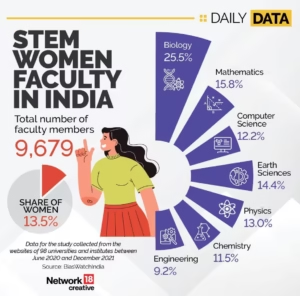
Fellowship and Funding Challenges
- Delayed Fellowships: Non-NET and university scholars face long delays in stipend payments, harming morale and basic sustenance.
- Stagnant Stipends: Many fellowships remain at ₹8,000 per month since 2012, far below living requirements.
- Forced Teaching Work: Scholars take up temporary teaching jobs, reducing research time.
- Failed Direct Transfer Systems: Attempts at bank-based transfers collapsed due to administrative and technical issues.
Why India Struggles to Retain Research Talent
- Limited Faculty Vacancies: Too few funded PhD seats restrict opportunities for capable students.
- Unpredictable Hiring: Contractual, non-transparent recruitment discourages long-term academic careers.
- Weak University Infrastructure: Many institutions lack stable administration, timely fund flow, and research governance.
Non-STEM Responsibilities Burden STEM Scholars
- Excessive Teaching Load: Scholars often teach unrelated subjects (history, psychology), affecting scientific focus.
- Administrative Duties: Heavy paperwork, event management, and clerical tasks reduce research productivity.
- Cultural Bias: Institutional structures often prioritise non-STEM disciplines, limiting resources for STEM fields.
Conclusion
India’s scientific progress depends on fixing structural gaps, ensuring predictable funding, strengthening industry linkages, improving university governance, and aligning research with national priorities. Without deep systemic reforms, India cannot build a globally competitive STEM ecosystem essential for future development.
SUDAN CIVIL WAR: DEEPENING HUMANITARIAN CRISIS
TOPIC: (GS2) INTERNATIONAL RELATIONS: THE HINDU
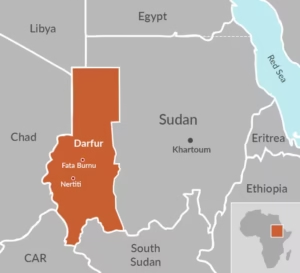
Nearly 10 million Sudanese have been forced to flee due to the ongoing civil war. Fresh clashes in Kordofan and Darfur have intensified civilian killings, famine, and economic collapse.
Root Cause of the Conflict
- Power Struggle: A clash for authority between SAF (Gen. al-Burhan) and RSF (Hemedti) after years of uneasy cooperation.
- Post-Revolution Fallout: Both factions helped remove Omar al-Bashir (2019) and jointly executed the 2021 coup, but diverged over military integration plans.
- Control of Resources: Each group seeks to retain control over wealth networks, armed power, and political influence.
- Failed Security Reform: Disagreement over merging RSF into the national army triggered the full-scale conflict in April 2023.
Territorial Division in Sudan
- SAF-Dominated Areas: Holds central and eastern Sudan, including Port Sudan and parts of Khartoum.
- RSF-Controlled Zones: Dominates Darfur and significant parts of Kordofan.
- Parallel Governance: RSF’s expanding territory enables it to run a de facto administration in western regions.
- Fragmented State: The country is now effectively split into rival military zones, weakening national governance.
Recent Escalation of Violence
- Kordofan Attacks: RSF air-drone strikes in Kalogi destroyed a kindergarten, hospital, and hit rescue groups, killing many children.
- Fall of El Fasher: After an 18-month siege, the last major SAF stronghold in North Darfur collapsed, shifting the war’s momentum.
- Rising Civilian Targeting: ACLED data shows ~400 attacks on civilians, with 55% recorded in 2025 alone.
- High Casualties: Over 1,400 people killed in Darfur-Kordofan region during these intensified clashes.
Deepening Humanitarian Crisis
- Large-Scale Deaths: More than 50,000 civilians have died since the conflict began.
- Mass Displacement: About 9.8 million people displaced (Sept 2025), now the fastest-growing displacement crisis globally.
- Collapsed Public Services: Conflict has destroyed healthcare, schooling, and basic administrative functions.
- Civilian Trapped Zones: Siege tactics have blocked food, medicine, and safe movement in several cities.
Conclusion
The Sudan conflict has evolved into a severe humanitarian catastrophe marked by mass displacement, famine, and economic collapse. Without urgent international mediation and sustained humanitarian access, Sudan risks long-term fragmentation and a deepening regional crisis.
STATE AS A CONTINUUM – SUPREME COURT ON JHARKHAND MINING CASE
TOPIC: (GS2) INDIAN POLITY: THE HINDU
The Supreme Court clarified that the state and its agencies have responsibilities beyond serving the political party or leader in power. This observation came while dismissing Jharkhand’s plea against a CBI investigation into illegal mining linked to Chief Minister Hemant Soren’s associates.
Background of the Case
- The case involves allegations of illegal mining in Jharkhand, where accused are reportedly linked to the Chief Minister’s family and aides.
- The State government challenged the transfer of the case to the CBI, claiming prior consent was required.
- The High Court ordered the CBI probe, and the Supreme Court was approached by the State to contest this transfer.
Supreme Court Observations
- State as a Continuum: The Court emphasized that the state exists beyond loyalty to the ruling party or leader, with obligations to law, citizens, and justice.
- Accountability: Justice Sanjay Kumar questioned whether the State was trying to shield alleged offenders, highlighting the five-month delay in registering the FIR despite a Magistrate’s order.
- Independent Agencies: The CBI probe should proceed unhindered when exceptional circumstances warrant, ensuring rule of law is upheld.
Key Points
- No Protection for Accused: The State cannot defend alleged criminals, even if politically connected.
- Obligation to Law: Officials must prioritize legal and civic duties over political affiliations.
- Citizen Rights: Complainants like Bijay Hansda should be protected from coercion or withdrawal pressures, ensuring justice is accessible.
- Judicial Guidance: Courts can reinforce state accountability and independence of investigative agencies.
Central Bureau of Investigation (CBI) Act and State Investigations
- Established under: Delhi Special Police Establishment Act, 1946 (renamed CBI later).
- Purpose: Investigate serious crimes, corruption, economic offenses, and cases of national importance across India.
- Autonomy: Functions under Department of Personnel & Training, Ministry of Personnel, Government of India, but is expected to operate independently in high-profile cases.
CBI Powers in States
- Consent Required: Normally, the CBI can investigate a case in a state only with the state government’s consent (as per Section 6 of DSPE Act).
- Exceptions: Consent may not be required if ordered by a court of law.
- Supreme Court or High Court can direct the CBI to probe if the state fails to act, especially in cases of corruption or serious crimes involving political figures.
- Coordination with State Police: CBI may coordinate with local police, but has authority to conduct independent investigations in the state once jurisdiction is granted.
Limitations & Safeguards
- Federal Balance: Consent rule ensures state’s autonomy is respected in law and order matters.
- Judicial Oversight: Courts can override state objections to ensure rule of law and justice.
- High-profile Cases: Includes cases of major corruption, economic frauds, multi-state or inter-state crimes, and when state agencies are deemed ineffective or biased.
- Example: In the Jharkhand illegal mining case, the Supreme Court allowed the CBI to investigate despite the state’s objections, citing public interest and failure of state authorities to act promptly.
Conclusion
The verdict underscores that government machinery is accountable to the law and citizens, not to transient political interests. Strengthening institutional independence is vital for upholding justice and democratic principles.
BREEDING PROJECT GIVES ENDANGERED WESTERN TRAGOPAN A LIFELINE
TOPIC: (GS3) ENVIRONMENT: THE HINDU
The captive breeding programme for the western tragopan (Tragopan melanocephalus) in Himachal Pradesh has successfully increased the population in captivity. Experts warn that without habitat protection and climate adaptation, long-term survival in the wild remains uncertain.
About the Western Tragopan
- Species: Tragopan melanocephalus, one of India’s rarest pheasants and the state bird of Himachal Pradesh.
- Habitat: Historically in Jammu & Kashmir, Himachal Pradesh, Uttarakhand, now restricted to fragmented pockets.
- Population: Estimated 3,000–9,500 mature individuals, all from a single subpopulation; climate change and human encroachment threaten survival.

Captive Breeding Programme
- Sarahan Pheasantry: First successful captive hatching in 2005, marking world’s first for the species.
- Population Growth: 2007–2015: 43 captive-born birds; currently, 46 birds maintained, with 6–8 eggs hatching annually.
- Genetic Diversity: Entire captive population originated from 8 wild founders, retaining ~87% of genetic variability.
- Habitat Simulation: Enclosures replicate natural conditions—dense cover, nesting material, seasonal diet—to reduce stress and improve survival.
Conservation Challenges
- Climate Impact: Shifts in insect availability and seasonal patterns affect chick survival in the wild.
- Limited Rewilding: Experimental releases in 2020–21 showed some success, but budget and protocol development delays have paused large-scale reintroductions.
- Human Disturbance: Habitat fragmentation and past community interference reduced survival chances in natural forests.
Role of Community & Policy
- Community-Based Tourism: Local participation provides alternative livelihoods, incentivising forest protection and reducing disturbance.
- Habitat Protection Needed: Ex-situ breeding alone cannot ensure survival; in-situ conservation is crucial.
- Long-Term Commitment: Reintroduction requires patience, monitoring, and adaptive management, similar to the decade-long breeding effort.
Species Protection Initiatives in India
- Project Tiger (1973): Protect Bengal tigers through tiger reserves and NTCA; population now 3,167 (2023).
- Project Elephant (1992): Conserve Asian elephants via elephant reserves, corridors, and reducing human-elephant conflict.
- Olive Ridley Turtle Conservation: Protect mass nesting sites in Odisha & Andhra; nest protection and community awareness.
- Project Snow Leopard (2009): Conserve snow leopards in Himalayas through habitat management, anti-poaching, and eco-tourism.
Conclusion
Captive breeding has stabilised the western tragopan population, but long-term conservation depends on habitat protection, climate adaptation, and community engagement. Sustainable survival requires coordinated ex-situ and in-situ efforts.
SOLAR STORM
TOPIC: (GS1) GEOGRAPHY: THE HINDU
ISRO announced that Aditya-L1, India’s first solar observatory, helped scientists understand the unusual behaviour of the May 2024 solar storm, one of the strongest in over 20 years. The mission provided crucial real-time data that explained why the storm’s impact on Earth did not follow typical patterns.
Solar Storm
- A solar storm refers to a sudden outburst of charged particles, magnetic energy, and radiation released from the Sun into space.
- These disturbances arise when the Sun’s magnetic fields become unstable and eject large amounts of energy outward.

What Triggers a Solar Storm?
- The Sun has constantly shifting and tangled magnetic field lines.
- Its equator spins faster than its poles, causing magnetic fields to twist and overstretch.
- When these twisted fields break and reconnect (magnetic reconnection), massive energy is released.
- This eruption may produce:
– Solar flares (intense flashes of light)
– Radiation storms (high-speed charged particles)
– Coronal Mass Ejections (CMEs) — giant clouds of plasma thrown into space
Impacts of Solar Storms on Earth
- If directed toward Earth, they disturb Earth’s magnetic field and create geomagnetic storms.
Effects may include:
– Radio communication failures
– GPS disturbances
– Power grid malfunctions
– Formation of bright auroras - Humans on Earth remain safe due to the protective atmosphere and magnetic field, which block harmful radiation.
- Solar Flares: These are powerful bursts of radiation across the entire electromagnetic spectrum — from X-rays and gamma rays to visible light. The strongest flares carry energy equal to billions of hydrogen bombs.
- Radiation Storms: Solar eruptions can accelerate electrons and protons to extremely high speeds. The fastest particles can reach Earth in 30 minutes, affecting satellites and astronaut safety.
Coronal Mass Ejections (CMEs)
- CMEs are massive clouds of electrically charged gas (plasma) erupting from the Sun’s corona.
- A single CME can eject billions of tons of material, forming huge bubble-like structures.
Aditya-L1 Mission
- India’s first dedicated solar observatory, launched by ISRO on 2 September 2023.
- Positioned in a halo orbit around Lagrange Point L1, about 1.5 million km from Earth.
- From L1, the spacecraft gets an uninterrupted view of the Sun without eclipses.
- Equipped with seven scientific instruments to study the Sun’s photosphere, chromosphere, corona, and solar particles.