
Why in News?
The Government of India has constituted the 8th Central Pay Commission (CPC) to review the salary, pension, and service conditions of Central Government employees. The Commission will submit its report within 18 months.
- A Pay Commission is a government-appointed body that recommends changes in the pay structure of government employees, based on economic conditions, labour market dynamics, and administrative needs.
- It aims to ensure that government pay remains fair, competitive, and fiscally sustainable.
- The 1st Pay Commission was set up in 1946, and since then, seven Pay Commissions have been constituted, with the latest (7th CPC) implemented in 2016.
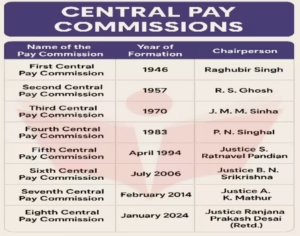
What is a Pay Commission?
- A Pay Commission is set up by an executive order.
- It examines:
- Salary scales of government employees
- Retirement benefits and pensions
- Allowances and service conditions
- Recommendations apply to:
- Central Government civilian employees
- Central Armed Police Forces
- All India Services
- Some roles in PSUs (indirectly through reference)
Terms of Reference (ToR) of the 8th CPC
The ToR guides what the Commission must evaluate:
- Economic and fiscal conditions of the country.
- Need to ensure adequate pay while maintaining fiscal discipline.
- Review retirement benefits, especially non-contributory pension expenses.
- Compare public sector pay structures with private sector benchmarks.
- Recommend measures for:
- Skill enhancement
- Recruitment and retention of talent
- Incentive-based pay structure
- Address changing nature of work, including:
- Digital skills
- Flexible working
- Training and performance-based careers
Evolution of Government Pay Structure
Pay Commission | Key Features |
1st to 4th CPC | Standardized pay rules, removed colonial disparities |
5th CPC | Introduced major salary increases and pension reforms |
6th CPC | Introduced Pay Band system + Grade Pay |
7th CPC | Introduced Pay Matrix; Ratio between highest and lowest pay set at 1:12.5 |
Current Challenges in Public Sector Compensation
- Compression Ratio Issue
- Lower-level employees in government earn higher relative salaries compared to market rates.
- Higher-level specialists earn less than private counterparts, affecting talent acquisition at senior positions.
- Non-contributory Pension Burden
- Pension expenditure for FY 2025–26 estimated at ₹2.76 lakh crore, stressing fiscal space.
- Need for Performance-linked Incentives
- Current promotions are seniority-based, limiting innovation and accountability.
- Adapting to Modern Work Culture
- Work-life balance, remote work options, and continuous training are becoming essential expectations.
Comparison of Public Sector Wage Bills
Country | Public Wage Bill (% of Govt. Expenditure) |
India | 17.7% |
U.S. | 20.5% |
France | 21.4% |
Germany | 16.4% |
Brazil | 24.9% |
India’s overall wage bill is reasonable, but efficiency and service delivery do not always match expenditure levels.
International Practices
- Many OECD nations follow Performance-Based Pay.
- Some countries review pay every 4–5 years rather than using large commissions.
Conclusion
Pay Commissions play a vital role in balancing public expenditure with fair compensation to government personnel. As governance challenges evolve, the 8th CPC must modernize pay, talent management, and work culture. Ensuring equity, fiscal responsibility, and administrative efficiency will be key to its success.
Why in News?
Ahead of COP30 (2025) in Brazil, South Asian climate experts, civil society groups, and governments have outlined common regional priorities to strengthen collective climate action.
COP30 is significant because it will review 10 years of the Paris Agreement, evaluate Nationally Determined Contributions (NDCs), and outline new climate finance mechanisms.

South Asia’s Key Climate Concerns
- Intensifying Climate Disasters
- Extreme rainfall → floods in India, Nepal, Bangladesh.
- Melting glaciers → risks of Glacial Lake Outburst Floods (GLOFs) in the Himalayas.
- Heatwaves worsening across plains and coasts.
- Rising sea levels threatening Maldives, Sri Lanka, Sundarbans.
- Economic and Social Vulnerability
- High dependence on agriculture and fishing.
- Climate impacts disproportionately affect women, poor households, and rural communities.
- Gap Between Climate Policies and Implementation
- Many South Asian countries have ambitious climate pledges, but lack technical capacity and finance to translate them into action.
What South Asia Wants from COP30
1. Stronger Adaptation Funding
- Increase grants rather than loans to reduce debt burdens.
- Prioritize climate-resilient agriculture, water conservation, mangrove restoration, and early-warning systems.
2. Reliable and Predictable Climate Finance
- Operationalize the new Loss and Damage Fund.
- Ensure direct access to funds for local governments and community institutions.
3. Regional Climate Cooperation
- Strengthen cross-border data sharing for:
- Flood forecasting
- Cyclone tracking
- Glacier monitoring
- Expand initiatives like:
- India’s Coalition for Disaster Resilient Infrastructure (CDRI)
- Nepal’s Sagarmatha Sambad dialogues.
4. Technology Sharing and Capacity Building
- Promote clean energy transition, especially solar and wind power.
- Public research institutions must collaborate across borders.
5. Just Transition and Climate Equity
- Shift away from fossil fuels while protecting livelihoods of workers in energy-dependent sectors.
- Private sector participation must complement—not replace—government responsibility.
Conclusion
South Asia needs collective climate leadership driven by cooperation, financial support, and technology sharing. COP30 presents an opportunity to secure climate finance, scale up adaptation, and strengthen resilience. A united South Asian voice will be crucial in ensuring fair climate outcomes and sustainable development for the region.
Why in News?
The Union Ministry of Health & Family Welfare has amended the Transplantation of Human Organs and Tissues Rules, 2025.
Key Changes in the Amendment
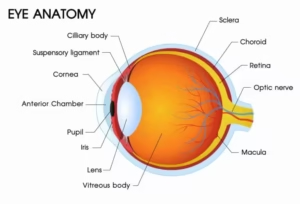
- Specular microscope requirement removed:
Earlier, centres performing corneal transplants needed a specular microscope, used to assess corneal endothelial cells.- Many smaller hospitals lacked this equipment, limiting services.
- Now, centres can perform procedures without this costly technology, improving access.
- Strengthening National Organ Transplant Programme (NOTP):
- More support will be given to government hospitals to expand corneal transplant units.
- Focus on increasing trained manpower, storage facilities, and donor coordination.
- Aim: Increase eye donation, expand services to semi-urban and rural regions, and reduce waiting time for corneal transplant patients.
Why in News?
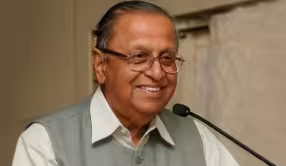
V. Rajaraman, a renowned computer scientist and one of the key architects of computer education in India, passed away in June 2024.
He was awarded the Padma Bhushan (1998) for his contributions to the growth of computer science and software education in India.
Early Life and Academic Journey
- Born in 1933, Rajaraman studied electrical communication engineering.
- He worked at IISc Bengaluru in the mid-1950s with U.S. computer scientist Vincent Rideout to design an analog computer.
- Completed Ph.D. from the University of Wisconsin, U.S.
- Returned to India to contribute to developing indigenous computer science education.
Key Contributions
1. Establishing Computer Science Education
- At a time when computers were rare and expensive, Rajaraman helped design India’s first academic courses in computer programming.
- He introduced structured curriculum at:
- IIT Kanpur (one of the earliest computing centers in India)
- Later at IISc Bengaluru
- He promoted M.Tech and B.Tech programmes in Computer Science in the 1970s–80s.
2. Development of Teaching Material
- In 1968, due to the lack of educational resources, he wrote one of India’s earliest textbooks on FORTRAN programming, which later became widely used.
- He emphasized low-cost, accessible educational tools for Indian students.
3. Strengthening National Computer Capacity
- Played a leading role in building computational capacity in educational institutions.
- Advocated establishing independent computer departments in universities.
- Under his guidance, the Computer Science and Engineering discipline became formalized across India.
4. Contribution to IIT Kanpur Computer Culture
- He was instrumental in shaping India’s first modern computer center at IIT-Kanpur (1960s–70s).
- Helped develop India’s first generation of programmers through hands-on laboratory teaching.
5. Policy and Institutional Leadership
- Key member of the Supercomputer Education and Research Centre (SERC) at IISc (established 1982).
- Guided national policies related to IT education and research.
Conclusion
V. Rajaraman’s work laid the academic and intellectual foundation for India’s IT revolution. His contributions ensured that computer education became accessible and structured, producing a skilled workforce. He remains a key figure in India’s transformation into a global software and technology leader.
Why in News?
The Gujarat Anti-Terrorist Squad recently arrested suspects allegedly preparing ricin, with links to Islamic State Khorasan Province (ISKP).
The incident highlights the dual threat of toxic chemicals to both national security and public health.
About Ricin
- Ricin is a highly toxic protein obtained from castor bean waste generated during castor-oil production.
- It is dangerous because it is relatively simple to extract, highly potent in tiny doses, and has no specific antidote, making it a matter of concern for counter-terrorism, forensic medicine, and public health preparedness.
Key Facts
- Source: Castor seeds (Ricinus communis); ricin is present in the seed pulp after oil extraction.
- Forms: Powder, mist, pellet, or dissolved in liquid.
- Stability: Stable under normal conditions; destroyed by temperatures above 80°C.
- Toxicity: Lethal dose estimated at ~5–10 micrograms per kg (varies with route).
- Routes of exposure: Inhalation, ingestion, injection.

How Ricin Works
- Ricin enters cells and inactivates ribosomes, blocking protein synthesis.
- Resulting cell death leads to organ failure (lungs, liver, kidneys) and can cause death within hours to days depending on dose and exposure route.
Clinical Presentation
- Inhalation: Cough, chest pain, pulmonary edema, respiratory failure.
- Ingestion: Severe gastroenteritis, vomiting, bloody diarrhea, dehydration, multi-organ failure.
- Injection: Local tissue damage, systemic toxicity, shock.
- Symptoms often appear within hours and progress rapidly.
Treatment & Response
- No antidote exists; management is supportive — airway support, fluids, managing shock, dialysis if needed.
- Early decontamination and rapid referral to tertiary care improve outcomes.
- Public-health response includes isolation of contaminated area, exposure tracing, and medical surveillance.
Security, Legal and Policy Dimensions
- Ricin is regulated due to its misuse potential and falls within control regimes under the Chemical Weapons Convention (CWC) and national statutes.
- Key policy needs: monitoring castor-processing units, licensing, and strict inventory controls for castor waste.
- Intelligence-law enforcement coordination is vital to detect manufacture and distribution networks.
Detection & Forensics
- Detection uses toxicology assays, immunoassays, and mass spectrometry; environmental sampling and clinical testing are critical.
- Forensic traceability helps link material to production sources and criminal chains.
Why in News?
The Standing Committee of the National Board for Wildlife (NBWL) recently cleared 13 defence and paramilitary projects, mostly in high-altitude protected areas of Ladakh and one in Arunachal Pradesh.
About National Board for Wildlife (NBWL)
- The National Board for Wildlife (NBWL) is the highest advisory body in India responsible for guiding the government on wildlife conservation and protection strategies.
- It operates under the Wildlife (Protection) Act, 1972, and plays a crucial role in evaluating and approving development projects in and around Protected Areas (PAs).

Composition and Structure
- The NBWL is a 47-member statutory body.
- Chairperson: Prime Minister of India
- Vice-Chairperson: Union Minister of Environment, Forest and Climate Change
- Members include:
- Senior government officials
- Heads of conservation agencies
- 10 eminent conservationists and ecologists, nominated by the Central Government
- Director General of Forests (Wildlife) acts as Member-Secretary
This composition ensures representation of science, governance, and public policy.
Functions of NBWL
- Advisory Role: Guides the Central and State Governments on wildlife conservation policies.
- Protected Area Governance:
Recommends:- Establishment and management of National Parks
- Wildlife Sanctuaries
- Conservation Reserves and Community Reserves
- Monitoring Illegal Trade & Poaching:
Works to curb:
- Poaching
- Illegal wildlife trafficking
- Habitat destruction
- Project Approvals: Evaluates the impact of infrastructure and development projects on wildlife and provides clearances or modifications.
- Publication of Wildlife Status Reports: NBWL must release a report every two years assessing conservation progress nationwide.
Standing Committee of NBWL
- Smaller body with maximum 10 members.
- Chaired by the Environment Minister.
- Acts as the primary project clearance authority for:
- Land diversion inside protected areas
- Projects in Eco-Sensitive Zones (ESZs)
Why in News?
The President of India recently undertook a state visit to Angola, marking the first-ever visit by an Indian President.
The visit aims to expand cooperation in energy, trade, healthcare, agriculture, and defence.
Geographical Profile
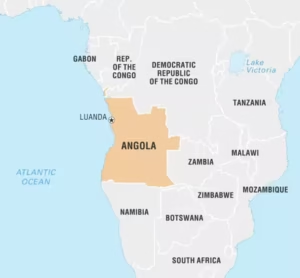
- Location: Southwestern coast of Africa.
- Borders: Republic of Congo (NW), DR Congo (N & NE), Zambia (SE), Namibia (S).
- Coastline: Along the Atlantic Ocean.
- Capital: Luanda
Physical Features
- Major Rivers: Cuanza and Cuango (used for hydropower, irrigation, and transport).
- Calandula Waterfalls: One of the largest in Africa.
- Highest Peak: Mount Moco
- Climate: Tropical, influenced by the cold Benguela Current which moderates coastal temperatures.
Economic Significance
- Natural Resources: Petroleum, diamonds, iron ore, uranium, copper.
- Oil Accounts for: ~90% of export revenue.
- India imports crude oil from Angola.
- Angola is also exploring partnerships with India in:
- Renewable energy via the International Solar Alliance (ISA)
- Medical training and pharmaceuticals
- IT and skill development programs
India–Angola Bilateral Relations
- Diplomatic ties established in 1985.
- Cooperation areas:
- Energy security
- Maritime cooperation in the Indian Ocean
- Defence training and capacity building
- Food processing, agriculture modernisation
- Educational and cultural exchanges
Angola is also a key partner in India-Africa Forum Summit (IAFS) engagement.
Why in News?
The Archaeological Survey of India (ASI) has restricted entry into the Nata Mandap (dancing hall) at the Konark Sun Temple due to concerns about structural stress and preservation.
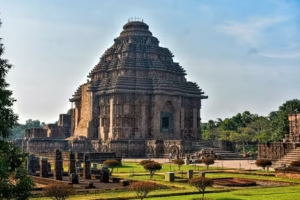
About Konark Sun Temple
- The Konark Sun Temple, located in Puri district of Odisha, is one of the finest examples of Kalinga architecture and is dedicated to Surya, the Sun God.
- Recognized as a UNESCO World Heritage Site in 1984, the temple reflects India’s engineering, artistic, and scientific heritage.
Historical Background
- Built around 1250 CE by King Narasimhadeva I of the Eastern Ganga Dynasty.
- Called the “Black Pagoda” by European sailors because of its dark stone and former magnetic properties.
- Served both religious and navigation purposes.
Architectural Features
- Designed as a massive chariot of the Sun God.
- 24 elaborately carved wheels, functioning as accurate sundials.
- Six stone horses pulling the chariot.
- Orientation ensures the first rays of sunrise illuminate the sanctum.
Stone and Construction
- Materials used:
- Khondalite (main structure)
- Laterite (boundary walls)
- Chlorite (door frames)
- Iron clamps and dowels were used, contributing to long-term weathering and structural stress.
Cultural and Artistic Significance
- Carvings depict:
- Hindu mythology
- Daily life scenes
- Musicians, dancers, animals, floral patterns
- Represents synthesis of art, science, astronomy, and devotion.
Modern Conservation Challenges
- Erosion from saline coastal winds
- Weathering of khondalite stone
- Water seepage and vegetation growth
- Human footfall pressure
The ASI’s restricted entry aims to reduce stress and prolong preservation.