

Daily Current affairs 12 March 2026

Daily Current Affairs 12-March-2026

Share this Post

INDIA’S LPG SUPPLY CRUNCH

TOPIC: (GS3) ECONOMY: THE HINDU

India is facing an LPG supply shortage due to rising import dependence and inadequate storage reserves.

Rising LPG Imports

  • Over 85% of imports pass through the Strait of Hormuz, making supply vulnerable to disruptions.
  • Imports have tripled to nearly 20 million tonnes (2011–12 to 2024–25).
  • Import dependency rose from 47% in 2015 to about 60% today.
  • India consumes 3 million tonnes per month, ranking as the second-largest LPG consumer globally.
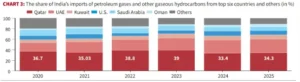
Inida's LPG Supply Crunch

Storage Weakness

  • Current storage covers less than half of monthly demand.
  • Two underground caverns (Mangaluru & Visakhapatnam) hold only 1.4 lakh tonnes, equal to less than two days of national use.
  • Unlike crude oil, LPG lacks strategic reserves; system designed for continuous flow, not stockpiling.

Domestic Consumption Growth

  • Daily consumption: 80,000 tonnes, with 85% used by households.
  • 33 crore LPG connections, including 10 crore added under PM Ujjwala Yojana (PMUY) since 2017.
  • PMUY improved access for poor households but also boosted import dependence.

Import Diversification

  • Agreement with the U.S. for 2.2 million tonnes annually.
  • But U.S. shipments take 45 days, compared to faster Gulf supplies.

Storage Solutions

  • Underground Caverns: Proven at Visakhapatnam & Mangaluru; located in stable Peninsular Shield rock formations.
  • Salt Caverns (Rajasthan): Cheaper, faster to build, naturally impermeable. EIL and Germany’s DEEP developing technology.
  • Depleted Gas Reservoirs: Potential in Krishna–Godavari, Cambay, and Mumbai offshore basins.

Global Practices

  • Europe stores 25% of annual gas consumption underground.
  • After the Ukraine war (2022), EU mandated 90% storage filling before winter to ensure supply security.

Conclusion

Expanding underground caverns, salt formations, and depleted reservoirs can strengthen energy security. Strategic storage, like crude oil reserves, is essential to safeguard against global supply shocks.

PASSIVE EUTHANASIA IN INDIA

TOPIC: (GS2) POLITY: THE HINDU

The Supreme Court allowed withdrawal of lifesustaining treatment for Harish Rana, a man in a vegetative state since 2013.

Case Background

  • Harish Rana suffered severe head injuries in 2013 and remained in a vegetative state.
  • His father’s plea to withdraw treatment was rejected by the Delhi High Court in 2024.
  • The family approached the Supreme Court, which set up medical boards in 2025.
  • Both boards confirmed his condition was irreversible with negligible recovery chances.
  • The Court directed AIIMS to provide palliative endoflife care ensuring dignity.

Court’s Ethical Stand

  • Passive euthanasia is not about “ending life” but about avoiding artificial prolongation when recovery is impossible.
  • The Court stressed that dignity must guide endoflife decisions, balancing compassion and medical reality.

Legal Position in India

  • Active vs Passive Euthanasia: Active euthanasia (assisted dying, e.g., lethal injection) → illegal, amounts to homicide or abetment of suicide. Passive euthanasia (withdrawing treatment) → permitted in limited circumstances.
  • Constitutional Basis: Article 21: Right to life includes right to live with dignity. Dignity extends to endoflife choices for terminally ill or vegetative patients.

Key Supreme Court Rulings

  • Gian Kaur v. State of Punjab (1996): No general “right to die” under Article 21.
  • Aruna Shanbaug Case (2011): Laid initial guidelines for passive euthanasia. Required High Court approval and medical board consultation. Distinguished between active (illegal) and passive (conditional) euthanasia.
  • Common Cause Case (2018): Recognised right to die with dignity as part of Article 21. Allowed Advance Medical Directives (living wills). Permitted withdrawal of futile treatment.
  • Simplification in 2023: Advance directives can be attested before a notary/gazetted officer. Hospitals must form two medical boards.

Current Status

  • As of March 2026, no dedicated legislation exists on euthanasia.
  • India relies on Supreme Court guidelines for implementation.
  • The Harish Rana case is the first real application of passive euthanasia in India.

Conclusion

By recognising passive euthanasia as part of the right to live with dignity, the Court has balanced compassion, and constitutional principles. However, the absence of a comprehensive law means India still depends on evolving judicial guidelines.

INDIA’S NEW GDP SERIES

TOPIC: (GS3) ECONOMY: THE HINDU

India has released a revised GDP series with 202223 as the base year. The new data shows a slight reduction in GDP size and changes in sectoral composition.

What is GDP

  • Gross Domestic Product (GDP): Value of all final goods and services produced in a country in a year.
  • Compiled by the National Statistical Office (NSO) using UNprescribed standards.
  • Base year revisions are done periodically to reflect new activities, updated data sources, and structural changes in the economy.

Why Base Year Revision Matters

  • Captures new sectors and activities.
  • Updates data sources and statistical methods.
  • Reflects structural changes in agriculture, industry, and services.
  • Improves accuracy and reliability of national accounts.

Background

  • Previous base year: 201112, revised in 2015.
  • That series faced criticism for inflated growth rates, especially in manufacturing and corporate sector contributions.
  • IMF gave India a ‘C’ grade for data quality, raising concerns about reliability.
  • Hence, the new revision was awaited to correct distortions.

Key Findings of the New Series

  • GDP Size: Economy appears 3–4% smaller than earlier estimates. Suggests correction of overestimation in 201112 series.
  • Growth Rates: Annual growth trends remain broadly similar, differing by about 1 percentage point.
  • Sectoral Composition
    • Agriculture & Industry: Share has increased.
    • Services: Share has declined slightly, though still dominant.
    • Manufacturing: Share rose from 14.3% to 14.7%, but absolute output fell by ~1.5%.
  • Institutional Sector Contributions
    • Private Corporate Sector (PCS) share reduced from 35.4% to 33.9%.
    • Household/Informal sector share increased, partly due to better measurement of agriculture.

Economic Implications

  • Targets Impacted: Smaller GDP size may delay goals like becoming a $5 trillion economy.
  • Statistical Accuracy: Revision improves credibility by correcting earlier overestimates.
  • Need for Transparency: Economists demand clearer explanations of methods and data sources to avoid future debates.

Conclusion

The new GDP series with 202223 as base year provides a more balanced picture of India’s economy. The changes highlight the importance of transparent statistical practices in shaping India’s economic policy and targets.

FISCAL HEALTH INDEX 2026

TOPIC: (GS3) ECONOMY: THE HINDU

NITI Aayog released the second annual edition of the Fiscal Health Index (FHI) 2026 in New Delhi.

About the Index

  • Introduced by NITI Aayog to provide a systematic and datadriven framework for assessing state finances.
  • Covers 18 major states and 10 NorthEastern & Himalayan states.
  • Designed to guide fiscal reforms and promote evidencebased policymaking.

Five Pillars of Fiscal Health

  • Quality of Expenditure – efficiency and productivity of spending.
  • Revenue Mobilisation – ability to generate own tax and nontax revenues.
  • Fiscal Prudence – discipline in managing deficits and liabilities.
  • Debt Index – overall debt levels of states.
  • Debt Sustainability – longterm ability to manage debt without stress.

Classification of States

  • Achievers: Strong fiscal discipline, high revenue, low deficits, manageable debt.
  • Front Runners: Broadly sound finances but weaker in some indicators.
  • Performers: Mixed results across pillars, moderate fiscal health.
  • Aspirational: Significant fiscal stress, high debt, persistent deficits, weak revenue base.

Highlights of FHI 2026

  • Achievers: Odisha, Goa, Jharkhand.
  • Front Runners to Performers: Karnataka, Telangana slipped in ranking.
  • Aspirational States: Kerala and Tamil Nadu moved down to this category.
  • NorthEastern & Himalayan States: Top performer – Arunachal Pradesh. Followed by Uttarakhand, Tripura, Meghalaya, Assam, and Mizoram.

Significance

  • Provides a comparable measure of fiscal health across states.
  • Helps policymakers identify strengths and weaknesses in state finances.
  • Encourages states to adopt better fiscal practices and reduce longterm risks.

Conclusion:

The Fiscal Health Index 2026 highlights both strengths and weaknesses in state finances, showing which states maintain discipline and which face stress.

ASTEROID 2024 YR4

TOPIC: (GS3) SCIENCE AND TECHNOLOGY: THE HINDU

NASA has confirmed that asteroid 2024 YR4 will not collide with the Moon in 2032, ruling out earlier concerns.

About Asteroid 2024 YR4

  • Type: Apolloclass asteroid – its orbit crosses Earth’s path but mostly lies beyond it.
  • Origin: Likely from a stony asteroid family in the central Main Belt between Mars and Jupiter.
  • Discovery: Found in December 2024 by the ATLAS telescope in Chile.
    • “Y” in the name → discovered in the second half of December.
    • “R4” → 117th asteroid identified in that period.

Features

  • NearEarth asteroid.
  • Size: 174–220 feet (53–67 meters) in diameter.
  • Orbital Period: 4.011 years (1,468 days).
  • Rotation Period: 19.46 minutes.
  • Composition: Most likely Stype (silicate rocks with nickeliron).

Significance

  • Demonstrates the importance of tracking nearEarth objects (NEOs) for planetary defense.
  • Confirms that advanced monitoring systems like ATLAS can detect and assess risks early.
  • Adds to scientific understanding of asteroid families and their movement patterns.

Conclusion

Asteroid 2024 YR4 is a nearEarth Apollotype asteroid with no threat of collision in 2032. Its discovery and study highlight the role of space monitoring systems in ensuring planetary safety and expanding knowledge of celestial bodies.

JHELUM RIVER

TOPIC: (GS3) ENVIRONMENT: THE HINDU

The Kashmir Valley is experiencing an unusually early spring, with the Jhelum River dropping below zerogauge level while temperatures hit record highs.

About the Jhelum River

  • Location: Flows through northwestern India (Kashmir Valley) and eastern Pakistan.
  • Tributary: Part of the Indus River system.
  • Names: Known as Vitasta in Sanskrit, Hydaspes in Greek, and Bidasp in Persian.
  • Importance: Considered the lifeline of Kashmir, supporting agriculture, drinking water, and hydropower.
  • Punjab Connection: Largest and westernmost of the five rivers of Punjab, flowing through Jhelum district in Pakistan.
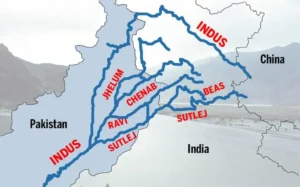
Jhelum River

Course

  • Origin: Emerges from Verinag Spring in Anantnag, at the foot of the Pir Panjal range.
  • Path: Flows northwest through the Vale of Kashmir, enters Wular Lake near Srinagar (which regulates its flow).
  • Pakistan Route: Forms a deep gorge before entering Pakistan, finally joining the Chenab River near Trimmu.
  • Length: About 725 km.

Hydrology

  • Flow depends on:
    • Snowmelt from the Himalayas and Karakoram (spring season).
    • Southwest monsoon rains (June–September).

Major Tributaries

  • Kishenganga (Neelum) River – largest tributary, joins near Muzaffarabad.
  • Kunhar River – second largest, connects Kanghan valley with Kohala Bridge.
  • Other tributaries: Sandran, Bringi, Arapath, Watlara, Lidder, Veshaw Rivers.

Conclusion

The Jhelum River is central to the ecology and economy of Kashmir, but its falling water levels highlight the growing risks of climate change and seasonal variability. Sustainable water management is crucial to safeguard this lifeline of the valley.

BLACK RAIN IN TEHRAN

TOPIC: (GS3) ENVIRONMENT: THE HINDU

Why in News?

Recently, “black rain” was reported in Tehran (Iran) after Israeli airstrikes on major oil storage facilities caused large fires and thick toxic smoke.
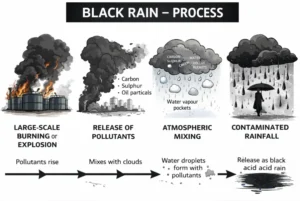
Black Rain in Tehran

What is Black Rain?

  • Black rain is precipitation containing dark particulate matter such as soot, ash, and oil droplets.
  • It occurs when raindrops absorb pollutants while falling through heavily polluted air, a process known as atmospheric scavenging.
  • These pollutants may include:
    • Hydrocarbons from burning oil
    • Sulphur dioxide and nitrogen oxides
    • Fine particulate matter and heavy metals
  • The rain often appears dark, sticky, or oily, leaving residue on buildings, vehicles, and soil.

How the Black Rain Occurred in Tehran

  • On 8 March 2026, Israeli airstrikes targeted oil depots and fuel facilities near Tehran.
  • The attacks triggered massive fires that burned for several days, releasing large quantities of smoke and toxic chemicals into the atmosphere.
  • Pollutants such as hydrocarbons, sulphur oxides, nitrogen compounds, and soot accumulated in the air over the city.
  • When a weather system brought rainfall, these pollutants mixed with raindrops and fell back to the ground as black or acidic rain.
  • The incident created a large toxic cloud over Tehran, affecting millions of residents.

Environmental and Health Impacts

1. Health Risks

  • Respiratory problems such as breathing difficulty, asthma aggravation, and lung irritation.
  • Skin and eye irritation due to contact with chemical pollutants.
  • Headaches and dizziness from inhaling polluted air.
  • Long-term exposure may increase the risk of cancer and chronic respiratory diseases.

2. Environmental Damage

  • Contamination of soil and water sources due to toxic particles.
  • Harm to agriculture and food safety if pollutants settle on crops.
  • Damage to urban infrastructure and ecosystems.

3. Wider Ecological Impact

  • Pollution may spread to surrounding regions depending on wind patterns.
  • Massive oil fires can release black carbon, a pollutant linked to climate warming.

Historical Examples of Black Rain

Black rain has occurred during several major environmental or wartime events:

  • Hiroshima (1945): After the atomic bombing, radioactive particles mixed with rain and fell as black rain.
  • Gulf War (1991): Burning oil wells in Kuwait produced soot-filled rainfall in nearby regions.
  • Industrial or wildfire disasters: Large fires sometimes create similar polluted rainfall events.

Preventive and Safety Measures

  • Staying indoors during periods of toxic rain.
  • Avoiding direct contact with contaminated rainwater.
  • Using protective masks such as N95 respirators.
  • Closing windows and limiting outdoor exposure.
  • Monitoring air quality advisories issued by authorities.

EUROPEAN FREE TRADE ASSOCIATION (EFTA)

TOPIC: (GS3) ECONOMY: THE HINDU

The Trade and Economic Partnership Agreement (TEPA) between India and EFTA states has completed two years since signing.

About EFTA

  • Established: 1960 under the Stockholm Convention.
  • Objective: Promote free trade and economic integration among members and globally.
  • Members: Iceland, Liechtenstein, Norway, Switzerland.
  • Nature: Unlike the European Union (EU), EFTA is not a customs union.
  • Headquarters: Geneva, Switzerland.

Governance Structure

  • EFTA Council: Highest decisionmaking body. Meets 8 times annually at ambassadorial level and twice at ministerial level.
  • EFTA Surveillance Authority (ESA): Ensures compliance with European Economic Area (EEA) rules in Iceland, Liechtenstein, and Norway.
  • EFTA Court: Located in Luxembourg. Handles disputes related to the implementation and interpretation of EEA agreements.

Key Features

  • Members are open, competitive economies committed to liberalising trade.
  • Negotiates and manages Free Trade Agreements (FTAs) worldwide.
  • Provides a flexible alternative to EU membership for smaller European economies.

Conclusion

The European Free Trade Association plays a crucial role in global trade by offering a platform for economic cooperation outside the EU framework.

Write a Review

Your email address will not be published. Required fields are marked *