
Daily Current Affairs 12-November-2025

Share this Post

TRAIN ACCIDENTS IN INDIA

TOPIC: (GS2) POLITY: THE HINDU

Railways are often called the lifeline of India, carrying over 23 million passengers daily and serving as a crucial driver of national integration and economic activity. However, repeated train accidents in recent years — due to both technical faults and human negligence — have raised serious concerns about operational safety and infrastructure reliability.

Major Causes of Train Accidents

  1. Staff Shortages in Critical Roles
    • Over 1.5 lakh posts in safety and operational categories remain vacant out of one million sanctioned positions.
    • Lack of trained personnel affects track maintenance, signalling supervision, and locomotive operation, leading to operational lapses.
  1. Weak Infrastructure and Outdated Systems
    • Delayed track renewal, obsolete signalling equipment, and frequent damage to cables during maintenance create operational vulnerabilities.
    • The Railway Board has repeatedly cautioned that such neglect could lead to serious safety risks.
  1. Inadequate Safety Technology
    • The KAVACH (Automatic Train Protection System), designed to prevent collisions by automatically halting trains, has been deployed on less than 2% of the total route length.
    • Most routes remain dependent on manual signalling, increasing risk of human error.
  1. Human Error and Fatigue
    • Mistakes in signal setting, train control, and point switching are frequent causes of accidents.
    • Long duty hours without adequate rest contribute to worker fatigue, impairing alertness.
  1. Uneven Resource Utilisation
    • Funds from the Rashtriya Rail Sanraksha Kosh (RRSK) — a ₹1 lakh crore safety corpus — have been used inconsistently across zones.
    • Many safety-critical works remain underfunded or delayed.
  1. Organisational Gaps and Accountability Deficit
    • Overlapping responsibilities between zones and departments weaken coordination.
    • Post-accident investigations often end with temporary staff suspensions rather than systemic reform.

Implications of Repeated Accidents

  1. Economic Consequences: Accidents cause loss of life, infrastructure damage, compensation payouts, and service disruptions, impacting logistics and GDP growth.
  2. Erosion of Public Trust: Frequent derailments and collisions weaken citizen confidence in public transport safety.
  3. Governance Credibility: Highlights issues of poor oversight, bureaucratic inertia, and reactive rather than preventive administration.
  4. Technological Backwardness: India still lags behind global safety standards such as Europe’s ETCS or Japan’s Shinkansen safety systems.

Government Measures and Reforms

  1. KAVACH System: Indigenous Automatic Train Protection (ATP) technology to automatically stop trains during danger situations.
  2. Introduction of Modern Trains: Vande Bharat, Amrit Bharat, and NaMo Bharat (RRTS) trains introduced with improved safety features and passenger comfort.
  3. Elimination of Level Crossings: All unmanned level crossings on broad-gauge routes have been removed to reduce collision risks.
  4. Amrit Bharat Station Scheme: Modernisation of 1,300+ railway stations to enhance safety, accessibility, and passenger facilities.
  5. Rashtriya Rail Sanraksha Kosh (RRSK): Dedicated ₹1 lakh crore fund (2017–22) for safety works like track renewal, bridge rehabilitation, and signalling upgrades.

Way Forward

  1. Accelerate KAVACH Implementation: Ensure nationwide coverage across all busy and high-density routes.
  2. Upgrade Infrastructure: Prioritise track renewal, modern signalling, and real-time monitoring through digital tools.
  3. Fill Safety Vacancies: Expedite recruitment and training for operational staff in safety-sensitive roles.
  4. Adopt Data-Based Safety Audits: Use AI-based predictive maintenance and accident data analytics to identify risk zones.
  5. Enhance Accountability and Coordination: Clearly define responsibilities among zones, ensuring institutional accountability for accidents.
  6. Install Black Box Technology: Introduce voice and video recorders in locomotives to assist in post-accident investigations.

Conclusion

Railway safety is not only a technical issue but also a governance challenge. To prevent future tragedies, India must move from reactive responses to proactive risk management, combining technology, manpower, and institutional reform. A modern, safe, and reliable railway system is crucial for both public confidence and the country’s economic resilience.

This article has been updated and published in detail on our new platform. Please visit the link below for the latest version:

👉 Read the full article on ekamiasacademy.in

ROLE OF FORENSIC EXPERTS IN EXPLOSION INVESTIGATIONS

TOPIC: (GS2) POLITY: THE HINDU

A recent explosion near Delhi’s Red Fort (Nov 10), which caused multiple casualties, showcased the vital importance of forensic science in modern crime investigation.

Primary Responsibilities of Forensic Experts

  • Immediate Scene Examination: Experts from the Delhi Forensic Science Laboratory (FSL) reach the blast site swiftly, often within an hour, to work alongside police officials.
  • Their first task is to observe and collect physical evidence while maintaining the integrity of the crime scene.
  • Collection and Preservation of Evidence: Samples like metal fragments, vehicle parts, carbon residues, wires, and soil are collected.
  • These are analyzed to determine the explosive type and triggering mechanism. Quick laboratory tests help identify whether the explosion was accidental or deliberate.

Scientific Analysis Techniques:

    • Fourier Transform Infrared Spectroscopy (FTIR) and Total Reflectance-Fourier Transform Infrared (ATR-FTIR) help in identifying chemical compositions of explosive residues.
    • Raman Spectroscopy and Scanning Electron Microscopy (SEM) are used to analyze micro-particles and trace elements from the blast site.
    • Thermal analysis techniques help study chemical activity and stability of residues.

Fire and Spread Analysis:

    • Fire mapping, flashpoint testing, and laser-based scene mapping are done to study how the fire spread and identify combustible materials that might have intensified the explosion.

Coordination Between Divisions

  • Multiple divisions of the forensic lab — such as chemistry, biology, physics, and cyber forensicscollaborate during such cases.
  • DNA analysis helps identify victims, while cyber experts analyze CCTV footage and digital evidence to trace suspects.
  • This multi-disciplinary approach ensures accuracy and strengthens the prosecution’s scientific evidence in court.

Challenges in Forensic Investigation

  • Contaminated evidence due to crowded or unsecured sites.
  • Lack of modern equipment and trained manpower in smaller states.
  • Time constraints and pressure from media and public expectations.

Conclusion

Forensic experts form the scientific backbone of any blast investigation. Their meticulous analysis not only identifies the type and source of the explosion but also assists in apprehending culprits and preventing future incidents. Strengthening forensic capacity is essential for national security, counterterrorism, and criminal justice reform in India.

This article has been updated and published in detail on our new platform. Please visit the link below for the latest version:

👉 Read the full article on ekamiasacademy.in

WHY ASTRONAUTS WEAR PRESSURISED SUITS

TOPIC: (GS3) SCIENCE AND TECHNOLOGY: THE HINDU

Space is a vacuum beyond Earth’s atmosphere devoid of air, oxygen, and pressure. In this harsh environment, astronauts must wear pressurised suits to protect their bodies from the absence of atmospheric pressure, extreme temperatures, and radiation exposure.

Importance of Atmospheric Pressure

  • The Earth’s atmosphere creates a pressure of about one atmosphere (1 atm), balancing the pressure inside our bodies and enabling normal respiration.
  • In space, no air pressure exists, and the absence of this equilibrium can cause decompression, hypoxia (lack of oxygen), and ebullism — where bodily fluids begin to boil due to low pressure.
  • Therefore, maintaining artificial pressure around the body is vital for survival.

Astronauts Must Wear Pressurised Suits

Role and Design of Pressurised Suits

  • A pressure suit is a specialized garment designed to protect astronauts from the low-pressure and high-radiation environment of space or high altitudes.
  • It provides oxygen supply, thermal regulation, and mobility while preventing bodily fluids from vaporizing.
  • Astronaut suits are made of multiple layers of rubberized and fabric materials to ensure air-tightness and flexibility.
  • These suits also shield astronauts during launch, re-entry, and emergencies, when cabin pressure may drop suddenly.

GAGANYAAN MISSION

Gaganyaan is India’s first manned space mission, being developed by ISRO. The mission aims to send a crew of three astronauts into low Earth orbit (about 400 km) for a few days and bring them back safely to Earth.

Objectives

  • To demonstrate India’s human spaceflight capability — including crew training, life support systems, re-entry, and recovery operations.
  • It will boost technological innovation and create new opportunities in aerospace, robotics, and life sciences.

Key Features

  • The spacecraft consists of two parts:
    • Orbital Module (OM) – where astronauts will live and work.
    • Crew Module (CM) – designed for re-entry and safe landing.
  • Astronauts will wear Russian-made Sokol KV-2 pressure suits for safety.
  • The mission will use the LVM3 (Launch Vehicle Mark-3) rocket.

Conclusion

Pressurised suits act as miniature life-support systems, protecting astronauts from the hostile conditions of space. As India steps into the era of human spaceflight with Gaganyaan, mastering such technologies will mark a major leap in indigenous aerospace innovation.

This article has been updated and published in detail on our new platform. Please visit the link below for the latest version:

👉 Read the full article on ekamiasacademy.in

G7 MEET: FOCUS ON UKRAINE WAR AND CHINA’S MINERAL DOMINANCE

TOPIC: (GS2) INTERNATIONAL RELATIONS: THE HINDU

At the G7 Foreign Ministers’ Meeting in Canada’s Niagara region, discussions centred around the Russia-Ukraine conflict and China’s growing control of critical minerals.

G7 Foreign Ministers’ Meeting in Canada’s Niagara Region

Key Agendas

  • Ukraine Crisis: Plans for sustained financial and military support to Kyiv. Focus on restoring energy infrastructure and charting a post-war recovery path.
  • Critical Minerals and Supply Chains: Efforts to reduce dependence on China for processing and refining rare earths. Promotion of diversified supply partnerships with India, Brazil, and Australia.
  • Multilateralism: Canada urged a multilateral dialogue suited to today’s complex global environment, stressing cooperation beyond traditional alliances.

India’s Engagement with the G7

  • Though not a formal member, India is a regular special invitee to G7 Summits — reflecting its rising global influence and role as a voice of the Global South.
  • India has been invited to G7 meetings by France (2019), U.K. (2021), Germany (2022), Japan (2023), and Italy (2024 Presidency).

India’s Focus Areas During G7 Engagements

  • India has emphasized climate justice, energy transition, digital public infrastructure, food and health security, and reforming global financial institutions.
  • It aligns its agenda with Sustainable Development Goals (SDGs) and promotes inclusive multilateralism, ensuring that the interests of developing nations are represented.

Strategic Significance for India

  • Participation strengthens India’s strategic partnerships with major economies (U.S., Japan, EU) while maintaining strategic autonomy.
  • It enhances India’s credibility as a bridge between the Global North and South, reinforcing its leadership role in forums like G20, BRICS, and SCO.
  • India uses G7 platforms to highlight issues like supply chain resilience, clean energy cooperation, and reforming global governance to make it more equitable.

Conclusion

The G7’s focus signals a shift from military alliances to resource-based strategic coalitions. Tackling China’s mineral monopoly and the Ukraine conflict is key to safeguarding global economic order. For India, these developments reinforce the need for strategic autonomy and resilient partnerships.

This article has been updated and published in detail on our new platform. Please visit the link below for the latest version:

👉 Read the full article on ekamiasacademy.in

CONSERVATION OF ENDANGERED SPECIES

TOPIC: (GS3) ENVIRONMENT: THE HINDU

Supreme Court Judge Justice P.S. Narasimha recently observed that environmental principles borrowed from Western legal systems,may not always help in protecting endangered species in India. He stressed the need for context-specific conservation models that align with India’s ecological and cultural realities.

Judicial Observations

  • Justice Narasimha made these remarks during a hearing on a petition concerning the conservation of the Great Indian Bustard (GIB) and the Lesser Florican, both critically endangered bird species native to India.
  • He noted that imported environmental doctrines are often anthropocentric (human-centered), focusing on human benefit rather than ecological preservation.
  • He emphasized that India requires its own conservation ethics, rooted in cultural and spiritual traditions that respect all forms of life.
  • The judge highlighted that captive breeding has shown limited success for these birds, implying that habitat protection and natural restoration are more effective long-term solutions.

Endangered Species

  • Endangered species are organisms facing a very high risk of extinction in the near future, mainly due to habitat loss, poaching, pollution, and climate change.
  • Examples in India include:
    • Great Indian Bustard (Critically Endangered)
    • Asiatic Lion (Endangered)
    • Snow Leopard (Vulnerable)
    • Ganges River Dolphin (Endangered)
    • One-horned Rhinoceros (Vulnerable, but recovering)

IUCN RED LIST

  • The IUCN Red List (International Union for Conservation of Nature) is the world’s most comprehensive inventory of the conservation status of species.
  • It categorizes species as Extinct, Critically Endangered, Endangered, Vulnerable, Near Threatened, or Least Concern.
  • The list helps governments and conservation bodies prioritize protection efforts.

Conclusion

Conservation in India must move beyond Western anthropocentric ideals to embrace eco-centric approaches grounded in Indian philosophy and traditional wisdom. Protecting endangered species like the Great Indian Bustard requires community participation, scientific management, and judicial vigilance to ensure long-term ecological balance.

This article has been updated and published in detail on our new platform. Please visit the link below for the latest version:

👉 Read the full article on ekamiasacademy.in

INDIA’S STAND AT COP30

TOPIC: (GS3) ENVIRONMENT: THE HINDU

India called on nations to uphold the principle of “Common but Differentiated Responsibilities and Respective Capabilities (CBDR-RC)”, which ensures climate justice and equity between developed and developing nations.

What is COP?

  • The COP is the supreme decision-making body of the UNFCCC (United Nations Framework Convention on Climate Change).
  • It brings together representatives from all member countries (called Parties) to review progress and negotiate actions to combat climate change.
  • The first COP (COP1) was held in Berlin, Germany (1995). COP meetings are held annually, where nations discuss greenhouse gas reduction targets, adaptation, and financing for climate action.

Major COP Outcomes:

    • COP3 (1997, Kyoto): Kyoto Protocol – set legally binding emission targets for developed nations.
    • COP21 (2015, Paris): Paris Agreement – aimed to limit global temperature rise to below 2°C, preferably 1.5°C.
    • COP26 (2021, Glasgow): Launched the Global Methane Pledge and pushed for net-zero commitments.
    • COP28 (2023, Dubai): First-ever Global Stocktake of Paris Agreement implementation.

UNFCCC (United Nations Framework Convention on Climate Change)

  • Adopted in 1992 at the Rio Earth Summit in Brazil. Entered into force in 1994 and now has 198 member countries.
  • stabilize greenhouse gas concentrations in the atmosphere at a level that prevents dangerous human interference with the climate system.
  • Common but Differentiated Responsibilities (CBDR): Developed nations, being historically responsible for emissions, must take the lead in reducing them.
  • IPCC (Intergovernmental Panel on Climate Change) provides scientific data. Green Climate Fund (GCF) supports developing countries with finance and technology for adaptation and mitigation.

The Paris Climate Agreement (2015)

  • Adopted at COP21 in Paris, the agreement aims to limit global temperature rise to well below 2°C above pre-industrial levels, preferably to 1.5°C.
  • It establishes Nationally Determined Contributions (NDCs) — voluntary national plans to cut emissions and adapt to climate change.
  • Core principle: CBDR-RC, acknowledging that while all countries must act, developed nations bear greater historical responsibility for emissions and must provide finance and technology support to developing countries.

India’s Position at COP30

  • Preserve the Paris Agreement: India said the Paris climate framework should not be changed or weakened.
  • Ensure Equity and Climate Justice: India urged countries to act fairly and equitably, reminding that developing nations must not be forced to bear the same emission reduction burden as developed nations.
  • Focus on National Adaptation Plans (NAPs): India requested all countries to submit their NAPs, emphasizing climate resilience and protection for vulnerable communities.
  • Address Finance and Technology Gaps: India pointed out that developed countries have not delivered the promised $100 billion per year in climate finance and urged greater support for funding and green technology transfer.

INDIA’S COMMITMENTS UNDER THE PARIS AGREEMENT

Updated NDC (2022):

    • Reduce emission intensity of GDP by 45% by 2030 (from 2005 levels).
    • Achieve 50% cumulative electric power capacity from non-fossil fuel sources by 2030.
    • Attain Net Zero by 2070 as per Prime Minister Narendra Modi’s announcement at COP26 (Glasgow).

National Programs:

    • National Action Plan on Climate Change (NAPCC) and state-level SAPCCs.
    • Green Hydrogen Mission, National Solar Mission, and E-Mobility Mission.
    • LiFE (Lifestyle for Environment) campaign promoting sustainable consumption.

Conclusion

India’s position at COP30 reflects its balanced approach in defending the principle of equity and shared but differentiated responsibilities. Preserving the Paris Agreement’s architecture is essential to ensure trust, fairness, and effectiveness in global climate governance.

This article has been updated and published in detail on our new platform. Please visit the link below for the latest version:

👉 Read the full article on ekamiasacademy.in

GST AND STATE REVENUES: BALANCING FISCAL FEDERALISM

TOPIC: (GS3) ECONOMY: THE HINDU

Recent data (October 2025) shows that despite record-high GST collections of ₹1.95 lakh crore, 16 states and UTs are earning less revenue than pre-GST levels, highlighting growing fiscal imbalance and uneven revenue growth across states.

Impact of GST on the Tax Landscape

  • Unified Structure: GST merged multiple taxes into one, easing compliance and boosting transparency.
  • Shift in Revenue Flow: States lost direct control over certain taxes; revenue now depends on the GST Council’s formula.
  • Dependence on the Centre: States relied heavily on GST compensation cess (2017–2022) to offset initial revenue losses.
  • Short-term Gains: Early years saw revenue surges due to better tax compliance and formalization.

State-wise Performance

  • High Performers: Maharashtra, Karnataka, Gujarat, Tamil Nadu, and Haryana — benefited from industrial and service sector dominance.
  • Lagging States: Punjab, Madhya Pradesh, Odisha, Chhattisgarh, and J&K — experienced revenue stagnation or decline.
  • Northeastern States: Mizoram, Nagaland, and Sikkim witnessed slight improvement due to low base effects and GST transfers.
  • Post-Compensation Stress: Fiscal strain increased after the end of GST compensation in June 2022, especially for smaller and agrarian states.

Fiscal Federalism Concerns

  • Centre–State Imbalance: 20 of 36 states/UTs collect less than 40% of total revenue from GST.
  • Revenue Underperformance: The 15th Finance Commission had projected a 7% GST-to-GDP ratio, but it remains around 2.6%.
  • Reduced Fiscal Space: Lower revenues restrict states’ capacity for social and capital expenditure.
  • Administrative Challenges: Refund delays, multiple tax slabs, and compliance burdens hinder efficiency, especially for smaller states.

Way Forward

  • The GST Council (2025) is reviewing rate rationalization and compensation mechanisms to help weaker states.
  • The Centre’s digital GST 2.0 initiative aims to enhance real-time compliance tracking and reduce input credit fraud.
  • Strengthening data-sharing, IT systems, and predictable transfers can restore fiscal trust.
  • Future reforms must ensure cooperative federalism, giving states both autonomy and stability in revenue planning.

Conclusion

While GST has streamlined India’s taxation framework, its uneven revenue impact across states reveals a gap in fiscal equity. Strengthening GST’s design through simpler rates, robust IT infrastructure, and fair compensation mechanisms is essential to achieve both economic efficiency and fiscal balance — the twin pillars of true cooperative federalism.

This article has been updated and published in detail on our new platform. Please visit the link below for the latest version:

👉 Read the full article on ekamiasacademy.in

RIFT VALLEY FEVER (RVF) OUTBREAK IN AFRICA

TOPIC: (GS3) SCIENCE AND TECHNOLOGY: INDIAN EXPRESS

The World Health Organization (WHO) has recently confirmed a new outbreak of Rift Valley Fever (RVF) in Mauritania and Senegal, Western Africa. The disease, primarily affecting animals, occasionally infects humans, raising concerns about zoonotic spillover and public health preparedness in the region.
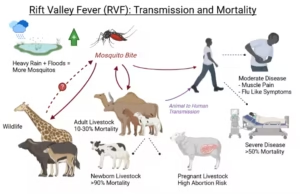
Rift Valley Fever (RVF)

About the Disease

  • Causative Agent: RVF is caused by a Phlebovirus of the Phenuiviridae family.
  • Primary Hosts: The virus mainly infects domestic livestock such as sheep, goats, cattle, and camels.
  • Transmission:
    • To humans – through direct contact with infected animal tissue, blood, or fluids, or mosquito bites.
    • Human-to-human transmission has not been recorded.
    • Different mosquito species act as carriers, varying by region.

Origin and Spread

  • The disease was first identified in the Rift Valley of Kenya in the 1930s.
  • Later spread to Egypt (1977) and across sub-Saharan Africa.
  • In 2000, it reached Saudi Arabia and Yemen, marking its first appearance outside Africa.

Clinical Symptoms

  • Mild Infection (≈90% cases): High fever, muscle and joint pain, headache, and fatigue — often resembling influenza.
  • Severe Infection: In some patients, it affects the eyes, liver, or brain, leading to hemorrhagic fever or encephalitis.

Treatment and Control

  • There is no specific antiviral treatment; management is supportive, focusing on hydration and symptom relief.
  • Preventive measures:
    • Vector control (mosquito management).
    • Avoiding contact with infected animals.
    • Strengthening surveillance and early warning systems.

This article has been updated and published in detail on our new platform. Please visit the link below for the latest version:

👉 Read the full article on ekamiasacademy.in

Write a Review

Your email address will not be published. Required fields are marked *