
INDIA’S CPI NEEDS URGENT REVISION
TOPIC: (GS3) ECONOMY: THE HINDU
The October 2025 inflation data has exposed critical flaws in India’s Consumer Price Index (CPI). A sudden fall in headline inflation despite high food prices, reveals structural and methodological problems in the index.
Key Highlights
- Retail inflation for October showed an abnormal fall to 0.25%, the lowest in more than a decade.
- This decline was caused by an unexpected 3.7% drop in the food and beverages index, even though actual food inflation was almost 9.7%.
- The gap between CPI’s statistical reading and real household experiences indicates a major failure in data capture and outdated weights.
- Since RBI relies on CPI to frame interest rate policy, inaccuracies threaten macroeconomic stability.
What Caused the October 2025 Inflation Anomaly?
- Sharp fall in food index, the biggest decline since the 2012 CPI series began.
- Real food prices climbed, showing complete mismatch between CPI numbers and market trends.
- Food holds 46% weight in CPI, so the flawed number drastically lowered overall inflation.
- Vegetable prices continued rising, contradicting the recorded fall.
- The drop reflects technical inconsistencies, not genuine deflation.
Why India’s CPI No Longer Reflects Reality
- Outdated base year (2012) fails to capture present-day consumption and digital economy patterns.
- Household spending has shifted, making current weights unrepresentative.
- GST-related price impacts are unevenly reflected across categories.
- Some components (fuel, housing, tobacco) show high inflation while the headline remains artificially low.
- Price collection often misses actual markets used by consumers, especially in urbanising areas.
Why a New CPI is Urgently Required
- Current weights ignore the effects of the GST regime.
- Rising spending on services, electronics, transportation, and digital utilities is poorly measured.
- Shifts in rural consumption patterns are not fully captured.
- GST rate reductions temporarily depress readings, masking real inflation trends.
- The government has acknowledged the need for a new CPI series, now under development.
What to Expect from the Revised CPI
- Better reflection of actual inflation faced by households.
- Revised weight structure with lower food share and higher services share.
- Improved decision-making for both fiscal and monetary policy.
- Adoption of global best practices, such as dynamic updating and digital price data.
- Likely rollout in the upcoming financial year.
DIFFERENCE BETWEEN CPI AND WPI
What They Measure
- CPI (Consumer Price Index): Measures the change in prices paid by consumers for goods and services (food, rent, transport, health, etc.).
- WPI (Wholesale Price Index): Measures price changes at the wholesale / bulk level, before goods reach consumers.
Who It Affects
- CPI: Shows cost of living and affects households directly.
- WPI: Shows producer-level inflation and affects businesses and supply chains.
Composition of Basket
- CPI: Includes services (education, health, transport) + goods.
- WPI: Includes only goods, no services.
Weight of Food
- CPI: High food weight (~46%), because households spend more on food.
- WPI: Low food weight (~24%); industry-related items dominate.
Use for Policy
- CPI: Used by RBI to set interest rates (monetary policy).
- WPI: Used to track supply-side pressures and price trends for producers.
Base Year
- CPI Base Year: 2012 (for CPI-Combined).
- WPI Base Year: 2011–12.
Published By
- CPI: Released by the National Statistical Office (NSO) under MoSPI.
- WPI: Released by the Office of the Economic Adviser, Ministry of Commerce & Industry.
Conclusion
India’s existing CPI has reached its functional limits. The October anomaly highlights deep structural flaws that can distort monetary policy, welfare programmes, and public perception. A revised, GST-aligned, and modern CPI is essential for sound economic governance.
This article has been updated and published in detail on our new platform. Please visit the link below for the latest version:
DIGITAL PERSONAL DATA PROTECTION ACT (DPDP), 2023
TOPIC: (GS2) POLITY: THE HINDU
India’s Digital Personal Data Protection Act (DPDP), 2023 has finally come into force, two years after Parliament cleared it. The law marks a major step toward protecting citizens’ digital privacy, in line with the Supreme Court’s 2017 Right to Privacy judgment.
Features of the DPDP Act
- Scope: Applies to digital personal data processed in India. Covers both private companies and government entities, unless exempted.
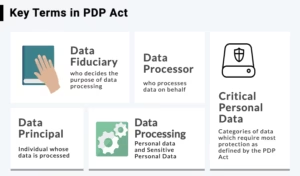
- Role of Data Fiduciaries: Entities that collect or use personal data are called data fiduciaries. They must ensure consent-based processing, transparency, and data security.
- Rights of Individuals (Data Principals): Right to access personal data. Right to correction and deletion of data. Right to grievance redressal.Right to nominate another person in case of death/incapacity.
- Duties of Individuals: Provide authentic information and not file false complaints.
Important Provisions of the Act
- Consent must be clear and specific, with easy withdrawal.
- Significant data fiduciaries (large organisations) must appoint a Data Protection Officer.
- Mandatory reporting of data breaches.
- Penalties up to ₹250 crore per violation for non-compliance.
- Data Protection Board of India (DPBI) established for enforcement.
- Exemptions for the State, especially for national security, investigations, and public order.
- Rules allow cross-border data transfer to trusted nations.
Issues & Concerns
- The Act weakens RTI, since government agencies can deny data citing privacy.
- Wide exemptions may allow state surveillance.
- Civil society groups say the Act lacks strong checks on government’s data use.
- Transparency activists fear the law gives the State “backdoor access” to personal data.
Way Forward
- Reduce broad government exemptions and ensure judicial oversight.
- Strengthen independent functioning of DPBI.
- Improve public awareness on data rights and responsibilities.
- Align rules with global standards like GDPR for better digital trade compatibility.
- Ensure robust cybersecurity infrastructure to prevent large-scale breaches.
Conclusion
The DPDP Act is a major milestone in India’s digital governance journey, but its effectiveness depends on transparent, accountable implementation. Strengthened oversight and balanced exemptions are essential for building public trust in the country’s data protection regime.
This article has been updated and published in detail on our new platform. Please visit the link below for the latest version:
AMR AND INDIA’S GLASS 2025 REFLECTIONS
TOPIC: (GS3) SCIENCE AND TECHNOLOGY: THE HINDU
Antimicrobial Resistance (AMR) in India has reached alarming levels, with the WHO-GLASS 2025 report confirming some of the world’s highest resistance rates. This exposes serious weaknesses in surveillance, stewardship, and access to effective antibiotics.
GLASS 2025 report
- The GLASS 2025 report places India among countries with the highest AMR burden, especially for gram-negative infections.
- India submitted data mainly from tertiary hospitals, leaving rural and district-level infections unreported.
- While many nations expanded AMR monitoring, India’s progress remains slow, pointing to gaps in funding, policy coordination, and the use of newer antibiotics.
Scale of AMR in India
- High resistance to commonly used drugs in E. coli, Klebsiella pneumoniae, and Staphylococcus aureus.
- WHO categorises AMR in India as a “serious and growing threat.”
- Gram-negative bacteria show limited treatment options, worsening ICU and sepsis outcomes.
- Current data reflects mostly urban hospitals, masking the reality in primary and rural health systems.
Why Surveillance Remains Weak
- Partial population coverage, leading to poor national estimates.
- Fragmented data from NCDC’s AMR labs with insufficient geographic spread.
- Shortage of trained microbiologists, irregular reporting, and inadequate lab infrastructure.
- Possible underestimation of AMR in vulnerable groups and remote areas.
Kerala’s Model for AMR Control
- Early adoption of a State Action Plan aligned with NAP-AMR.
- Operational One Health approach, linking human, animal, and environmental sectors.
- Strong stewardship committees, infection-control measures, and institutional continuity.
Challenges in Stewardship and Awareness
- Over-the-counter antibiotics, self-treatment, and incomplete courses fuel resistance.
- In hospitals, absence of stewardship teams leads to excessive broad-spectrum use.
- Low community awareness and delays in culture-sensitivity testing encourage irrational prescriptions.
What India Must Prioritise
- Strong stewardship through behavioural change in patients and clinicians.
- Decentralised surveillance to cover rural and peripheral facilities.
- Ensuring affordable access to new antibiotics for rising MDR infections.
- Strengthening One Health integration for long-term AMR containment.
AMR – ANTIMICROBIAL RESISTANCE
- AMR means germs stop responding to medicines — bacteria, viruses, or fungi become resistant, so antibiotics and other drugs no longer work.
- It happens mainly due to misuse and overuse of medicines, such as taking antibiotics without need, not completing doses, or using them in animals and agriculture.
- Infections become harder to treat, leading to longer illness, higher medical costs, and more deaths.
- Preventing AMR requires correct medicine use, good hygiene, vaccination, and strong hospital and community infection-control practices.
Conclusion
India faces a decisive moment where AMR is advancing faster than current systems can respond. Strengthened surveillance, affordable innovation, and robust stewardship are essential to prevent AMR from evolving into a national health emergency.
This article has been updated and published in detail on our new platform. Please visit the link below for the latest version:
NUCLEAR ORDER DISRUPTION BY THE U.S
TOPIC: (GS2) INTERNATIONAL RELATIONS: THE HINDU
Recent signals from the United States about restarting nuclear explosive tests have created uncertainty in an already fragile arms-control environment. This shift threatens balance among nuclear powers and poses strategic concerns for countries like India.
Nuclear explosive tests
- The Comprehensive Nuclear-Test-Ban Treaty (CTBT) is facing its deepest crisis since 1996.
- Former U.S. President Donald Trump hinted at reviving nuclear testing, breaking a three-decade voluntary moratorium.
- The move comes at a time when Russia has withdrawn CTBT ratification and China denies conducting explosive tests, adding to mutual distrust.
- These developments may trigger a new phase of nuclear competition and doctrinal shifts.
Evolution of the Nuclear Order
- Post-World War II period: Nuclear weapons peaked at ~65,000 in the 1970s; now reduced to ~12,500.
- Non-Proliferation Treaty (NPT): Created a system distinguishing five recognized nuclear powers from newer entrants like India and Pakistan.
- CTBT negotiations (1993–96): Though not in force, created a global political norm against nuclear explosive testing.
Why U.S. Testing Matters
- End of restraint: U.S. reversal of its 1992 testing moratorium may encourage other major powers to follow.
- Shift toward tactical nuclear weapons: Development of low-yield warheads increases the potential for battlefield use and miscalculation.
- Challenge to verification norms: U.S. alleges that Russia and China conduct “non-yield” tests, undermining mutual confidence.
Why CTBT Is Breaking Down
- The treaty has not entered into force because eight key states (including the U.S., China, India, Pakistan) have not ratified it.
- Russia’s de-ratification deepens mistrust.
- Competing interpretations of what counts as a “zero-yield” test weaken the verification and compliance regime.
Technology and the New Arms Race
- Rising investments in hypersonic missiles, autonomous delivery platforms, and advanced missile defence systems are altering strategic calculations.
- Nuclear powers are leaning toward counterforce doctrines, increasing risks of instability.
Implications for India
- Possible chain reaction of testing by China or Pakistan may widen strategic asymmetry.
- China–Pakistan nuclear collaboration continues to pose challenges.
- India must weigh the need for credible minimum deterrence while maintaining its reputation for responsible behaviour.
WHAT IS CTBT?
- CTBT stands for Comprehensive Nuclear-Test-Ban Treaty, a global agreement that bans all nuclear explosions—military or civilian.
- It aims to stop countries from testing nuclear weapons, preventing new designs and slowing the nuclear arms race.
- The treaty has not come into force because some key countries (including the U.S., China, India, Pakistan) have not ratified it.
Why P5 Countries Have Access to Nuclear Weapons?
- The NPT (Non-Proliferation Treaty) of 1968 officially recognises only five countries—the U.S., Russia, China, UK, and France (P5)—as nuclear-weapon states because they tested nuclear weapons before 1967.
- These countries were given legal status under the NPT in exchange for a promise to reduce their nuclear arsenals and work toward disarmament.
- NPT rules do not allow any other country to gain nuclear-weapon status, which is why India, Pakistan, Israel, and North Korea are outside the recognised group.
Conclusion
The weakening of the CTBT framework marks a major shift in global nuclear politics. Renewed testing by major powers may accelerate modernisation races and undermine hard-won norms. For India, the priority will be to secure strategic stability while upholding its commitment to restraint, transparency, and responsible deterrence.
This article has been updated and published in detail on our new platform. Please visit the link below for the latest version:
NATIONAL MIGRATION SURVEY 2026–27
TOPIC: (GS2) POLITY: THE HINDU
The Ministry of Statistics and Programme Implementation (MoSPI) has announced that the National Statistics Office (NSO) will conduct a year-long nationwide survey from July 2026 to June 2027.
This will be India’s most comprehensive migration study since 2007–08, filling long-standing data gaps.
About the National Migration Survey (2026–27)
- A nationwide household survey covering all states and Union Territories, except remote parts of the Andaman & Nicobar Islands.
- Focuses on individual-level migration, which represents the majority of population movement in India.
- Captures short-term, long-term, and inter-state migration, including return migration, which has grown since the pandemic.
- Collects data on employment shifts, income, health, education, housing, and remittance flows.
- Uses digital handheld devices for real-time and more reliable data recording.
Historical Background
- Previous dedicated migration surveys were held in 1955, 1963–64, and 2007–08.
- After 2007–08, information on migration was captured only partly through the Periodic Labour Force Survey (PLFS).
- Traditional trends show female migration mainly linked to marriage, while male migration is largely for work.
Need for the Survey
- Addresses a 17-year gap in national migration estimates.
- Helps understand economic mobility, urbanisation, inter-state labour flows, and climate-related displacement.
Revised Definitions and Methodology
- Short-term migrants: Redesigned to include stays from 15 days to less than 6 months for work or job search.
- Broader reasons captured: employment, education, marriage, distress movement, climate stress, and displacement.
- Includes new indicators on well-being, access to services, and living conditions post-migration.
- Utilises GPS-enabled validation for improving data accuracy.
- Introduces a separate return migration category to capture cyclical labour movements.
This article has been updated and published in detail on our new platform. Please visit the link below for the latest version:
HEPATITIS BE INCLUDED IN UNIVERSAL IMMUNISATION PROGRAMME (UIP)
TOPIC: (GS2) HEALTH: INDIAN EXPRESS
India is reassessing vaccine priorities under the Universal Immunisation Programme (UIP), especially as the government considers adding the Typhoid Conjugate Vaccine (TCV).
About Hepatitis A
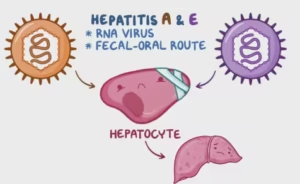
- A viral infection triggered by the Hepatitis A Virus (HAV), spreading mainly through contaminated food, water, or close contact with infected individuals.
- Produces acute liver inflammation, leading to jaundice, fever, fatigue, vomiting, and abdominal discomfort.
- No antiviral cure exists; the disease usually resolves on its own within six months, requiring only supportive care.
- Offers 90–95% protection, provides immunity for 15–20 years or often lifelong, and prevents symptomatic disease.
- Better sanitation has reduced childhood exposure, but this has pushed infections into adulthood—where disease severity is significantly higher.
What Is the Universal Immunisation Programme (UIP)?
- 1985; later integrated with the Child Survival and Safe Motherhood Programme (1992) and the National Rural Health Mission (2005).
- Coverage: Supplies free vaccines against 12 diseases—nine across India (DPT, Polio, Measles, Rubella, TB, Hepatitis B, Hib) and three in specific states (Rotavirus, JE, Pneumococcal).
- Contribution: Crucial in polio eradication, reducing measles mortality, and improving overall child survival.
Why Hepatitis A Merits Inclusion in UIP
- Higher Severity in Adults: Earlier, most Indians were naturally exposed in childhood, but falling transmission has led to rising adult infections, which are far more likely to cause acute liver failure.
- Increasing Outbreaks: States such as Kerala, Maharashtra, Delhi, and Uttar Pradesh have witnessed repeated clusters, indicating a growing public-health risk.
- Declining Immunity Levels: Urban seroprevalence has dropped from about 90% to below 60%, leaving millions vulnerable.
- Availability of an Affordable Indian Vaccine: The indigenous Biovac-A is safe, low-cost, and requires only one dose, making national rollout feasible.
- No Risk of Antimicrobial Resistance: As a viral disease treated without antibiotics, Hepatitis A avoids the risk of drug resistance—a major concern with other infections.
HEPATITIS
- Hepatitis refers to liver inflammation caused by viruses, alcohol, drugs, or autoimmune conditions.
- Viral forms:
- Hepatitis A: Fecal–oral; acute; vaccine available.
- Hepatitis B: Blood/body fluids; chronic potential; vaccine available.
- Hepatitis C: Blood transmission; often chronic; no vaccine.
- Hepatitis E: Fecal–oral; usually acute.
This article has been updated and published in detail on our new platform. Please visit the link below for the latest version:
MUDH-NYOMA AIRBASE
TOPIC: (GS3) SECURITY: PIB
The Indian Air Force (IAF) has inaugurated the Mudh-Nyoma Airbase in Ladakh, marking a major expansion of India’s airpower close to the Line of Actual Control (LAC) with China.
Location and Key Features
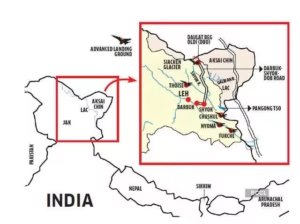
- Situated in Nyoma, southeastern Ladakh, at 13,700 feet, making it India’s highest airbase and among the highest globally.
- Located just 23 km from the LAC, offering a crucial forward operating position.
- Close to the southern bank of Pangong Tso, an area witnessing repeated India–China standoffs.
Upgradation and Infrastructure
- Originally a mud landing strip, now upgraded by the Border Roads Organisation (BRO) under a project started in September 2023.
- The ₹230 crore upgrade includes: A 2.7-km concrete runway capable of handling heavy aircraft. New Air Traffic Control (ATC), hangars, crash bay, and personnel facilities.
- Infrastructure supports operations in extreme high-altitude winters, enhancing all-weather capability.
Operational Capabilities
- Can operate transport aircraft like C-130J and potentially C-17 Globemaster III.
- Suitable for fighter aircraft such as Sukhoi-30MKI.
- Designed to host UAVs and helicopters, boosting surveillance and mobility.
Strategic Importance
- Strengthens India’s rapid deployment and logistics capability in eastern Ladakh.
- Enhances deterrence posture and sustains India’s airpower edge near the LAC.
- Supports ongoing border management, surveillance, and reinforcement during crises.
- Complements existing airbases in Ladakh—Leh, Thoise, and Fukche—improving operational flexibility for the IAF.
Conclusion:
The Mudh-Nyoma airbase significantly strengthens India’s high-altitude airpower and rapid-response capability along the LAC. Its strategic location and upgraded infrastructure enhance deterrence and operational readiness against emerging threats in eastern Ladakh.

This article has been updated and published in detail on our new platform. Please visit the link below for the latest version:
GUJARAT’S AMBAJI MARBLE GETS GI TAG
TOPIC: (GS2) ECONOMY: PIB
The famous Ambaji white marble from Gujarat has been awarded a Geographical Indication (GI) tag, recognising its unique quality and heritage value. This strengthens India’s efforts to protect traditional products with distinct regional identity.
Ambaji Marble
- Found in Ambaji, a major pilgrimage site and Shaktipeeth in Gujarat’s Banaskantha district.
- Known for its high-grade white colour, fine texture, and superior strength.
- Mined for nearly 1,200–1,500 years, with references to mining activity since the Dilwara Jain temple era.
- Widely used in temples and heritage structures due to its durability and aesthetic value.
Why It Received the GI Tag
- The GI tag was granted by the Geographical Indications Registry, Ministry of Commerce and Industry.
- The recognition highlights the marble’s exceptional purity, global reputation, and traditional mining practices.
- Ambaji marble competes in quality with renowned stones used in monuments like the Taj Mahal.
Significance of the GI Tag
- Protects the product from imitation and boosts the local economy.
- Enhances market value and strengthens the marble’s identity in national and global markets.
- Supports artisans and quarry workers through demand generation.
- Helps preserve India’s cultural and geological heritage.
Important GI tags from Gujarat
- Patola of Patan – World-famous double ikat silk weave, extremely rare and costly.
- Gir Kesar Mango – Premium saffron-coloured mango from Junagadh.
- Kutch Embroidery – Traditional hand embroidery with mirror work.
- Bandhani (Kutch & Jamnagar) – Signature tie-and-dye textile art.
Conclusion
The GI recognition for Ambaji marble protects a historically significant natural resource and promotes regional development. It strengthens India’s broader GI ecosystem and supports traditional industries.
This article has been updated and published in detail on our new platform. Please visit the link below for the latest version: