AI TO FIGHT CYBERCRIME
TOPIC: (GS3) SCIENCE AND TECHNOLOGY: THE HINDU
Microsoft CEO Satya Nadella recently announced the statewide rollout of MahaCrimeOS AI for the Maharashtra Police to strengthening cybercrime investigation and justice delivery.
What is MahaCrimeOS AI?
- MahaCrimeOS AI is an artificial intelligence–driven crime investigation platform.
- It has been developed using Microsoft Foundry in collaboration with the Maharashtra Government.
- The system is designed to assist police in cybercrime, financial fraud, narcotics, and crimes against women.
- It aims to move policing from manual, paperwork-heavy methods to data-driven and technology-enabled investigations.
MARVEL: Maharashtra’s AI Policing Framework
- MARVEL (Maharashtra Research and Vigilance for Enhanced Law Enforcement) is a state-led AI initiative.
- Set up in 2024 as a Special Purpose Vehicle (SPV).
- Maharashtra is the first Indian state to establish a dedicated AI body for policing.
- MARVEL adapts global AI tools to suit Indian legal and policing requirements.
From CrimeOS to MahaCrimeOS AI
- The original CrimeOS AI was developed by CyberEye, a Microsoft partner.
- MARVEL customised it into MahaCrimeOS AI, aligning it with: Maharashtra Police procedures, Supreme Court and High Court investigation guidelines
- The platform is designed in Marathi, ensuring ease of use for all police personnel.
Features of MahaCrimeOS AI
- Accepts complaints in PDFs, audio files, images, handwritten notes, and text.
- Uses multimodal AI to extract and analyse information in any language.
- Automatically generates investigation plans after reading FIRs.
- Drafts official letters to banks and telecom firms within seconds.
- Prepares date-wise, time-stamped case diaries for court use.
Benefits for Police and Governance
- Reduces routine paperwork, allowing officers to focus on investigation.
- Provides a real-time dashboard of active cases and pending tasks.
- Enables faster decision-making through an AI investigation copilot.
- Makes advanced data analysis accessible to all officers, not just cyber experts.
- Helps meet strict timelines under the Bharatiya Nyaya Sanhita (60–90 days for charge sheets).
Impact on Cybercrime and Justice Delivery
- Improves tracing of digital footprints using telecom and open-source intelligence.
- Enhances inter-state coordination in complex fraud cases.
- Speeds up investigations, improving victim satisfaction and public trust.
- Demonstrates how AI can support future-ready, transparent policing.
Conclusion
MahaCrimeOS AI represents a major shift towards AI-enabled law enforcement in India.
By combining technology, legal protocols, and local language support, it positions Maharashtra as a national leader in smart policing and cybercrime control.
INDIGO FLIGHT DISRUPTIONS AND PILOT ROSTERING CRISIS
TOPIC: (GS2) GOVERNANCE: THE HINDU
IndiGo Airlines faced large-scale flight delays and cancellations in early December, impacting more than 12 lakh passengers across India.
What Happened to IndiGo Operations?
IndiGo suffered a serious breakdown in its flight operations during November and early December.
- More than 5,000 flights were cancelled in the first ten days of December.
- Nearly 900 flights were cancelled in November alone.
- The disruption created widespread chaos at airports, including:
- Flight crew reporting to incorrect locations.
- Pilots waiting at airports without being assigned duties.
- Checked-in baggage reaching destinations even after flight cancellations.
- Airline call centres collapsing due to excessive passenger complaints.
- Passenger protests and slogan-shouting inside airport terminals.
Reason: Planning Gaps in Pilot Rostering
IndiGo informed the Directorate General of Civil Aviation (DGCA) that it had miscalculated pilot availability under the revised FDTL rules that came into force on November 1.
- The airline faced a shortage of 65 pilots-in-command.
- Additional factors worsened the situation: Changes in winter flight schedules. Poor weather conditions and congestion in Indian airspace.
- IndiGo requested temporary relaxation from the new rules to restore normal operations.
Impact on Passengers
- The scale of disruption was significant and directly affected passengers.
- Nearly 12.5 lakh passengers were impacted until December 9.
- IndiGo provided: ₹1,100 crore in ticket refunds. ₹10,000 travel vouchers to severely affected passengers between December 3 and 5.
- The DGCA granted a temporary exemption from the new FDTL norms until February 10 to stabilise operations.
Flight Duty Time Limitation (FDTL) Rules
FDTL rules regulate pilots’ working hours, rest periods, and night flying duties to ensure aviation safety.
- The 2011 FDTL rules were introduced after: The 2010 Mangalore air crash, where pilot fatigue was a key factor.
- Recommendations of the Nasim Zaidi Committee, which relied on NASA studies on fatigue and circadian rhythm disruption.
- Key safety provisions in 2011 included: A ban on consecutive night flying duties. Night landings restricted to two hours. Maximum duty time capped at nine hours.
Why Were the Rules Revised in 2019 and 2024?
- The 2019 revision diluted several pilot-friendly protections: It allowed consecutive night duties. It introduced vague definitions for duty and flying hours.
- Pilot associations challenged these changes in court.
- In January 2024, the DGCA restored safety-focused norms: Weekly rest was increased from 36 hours to 48 hours. Night flying and duty hours were strictly capped.
- The Delhi High Court ordered phased implementation, with night-duty rules effective from November 1, which triggered IndiGo’s staffing crisis.
Why Other Airlines Were Not Affected
Other airlines such as Air India, Akasa Air, and SpiceJet did not face similar disruptions because:
- They had excess pilots due to grounded aircraft or delayed plane deliveries.
- Their operational models allowed greater staffing flexibility.
- In contrast, IndiGo’s cost-efficiency-driven and lean staffing strategy left very little margin for operational shocks.
Broader Concerns and Way Forward
- IndiGo’s market share increased from 47% to 65%, while employee costs declined from 11% to 8%.
- Major concerns include: Rising pilot fatigue and declining morale. High pilot training costs leading to long-term debt pressure.
Key reforms needed:
- Stronger passenger rights during delays and cancellations.
- Transparent and airline-specific compensation rules.
- Greater regulatory focus on human factors in aviation safety.
- Enhanced competition and rationalisation of airline operating costs.
Conclusion
The IndiGo disruption highlights the conflict between aggressive cost efficiency and aviation safety.
Sustainable airline operations require balanced regulation, humane rostering practices, and strong passenger-centric safeguards.
GOVERNORS’ DISCRETION AND ASSENT TO STATE BILLS
TOPIC: (GS2) INDIAN POLITY: THE HINDU
In 2025, the Supreme Court gave an advisory opinion on a Presidential Reference that diluted timelines earlier fixed for Governors to act on State Bills.
Governor’s Assent to Bills
- Under Article 200, a Governor can:
- Give assent
- Withhold assent
- Return the Bill for reconsideration
- Reserve the Bill for the President
- Several Opposition-ruled States alleged that Governors were delaying assent indefinitely, causing policy paralysis.
April 2025 Judgment: State of Tamil Nadu vs Governor
- The Supreme Court:
- Fixed clear timelines for Governors to act on Bills.
- Held that unexplained delay could invite judicial intervention.
- Introduced the idea of “deemed assent” if Governors violated timelines.
- Significance:
- Strengthened legislative supremacy of elected Assemblies.
- Curbed obstructionist use of Raj Bhavan powers.
Special Reference No. 1 of 2025: Course Correction
- On a Presidential Reference, a Constitution Bench held:
- No constitutional basis for judicially imposed timelines.
- Deemed assent is not envisaged in the Constitution.
- Governors and the President enjoy wide discretionary space.
- Though advisory, such opinions carry strong persuasive value.
Issue of “Constitutional Dialogue”
- Court described Article 200 as enabling dialogue between institutions.
- Criticism: A dialogue needs timely response, not prolonged silence. Governors had turned silence into a political tool.
- The advisory opinion allows: Motivated inaction, with courts limited to merely directing a decision.
Reconsidered Bills and President’s Reference
- Original understanding: If a Bill is returned and re-passed by the Assembly, the Governor must assent.
- New interpretation: Governor may still reserve the Bill for the President even after reconsideration.
- Concern: Creates a constitutional vacuum where Bills can be stalled indefinitely.
Checks and Balances: A False Equivalence
- Court justified discretion as a constitutional safeguard.
- Critics argue: Courts already review unconstitutional laws. Assent is a procedural step, not a form of pre-legislative judicial review.
- Excessive discretion turns the Governor into a dominant check, not a balance.
Federalism and Democratic Concerns
- Governors are unelected and act as Union representatives.
- Expanded discretion risks: Central overreach and Weakening of State autonomy
- Missed opportunity to Subject unilateral referral of Bills to judicial scrutiny (as earlier suggested by the Sarkaria Commission).
Conclusion
The advisory opinion marks a retreat from earlier restraints on gubernatorial power. It weakens clarity, revives uncertainty, and may deepen Centre–State tensions.
NEW INSURANCE BILL 2025
TOPIC: (GS2) INDIAN POLITY: THE HINDU
The Union Cabinet has approved the Sabka Bima Sabki Raksha (Amendment of Insurance Laws) Bill, 2025 for introduction in Parliament.
Background
- The Bill seeks to amend the following laws:
- Insurance Act, 1938
- Life Insurance Corporation (LIC) Act, 1956
- IRDAI Act, 1999
- Its main objectives are:
- Modernising the insurance sector
- Expanding insurance coverage
- Attracting domestic and foreign investment
- Strengthening regulatory oversight
- The reforms align with the national vision of “Insurance for All by 2047.”
Major Provisions of the Insurance Bill 2025
100% Foreign Direct Investment (FDI)
- The FDI cap in insurance companies is increased from 74% to 100%.
- Expected benefits include:
- Inflow of long-term global capital
- Improved technology adoption and product innovation
- Better customer service and faster claims settlement
- The provision aims to raise India’s low insurance penetration.
Easier Entry for Foreign Reinsurers
- The Net Owned Fund (NOF) requirement is reduced:
- From ₹5,000 crore to ₹1,000 crore
- This move encourages participation of more global reinsurers beyond GIC Re.
- Key benefits include:
- Better risk-sharing mechanisms
- Increased competition
- Enhanced financial stability of insurance companies
Stronger Powers for IRDAI
- IRDAI is granted disgorgement powers to recover unfair gains.
- Introduces one-time registration for insurance intermediaries.
- The threshold for IRDAI approval of equity transfer is raised from 1% to 5%.
- The regulator must follow: Clearly defined Standard Operating Procedures (SOPs), Transparent penalty guidelines
- These steps improve regulatory clarity and ease of doing business.
Greater Autonomy for LIC
- LIC can open new zonal offices without prior government approval.
- It is allowed to restructure overseas operations according to host-country laws.
- The objective is to ensure: Faster decision-making, Greater global competitiveness
Key Omissions and Limitations
No Composite Licence
- A composite licence would allow one insurer to offer life, health, and general insurance together.
- The Bill continues the separate life and non-life insurance structure. This limits bundled products and reduces competition.
Capital Norms Remain High
- Minimum capital requirements remain unchanged:
- ₹100 crore for insurers
- ₹200 crore for reinsurers
- High entry barriers discourage: Small and niche insurers, Regional and rural-focused players
Dropped Reform Proposals
- The Bill does not include:
- Permission for insurers to sell other financial products
- Flexible investment norms
- Allowing agents to sell policies of multiple insurers
No Provision for Captive Insurance
- Large corporations are still not allowed to set up captive insurance companies.
- Captive insurers help firms manage risks internally and reduce insurance costs.
- Their absence delays reforms in corporate risk management.
Conclusion
The Insurance Bill 2025 introduces significant liberalisation through 100% FDI and stronger regulatory powers for IRDAI.
VIKSIT BHARAT SHIKSHA ADHISHTHAN (VBSA) BILL, 2025
TOPIC: (GS2) INDIAN POLITY: THE HINDU
The Union Government has introduced the Viksit Bharat Shiksha Adhishthan Bill, 2025 in Parliament during the Winter Session.
Background
- India’s higher education system is regulated by multiple bodies, leading to:
- Overlapping roles
- Multiple approvals
- Inconsistent standards
- To address these issues and implement the vision of NEP 2020, the government has proposed the VBSA Bill.
- The aim is to simplify regulation, improve quality, and modernise governance.
Objectives of the VBSA Bill
- Promote excellence in teaching, learning, research and innovation
- Ensure Better coordination among regulators, Clear academic and institutional standards
- Follows the NEP principle of “light but tight” regulation—less bureaucracy with strong accountability.
Structure of the VBSA Framework
- Viksit Bharat Shiksha Adhishthan (VBSA): Apex umbrella commission with 12 members, It supervises three specialised councils:
- Regulatory Council (Viniyaman Parishad): Maintains regulatory norms and Oversees governance standards in HEIs
- Accreditation Council (Gunvatta Parishad): Manages accreditation of institutions and programmes and Promotes an independent accreditation ecosystem
- Standards Council (Manak Parishad): Each council can have up to 14 members, including State representatives and experts.
Institutions Covered
- Central and State universities
- Colleges and higher educational institutions
- Institutions of national importance and eminence
- Technical and teacher education institutions
Excluded programmes:
- Medicine, Dentistry, Nursing, Law, Pharmacy, Veterinary Sciences
- These will continue under existing professional regulators.
Key Reforms Proposed
- Replacement of UGC, AICTE and NCTE with a single framework
- Separation of funding from regulation: Grant allocation removed from UGC, Funding to be handled through Ministry-approved mechanisms
- Foreign universities: Standards for entry into India, Support for Indian universities to open offshore campuses
- Outcome-based accreditation instead of input-based compliance.
Penalties and Enforcement
- Monetary penalties from ₹10 lakh to ₹75 lakh
- Fines up to ₹2 crore for operating without accreditation
- Powers to Suspend degree-granting authority and Close institutions for repeated violations
Concerns and Criticism
- Possible over-centralisation of powers
- Reduced financial autonomy of universities
- Risk of excessive central influence in appointments
- However, inclusion of State representation addresses some federal concerns.
Conclusion
The VBSA Bill, 2025 is a landmark reform that seeks to simplify regulation, raise academic quality, and align higher education with global standards.
GLOBAL CONFLICT TRENDS 2025 – ACLED REPORT
TOPIC: (GS2) INTERNATIONAL RELATIONS: THE HINDU
The Armed Conflict Location and Event Data (ACLED) has released its latest global conflict report for 2025.
It highlights that nearly one in six people worldwide were exposed to conflict, with a sharp rise in violence involving state forces and civilians.
About ACLED Report
- ACLED is an independent organisation that tracks political violence and conflict events globally.
- Its 2025 report provides data-driven insights into conflict intensity, actors involved, and civilian impact.
Scale of Global Conflict in 2025
- Around 831 million people, nearly 10% of the global population, were affected by conflict.
- This means one in six people worldwide faced exposure to violence or insecurity.
- Nearly 2 lakh violent incidents were recorded globally, almost double compared to four years ago.
Features of Conflict in 2025
- Conflicts showed less restraint and higher brutality.
- Armed groups increasingly ignored civilian safety.
- Nearly three-fourths of violent events involved state forces, indicating growing state participation in violence.
Regional Conflict Trends
- Europe witnessed the sharpest rise in violence due to the Russia–Ukraine war.
- This conflict affected the largest number of people globally since 2022.
- West Asia saw a decline in violence due to: End of Syria’s civil war, Ceasefires in Gaza and Lebanon
- Violent incidents in the region fell by almost 50% compared to 2024.
- Reduced air strikes led to a global fall in aerial warfare.
Rising Violence Against Civilians
- Over 56,000 incidents of direct violence against civilians were reported — the highest in five years.
- State forces were responsible for 35% of civilian-targeted violence, up from 20% in 2020.
- Government forces participated in 74% of all violent events globally.
Major Actors Behind Civilian Harm
- Israel and Russia accounted for most cross-border state violence against civilians.
- Myanmar’s military alone caused nearly one-third of state-led violence against its own civilians.
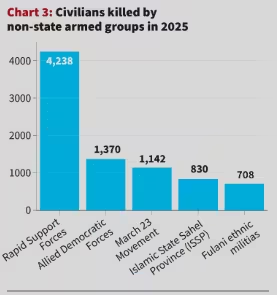
- Non-state actors caused around 60% of civilian deaths overall.
Role of Non-State Armed Groups
- Sudan’s Rapid Support Forces (RSF) killed over 4,200 civilians in 2025.
- Other major groups included: Allied Democratic Forces (ADF), M23 rebel group in Africa
- Many deaths are likely underreported.
Changing Nature of Warfare
- Increased use of commercial drones by armed groups.
- Nearly 470 non-state groups used drones in the last five years.
- Shows easy access to advanced technology and evolving conflict methods.
Conclusion
The ACLED report reveals a worrying global trend of intensifying conflicts, growing state violence, and shrinking civilian protection. It underlines the urgent need for stronger international conflict prevention and humanitarian safeguards.
MAN-PORTABLE AIR DEFENCE SYSTEMS (MANPADS)
TOPIC: (GS3) SEQURITY: THE HINDU
The Indian Army is reorienting its Man-Portable Air Defence Systems (MANPADS) to counter the growing threat from low-flying, sub-sonic cruise missiles.

What are MANPADS?
- MANPADS are short-range surface-to-air missile systems that can be operated by a single soldier or a small team.
- They are commonly known as shoulder-fired anti-aircraft missiles.
- Designed to shoot down low-flying aircraft, helicopters, drones and cruise missiles.
Key Features
- Highly portable: Usually less than 2 metres long.
- Lightweight: Weigh around 20 kg, making them easy to deploy.
- Quick reaction weapon for frontline air defence.
- Effective against low-altitude and slow-moving aerial targets.
Historical Background
- First introduced in the 1960s by: USA – Redeye missile, Soviet Union – Strela missile
- Developed to provide infantry units with organic air defence capability.
- Today, around 105 countries use MANPADS.
- Only about 12 countries, including India, manufacture them.
Famous MANPADS Systems
- FIM-92 Stinger – United States
- 9K32 Strela-2 (SA-7) – Soviet Union
- FN-16 – China (newer generation system)
Types of MANPADS
- Command Line-of-Sight (CLOS): Missile is guided manually by the operator using remote control.
- Laser-Guided (Beam Rider): Missile follows a laser beam aimed at the target.
- Infrared (Heat-Seeking): Most common type. Locks onto the heat signature of aircraft engines.
Main Components
- Missile sealed inside a launch tube
- Gripstock (firing and control unit)
- Battery unit to power guidance and firing systems
Strategic Importance for India
- Strengthens last-mile air defence at the tactical level.
- Cost-effective solution against drones and cruise missiles.
- Enhances survivability of ground forces in modern warfare.
Conclusion
MANPADS remain a critical element of modern air defence due to their mobility and effectiveness.
BLUEBIRD-6 SATELLITE
TOPIC: (GS3) SCIENCE AND TECHNOLOGY: THE HINDU
ISRO is set to launch the BlueBird-6 commercial satellite of U.S.-based AST SpaceMobile on 21 December 2025 using its LVM-3 rocket.

What is BlueBird-6?
- A commercial communication satellite developed by AST SpaceMobile (USA).
- Designed to provide direct-to-mobile internet connectivity without the need for ground-based cell towers.
- Enables ordinary smartphones to access broadband services directly from space.
Features of BlueBird-6
- Weight: Around 6.5 tonnes, among the heaviest payloads launched by ISRO.
- Orbit: Operates in Low Earth Orbit (LEO) for wide and efficient coverage.
- Technology: Equipped with one of the largest phased-array antennas ever used. Antenna area of nearly 2,400 square feet.
- Coverage: Supports connectivity in remote, rural and underserved regions.
- Significance: Helps reduce the digital divide. Strengthens global mobile broadband access.
Strategic Importance
- Demonstrates ISRO’s capability to launch heavy commercial satellites.
- Boosts private sector participation in space activities.
- Strengthens India–US cooperation in advanced space technologies.

About LVM-3 (GSLV Mk III / Bahubali)
- ISRO’s heavy-lift launch vehicle.
- Height: About 43 metres; Weight: Around 640 tonnes.
- Payload capacity:
- 10 tonnes to LEO
- 4 tonnes to GTO
- Three-stage rocket:
- Solid boosters (S200)
- Liquid core stage (L110)
- Cryogenic upper stage (C25)
- Key role in Gaganyaan human spaceflight mission.
Conclusion
The BlueBird-6 launch marks a milestone in commercial space launches by ISRO.
It showcases India’s technological strength while contributing to global digital connectivity and space diplomacy.